AI drama film generator

Make a drama film with AI.Small moments, real faces.

Write the scene and everything it leaves unsaid, get a storyboard of every gesture and close-up, and keep the same face from the first shot to the last.
  • Free screenwriting
  • Every close-up storyboarded
  • Faces that stay the same
Drama rushes

Today: write your screenplay for free, then turn it into a storyboard with Storyboard Beta at $9.99 a month.

Next: each shot generated as video with the Filmmaker plan, targeted for 30 September 2026.

Examples

Quiet films from the ScreenWeaver team.

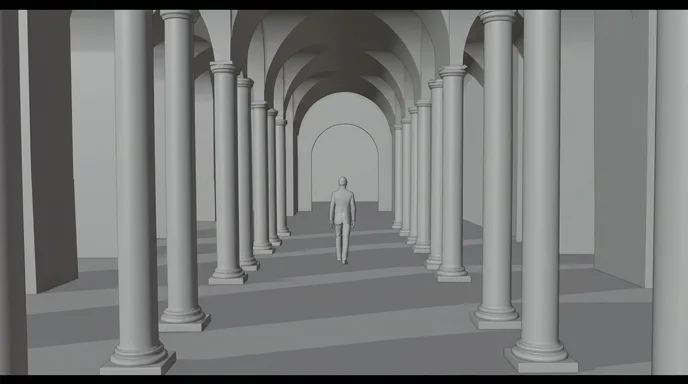
Three shown with their grey storyboard frame and finished shot, one as a finished still.
  • A hand turning the yellowed page of an old book in a wooden rowboat

    The Reader on the River

    A young man drifts down a forest river in a rowboat, turning the pages of an old book.

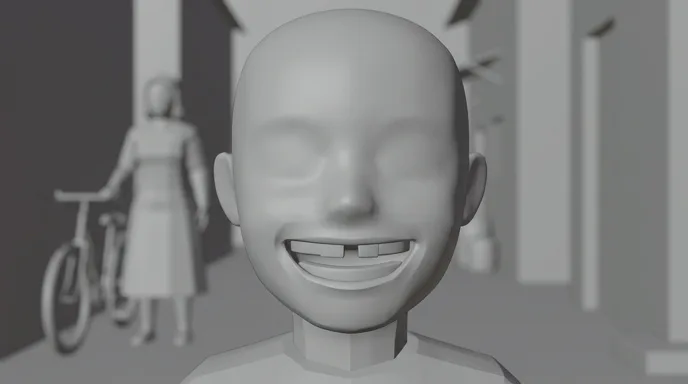
  • A smiling boy with a missing front tooth in a whitewashed alley

    Grandma Lin's Bread

    The same alley, another morning. A boy runs out with warm bread for her basket.

  • A small figure in white walking down a long pink colonnade in hard sunlight

    The Colonnade

    A man in white walks an endless pink colonnade. Art-house drama in two shots.

  • Three young people walk along a seaside promenade at sunset, one holding a small suitcase

    The Last Evening

    Three friends on a seaside promenade at sunset. One of them carries a suitcase.

One quiet scene, page to screen

Grandma Lin: six shots of an ordinary morning.

Six shots from the ScreenWeaver team, and a page of screenplay written for them. Almost nothing happens in it, and that is the drama. Each shot carries its direction note underneath.
Screenplay · page 1

EXT. WHITEWASHED ALLEY, LIN'S DOORWAY - EARLY MORNING

Washing hangs across the lane. GRANDMA LIN (80s) wheels an old bicycle out of her door. Both hands on the grips.

Her thumb finds the bell. It rests there. She does not ring it.

The alley runs a long way. She walks the bicycle down the middle of it. She does not get on.

NEIGHBOUR (O.S.)

Still not riding it, Auntie Lin?

Leaf shadows cross her face. Eyes down. The smallest smile. No answer.

The front wheel ticks over the paving stones. Same stones, same pace, every morning.

She walks on toward the light at the end of the alley. The bicycle keeps her company.

CUT TO:

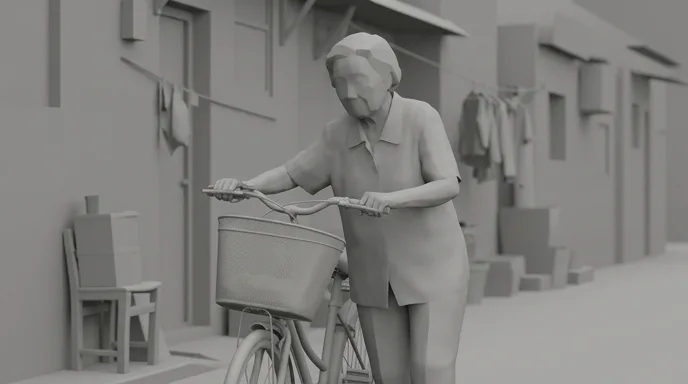
  1. An elderly woman in a pale blue blouse wheels a bicycle out of her doorway in a whitewashed alley
    Grey storyboard frame of the doorway shot
    01

    Medium wide · the doorway

    Medium wide of an old woman wheeling a bicycle out of her doorway, both hands on the grips, whitewashed alley, washing on the line, soft morning light, she moves slowly

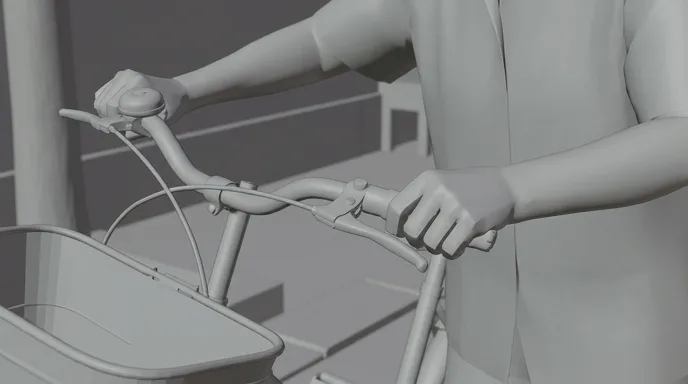
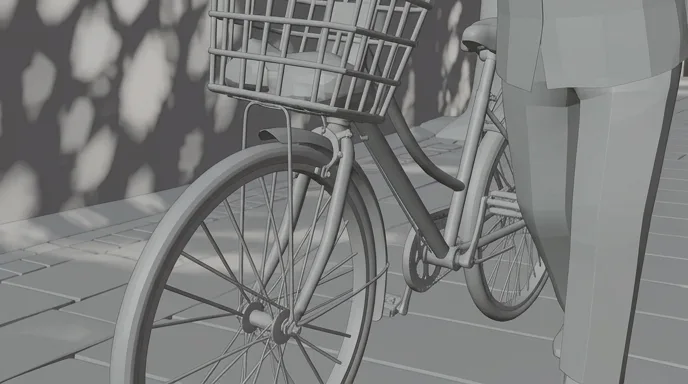
  2. Close-up of an old hand on a bicycle handlebar beside the bell
    Grey storyboard frame of the hand on the handlebar
    02

    Insert · the bell

    Tight insert on her hand on the handlebar, thumb resting near the bell, it does not ring, wire basket in the foreground, background soft

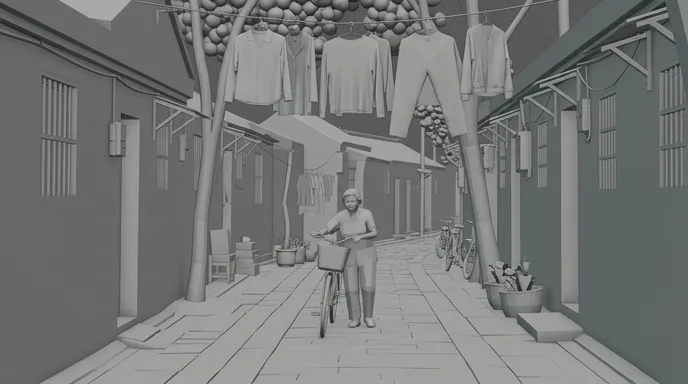
  3. A long whitewashed alley with laundry overhead, the woman walking her bicycle far down the lane
    Grey storyboard frame of the alley in depth
    03

    Deep wide · the alley

    Deep wide down a long alley, laundry strung overhead, she walks the bicycle toward camera in the middle of the lane, small in frame, not riding

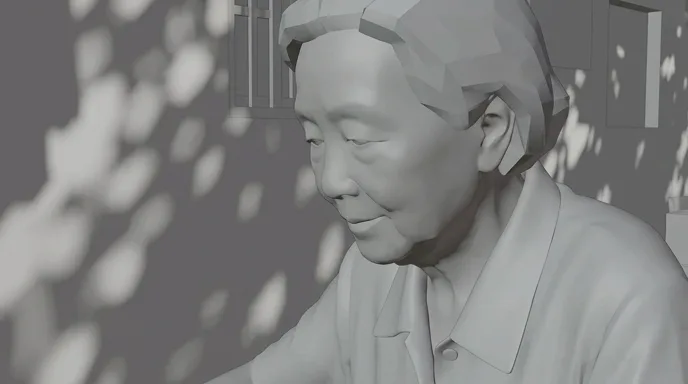
  4. Close-up of the elderly woman's face in leaf shadow, eyes lowered, a faint smile
    Grey storyboard frame of the close-up
    04

    Close-up · the non-answer

    Close-up of her face in dappled leaf shadow, eyes down, the faintest smile, no words, locked-off camera, hold the frame

  5. The front wheel and basket of a bicycle rolling over paving stones, her legs walking beside it
    Grey storyboard frame of the wheel
    05

    Low insert · the wheel

    Low angle on the front wheel and wire basket rolling over worn paving stones, her steps beside it at the same slow pace

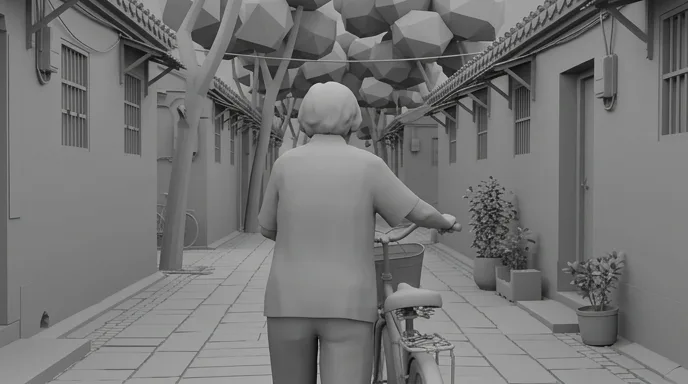
  6. The woman seen from behind, walking her bicycle down a tree-lined alley toward the light
    Grey storyboard frame of the walk away
    06

    From behind · the walk away

    From behind, she walks the bicycle away down a tree-lined alley toward the sunlit end, static camera, let her get small

The team's cut of the six shots: twelve seconds, 16:9, made in 1080p. A finished drama would hold each shot two or three times longer.

Writing drama

What an AI drama film generator needs from your script.

The model can render a face. Only the script can give it something to hide.
  1. 01

    Write the subtext, not the feeling

    Never write "she is sad". Write what she does instead of saying it. The scene never explains why Lin walks the bicycle. The reason stays off the page, and the audience supplies it.

  2. 02

    One small gesture per scene

    A thumb on a bell she does not ring. A cup put down too carefully. Give each scene one gesture the camera can find, and it becomes one insert in the storyboard.

  3. 03

    Ration the dialogue

    One line can carry a scene when everything around it is quiet. Here the neighbour asks the only question, and the answer is a smile.

  4. 04

    Let the ambience play

    A drama is mostly room tone: a radio two floors up, a kettle, a wheel on stone. Write those sounds into the action lines and tell the editor where no music should play.

  5. 05

    Show the routine, then break it

    Same alley, same pace, every morning. Once the audience knows the everyday, one changed detail becomes the event. The ordinary is your setup.

  6. 06

    Give the face an action, not an emotion

    "She almost answers" can be played. "She feels nostalgic" cannot. Close-ups work best with one playable intention, written as something the character does.

Structure and pacing

Three minutes of drama: slower, closer, quieter.

Drama runs slower than genre films. Shots of four to eight seconds are normal, and one held close-up can carry a whole beat.
  1. 20 %

    The routine

    The everyday, shown long enough to become a rhythm.

  2. 15 %

    The crack

    One thing out of place: a question, an empty chair, a letter.

  3. 30 %

    The pressure

    Scenes where nobody says the thing. The gestures get smaller, the frames get closer.

  4. 15 %

    The turn

    A choice made in silence, often a single gesture. The climax is small.

  5. 20 %

    The new routine

    The opening image returns, changed. Same place, different meaning.

For a one-minute film, keep the routine and the turn, and let a single held shot do the work of the pressure.

Shot vocabulary

Eight shots drama is built from.

With the wording that gets each one from an image or video model. Most of them are about waiting: a face, a hand, an empty frame.
  • The held close-up

    A face held longer than is comfortable. Nothing happens, and that is the point.

    close-up of an elderly woman looking down, soft morning side light, leaf shadows drifting across her face, shallow depth of field, locked-off camera, she barely moves

  • The hand insert

    The gesture the scene turns on, framed tight.

    insert close-up of a wrinkled hand resting on a bicycle bell, thumb still, not ringing, soft background, natural morning light

  • The corridor of routine

    An alley or a hallway walked every day, seen deep and symmetrical.

    deep wide shot down a narrow alley, laundry lines overhead, a figure walking a bicycle toward camera, one-point perspective, soft morning light

  • The walk away

    A back to the camera, and the audience left behind.

    shot from behind, old woman walking a bicycle away down a tree-lined alley toward the light, static camera, she grows small in frame

  • The two‑shot with a gap

    Two people in one frame, and a space between them that says what they will not.

    medium two-shot at a kitchen table, father and daughter at opposite ends, an empty chair between them, window light, neither looks at the other

  • The window portrait

    One window, one face, no fill light.

    portrait beside a single window, soft daylight on one side of the face, the other side in shadow, no artificial light, muted colours

  • The object left behind

    An empty chair, an untouched cup: what stays after the person goes.

    static wide of an empty wooden chair by a doorway, morning light moving slowly across a whitewashed wall, washing stirring on the line, no people

  • The unbroken drift

    One slow move that lets a moment play in real time, without a cut.

    single continuous shot, camera drifting slowly alongside a rowboat on a forest river, a young man reading, sunlight through the trees, no cuts

Light and palette

Natural light, muted colour.

Drama feels true when the light has a source you believe: a window, a gap in the leaves, the sun at the end of an alley. Ask for morning or late afternoon, let faces fall half into shadow, and keep saturation low. The five colours below were sampled from the Grandma Lin shots: pale walls, a faded blouse, warm skin. Nothing is louder than the blouse, and that restraint is the look.

  • Lime-wash wall

    #DFDDD4

  • Faded blouse

    #698594

  • Morning skin

    #A88063

  • Courtyard leaves

    #5D6B42

  • Doorway shadow

    #101718

Where AI goes wrong

Six ways AI makes drama ring false.

Video models are built for spectacle. Drama asks them for stillness, restraint and faces, which are their weakest skills.
  • Faces that overact

    Models push emotion: tears on cue, wide grins, raised eyebrows. Ask for less: "eyes down", "barely smiles", "almost speaks". Underplay in the prompt and the face starts to read as real.

  • The face that changes between shots

    Drama lives in close-ups, so a drifting face breaks the film. Grandma Lin is on screen in five of six shots. One reference of her face, carried from shot to shot, is what keeps her the same woman. ScreenWeaver carries characters and locations across shots.

  • Lips that miss the words

    Lip sync drifts over long lines. Keep dialogue short, and place it off screen, from behind or in a wide, like the neighbour's question. Let the reaction carry the scene, not the mouth.

  • Hands that fumble the gesture

    The small gesture is the scene, and hands are a model's weak spot. Keep the action simple: a thumb rests, fingers close. One motion per insert, framed tight.

  • Everything looks like an advert

    Models default to glossy, saturated and new. Drama needs worn things: faded cotton, chipped paint, uneven light. Name the wear in every prompt and ask for muted colour.

  • Long takes that fall apart

    Clips last seconds, and motion degrades toward the end. Plan a long take in the storyboard as one slow move with little action, and hide the join on a turn of the head or a pass behind a pillar.

Sub-genres

Family, coming of age, slice of life, social realism.

  • Family drama

    Kitchens, doorways, dinners. Two-shots with space between people, and one secret nobody names.

  • Coming of age

    Last summers and first departures. Golden hour, friends in wide shots, one face in close-up when it changes.

  • Slice of life

    A routine filmed with attention, like Grandma Lin's morning. Long shots, ambient sound, no villain.

  • Social realism

    Work, money, housing. Eye-level framing, available light, real places, faces that look lived in.

The pipeline

Write. Board. Produce.

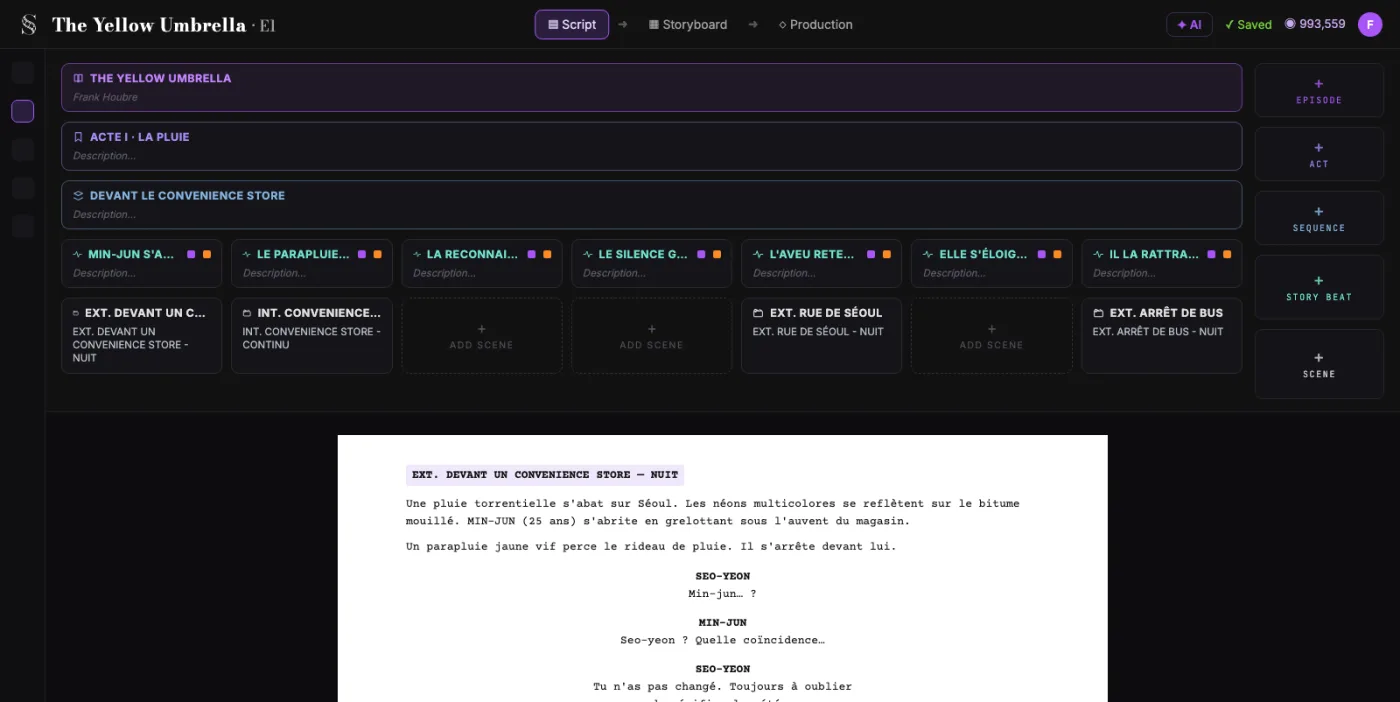
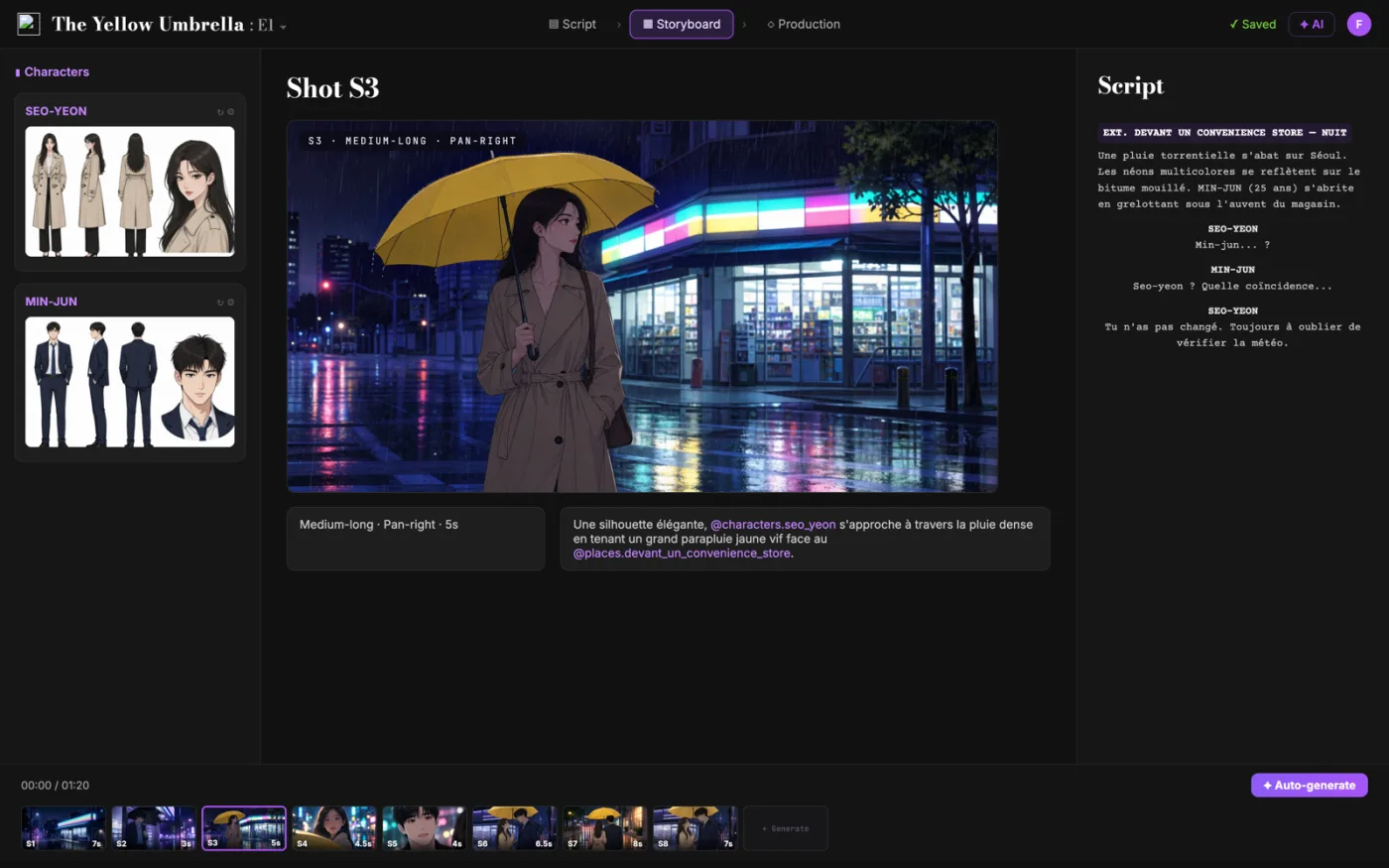
  1. ScreenWeaver screenplay editor: acts, sequences and beats above the formatted script of The Yellow Umbrella

    01The screenplay, enriched

    An industry-standard screenplay editor, and more: a visual outline and beat editor, your writing inspirations (notes, photos, audio) kept next to the page, and an AI researcher to support your writing, not replace it.

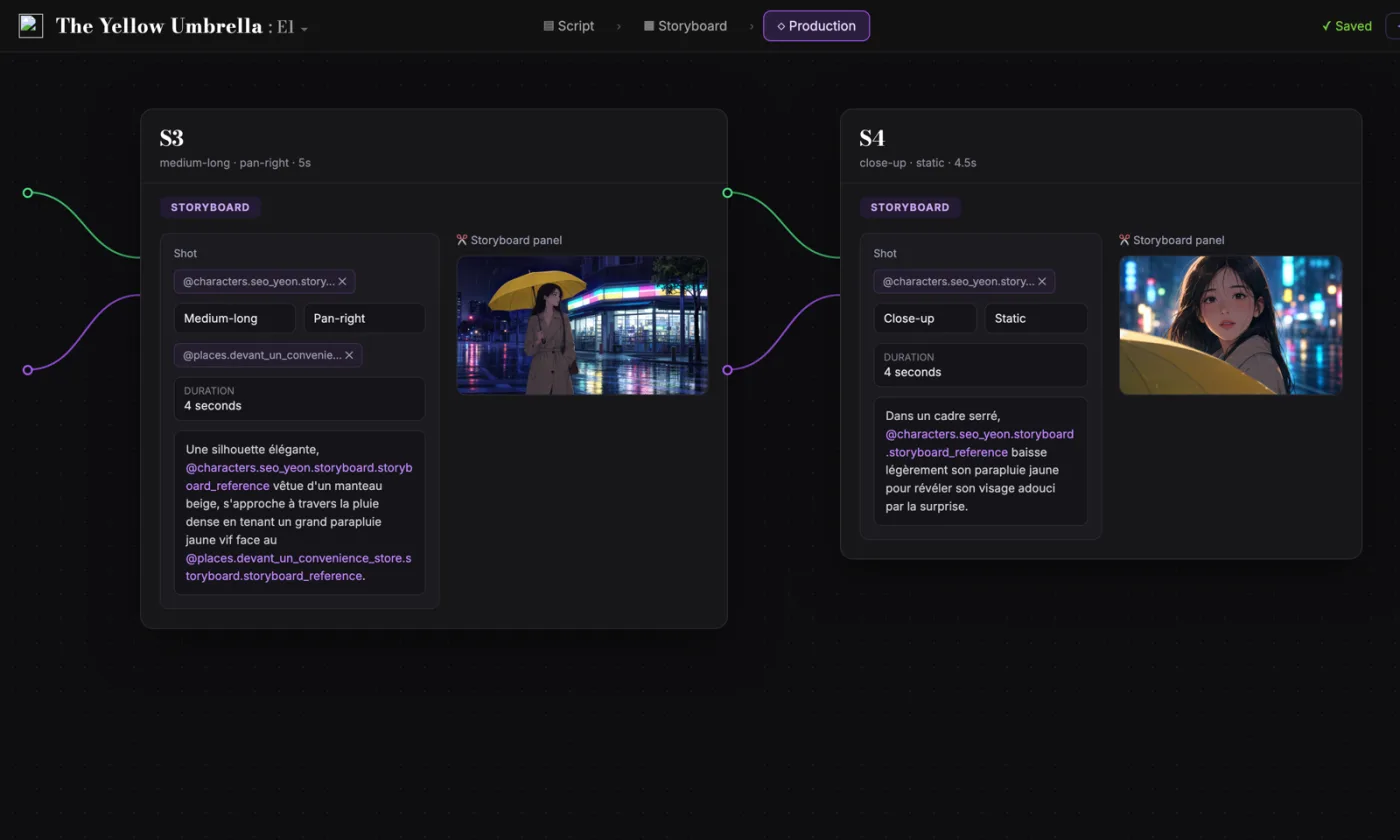
  2. ScreenWeaver storyboard: shot S3 of The Yellow Umbrella with characters, shot settings and the script beside it

    02The storyboard, made easy

    Shot breakdown generated from your screenplay, manual control over every shot (frame, angle, movement, duration), and generative AI previsualization in one click.

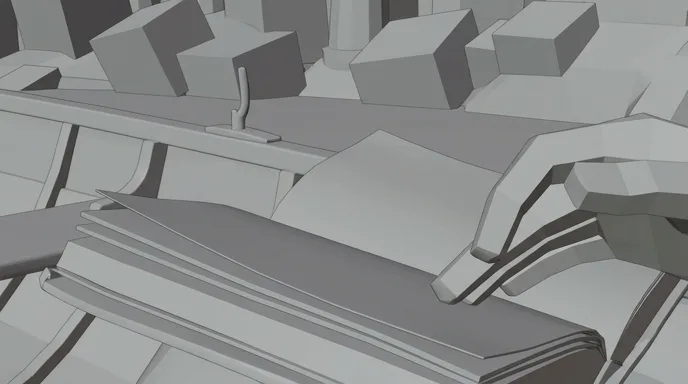
  3. ScreenWeaver production canvas: shots S3 and S4 as connected nodes carrying their storyboard panels and prompts

    03AI production, with finesse

    Footage generation pipelines connected to your screenplay and storyboard. Optimized out of the box, fully editable workflow.

FAQ

Drama with AI, your questions

Can an AI drama film generator make something that feels real?
The feeling comes from the writing, so ScreenWeaver starts there. Write the drama for free today, then storyboard every shot with Storyboard Beta at $9.99 a month. Each shot becomes video once the Filmmaker plan opens, targeted for 30 September 2026.
Can AI actors carry an emotional scene?
In short shots, yes, when you ask for small, playable actions instead of emotions. Write "eyes down, almost smiles", keep close-ups brief, and let the sound and the cut do part of the work. Big crying scenes remain the hardest for any model.
How do I keep the same face through a whole drama?
Give each character a reference once. In ScreenWeaver, characters, locations and references carry from shot to shot, so the woman in the last close-up is the woman from the first wide.
How much dialogue should an emotional short film have?
Less than you think. A three-minute drama can work with five or six lines. Put them where lip sync is safe: off screen, from behind, or in a wide shot.
How long should the shots be in a drama?
Longer than in genre films: four to eight seconds is common, and a held close-up can run longer. A three-minute drama is roughly thirty to forty shots.
Can an AI-made drama get into festivals?
They already do. Films made with ScreenWeaver have been recognised at festivals: Voidborn won awards, Les Fils du Vinnana received an honourable mention, and Lost Garden was a finalist. Read each festival's rules on AI before you submit.
Does writing the script cost anything?
No. On the Screenwriter plan you pay $0, and it never expires: unlimited projects and pages, industry-standard formatting, and export to PDF or Final Draft (.fdx).
Which video models sit behind ScreenWeaver?
ScreenWeaver runs on Seedance 2.0 and 2.5, through footage pipelines wired to your script and storyboard. They are optimised by default, and you can edit every step.

Your quietest scene starts on the page.

Write it for free. Storyboard every gesture when you are ready.