
Short answer: you always need the shot list, and you need a storyboard only for the scenes where a sentence cannot describe the frame. Live-action dialogue can shoot from a list alone. Action, VFX, animation and AI-generated films cannot, because there the board is the shot list. That is the verdict; what follows is why, and where it flips. Choosing a tool for both? Our Boords vs StudioBinder comparison covers storyboards and shot lists side by side.
Both documents come out of the same week of prep. If your project starts as a screenplay and ends as generated footage, the AI storyboard tool produces the panels and the shot data in the same pass, which quietly dissolves the whole question. For everyone shooting with a camera, the question is real, and it costs money if you answer it wrong.
The two documents, side by side
| Shot list | Storyboard | |
|---|---|---|
| What it is | A table: one row per shot | A sequence of drawn frames: one panel per shot |
| Answers | Which setups do we need, and in what order? | What does each shot look like, and how does it cut? |
| Owner | Director, built with the DP and the 1st AD | Director, drawn by a storyboard artist or generated |
| Reads best for | 1st AD, DP, script supervisor, gaffer | DP, VFX supervisor, editor, financiers |
| Time to make | An evening per scene, less with practice | Days per scene for hand-drawn boards; minutes with AI, plus revision |
| Cost on a short | Your own time | Your own sketches for free, or a storyboard artist's day rate |
| Shows composition | No, only a shorthand like MCU or low angle | Yes, that is the entire point |
| Shows lens, setup count, priority | Yes | Rarely, unless annotated |
| Survives the day | Gets crossed off row by row | Gets ignored once the light changes |
| Mandatory for | Every live-action shoot | Action, VFX, animation, commercials, AI video |
The short version of the table: the list is an inventory, the board is an argument. Inventories are cheap to make and impossible to shoot without. Arguments are expensive and only worth having where the frame is doing something a crew member could misread.
Why the shot list is non-negotiable
A shooting day is made of setups, not shots and certainly not scenes. Each time the camera moves to a new position and the lights follow, a chunk of the day vanishes, anywhere from twenty minutes to over an hour depending on the relight. The shot list is the only prep document that counts setups, which is why the 1st AD builds the schedule from it and nothing else.
Walk on set with a storyboard and no list, and three things happen in order. The AD asks how many setups you have, and you count panels, which is wrong because three panels can share one camera position. Then the DP asks what lens you saw in your head, and the drawing does not say. Then the day runs long and you have no priority column telling you which shot dies first, so the close-up that the scene depends on gets cut at 6 p.m. because it happened to be last on the wall.
The list fixes all three because a list is a promise about time. The full breakdown of what goes in each column lives in what a shot list is; the short version is seven columns: shot number, size, angle, movement, lens, subject and action, notes. Add a priority flag. That flag is worth more than any drawing when the sun goes down.
The list has a second job that boards cannot do: it lets the script supervisor mark the lined script, and it tells the sound recordist which shots are MOS. Those are two departments that never look at a storyboard.
What a storyboard does that a list never will
Try to describe this in a row: a man sits in the left third of a wide frame, a doorway cuts the right edge, and a shadow enters the doorway two seconds before he turns. You can write it. Nobody on the crew will picture it the same way, and the VFX vendor who has to composite the shadow will picture it wrong.
That is the board's territory: composition, screen direction, the relationship between two consecutive shots, and anything that has to be built before the camera rolls. It is also why the storyboard grew up in animation at Disney in the early 1930s, where nothing existed until somebody drew it. Panels settle arguments that a table just postpones to the day, when every minute of arguing has a full crew standing around it.
Three situations make boards mandatory rather than nice to have:
- Somebody has to build something before the shoot: a stunt, a set, a creature, a greenscreen plate, a practical effect. The stunt coordinator needs to see where the camera is to keep the performer safe, and the VFX house quotes from the board, not from the list.
- Money is being asked for. Financiers and brand clients do not read shot lists. A commercial gets approved from a board, and the agency signs off panel by panel, which is why commercial boards exist in a stricter format than film boards.
- There is no set to walk. Animation, 3D and AI video have no location scout and no rehearsal. The board is the first and often the only moment where the film exists as images before it is made. In anime the e-konte even carries the timing per cut, so it is board, list and schedule in one book.
If the drawing part scares you, it should not. Stick figures with arrows work. A board is a spatial diagram. Nobody is grading the drawing, and clarity beats rendering every single time. The storyboard from screenplay guide covers how to pick which scenes deserve panels at all.
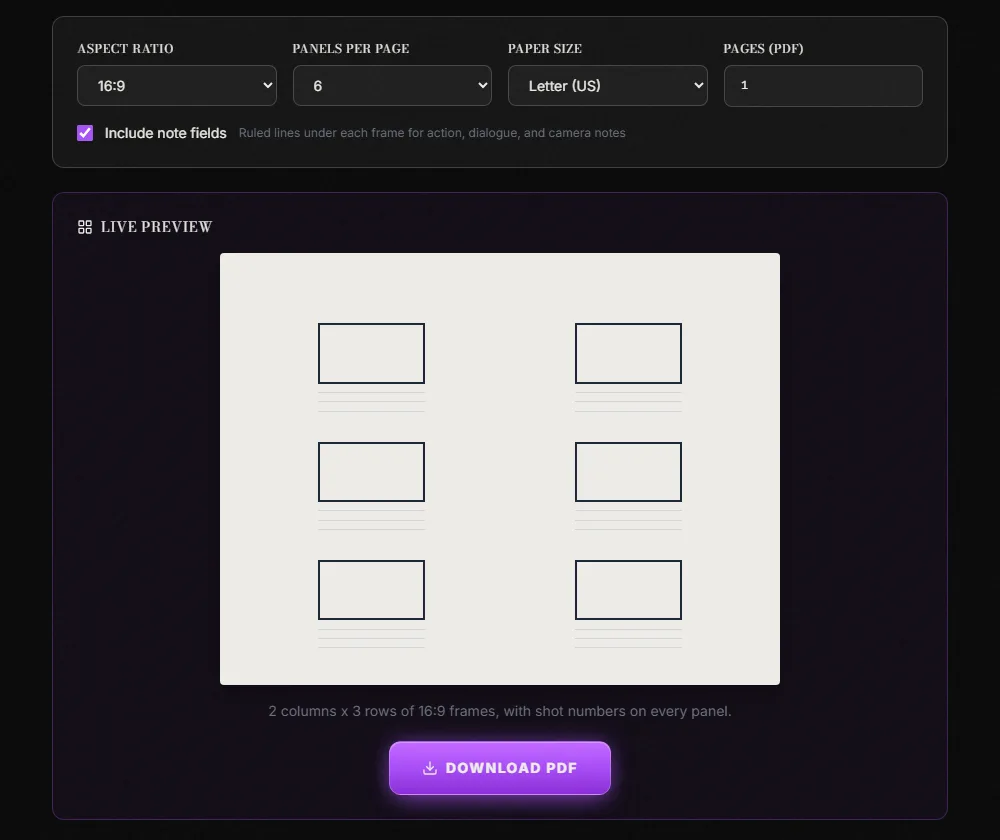
The free storyboard template generator on screenweaver.ai, captured 10 September 2026. Frames are drawn at the real aspect ratio of the project, which is the one thing a shot list can never show. The free storyboard template article covers how to fill each field on the sheet.
The order of operations that saves the most time
The sequence that works is not the one you would guess from the names, because the list comes last.
- Break the scene down into beats on paper. What has to be seen, in what order.
- Board the scenes that need boards. Skip the ones that do not; a dialogue scene at a kitchen table does not need twelve panels of two people talking.
- Extract the shot list from the boards, then add the setups the boards skipped: masters, safety coverage, inserts of the prop everyone forgets.
- Give the list to the 1st AD, who reorders it by location and light into the schedule.
- Print the boards for the scenes that have them and pin them near the monitor. Leave the list on a clipboard at the camera cart.
Steps 2 and 3 are where people go wrong. Boards done after the list turn into illustrations of decisions already made, which is pleasant and useless. Lists done without any boards for the complicated scenes produce rows like "cool shot of the fight" in the size column, and that row will be shot exactly as written, which is to say nobody knows how.
The shared vocabulary between the two is the size scale. Whatever ends up in the caption of a panel must appear verbatim in the size column of the corresponding row, or the operator and the AD are working from two films. The full glossary, with where each frame cuts the body, is in the storyboard shot types reference.
Which one do you need, by project
| Your project | Shot list | Storyboard | Notes |
|---|---|---|---|
| Dialogue-driven short, two or three locations | Required | Skip | Board only a scene with a visual reveal |
| Feature with action sequences | Required | Board the action, skip the rest | The stunt coordinator will ask for the boards before rehearsal; the fight scene boarding method shows what they expect on the page |
| Anything with VFX or compositing | Required | Required for every VFX shot | Vendors quote from boards; a list gets you a vague quote |
| Commercial or branded content | Required for the shoot | Required for approval | The client signs the board before a single dollar moves |
| Music video | Required | Strongly recommended | Lip-sync and cut-to-beat live on the board; see the music video storyboard guide |
| Documentary | Setup list only | Board reconstructions and motion design only | You cannot board an interview answer you have not heard |
| 2D or 3D animation | Comes out of the board | Required, it is the film | Layout and timing are read off the panels |
| AI-generated film | Comes out of the board | Required, the board is the prompt plan | Each panel becomes a clip brief; see the storyboard-first AI workflow |
Read the bottom two rows again. In animation and AI video the arrow reverses: the shot list is derived from the board, not the other way around, because there is no physical setup to count. What you count instead is panels, model calls, and seconds of generated footage. That inversion is the single biggest mental shift for a live-action director moving to generated video, and it is why the "which one do I need" question has two honest answers depending on how the film gets made.
Try it free
Try Screenweaver for free on your script
It is free. Import your existing project, get a clearer view of your outline, and regain control of your story structure in minutes.
Start FreeWhat each one costs
A shot list costs an evening and a spreadsheet (ours is a free shot list template you can download as a CSV). If you have never made one, the first will take longer than the scene deserves, and by the third you will be faster than the scene deserves.
A storyboard costs one of three things. Your own time and dignity, if you draw stick figures. A professional storyboard artist's day rate, if you hire one, and rates vary enormously with market and experience, so get quotes rather than trusting any number you read online, including here. Or a subscription and some reroll credits, if you generate panels from the script and revise. The generated route is cheap enough that the trade-off changes: boarding every scene stops being a luxury and starts being a way to catch staging problems before anyone books a location.
The cost that matters more than any of these is the one on the day. A missing shot list costs setups. A missing storyboard on a VFX or stunt scene costs a reshoot. Put those two numbers next to the price of an evening with a spreadsheet.
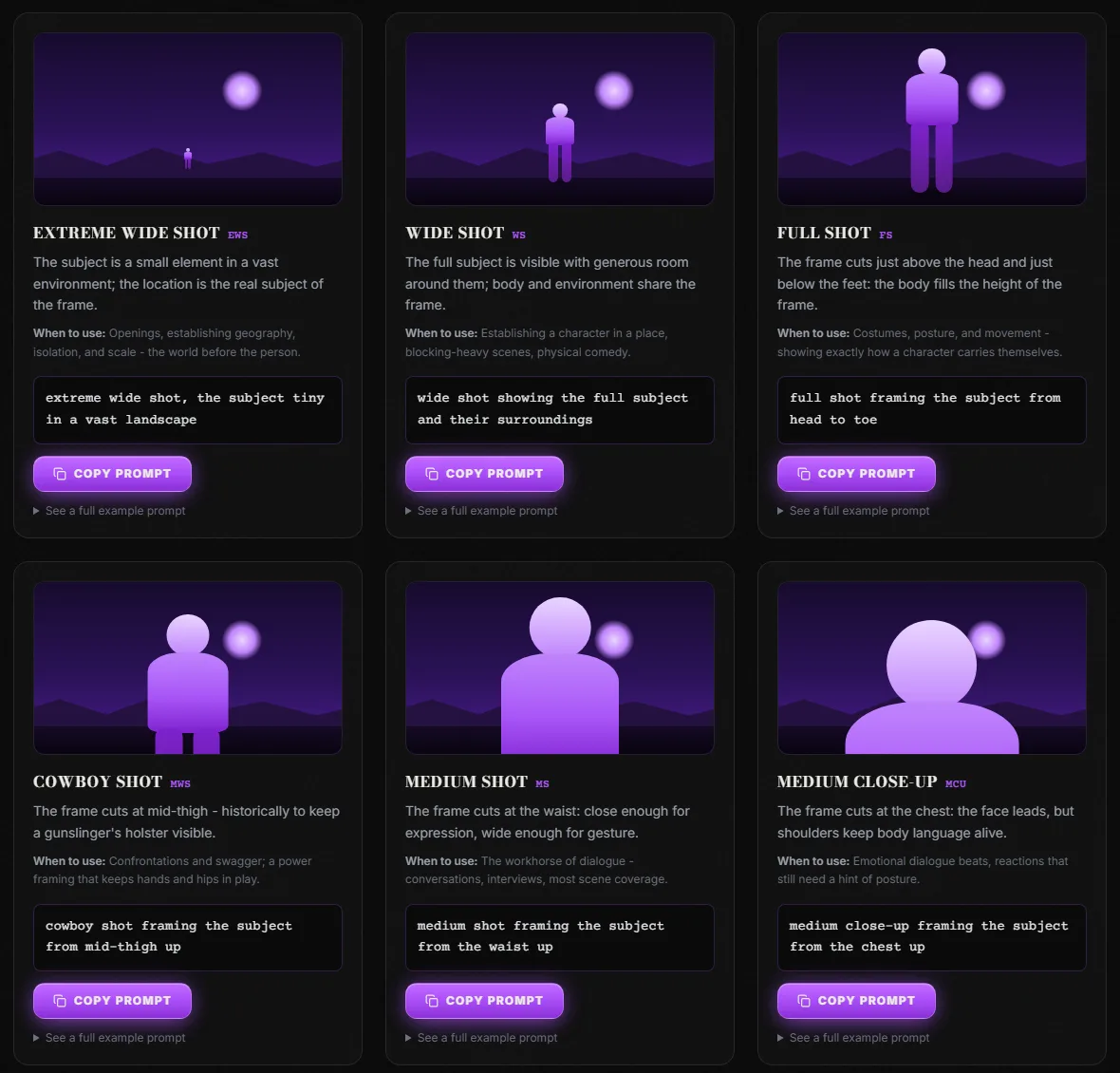
The shot size guide on screenweaver.ai, captured 10 September 2026. The abbreviations here are the bridge between the two documents: the same word goes in the panel caption and in the size column.
A checklist before you decide
Run each scene through these. Any yes means that scene needs panels; the shot list is a given.
- Does someone have to build, rig or composite something before the camera rolls?
- Is a stunt performer or an animal in the shot?
- Will a client, financier or festival commission approve this before it is shot?
- Does the scene depend on screen direction across more than two shots (a chase, a search, a reveal)?
- Are two consecutive shots meant to match on action or on eyeline in a way that a cut could ruin?
- Is there no location to walk and no rehearsal to watch, because the film is animated or generated?
- Would you struggle to describe the frame in one line without using the word "cinematic"?
Seven noes and the scene is a shot-list scene. Save the drawing time for the scene down the page that answered yes to three.
FAQ
Do I need both a shot list and a storyboard?
You need a shot list for any live-action shoot, and a storyboard for the scenes where composition, screen direction or something built in advance has to be agreed on before the day. Most shorts end up with a full shot list and boards for two or three scenes. Animation and AI video invert this: the board is required and the list is extracted from it.
Which comes first, the shot list or the storyboard?
Board first, for the scenes that need boards, then extract the shot list from the panels and add the coverage the boards skipped. Doing it in the other order turns the storyboard into an illustration of decisions already made. Scenes that do not need boards go straight to the list.
Can a storyboard replace a shot list?
Not on a live-action set. Panels count shots, not setups, and they carry no lens, no priority flag and no MOS mark, so the 1st AD cannot schedule from them. In animation and generated video the board effectively is the shot list, because there are no physical setups to count.
Is a shot list enough for a short film?
For a dialogue-driven short with ordinary coverage, yes. Add boards only for a scene with a visual reveal, a stunt, an effect or complicated screen direction. Boarding a kitchen-table conversation panel by panel is time you could spend rehearsing.
How detailed does a storyboard need to be?
Detailed enough that two people reading it picture the same frame. Stick figures, a horizon line and movement arrows achieve that. Rendering quality only matters when the board is a sales document for a client or a financier, which is where commercial boards get polished.
What is the difference between a shot list and a shooting schedule?
The shot list inventories setups scene by scene, in story order. The shooting schedule, built by the 1st AD from that list, reorders every setup by location, cast availability and light, which is why the last scene often shoots on day one. The list is the director's document; the schedule is the AD's.
Final Step
Build your next script with Screenweaver
Move from ideas to production-ready pages faster with timeline-native writing and AI-assisted story flow.
Try Screenweaver