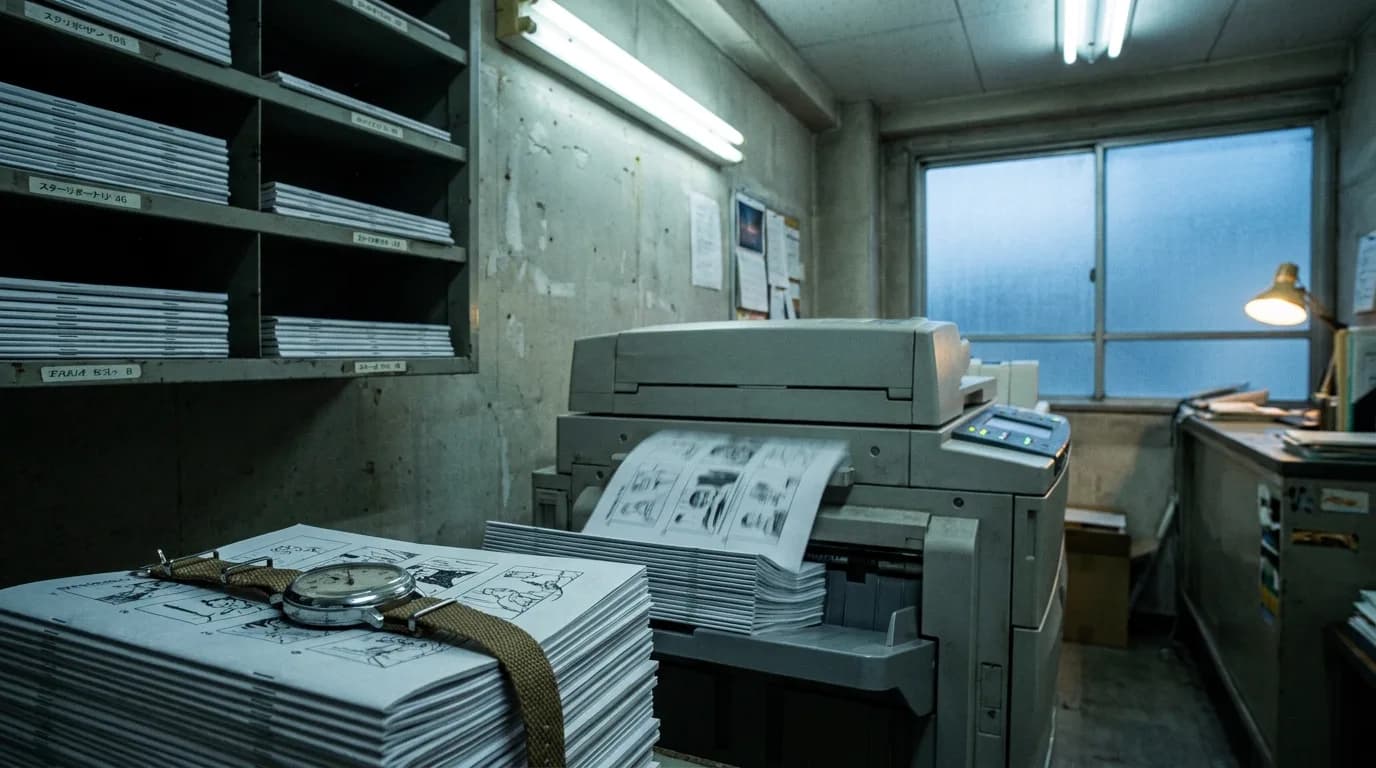

E-konte is the Japanese anime storyboard, and it works less like a pitch document than like a set of construction drawings. Each cut gets a number, a 16:9 frame, an action note, its dialogue, and a duration written in seconds and frames. Every department downstream builds from that page. Change a number on it and you change the budget.
If you want the frames drawn for you before you start filling in those fields, that is what the AI storyboard tool is for. The document below still has to be designed by a person.
It sits between the script and everything expensive
Western storyboards often live as a parallel document. Somebody boards a sequence, the board informs the shoot, and if the board and the film disagree, the film wins. Anime does not work that way. The konte is upstream of layout, and layout is upstream of key animation, so a vague board produces vague layouts and expensive corrections two departments later.
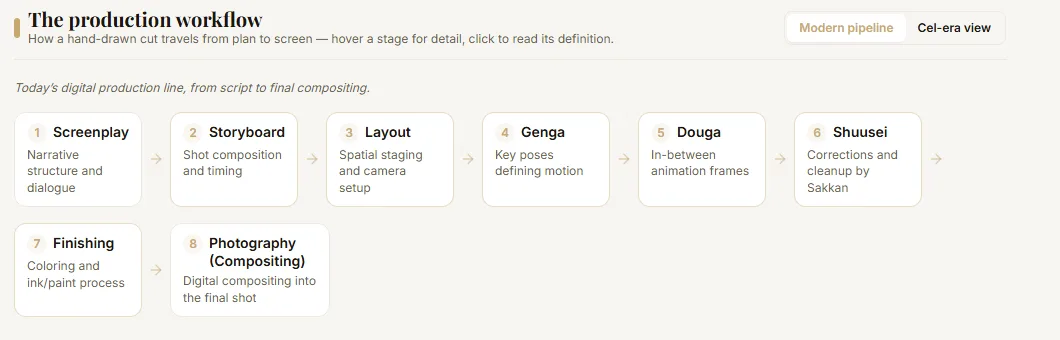
Animation Cel, "Animation Glossary", captured 7 September 2026.
Read the order in that diagram carefully, because it explains why the konte carries so much weight. Layout defines the exact spatial composition of a shot before animation begins. Genga sets the key poses. Douga fills the in-betweens. Shuusei fixes what came out off-model. None of those four departments talks to the script. They talk to the board.
The unit they all track is the cut, which Japanese production treats as one unbroken shot and uses as the organising key for every piece of work from layout through final compositing. Cut 87 is a folder, a timesheet, a payment line and a deadline. It starts life as a number in the left column of a storyboard page.
The nine fields on a konte page
A blank e-konte sheet is not a grid of empty boxes. It is a form, and the fields on it are close enough to standard across studios that an animator can pick up an unfamiliar board and know where to look.
| Field | What goes in it |
|---|---|
| Scene / cut | Scene number and cut number. One scene holds many cuts |
| Page number | How far into the episode this page falls |
| Action | Acting notes, staging and camera moves |
| Storyboard area | Thumbnail drawings showing composition and rough acting |
| Frame | The 16:9 box matching the final output image |
| Bleed area | Space outside the frame, for overshoot and adjustment |
| Dialogue and SFX | Spoken lines plus onomatopoeia, written in katakana |
| Time | Length of the cut, in seconds plus frames |
| Total time | Running length of the whole page |
Source for the field list: the Sakuga Wiki entry on e-konte, which is the clearest English breakdown of the sheet I have found.
Two of those fields catch people out.
The bleed area is not decoration. Storyboard artists routinely draw past the frame line for a pan, a tilt, or a shot with more detail than the box will hold, and the layout artist reads that overspill as instruction. If your board has no room outside the frame, you have quietly removed camera movement from the vocabulary.
The other is the reading order inside the storyboard column. Drawings lower on the page come later in time, but a new drawing does not mean a new cut. A single cut might need a dozen thumbnails to show a movement; an establishing shot of a city might need one. The cut column is the only authority on where one shot ends and the next begins, which is why experienced animators are told never to infer cut boundaries from the pictures alone.
Timing is written in seconds and frames, and it is not negotiable
The time column uses a notation that looks strange for about an hour and then becomes obvious. Animation runs at 24 frames per second, so a duration is written as seconds plus frames, in parentheses. A cut of one and a half seconds is (1+12). Three quarters of a second is (0+18).
You could write 0.75 instead. Try holding a whole episode in decimals of 0.0416666 and the appeal of the frame count becomes clear immediately.
That number is a commitment. Anime budgets are accounted for down to the frame, and an animator who quietly stretches a cut throws off the arithmetic for everyone holding a piece of that episode. There is room to play with the internal rhythm of a movement. There is no room to change the total. If the timesheet the production office pre-filled disagrees with the konte, the timesheet wins.
Frames also govern how the movement inside a cut gets built. A drawing held for one frame is animation on ones, two frames is on twos, three is on threes. Anime works mostly on twos and threes, keeping ones for motion so fast that every frame needs its own drawing. One physical timesheet holds 144 frames, which is exactly six seconds, so a nine-second cut is already a two-sheet job before anyone has drawn anything.
If you are converting between the two systems while you board, the video frames calculator does the seconds-to-frames arithmetic without the mental load.
What a real konte page looks like
The physical format is duller than the mythology around it. Japanese anime storyboards are usually made as a bundle of A4 sheets carrying picture and script five panels at a time, then handed downstream. That description comes from the abstract of Griffith, a web-based konte authoring tool built with Japanese animation professionals and published at CHI 2024.
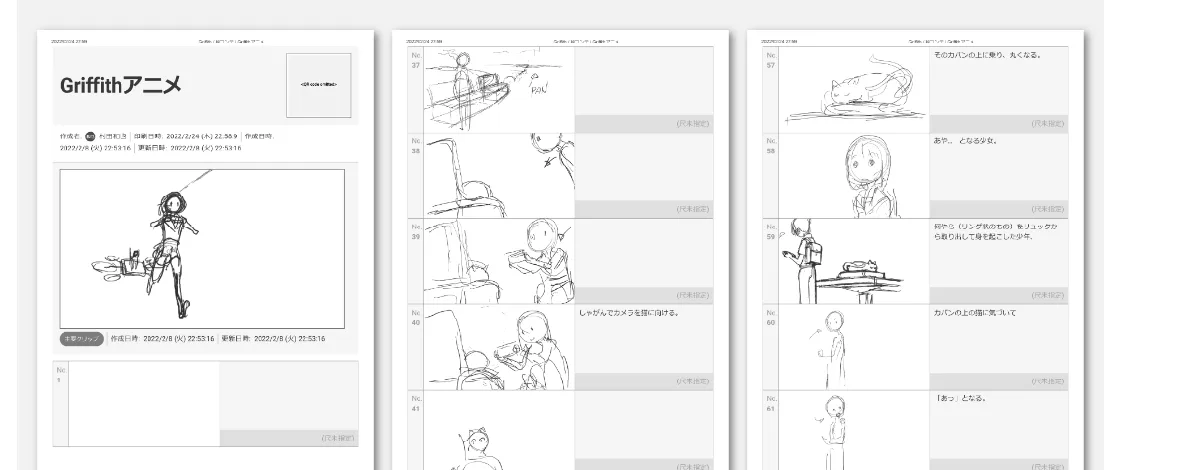
Arch Research, "Griffith" project page, Fig. 5, captured 7 September 2026.
Count the rows. Five cuts to a page, numbered in the narrow left column, each with its frame, its description block, and a timing box at the lower right. The sample board on that page prints to 131 sheets. That is the shape of the object the whole studio works from: a stapled brick of paper, photocopied, distributed, annotated, and eventually contradicted by the timesheet.
The research team behind Griffith names one design principle worth stealing even if you never touch their tool. The timeline runs vertically, not horizontally. Anime storyboarding thinks in a column that falls down the page, and editing software that insists on a horizontal track is fighting the habit of everyone who will read your board.
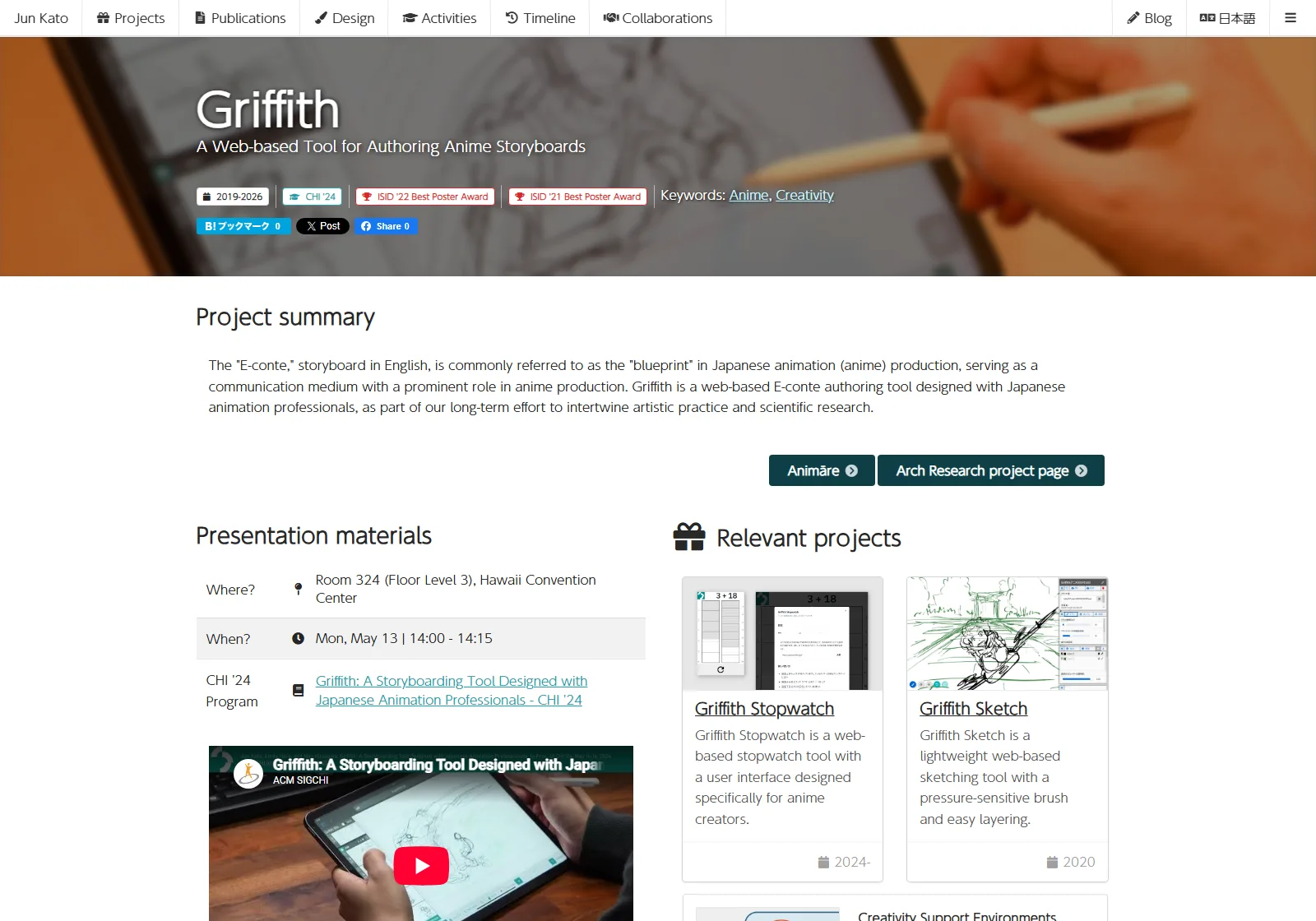
Jun Kato, "Griffith: A Web-based Tool for Authoring Anime Storyboards", captured 7 September 2026.
Note the companion tool listed on the right of that page: a stopwatch, built specifically for anime creators. The stopwatch is how durations get decided in the first place, and a research group thought that habit worth rebuilding for the browser in 2024. Timing a cut is still a physical act.
Working out how many cuts you are boarding
There is no standard cut count, and anyone who gives you one has averaged away the difference between a dialogue episode and an action episode. Do the division instead (the Western TV animation ratio, 60 to 72 panels per minute, is worked through in how many storyboard frames per minute).
| Episode length | Slow, contemplative (6s per cut) | Standard TV drama (4s) | Action, fast cutting (2.5s) |
|---|---|---|---|
| 22 min (standard TV episode) | 220 cuts | 330 cuts | 528 cuts |
| 11 min (short format) | 110 cuts | 165 cuts | 264 cuts |
| 90 min (feature) | 900 cuts | 1,350 cuts | 2,160 cuts |
That is arithmetic, not doctrine. It exists so that when you have boarded 40 cuts and you are four minutes into a 22-minute episode, you know whether you are on pace or quietly building a film.
Then divide by five and you have your page count, which is the number the production desk actually cares about, because pages are what get photocopied and distributed on a date.
Try it free
Try Screenweaver for free on your script
It is free. Import your existing project, get a clearer view of your outline, and regain control of your story structure in minutes.
Start FreeThe konte becomes the animatic, and the animatic becomes the episode
Once the board exists, images from it get timed against a soundtrack to make the first video the production ever sees. In Japanese studios this rough cut is updated continuously: layouts replace thumbnails as they arrive, then key animation replaces layouts, until by the end the file is functionally the finished episode.
This is the part that Western productions most often skip, and skipping it costs more than making it. A board is a set of claims about timing. The animatic is where those claims get tested, and it will tell you within one viewing that cut 112 is two seconds too long and the reaction shot you cut for time is the one the scene needed.
If you are generating rather than drawing, the same logic applies with more force, because generated shots arrive at a fixed length and the temptation is to accept whatever the model produced. Cut it against the board first. The related workflows are covered in generating a storyboard from your screenplay and, for the manual route, how to make a storyboard from a screenplay.
For the whole loop in one place, from the script written as a cut list to a generated episode retimed on twos and threes, see our guide to making anime with AI, built on a 21-minute episode boarded at around 400 cuts.
The schedule reality nobody puts in the tutorials
A typical anime episode takes roughly two to three months to produce, and Sakuga Blog's analysis of production scheduling is blunt that average here means something close to bad. Anime News Network's breakdown of episode timelines describes teams starting with two months or more per episode, then watching that slip to seven weeks, six, and sometimes four or five.
Storyboarding absorbs a lot of that pressure without showing it, because it is classified as pre-production. Sakuga Blog points out that studios do not allocate binding fees to the storyboard stage, so a storyboarder given a longer schedule is often just a storyboarder taking on more concurrent gigs to eat. The same piece cites Masaaki Yuasa storyboarding the entirety of Ping Pong at one episode a week without sleep, and notes that the finale of Wonder Egg Priority was not fully storyboarded by the date it was supposed to air.
If you are producing anything animated on a schedule, the board is the earliest place you can find out you are in trouble, and the cheapest. Anything that gives a director more boarded cuts per day buys back time in the one stage of the pipeline where thinking still changes the outcome.
Where AI actually helps, and where it does not
Generative tools are good at the part of konte production that is drawing labour and bad at the part that is direction.
What they do well:
- Producing a legible frame for a cut you have already designed, fast enough that you can board a whole sequence in an afternoon.
- Holding a character's appearance across dozens of frames, if you feed them a reference. The character consistency sheet exists to build that reference before you generate anything.
- Giving a rough board enough visual clarity that a producer or a committee can read it, which matters more in pitching than in production.
- Filling the in-betweens once your keys exist, which is the one studio stage a model genuinely absorbs. The AI anime production pipeline maps the rest of the stages onto what you still have to do yourself.
What they do badly, and I would not hand any of this to a model:
- Choosing the cut boundaries. Where a shot ends is a directing decision and it carries the meaning of the scene.
- Assigning durations. A model has no stake in whether the reaction holds for eight frames or twenty.
- Camera moves that need the bleed area. Generated images arrive framed, and a pan that lives half outside the frame is exactly what they cannot express.
- Anything that has to survive contact with a Japanese production. Studios work from the fields, not from pretty frames, and a board without a cut column and a time column is not a konte.
The split I would use: generate the pictures, write the numbers yourself. If you are coming to this from a comics or manga project, the adaptation specifics are handled separately in manga to anime with AI, the vertical-format version in boarding a webtoon, and the notation your script needs before any of it is in scripting manga and anime.
Checklist before you hand the konte over
- Every cut has a number, and the numbers run without gaps.
- Every cut has a duration in (seconds+frames), not decimals.
- Page totals are written and add up to the runtime you were given.
- Camera moves are drawn through the bleed area, not described in words alone.
- Off-screen lines are marked OFF or O.S., interior monologue as MONO, so nobody animates mouth flaps for a thought.
- Sound effects appear in the dialogue column where the timing matters.
- Cut sections are struck through clearly, and replacement material is labelled with the cut it replaces.
- The board is paginated and dated, because a konte gets revised and two versions in a studio is how a scene gets animated twice.
Tools for this
- Storyboard template generator for printable 16:9 panels with note lines, if you want the paper version.
- Video frames calculator for the seconds-and-frames conversions the time column demands.
- Shot size reference when the action column needs the standard term rather than a description.
- ScreenWeaver to turn a script into frames before you start assigning cut numbers and durations.
FAQ
What does e-konte mean?
E (絵) means picture and konte is a shortening of continuity. So the word is closer to picture continuity than to storyboard, and the emphasis is right: the document exists to fix the order and duration of shots, not to look good. Sakuga Blog calls it the visual script of anime.
How is an anime storyboard different from a Western one?
Format and authority. A konte is a printed A4 form with fixed fields for cut number, drawing, action, dialogue and timing, usually five cuts to a page, and the whole studio works from it rather than from the script. Western boards vary in layout and often function as a proposal that the shoot can override.
Why is the timing written as (2+12) instead of 2.5 seconds?
Because animation is built one frame at a time at 24 frames per second, so frames are the working unit. (2+12) is two seconds and twelve frames. Decimals would force everyone from the key animator to the compositor to convert back into frames anyway, and the conversions would be ugly.
Who draws the e-konte?
The director or the episode director, sometimes with a dedicated storyboard artist. Because it is drawn by the person directing rather than a separate department, konte carry a strong personal style: some directors board in near-finished detail, others in a shorthand only their regular collaborators can read.
Can I use AI to make an anime storyboard?
For the drawings, yes, and it saves real time. For the structure, no. Generate frames from your cut list, then fill in the cut numbers, the durations and the camera notes yourself. A board without those fields will not survive a production, however good the pictures look.
How many pages should my board be?
Divide your runtime by your average cut length to get a cut count, then divide by five for a page estimate at the standard density. A 22-minute episode cut at four seconds lands near 330 cuts and roughly 66 pages. Action sequences will push both numbers up hard.
Final Step
Build your next script with Screenweaver
Move from ideas to production-ready pages faster with timeline-native writing and AI-assisted story flow.
Try Screenweaver