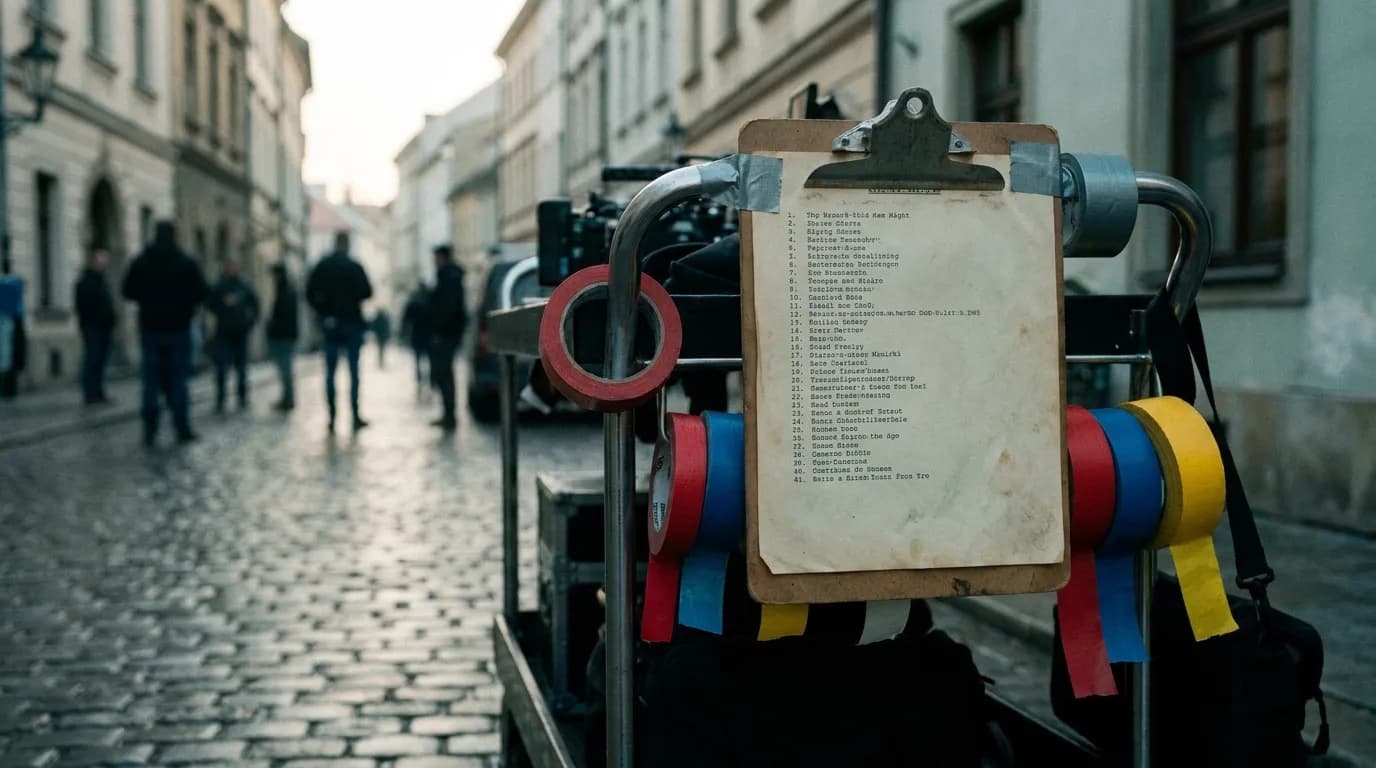

A shot list is the numbered inventory of every camera setup a scene needs, with shot size, angle, movement, and subject listed for each. It turns a screenplay scene into concrete instructions a crew can shoot in order. Directors build it during pre-production, usually with the 1st AD and the DP, scene by scene.
The document, in plain terms
Picture a spreadsheet taped to a camera cart at 6 a.m. Each row is one shot. Read any row and you know what the camera does, where it points, what lens goes on, and what the actors do inside the frame. That is the entire job of the document: nobody on set should have to guess what gets shot next or why.
The screenplay says what happens. The shot list says how the camera covers it. A three-page argument scene might be one paragraph of stage direction on the page and twenty rows on the list, because coverage multiplies. The scene plays once; the camera sees it from many positions.
A shot list is also a promise about time. Every row costs a setup, and setups are what a shooting day is actually made of. When the 1st AD says you are behind, they mean rows are dying. A director who walks on set without a list finds out at wrap which shots never existed.
The standard columns
Formats vary by production, but the same seven columns show up on almost every working list. A shot is the basic unit of filmmaking, and each column pins down one property of it.
| Column | What it records | Example entry |
|---|---|---|
| Shot number | Scene number plus a letter, in intended order | 12C |
| Shot size | How much of the subject fills the frame | MCU (medium close-up) |
| Angle | Camera height and orientation to subject | Low angle, 3/4 front |
| Movement | What the camera does during the shot | Slow push in |
| Lens | Focal length, or at least a range | 50mm |
| Subject and action | Who or what, doing what | Maya reads the letter, looks up |
| Notes | Anything the row cannot hold | Match cup position from 12A |
Some productions add columns for equipment (dolly, gimbal, sticks), estimated setup time, interior/exterior, or a priority flag marking which shots can die first when the day runs long. Add columns when they earn their space. A list nobody can read at a glance has failed at its one job.
Shot sizes use a shared shorthand: WS (wide), MS (medium), MCU, CU (close-up), ECU (extreme close-up), OTS (over the shoulder), plus "insert" for a detail like hands or a prop. Learn the abbreviations once and every list you ever read gets faster, and the full storyboard shot types reference has the cut points behind each one.
Who builds it, and when
The director owns the shot list. It is the director's visual intent written down. But it gets built in conversation, because two other people have veto-shaped opinions.
The DP turns intent into lenses and light. "I want this to feel like the walls are closing in" becomes a 32mm slightly below eye level, and the DP will also tell you which of your beautiful ideas needs two hours of rigging. The 1st AD turns the list into a schedule and is the person who counts. Twenty-six setups planned, eleven hours available, do the math with them in prep or do it in front of the crew.
Timing: the list comes late in prep, after locations are locked, because geography changes shots. The kitchen you scouted has a window where your imagined wall was, and three rows just changed. A common order of operations: lock the scene, board it, then extract the list from the boards. If you want the boarding half of that pipeline, here is how to make a storyboard from a screenplay.
On small crews, one person wears all three hats. The conversation still has to happen, even if it happens inside one skull. Ask yourself the DP question (can I actually get this shot?) and the AD question (do I have time for all of these?) or the set will ask for you.
How long it takes
Typical working ranges, from practice rather than any survey:
A single dialogue scene usually takes an hour or two to list properly, including the argument with yourself about coverage. A complex action or crowd scene can eat an afternoon on its own. A short film of ten to fifteen pages tends to take a day or two of focused work. A feature runs days to weeks, spread across prep rather than done in one sitting, because location locks, cast availability, and rewrites keep reopening scenes you thought were finished.
The first pass is fast. You know the obvious shots. The time goes into the second pass, where you cut the shots you cannot afford and discover the ones you forgot: the insert of the letter, the reverse you need for the exit, the establishing wide that every editor begs for and every director forgets.
Budget the time honestly. An hour saved on the list becomes three hours lost on set, at set prices, with forty people watching you improvise.
A complete 20-shot example: the kitchen argument
Here is a full list for an invented two-character scene, written for this article. The setup: MAYA has found a letter proving her husband DAN turned down a job offer in another city without telling her. Night. Kitchen. She confronts him; the argument builds; he leaves. Scene 12 of an imaginary script.
| # | Size | Angle | Movement | Lens | Subject and action | Notes |
|---|---|---|---|---|---|---|
| 12A | WS | Eye level | Static | 24mm | Full kitchen, Maya at counter, Dan enters | Master, run whole scene |
| 12B | MS | Eye level | Static | 35mm | Maya at counter, letter in hand | Her side, full scene |
| 12C | MS | Eye level | Static | 35mm | Dan at doorway, then to fridge | His side, full scene |
| 12D | Insert | High angle | Static | 50mm | The letter on the counter, Dan's name visible | Shoot before pages wilt |
| 12E | MCU | Eye level | Static | 50mm | Maya: "When were you going to tell me?" | Key line, protect it |
| 12F | MCU | Eye level | Static | 50mm | Dan deflects, opens beer | Match 12E height |
| 12G | OTS | Over Maya | Static | 50mm | Dan across the island, cornered | Island stays between them |
| 12H | OTS | Over Dan | Static | 50mm | Maya pushes the letter toward him | Letter enters frame low |
| 12I | CU | Eye level | Slow push | 65mm | Maya realizes he is not going to apologize | Push starts on his silence |
| 12J | CU | Eye level | Static | 65mm | Dan: "I did it for us" | Flat delivery, no push |
| 12K | Insert | Top down | Static | 50mm | Maya's hand crushing the letter edge | Continuity: left hand |
| 12L | MS | Low angle | Static | 35mm | Dan rounds the island toward her | First time he closes distance |
| 12M | MCU | Eye level | Handheld | 35mm | Maya backs a step, holds ground | Switch to handheld here |
| 12N | MCU | Eye level | Handheld | 35mm | Dan, voice up, the worst version of him | Handheld matches 12M |
| 12O | ECU | Eye level | Static | 85mm | Maya's eyes, the decision forming | Quietest shot in scene |
| 12P | WS | Eye level | Static | 24mm | Both frozen across the kitchen, silence | Reuse 12A position |
| 12Q | MS | Eye level | Pan right | 35mm | Dan grabs keys, exits frame right | He exits right |
| 12R | MCU | Eye level | Static | 50mm | Maya listens: door slams offscreen | Hold six seconds after slam |
| 12S | Insert | Eye level | Static | 65mm | The crushed letter dropped on the counter | Final image candidate |
| 12T | WS | High angle | Static | 24mm | Maya alone in the empty kitchen | Alt final image, top of stairs |
Twenty rows, one evening scene, probably a full shooting day with lighting turnarounds. Notice the structure: masters first (12A to 12C), coverage in the middle, and two candidate endings because the editor deserves a choice. Notice too that the handheld switch at 12M is a decision made now, in a warm room, and written down where the whole crew can see it.
If a scene like this still feels visually flat on paper, the fix usually happens upstream of the list; here is how to make a scene visually interesting before you commit coverage to it.
Try it free
Try Screenweaver for free on your script
It is free. Import your existing project, get a clearer view of your outline, and regain control of your story structure in minutes.
Start FreeShot list vs storyboard vs shooting schedule
Three prep documents, constantly confused, doing three different jobs. If your real question is which of the first two your project needs, the shot list vs storyboard comparison settles it scene by scene.
| Document | Unit | Question it answers | Sorted by |
|---|---|---|---|
| Storyboard | Drawn frame | What does each shot look like? | Story order |
| Shot list | Table row | What setups do we need? | Scene, then shot |
| Shooting schedule | Time block | When does each thing get shot? | Efficiency, not story |
The storyboard shows composition, the list inventories setups, and the schedule (the 1st AD's document) reorders everything by location and light, which is why films shoot the ending on day two. The three feed each other in that order. On set, the script supervisor mirrors the list in reverse with a lined script, drawing a vertical line through the pages for each setup that covers them; a lined script generator shows what that markup looks like on your own scene. For where boards sit in an AI production pipeline specifically, see the storyboard-first workflow.
Beginner mistakes that show up in dailies
The failure checklist. If you can answer no to each, your list is ahead of most first attempts:
- Listing only the shots you are excited about, and no masters or safety coverage
- No insert shots, so the letter, the phone screen, and the ring never get filmed
- Ignoring screen direction, so characters swap sides between angles
- Planning 30 setups for a 10-setup day and cutting at random when time collapses
- Writing "beautiful cinematic shot" in the size column instead of an actual size
- No priority flags, so when the day dies, the crucial close-up dies with it
- Never walking the location, so half the angles are physically impossible
The pattern behind all seven is the same: treating the list as a wish list instead of a contract with the clock. A good shot list is pessimistic. It assumes the day will shrink and decides in advance what survives.
Drafting one faster from a screenplay
The slow part of shot listing is mechanical: reading the scene, splitting it into visual beats, and writing a first-guess row for each beat. That part can be assisted. Tools that read screenplay structure, like an AI storyboard generator, can draft frames and a starting shot inventory directly from your scene text, which turns your job from typing rows into editing them, and editing is where your actual taste lives anyway.
The judgment part does not compress. Which line deserves the close-up, when the camera goes handheld, which two shots can die when the day runs short: those calls stay yours, and no draft, human or machine, makes them for you.
Start with one scene tonight. Pick the hardest scene in your script, give it an hour, and write every row. You will find at least two shots you did not know the scene needed, and finding them at a desk is the whole point of the document.
FAQ
What is a shot list in one sentence?
A shot list is a numbered table of every camera setup a scene requires, specifying shot size, angle, movement, lens, and subject for each one. It translates the screenplay's action into concrete camera instructions the crew can execute in order. If a shot is not on the list, it probably does not get filmed.
Who is responsible for making the shot list?
The director owns it, because it encodes the director's visual plan for every scene. In practice it gets refined with the director of photography, who translates intent into lenses and lighting, and the first assistant director, who checks the list against the hours actually available. On tiny crews one person does all three jobs, but all three questions still need answers.
How long should a shot list take to make?
For a single dialogue scene, an hour or two is a normal range. A short film usually takes a day or two of focused prep, and a feature takes days to weeks spread across pre-production, since location locks and rewrites keep reopening finished scenes. The second pass, where you cut what you cannot afford, takes longer than the first.
How many shots does a typical scene need?
There is no fixed number, but a two-person dialogue scene commonly lands between 8 and 20 setups: a master or two, coverage on each character in a couple of sizes, and a few inserts. Action scenes need more rows for fewer screen seconds. The real constraint is the shooting day, since every row costs setup time.
What is the difference between a shot list and a storyboard?
A storyboard is drawn frames showing what each shot looks like; a shot list is a table inventorying which setups exist. Boards answer composition questions, lists answer logistics questions, and strong prep uses both: board the scene first, then extract the list from the panels. The shooting schedule then reorders everything by location and daylight.
Do I need a shot list for a one-minute film?
Yes, and it will be short, which is exactly why it is worth doing. A one-minute piece might be six to ten rows, and writing them forces the decisions (sizes, angles, what the final image is) that otherwise get improvised on the day.
Final Step
Build your next script with Screenweaver
Move from ideas to production-ready pages faster with timeline-native writing and AI-assisted story flow.
Try Screenweaver