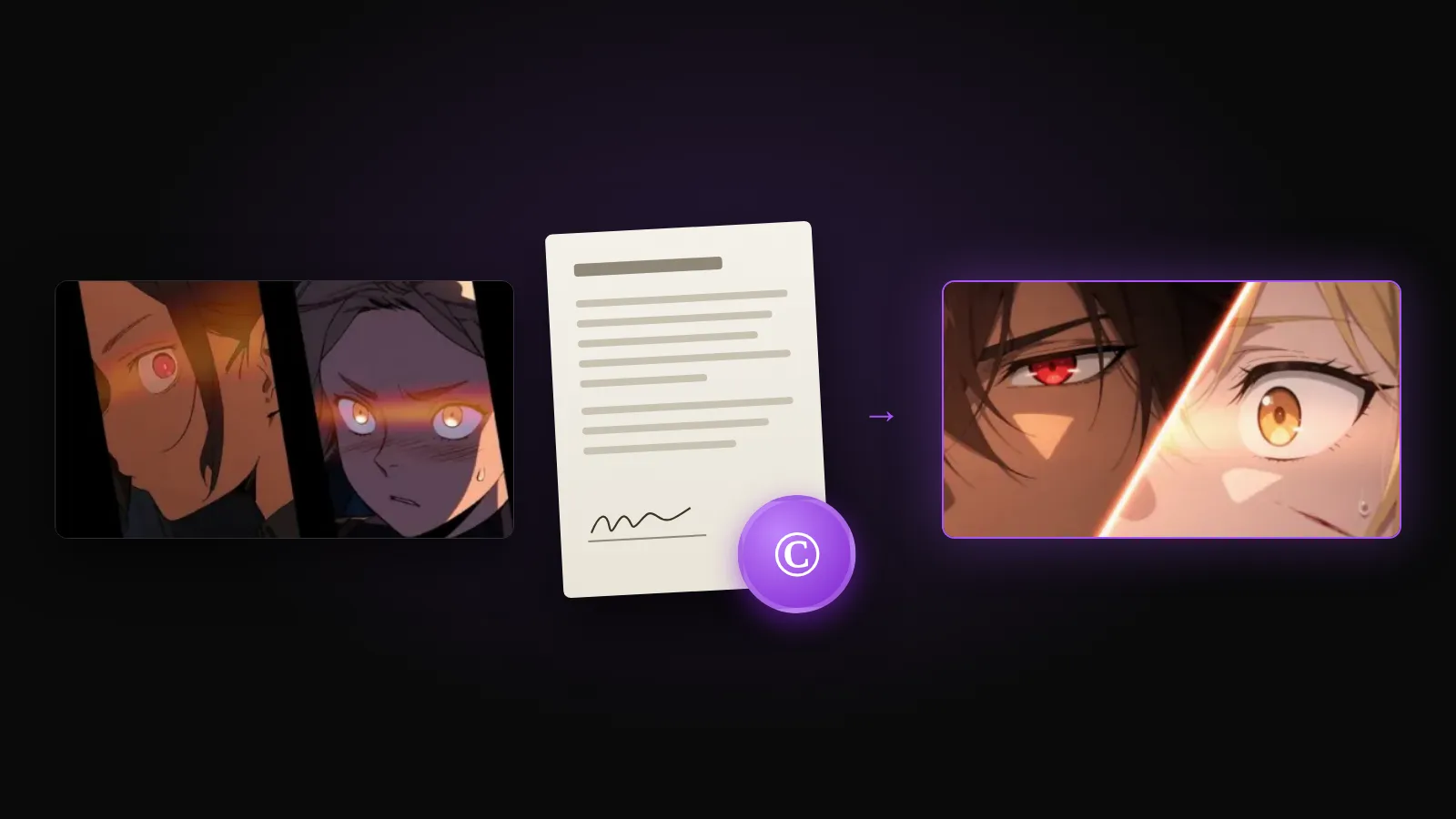

To animate a webtoon you need the right to adapt it, and that right belongs to whoever holds the copyright: you, if you created the series and never signed the adaptation rights away; the platform or the publisher, if your contract assigned them; the author and their publisher, for anyone else's series. Having the panels on your screen gives you none of it. Neither does a credit to the artist.
This is the rights half of the webtoon to anime cluster. The production half is webtoon to animation with AI. Nothing below is legal advice: it is the map you bring to a lawyer, so the meeting is short.
Three situations, three answers
Almost every case falls into one of these.
| Your situation | Who holds the adaptation right | What to do before you animate |
|---|---|---|
| You created the series and publish it yourself, on CANVAS, a personal site or another open platform | Usually you, and every co-author | Read the platform's terms for the licence you granted, then get written agreement from any co-author |
| Your series runs under a platform or publisher contract (Originals, a print deal, an agency) | Often the platform or publisher, or shared, depending on the contract | Read the clause on derivative and audiovisual rights. If it is unclear, ask in writing before you publish anything |
| The series is someone else's | The author and whoever they licensed it to | A written licence for the adaptation, or do not adapt it |
A fourth case comes up constantly: fan adaptations. A fan animation of a series you love is an adaptation of someone else's work. Some rights holders tolerate fan work, some do not, and tolerance is not a licence. Never build a commercial pilot, a crowdfunding campaign or a product demo on it.
What "the right to adapt" actually is
Copyright is a bundle. The piece that matters here is the right to make a derivative work: a translation, a new version, an adaptation into another medium.
In France, the author's economic rights are the right of reproduction and the right of performance (article L122-1 of the Code de la propriété intellectuelle), and any adaptation or transformation made without the author's consent is unlawful (article L122-4). The author also keeps a moral right to the respect of the work (article L121-1), which cannot be sold. And article L131-3 sets a specific rule for audiovisual adaptation: the transfer of those rights must be made in writing, on a document separate from the publishing contract for the printed work. A print deal alone does not carry the animation rights. The full code is on Légifrance.
In the United States, the right "to prepare derivative works based upon the copyrighted work" is one of the owner's exclusive rights under section 106 of the Copyright Act. Same idea, different vocabulary.
Two consequences most creators miss:
- Co-authors each hold the right. A webtoon with a writer and an artist has two authors. Adapting it needs both, in writing, even if one of them did "only the script".
- The moral right survives a sale. An author who licensed the animation rights can still object to an adaptation that distorts the work. A rights holder who signs off on your pilot is not the same as the author being happy with it. On your own series this is you; on anyone else's, show the author early.
What posting on a platform signs away
Read the actual terms of your platform, at the date you publish. As an example, WEBTOON's Terms of Use, checked in October 2026, grant WEBTOON a non-exclusive licence over what you post, and for comics posted on CANVAS they limit WEBTOON's right to modify or create derivative works to specific purposes. A non-exclusive licence leaves you free to license the same work elsewhere, which is why CANVAS creators generally keep the practical freedom to adapt their own series.
Originals and publishing contracts are a different animal: they are negotiated, and they often cover derivative and audiovisual rights explicitly. If your contract has a clause on adaptations, merchandising or "media rights", that clause decides whether you can publish an animated pilot, even of your own characters.
What to look for in any contract:
| Clause | The question it answers |
|---|---|
| Grant of rights | Exclusive or non-exclusive, and which media |
| Derivative works, adaptations, audiovisual, media rights | Whether animation is included, and who controls it |
| Territory and duration | Where and for how long the grant applies |
| Right of first negotiation or first refusal | Whether you must offer the adaptation to the platform first |
| Reversion | Whether the rights come back to you if they are not exploited |
The other rights inside an animated adaptation
An animated pilot is not one work. Beyond the comic itself, check:
- Voices. A recorded performance belongs to the performer under their agreement. A cloned or AI voice that imitates a real person needs that person's written consent.
- Music. A generated track comes with the music model's licence terms; a licensed track with its own. Read both before you monetise.
- Likeness. Real people in your references or prompts need written consent, minors through their legal representatives.
- Third-party designs. Brands, logos, other artists' characters in the background of a panel.
- Collaborators. A colourist, a background artist or an editor can be a co-author of what they made. Put the split in writing at the start.
Try it free
Try Screenweaver for free on your script
It is free. Import your existing project, get a clearer view of your outline, and regain control of your story structure in minutes.
Start FreeWho owns the frames and clips you generate
This is a separate question from the adaptation right, and it has two halves: what the tool's contract says, and what copyright law will protect.
The contract. ScreenWeaver's terms say you keep all rights in your inputs, that ScreenWeaver claims no ownership of your outputs, and that any right it might hold in an output is assigned to you, subject to third-party rights and the terms of the model used. The same section is explicit about what it does not promise: an output is not guaranteed to be original, unique, exclusive or protectable by copyright, and similar outputs can be generated for other users. Other tools have their own wording; read it.
The law. In January 2025 the US Copyright Office published Part 2 of its report on copyright and artificial intelligence, on copyrightability. Its position: outputs are protected where a human contributes sufficient expressive authorship, such as human-made material that remains perceptible or a creative selection and arrangement, and a prompt alone does not make you the author of the output. Other countries are working through the same question, and the answer varies by jurisdiction.
For a webtoon adaptation this is good news. Your panels, your characters, your script and your editing decisions are human authorship. The more of your own work survives into the cut (panels used as references, the shot breakdown, timing, dialogue, the edit) the stronger your position. Keep the evidence: the source pages, the shot list, the version history of the project. What you own in an AI film covers registration and the production log in detail.
Your data and model training
The question creators ask most in webtoon communities is not legal at all: will my art be used to train someone's model?
What ScreenWeaver's privacy policy says, as of October 2026: your inputs and outputs are not used to train ScreenWeaver's own models, and are not sold or licensed to anyone for training. When you start a generation, the inputs it needs (prompt, references, settings) are sent to the model you chose, directly or through a gateway. Those providers are used through their professional APIs, whose terms generally exclude training on submitted data, and some keep data for a short period to detect abuse. Each provider's own policy applies on top of that.
Checklist before you publish a pilot
- You know who holds the adaptation right, and you have it in writing if it is not only you
- Every co-author of the series has agreed in writing
- Your platform or publisher contract allows an animated adaptation, or you have a written yes
- Voices: performer agreements, or written consent for any voice that imitates a real person
- Music: the licence covers the way you will publish (free, monetised, crowdfunding)
- No third-party characters, logos or real people without permission
- You kept the source pages, the shot list and the project history
- Your release text does not suggest an affiliation with a platform, a studio or another series
FAQ
Can I animate my own webtoon without asking the platform?
If you publish under a non-exclusive licence, such as WEBTOON's terms for CANVAS at the time of writing, you generally keep the freedom to adapt your own series. Read your platform's current terms, and if you have a negotiated contract (Originals, a publisher, an agency), read its clause on derivative and audiovisual rights first.
Can I animate a webtoon I love if I credit the artist?
No. Credit is not permission. Adapting someone else's series needs a licence from the rights holders. Commentary and analysis of a series are a different use from adapting it, and the line between them depends on the country and the case.
Do I need a separate contract for the animation rights in France?
Yes. Article L131-3 of the Code de la propriété intellectuelle requires the transfer of audiovisual adaptation rights to be made in writing, on a document separate from the contract for the printed edition.
Who owns the AI images and videos made from my webtoon?
Contractually, with ScreenWeaver, you do: it claims no ownership of outputs and assigns any right it might hold to you. Whether copyright protects a given output depends on the human authorship in it and on the country. Your panels, characters, script and edit are yours either way.
Is my webtoon used to train AI models on ScreenWeaver?
Not ScreenWeaver's own models: inputs and outputs are not used for training and are not sold or licensed for it. During a generation, the needed inputs go to the model you selected, through professional APIs whose terms generally exclude training on submitted data.
Should I talk to a lawyer?
For your own series published on an open platform, the checklist above usually covers it. For anything involving a negotiated contract, several co-authors, a sale, a crowdfunding campaign or someone else's series, yes: an intellectual property lawyer, with your contracts and this checklist in hand.
Final Step
Build your next script with Screenweaver
Move from ideas to production-ready pages faster with timeline-native writing and AI-assisted story flow.
Try Screenweaver