
A storyboard artist costs about $20 to $50 a panel on freelance marketplaces, £450 a day for 15 to 25 frames from an established commercial artist, and a union floor of $4,686.94 for a half-hour animated episode. An AI panel costs a few cents of compute plus the minutes you spend judging it. The gap is enormous. Where it matters is the useful question.
Every number below comes from a published rate card, a wage scale or a vendor pricing page, captured this week, and the AI figures are the list prices of the models an AI storyboard tool runs on. Where I give an estimate from my own experience instead, I say so.
The numbers on one page
| Job | Storyboard artist | AI, raw generation cost | AI, hours of your own time |
|---|---|---|---|
| :30 commercial, 20 B&W frames | $300 to $800 on Fiverr for 12 to 24 panels; £450 for a day from a commercial artist | $4 to $8 | 1 to 2 |
| 12-page action sequence, about 230 panels | $3,450 to $6,900 at volume rates; about £4,500 for two artist weeks | $46 to $92 | 8 to 19 |
| Half-hour animated episode, 1,320 to 1,584 panels | $4,686.94 union unit minimum; roughly $25,000 to $35,000 at weekly scale for the hours the Guild says it takes | $290 to $590 | 45 to 130 |
| Pitch deck, 6 colour hero frames | $180 to $600 at presentation quality; one artist day in colour | About $4 | 1 to 2 |
The AI column assumes three generations per panel you keep, my working figure for stills once references are locked (video runs higher), and Google's list prices for Nano Banana 2 at 1K and Nano Banana Pro at 2K. The hours column is my own working estimate of two to five minutes per kept panel, rerolls and judging included, plus reference setup. It is a bracket.
Read the table the way a producer would. On a commercial, the artist is affordable and the drawing itself is often the point. On an animated series, the artist is the production. On a boarded action sequence for a live-action feature, or on an AI film where the panel becomes the reference for the video model, the AI column changes what gets boarded at all, because you can now afford coverage on every scene instead of the three that scare you.
What a storyboard artist actually charges
Freelance marketplaces
Fiverr's own cost guide, published 3 August 2026 and drawn from its marketplace data, gives the clearest public bracket for small jobs. A six-panel board for a :30 spot runs $120 to $300, or $20 to $50 a panel. Twelve to 24 panels for a short film scene land between $300 and $800. Past 50 panels, experienced artists discount to $15 to $30 a panel, so a 50-plus panel job comes in at $1,500 to $3,000 or more.
The modifiers matter as much as the base. Thumbnails cost 40 to 60 percent less than finished boards. Presentation quality, with expressions, environments, lighting notes and camera annotations, adds 50 to 100 percent. Rush delivery inside 24 to 72 hours adds 25 to 50 percent, and same-day can double the rate. Each revision round beyond the one or two included adds 15 to 25 percent of the project price. If you have ever wondered why the quote doubled between the brief and the invoice, it is usually those four lines.
A working commercial artist's rate card
Marketplace averages hide a lot of skill variance, so here is one named professional. Seb Antoniou, a UK storyboard artist working for agencies and production companies, publishes his 2026 rates in full.
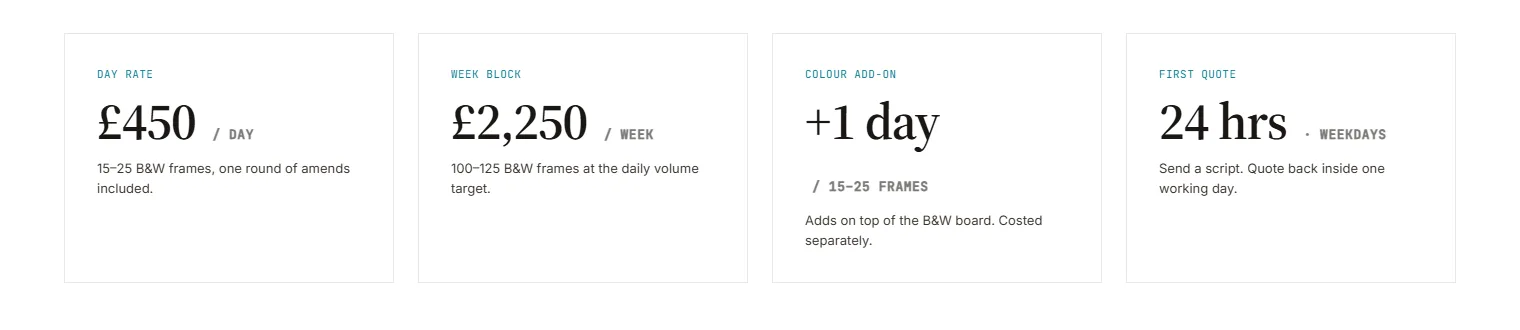
Headline rates from sebantoniou.com/rates, captured 13 September 2026.
The structure is the thing to learn from. £450 a day buys 15 to 25 black and white frames with one round of amends. A £2,250 week block buys 100 to 125 frames. Colour is a separate day at the same volume. Rush sits at a 25 to 50 percent uplift, extra revision rounds are extra days, and wider usage rights (agency archive, multi-year reuse, internal training) are a separate line on the quote. Divide it out and a professional B&W frame costs £18 to £30, with the drawing, the read of the script and the judgement all included in that figure.
Feature blocks on his card run three to six weeks, a TV drama episode one to two weeks, a short film or a key sequence three to five days. Those durations are as useful as the prices, because they are what you are really buying: an artist's calendar.
The union floor in animation
Animation is where storyboards stop being optional, and it has the only collectively bargained storyboard prices I know of. The Animation Guild, IATSE Local 839, publishes wage scales for August 2024 to July 2027, and the storyboard classification has two kinds of minimum.
The first is weekly employment. The journey rate for an Animation Story Person, which is the Guild's name for a storyboard artist on staff, runs from $2,255.20 to $2,622.00 a week across the steps of the agreement, about $56 to $66 an hour, with higher scales for high-budget streaming series and for a Production Board artist. A key artist supervising others gets 15 percent above journey.
The second is the unit rate, a flat minimum for boarding a whole episode as a freelancer.
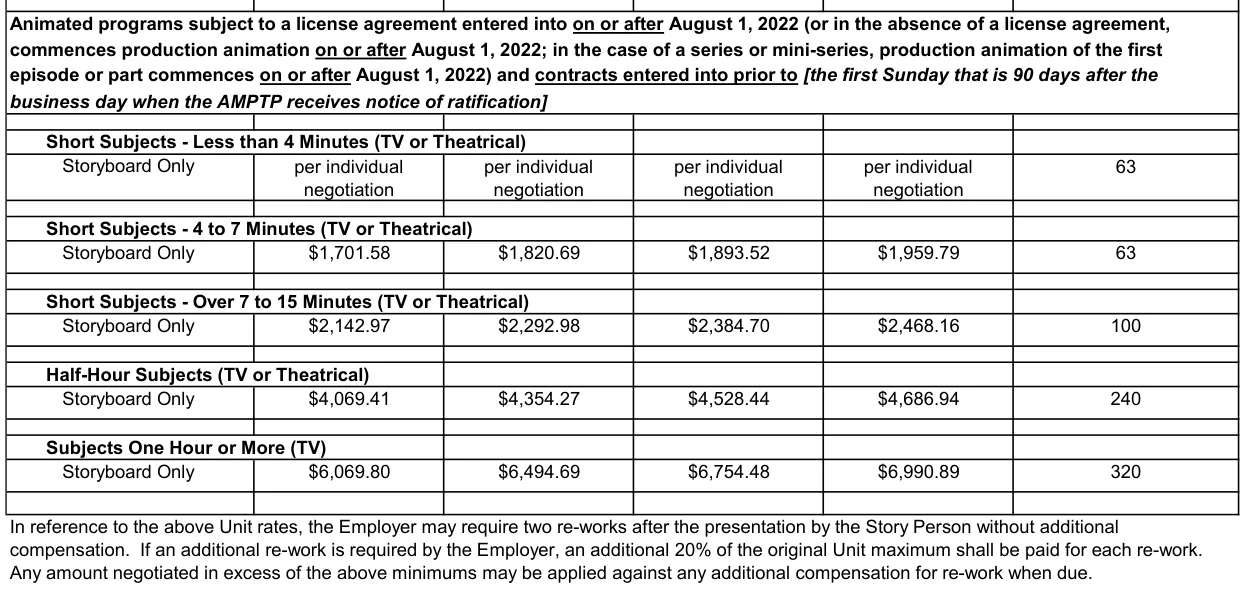
Storyboard unit rates, page 9 of the Animation Guild Local 839 wage scales for August 1, 2024 to July 31, 2027, as printed 2 January 2025 and captured 13 September 2026. The four columns are the contract's periods; the current one, 2 August 2026 to 31 July 2027, is the fourth.
For the period we are in now, a half-hour episode on a program licensed after August 2022 has a "Storyboard Only" floor of $4,686.94. A 4 to 7 minute short is $1,959.79. An hour is $6,990.89. A theatrical feature of 75 minutes or more is $9,410.82. The employer gets two re-works after presentation for free; each further re-work costs 20 percent of the unit maximum. The same document adds a newer Storyboard Pilot Unit scale for pilots, where a half-hour is $19,375.20 in the current period, which tells you what the studios think a board is worth when the show has not been sold yet.
Now put the unit floor next to the Guild's own time estimate. In the post I leaned on for the frames-per-minute article, a veteran board artist put a 22-minute episode at 1,320 to 1,584 cleaned-up panels and 440 to 528 hours of drawing. At journey hourly scale that is roughly $25,000 to $35,000 of labour. The unit minimum for the same episode is under $5,000. That gap is the argument the 2016 post was making about deadlines, and it is why experienced freelancers negotiate well above the floor or take staff weeks instead. If you are budgeting an animated episode at the unit minimum and expecting Guild-quality boards on a sane schedule, one of those three things will give.
What an AI storyboard actually costs
The compute is nearly free
The models behind current AI storyboard tools publish per-image prices. On Google's Gemini API pricing page, Nano Banana 2 (Gemini 3.1 Flash Image) lists at $0.067 for a 1K image and $0.101 at 2K; Nano Banana Pro (Gemini 3 Pro Image) lists at $0.134 for a 1K or 2K image and $0.24 at 4K; the Lite model is $0.0336 at 1K; batch pricing halves all of it. For comparison, the hero image at the top of this article, generated at 16:9 on Nano Banana Pro through Vercel's AI Gateway, cost about 14 cents, and that is the number we log every day for this blog.
So one generated panel costs between three and fourteen cents. Three generations per kept panel puts the compute for a 230-panel action sequence at $46 to $92, and for a whole half-hour episode's worth of panels at $290 to $590. That is less than a single day of a commercial artist for the volume of a union episode, which is the fact that makes producers' eyes go wide and then, correctly, suspicious.
The subscription is the floor you actually pay
Nobody buys panels at API prices. You buy a tool, and the tool bundles the model, the script import, the frame layout and the export.
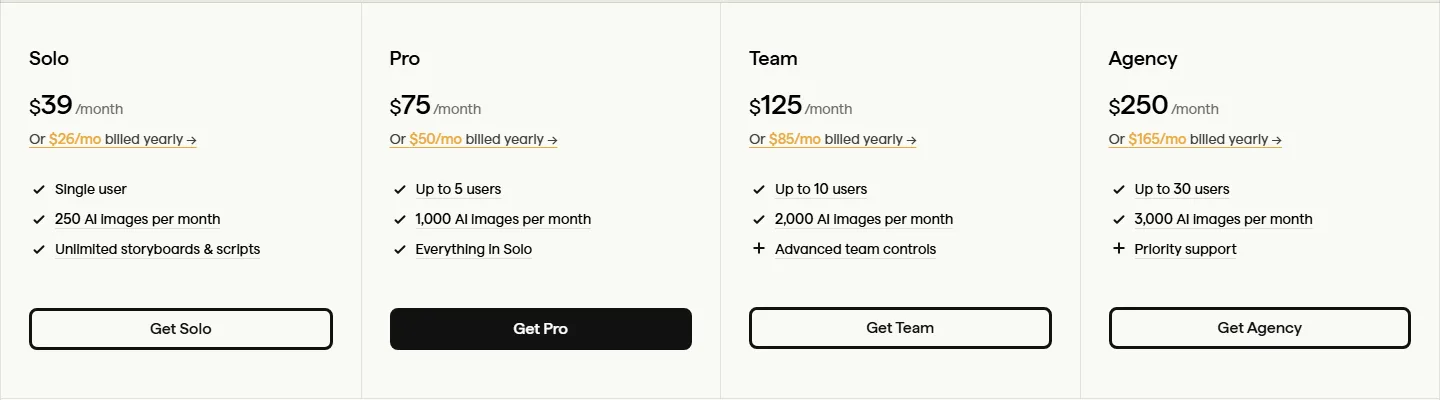
Boords plan cards from boords.com/pricing, monthly billing, captured 13 September 2026.
Boords, the incumbent storyboard software for agencies, prices Solo at $39 a month with 250 AI images, Pro at $75 with 1,000, Team at $125 with 2,000 and Agency at $250 with 3,000, with a third off on annual billing. On Solo that is about 16 cents per image if you use the whole allowance, which is near the raw Nano Banana Pro price plus a margin for the rest of the product. ScreenWeaver's writing workspace is free, and the Storyboard Beta that generates boards from the screenplay is listed at $9.99 a month on our homepage at the time of writing, with each generated image drawing credits. The cost-of-an-AI-film piece walks through why the subscription is the floor and the reroll multiplier is the bill; the same logic applies to stills, with a much smaller multiplier because a still is judged in seconds.
Your time is the real line item
The "cents per panel" pitch leaves out the person running the loop. Somebody still has to break the scene into shots, choose the framing, write or edit the action text, generate, look, reject, fix the reference sheet, and generate again. On a prepared project the whole loop takes two to five minutes per kept panel in my experience; on an unprepared one it takes longer than drawing would. Add one to two hours per main character to build the reference sheet that keeps faces and costumes stable, because without it every panel is a fresh casting session. The character consistency sheet tool exists to cut that setup down, and the script-to-storyboard walkthrough shows the loop shot by shot.
Run that against the episode example. 1,450 panels at two to five minutes is 48 to 121 hours. That is one to three weeks of somebody's full attention. Far less than the 440 to 528 hours the Guild post budgets for drawing, and far more than the compute bill. Price it at whatever your day costs and put it in the table. If the person doing it is the director, it is the director's week you are spending.
Try it free
Try Screenweaver for free on your script
It is free. Import your existing project, get a clearer view of your outline, and regain control of your story structure in minutes.
Start FreeWhere the artist wins, and you should pay
An artist's panel carries decisions a model cannot make for you. Four cases where I would not try to save the money:
- Choreography and physics. A fight, a stunt, a car through a shop window: the artist draws where the weight is, where the camera can physically stand, and what the stunt coordinator needs to see. A generated frame gives you a plausible picture of a punch, which is a different product.
- Boards that sell. In agency work the board is shown to the client to win the job. The hand, the style and the wit of the drawing are part of what is being sold, and buy-out of usage rights is a line on the artist's quote because the drawings have a life after the shoot.
- Union animation. On a Guild show the storyboard artist is a contractual classification, the board is the blueprint every downstream department works from, and the two-re-work clause is doing real work in the schedule. Nothing about that changes because a model got cheaper.
- Notes with a brain attached. Send an artist "make the reveal land harder" and you get back a reframed sequence. Send a model the same note and you get the same frame with more contrast. Revision rounds cost 15 to 25 percent with an artist; they cost your afternoon with a model.
Where AI wins
- Coverage. Live-action productions board the scenes they are scared of and shot-list the rest, because artist days are finite. At cents a panel you can board everything, which changes the shot list versus storyboard decision from "which scenes earn panels" to "which scenes earn an artist".
- Iteration at the story stage. Pixar's 125,000 drawings for WALL-E were mostly versions thrown away. Rerolling a still is the cheap version of that process, and the only version a two-person team can afford.
- AI films. When the finished film is itself generated, the storyboard panel is not a drawing of the shot, it is the image reference the video model will animate. The storyboard-first workflow exists because a panel that costs seven cents saves a video take that costs dollars.
- Consistency once locked. Ask five artists for the same character and you get five characters. A reference sheet, once it is right, holds across a thousand panels.
The hybrid most productions land on
Most live-action and hybrid projects end up in both columns. Board the whole script with AI for coverage and continuity, then pay an artist for the sequences where the drawing is the decision. On a feature that usually means the action, the stunts, the VFX handoffs and the one scene the financier needs to see in colour. The artist starts from a board that already exists, which shortens the brief and the revision loop, and the money goes where the skill is irreplaceable.
Pay an artist when at least one of these is true:
- The scene has a stunt coordinator, a VFX supervisor or a safety officer attached.
- The board itself will be shown to a client or a financier to win money.
- The production is under a Guild or union agreement that classifies the role.
- You need the panel to carry staging intent that words cannot, not just a picture.
- You expect more than two rounds of substantive notes on the sequence.
- The style of the drawing is part of the film's identity (animation, graphic novel adaptation).
- Nobody on the team has the hours to run the generation loop themselves.
If none of those apply, generate the board, spend the artist money on something the camera will see.
How to estimate your own number
- Turn minutes into panels. Time the script with the script time calculator, then apply the per-minute rates from the frames-per-minute guide: 60 to 72 for TV animation, one panel per shot plus moves for live action, 11 to 22 for a :30.
- Pick the artist tier. Marketplace at $15 to $50 a panel, professional day rate at £450 for 15 to 25 frames, union unit or weekly scale for animation.
- Multiply, then add the modifiers. Colour, presentation quality, rush and extra revision rounds each move the quote by 25 to 100 percent; put them on the sheet before you ask.
- Cost the AI path honestly. Subscription plus three generations per panel at the model's list price, plus your own hours at two to five minutes per kept panel, plus reference setup per character.
- Split the script. Mark the sequences that hit the checklist above and price those with the artist. Everything else goes in the AI column.
Both totals on one page, side by side, is the deliverable. The moment you see that a whole feature's coverage costs less than one artist week, and that the three sequences that matter still cost the artist week, the decision usually makes itself.
FAQ
How much does a storyboard artist cost per panel in 2026?
On freelance marketplaces, Fiverr's August 2026 guide puts a simple commercial panel at $20 to $50, with volume rates of $15 to $30 past 50 panels and presentation quality adding 50 to 100 percent. An established UK commercial artist publishes £450 a day for 15 to 25 frames, which is £18 to £30 a frame with one round of amends included.
How much does a storyboard cost for a 30-second commercial?
Between $300 and $800 for 12 to 24 marketplace panels, or one day of a professional commercial artist, £450 on the rate card captured above, for 15 to 25 black and white frames. Colour, rush and extra revision rounds are the lines that push a spot's board past $1,000. The commercial storyboard guide covers how many frames each spot length needs.
What is the union rate for storyboarding an animated episode?
The Animation Guild's 2024 to 2027 wage scale sets a "Storyboard Only" unit minimum of $4,686.94 for a half-hour episode on a program licensed after August 2022, in the period running 2 August 2026 to 31 July 2027, with two re-works included and 20 percent per additional re-work. Weekly staff scale for a journey Animation Story Person runs $2,255.20 to $2,622.00 a week across the agreement.
How much does an AI-generated storyboard panel cost?
Between three and fourteen cents of compute at Google's list prices for the Nano Banana family, and roughly 16 cents per image on Boords' Solo plan if you use the full allowance. Multiply by the generations you burn per panel you keep, typically two to four for stills with references locked, and add your own time at two to five minutes a panel.
Is an AI storyboard good enough to replace an artist?
For coverage, continuity, previs and AI film references, yes, and it lets you board scenes that would never have earned an artist day. For fight choreography, client-facing agency boards, union animation and any sequence where the drawing carries staging intent, no. Most productions end up boarding everything with AI and paying an artist for the handful of sequences where the skill is the point.
Does the storyboard artist own the drawings?
Standard rate cards assume single-campaign or single-production use, and wider rights such as agency archive, reuse across years or internal training are quoted as a separate buy-out line. Ask before the job, not after, because it is one of the cheapest lines to add up front and one of the most expensive to add later.
Final Step
Build your next script with Screenweaver
Move from ideas to production-ready pages faster with timeline-native writing and AI-assisted story flow.
Try Screenweaver