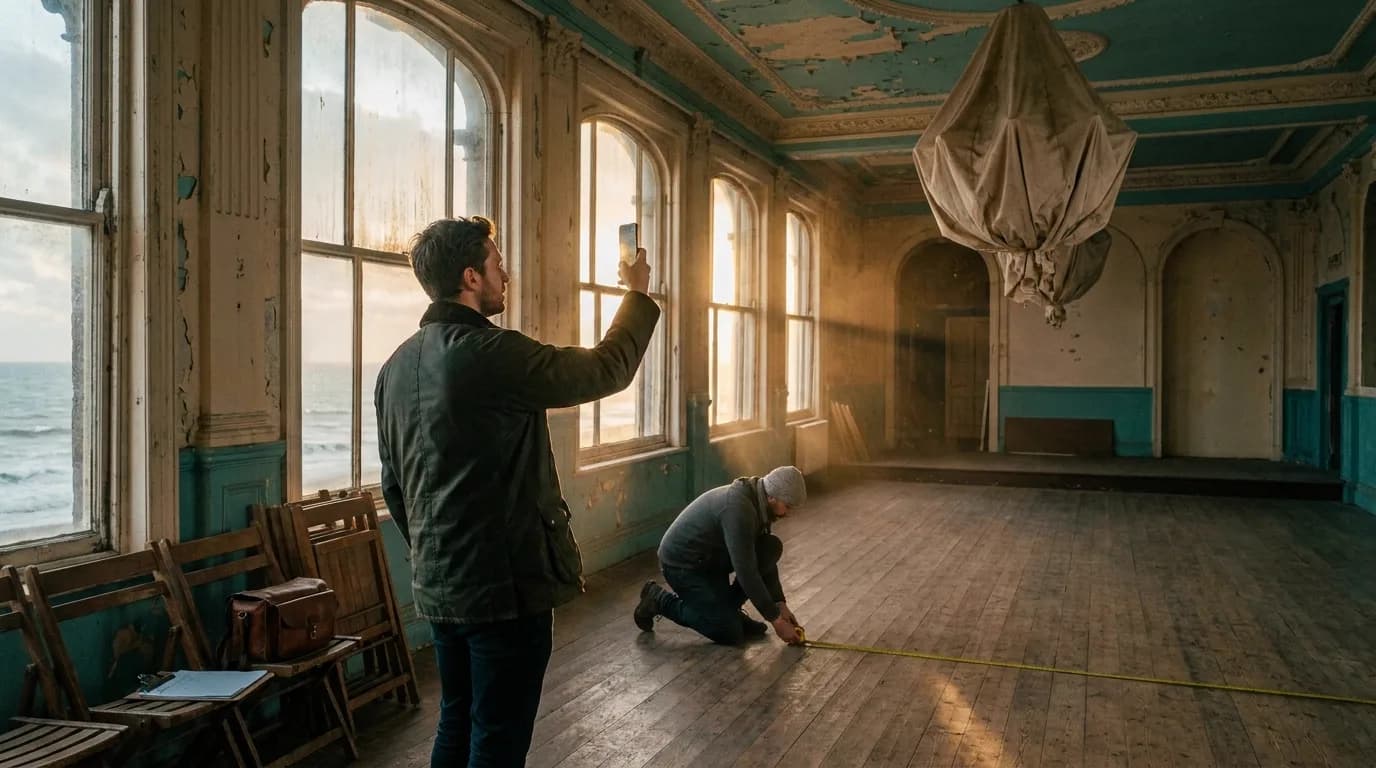

Location scouting is finding and checking the real places where you'll film each set in your script, then getting permission to use them. This location scouting checklist covers what to check on a visit: light, sound, power, access, parking, facilities and permission. There's a printable scout sheet to take with you, and the whole thing sits inside our independent filmmaker workflow.
A place can look perfect in photos and still cost you a shoot day. The gate is locked until nine, a train goes past every few minutes, or there's no socket within fifty metres. The checklist is there to catch those things while you can still say no.
The location scouting checklist
Print this or copy it to your phone. One pass per location, ideally at the hour you plan to shoot.
| Area | Check | Why it matters |
|---|---|---|
| Light | Sunrise and sunset on the shoot date, not the scout date | Light can move by more than an hour between scout and shoot |
| Light | Which way the main windows face (compass bearing) | Tells the DP when direct sun hits the set |
| Sound | Listen for two minutes with everyone silent | Trains, planes, fridges, school runs and church bells don't show in photos |
| Sound | Ask what happens at the times you'll shoot | Bin day, market day, building work next door |
| Power | Number of sockets, where the fuse box is | Decides between house power, batteries or a generator |
| Access | Gate and door hours, keys, stairs, lifts, door widths | Kit has to get in, and a dolly needs a wide door |
| Parking | Where the van and cars go, any restrictions | A long walk from parking eats your morning |
| Unit base | A room or space for kit, make-up and holding actors | Keeps the set clear |
| Facilities | Toilets, water, somewhere warm | Nobody works well after four hours in the cold |
| Phone signal | Bars on two networks | Your call sheet and your safety plan depend on it |
| Safety | Nearest A&E and the drive time | It goes on the call sheet |
| Permission | Who owns it, who decides, who else needs telling | Owner, neighbours, council, sometimes the police |
| Paperwork | Fee, insurance certificate, contract, property release | Nothing is locked until it's signed |
| Records | Photos, plan, GPS pin, contact name and number | Lets the director, DP and 1st AD see what you saw |
The items come from what Wikipedia's location scouting entry lists as the scout's job: aesthetics, cost, logistics and distance from other locations, parking and facilities, power, light and weather, and permission from owners, neighbours, local government and police. The order is ours. We put light and sound first because on a small budget they're the two things you can't buy your way out of.
The five stages, from script to signed
Scouting isn't one visit. It's a funnel that starts with a list of sets and ends with a signed release.
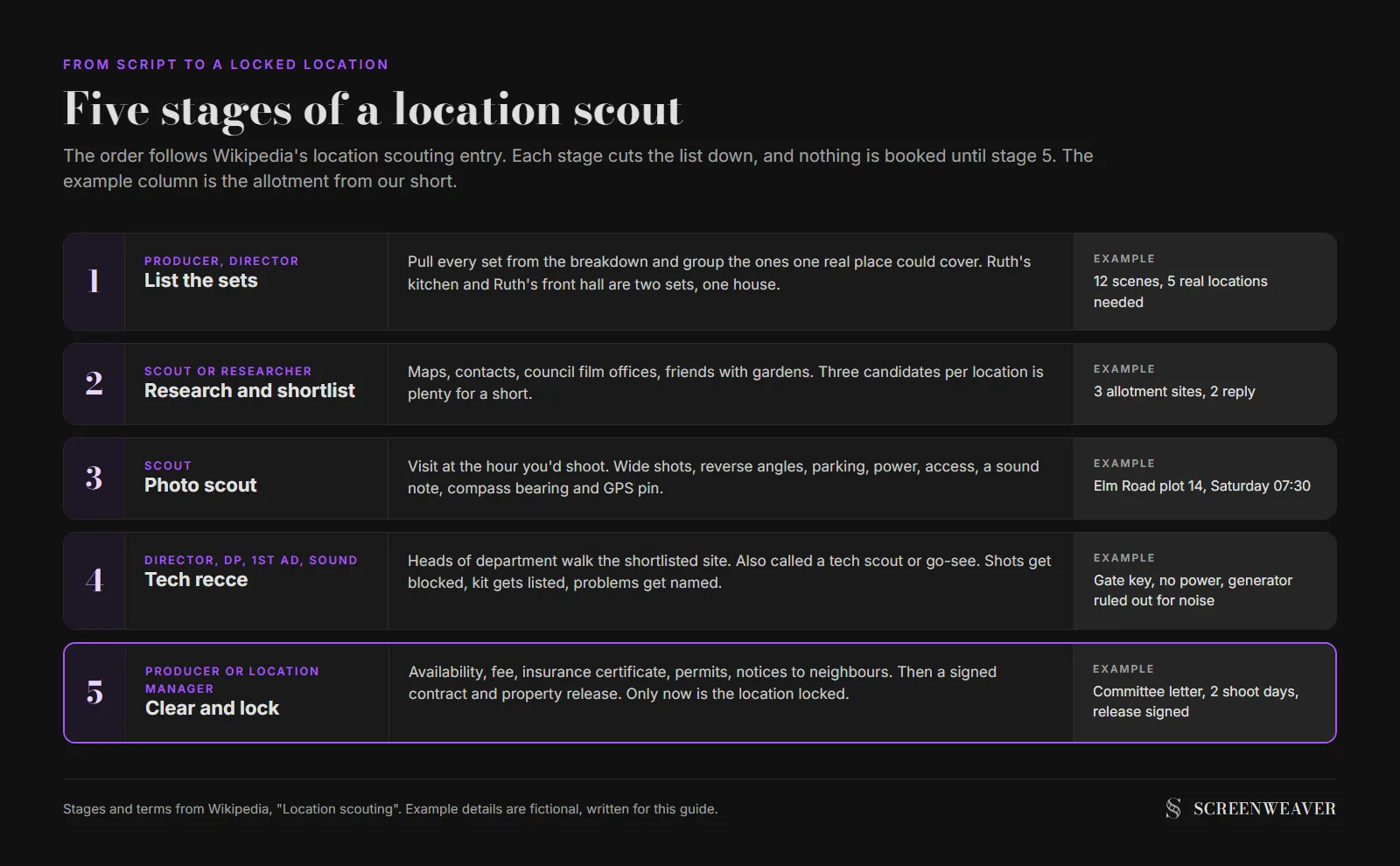
- List the sets. Take every set from your script breakdown and group the ones a single real place could cover. Ruth's kitchen and Ruth's front hall are two sets but one house.
- Research and shortlist. Maps, local contacts, your council's film office, friends with the right kind of garden. For a short, three candidates per location is usually enough.
- Photo scout. One person visits, photographs, measures and fills the sheet.
- Tech recce. The director, DP, 1st AD and ideally sound walk the place together. Wikipedia notes this visit also goes by "tech scout" or "go-see". It's where shots get blocked and problems get named out loud.
- Clear and lock. Availability, fee, insurance certificates, permits and notices to neighbours. Then a contract and a property release. Wikipedia calls the result "locked down", and only then is the place yours for the dates.
On a short where the director is also the scout, stages 3 and 4 become one visit. That's fine. Just don't skip the questions stage 4 would ask.
Light: scout on the date you can't visit
Say you scout in mid-October and shoot in early November. In the UK the clocks go back in between, on the last Sunday of October, so the light you saw at 4pm on the scout won't be there at 4pm on the shoot.
We used SunCalc to compare the two dates for central London. On Saturday 17 October 2026, sunset is at 18:03 BST and the sun is still about 16 degrees up at 4pm. On Sunday 8 November it sets at 16:22 GMT, and at 4pm it's about 2 degrees above the horizon.
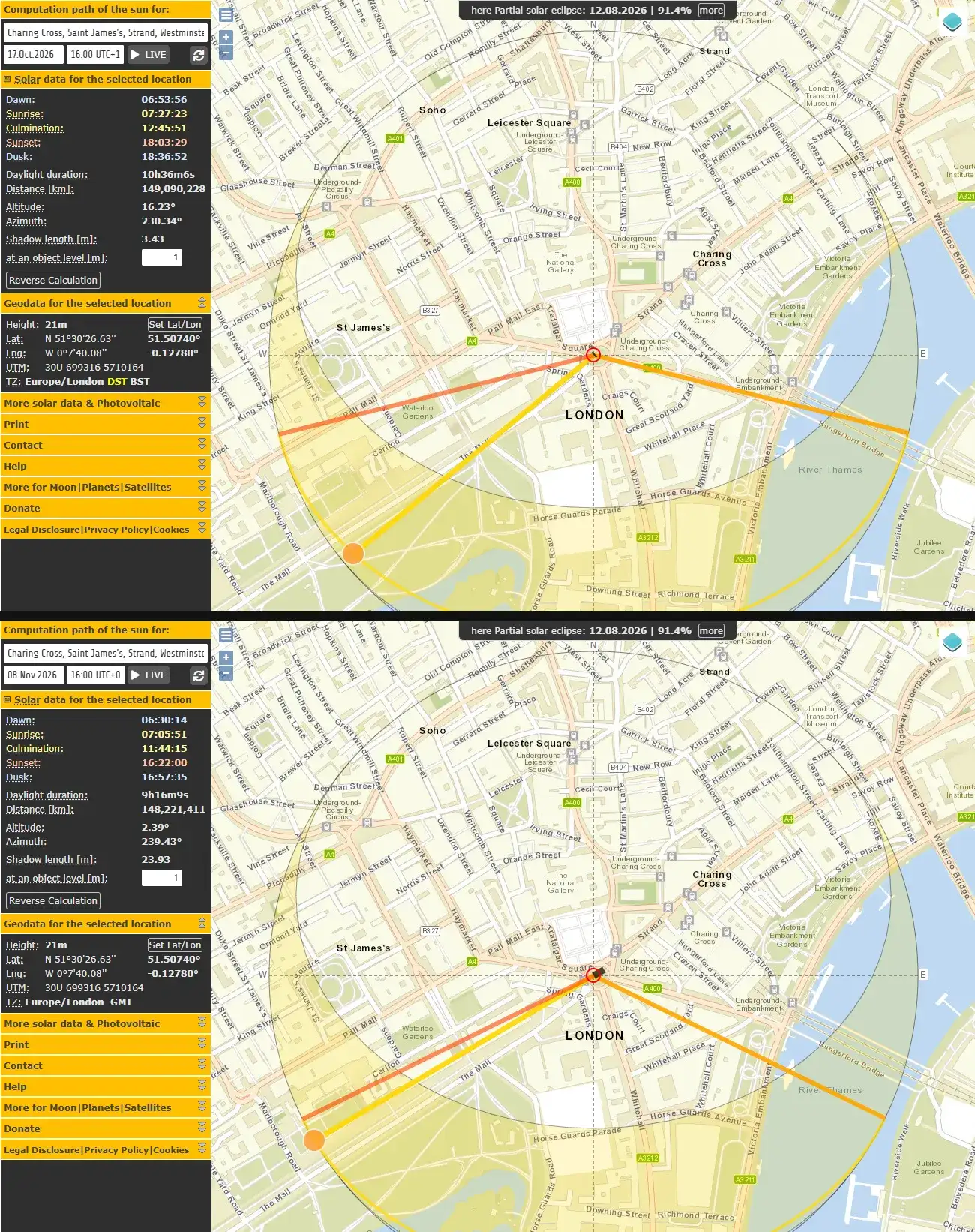
Same clock time, very different light. In our example short, scene 11 is a dusk scene at the allotment. Planned from the scout photos, it would have landed well over an hour after the real dusk.
So when you scout, write two sets of sun times on the sheet: what you saw, and what you'll get. Any sun app or website does this. Take a compass bearing of the main window or the main view while you're there, because a time on its own doesn't tell the DP where the sun will be.
Sound: two minutes of silence
Ask everyone to stop talking and listen for two minutes. Write down everything you hear. It's the cheapest test on the list and the easiest to skip, because you pick a location with your eyes.
Then ask the owner about the hours you'll be there. A quiet street at 11am on a Tuesday can be a school drop-off at 8:30. If your sound recordist can't come to the scout, record a minute of room tone on your phone and send it to them.
Power, access and the unit base
Count the sockets in the room you'll shoot in and find the fuse box. Photograph both. That photo saves your gaffer a visit, and it settles early whether you'll work from house power, batteries or a generator. A generator also brings its own noise, which loops back to the sound check above.
For access, think about the heaviest thing you'll carry. Measure narrow doors. Count stairs. Ask when gates open and who has the keys. Then find your unit base: somewhere for kit cases, make-up and actors waiting between scenes. On a small shoot that might be a spare bedroom or a church hall's side room, but it has to exist.
What to photograph
Photos are the main output of a scout. They let people who weren't there make decisions. Wikipedia lists the usual set: panoramic photos, reverse angles that show space for equipment, sun angles, parking and signage, a sketch or floor plan, access points such as doorways and lifts, and GPS coordinates with compass directions.
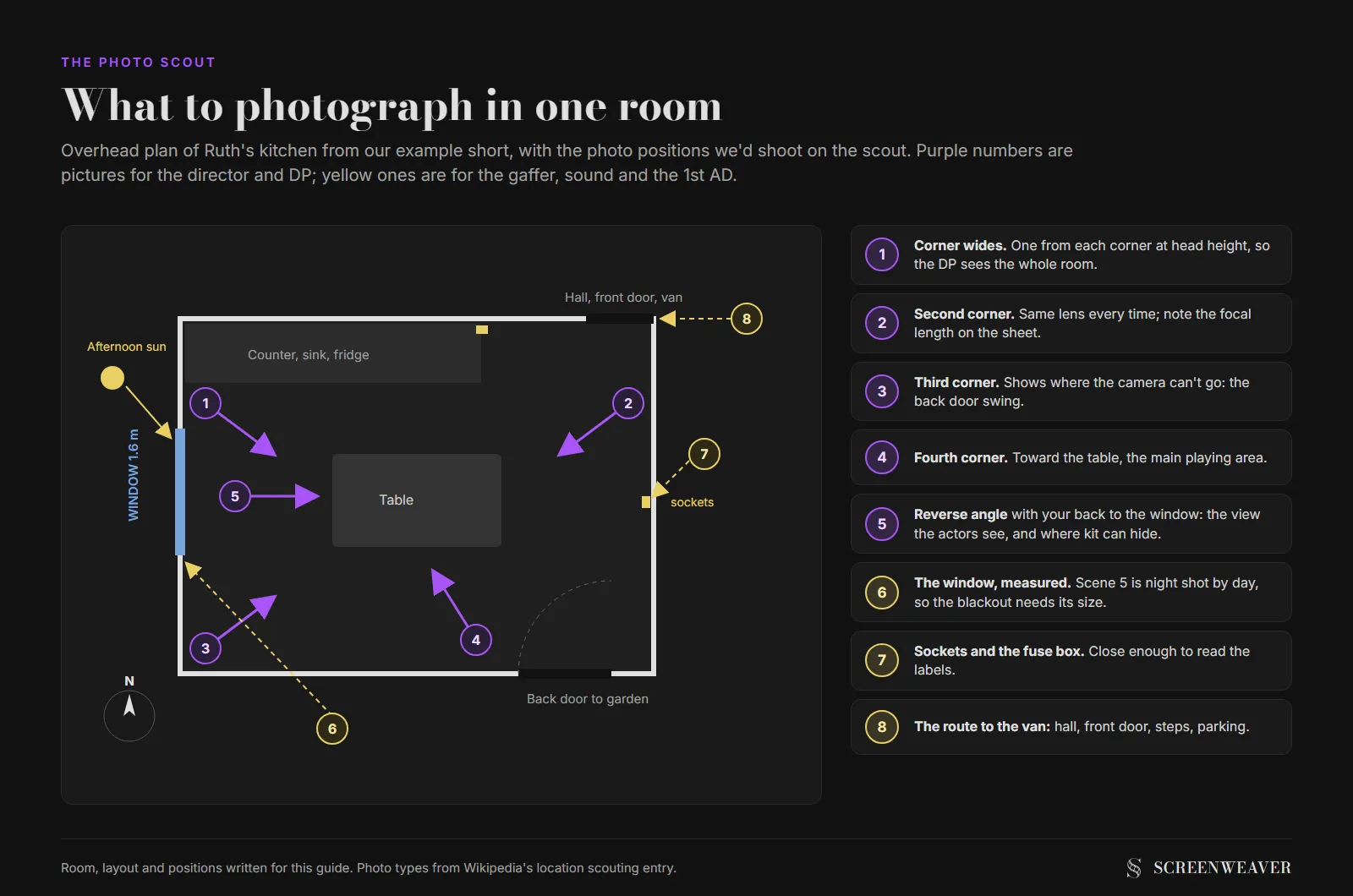
The corner wides are for the director and DP. The rest are for the people who'll make the day work: the gaffer wants the sockets, the 1st AD wants the route to the van, and whoever handles blackout wants the window measurements. In our example, scene 5 is a night scene shot in daylight, so the window size goes straight on the shopping list.
Shoot everything at the same focal length, and write it down. Photos taken at different focal lengths make one room look like three.
Try it free
Try Screenweaver for free on your script
It is free. Import your existing project, get a clearer view of your outline, and regain control of your story structure in minutes.
Start FreeThe scout sheet, filled
One location, one sheet. Ours combines the checklist above with a verdict at the bottom, because the point of a scout is a decision.
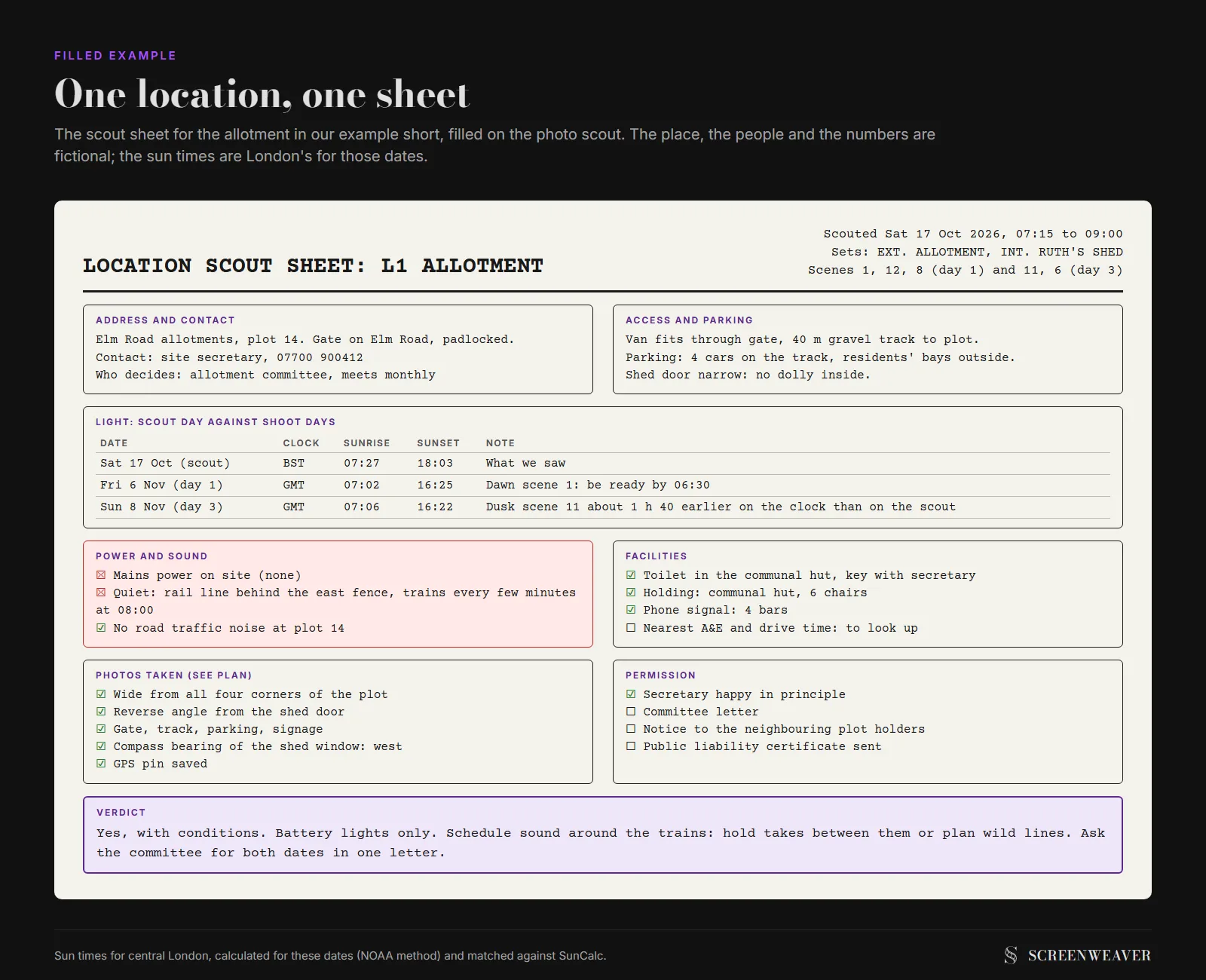
This example continues the short from our stripboard guide: twelve scenes, five real locations, three shoot days. The allotment hosts five scenes across day 1 and day 3. The scout found no mains power and a railway behind the fence. Neither kills the location, but both change the plan. Battery lights only, and sound holds between trains. Both notes go into the schedule and the budget before anyone signs anything.
The blank version of this sheet is the printable PDF linked at the top.
Permission and permits
Private property needs the owner's permission, full stop. For public streets and land, the rules depend on where you are, so find your local film office before the scout rather than after.
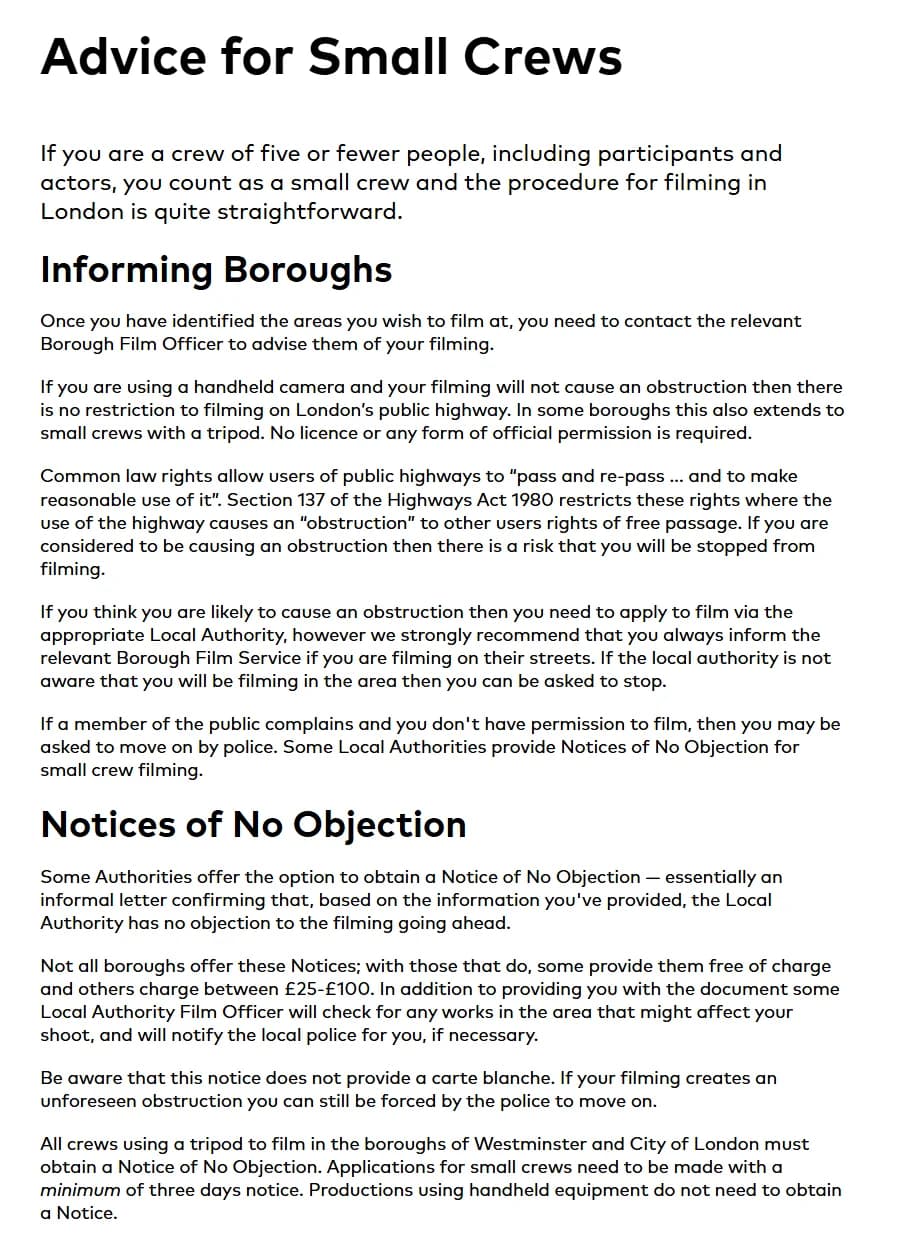
In London, for example, Film London's advice for small crews counts a crew of five or fewer, actors included, as a small crew. It says there's no restriction on filming on the public highway with a handheld camera if you don't cause an obstruction, and that some boroughs offer a Notice of No Objection, free or for £25 to £100. Tripods in Westminster and the City of London need that notice, applied for at least three days ahead.
That's London. Other cities and countries have their own film offices and their own rules, and they change. Check the current page for your area before you plan around it.
On a private location, the paperwork at the end is a location agreement and a property release. Ask for the fee and what it covers in writing, send your public liability certificate if they ask for one, and give neighbours a note with dates and a phone number. You want neighbours to hear about the shoot from you, not from a van outside their window at 7am.
Scouting for an AI-assisted film
If some of your shots will be generated rather than filmed, you still scout, just differently. Photos of a real place become reference images, so the checklist shifts toward consistency: the same focal length, shots from every side, close-ups of textures and signs you'd want repeated. Our guide to consistent locations and props in AI video covers how those references get used.
In ScreenWeaver, locations sit with characters and props as story elements, and each location can hold its own reference images. That gives your scout photos a home inside the project instead of a folder on someone's phone. The film pre-production page shows how that part works.
Common scouting mistakes
- Scouting at noon for a scene set at dawn.
- Trusting the owner's word that "it's quiet".
- Photographing the pretty side of the room only.
- Forgetting the toilet question until the shoot day.
- Leaving permission until after the location appears on the schedule.
- Not writing down who said yes, and when.
Before you lock anything, run the full script through the script breakdown checklist so the list of sets you scout for is complete, then rough out the days with the shooting schedule calculator.
FAQ
What is location scouting in film?
It's the pre-production work of finding real places to film each set in the script, checking them for light, sound, power, access and cost, and getting permission to use them. It ends when a location is cleared and a contract and property release are signed.
What's the difference between a location scout and a tech recce?
The scout finds and documents candidate places, usually alone, with photos and notes. The tech recce (also called a tech scout or go-see) comes later: the heads of department visit the shortlisted place together to plan shots, kit and logistics.
What should I bring on a location scout?
A phone or camera with a fixed focal length, a compass and sun app, a tape measure, the printed scout sheet, the script pages set there, and the owner's contact details. A torch helps for fuse boxes and cellars.
How many locations should I scout for each set?
For a short film, two or three candidates per real location is usually enough. Scout fewer and you have no fallback if the owner says no; scout many more and the process eats your prep time.
Do I need a permit to film on the street?
Not always. The answer changes with the city and with how much space you take up. In London, Film London says small crews with a handheld camera that don't cause an obstruction face no restriction on the public highway, while tripods in some boroughs need a Notice of No Objection. Check your own local film office.
When should location scouting happen?
After the script breakdown and before the shooting schedule is final. The schedule depends on which locations you get and when they're available, so scouting usually runs alongside early scheduling and feeds the budget.
Final Step
Build your next script with Screenweaver
Move from ideas to production-ready pages faster with timeline-native writing and AI-assisted story flow.
Try Screenweaver