
A commercial storyboard is a timing document with pictures attached. Every panel owes a duration in seconds, and those durations have to total the length the client already paid for. Board a :30 that way and the cutdowns and the client review get shorter. The supers and the legal holds are what sink boards in review.
If you want the frames drawn for you before you start arranging them, that is what the AI storyboard tool exists for. The thinking below still has to happen first. And if the spot itself will be generated, the board is also the document clearance and the client sign off against; the brief to broadcast workflow for AI commercials covers what happens after the board.
The seconds are the product
An ad board differs from a film board in one way, and it changes everything downstream: the total is fixed before you draw a line. A feature scene can run four minutes or six and nobody outside the edit will care. A :30 runs thirty seconds. The media buy says so.
If your board implies thirty-four seconds of material, four seconds of somebody's idea dies in an edit suite. It will not be the legal super that dies.
So the first column of an ad board is the duration. Write the seconds in before you draw anything, and keep a running total in the corner of the page. I have watched boards get approved at agency, get shot, and then reveal in the offline that the product demo needed six seconds and only had three. Nobody caught it because nobody had added up the panels.
Add them up.
Panel count comes out of the cut rate
Start with arithmetic instead of instinct. Subtract the end card, then divide what remains by your average shot length.
An end card holds two to three seconds in most spots. It has to be long enough to read a URL or an offer, which is longer than people think. If you have not locked the runtime yet, timing the script comes before any of this.
| Spot length | Time left after end card | Calm (2.5s per shot) | Standard (1.8s) | Fast (1.2s) |
|---|---|---|---|---|
| :06 bumper | 4s | 2 panels | 2 panels | 3 panels |
| :15 | 13s | 5 panels | 7 panels | 10 panels |
| :30 | 27s | 11 panels | 15 panels | 22 panels |
| :60 | 57s | 23 panels | 32 panels | 47 panels |
Nothing in that table is a rule. It is division, and it tells you when your ambition and your runtime have stopped speaking to each other. A director who arrives with thirty-five panels for a :30 has not designed a fast spot, they have designed a :45.
The number that matters more than the count is the spread. Ads that work rarely hold a constant cut rate. They open slow to establish, tighten through the middle, then hold the last shot longer than feels comfortable so the end card lands. Board that rhythm explicitly: put 3.5s on panel one and 0.8s on panel nine, and let the page show the shape.
The first five seconds are a separate design problem
On skippable in-stream placements the viewer gets a skip button after five seconds. That single fact reorganizes the front of your board.
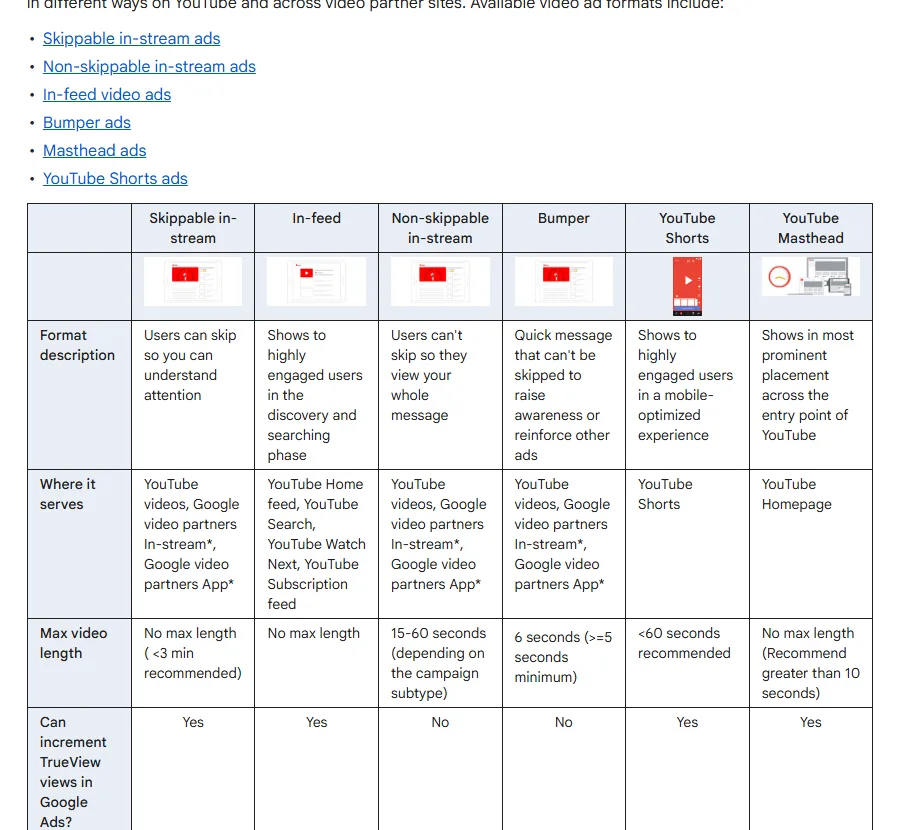
Google Ads Help, "About video ad formats", captured 4 September 2026.
The same table sets the other boundaries you board against: bumpers cap at six seconds with a five second floor, non-skippable in-stream runs 15 to 60 seconds depending on the campaign subtype, and Shorts creative is recommended under sixty. On cost-per-view bidding, Google counts a view once someone watches thirty seconds, or the whole video when it runs shorter than that, or interacts with it.
Read that billing line again and then look at your board. On a :30, the entire spot is the billable unit. On a :60, the thirtieth second is a threshold, and where you place the product relative to it is a media decision as much as a creative one.
On a skippable placement that means four things for the front of your board.
- Panels one and two carry the whole job of earning second six. Board them as if the rest does not exist.
- Put the product or the brand somewhere in those first five seconds even if the reveal comes later. Viewers who skip should still have seen who is talking.
- Do not open on a slow establishing wide out of habit. It is a lovely panel and it is five seconds of nothing.
- Board a second version of panel one. Front-end variants are the cheapest test you will ever run, and they cost one drawing.
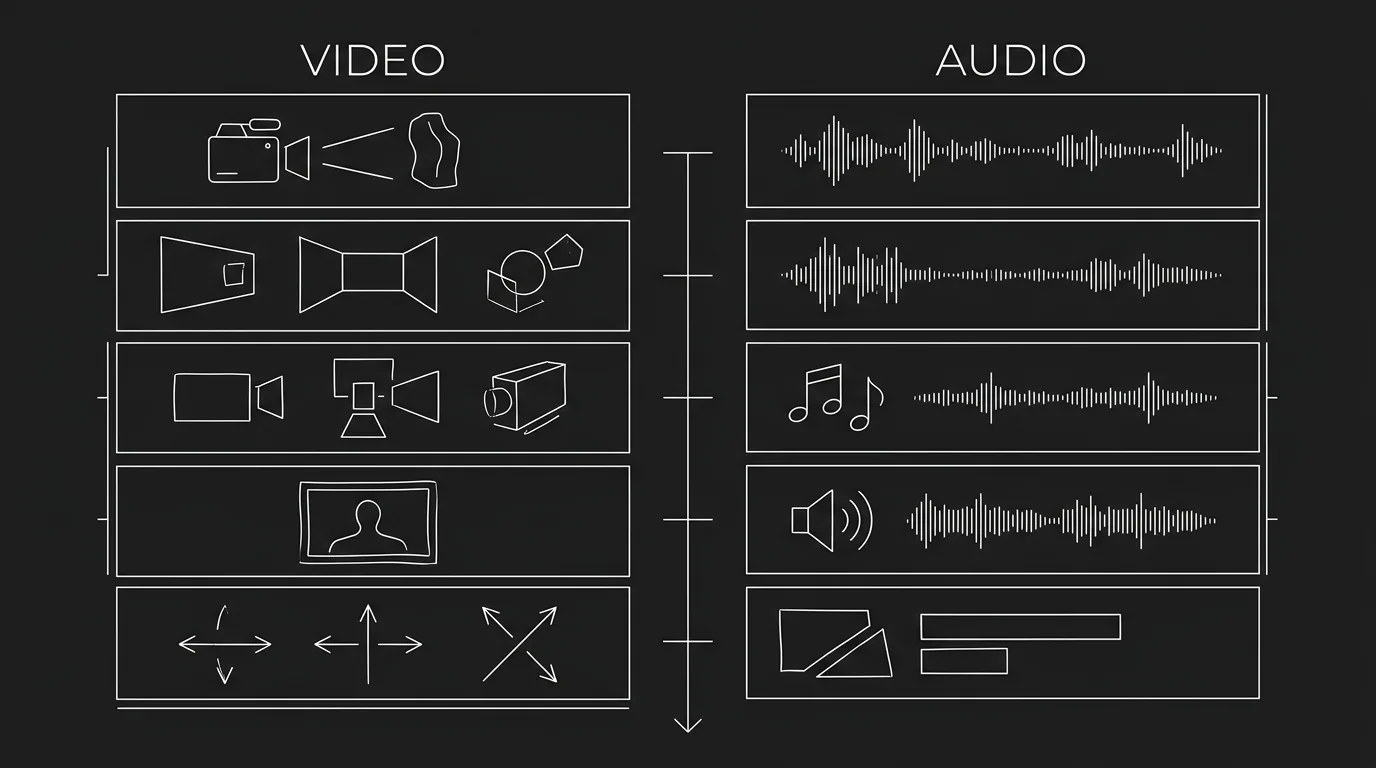
For a bumper, six seconds means roughly two ideas and a logo. Board it as one gesture, not a miniature :30. The 30-second A/V script format sets up the audio and video columns this board sits on top of.
What every ad board has to place
Most spots put five things on screen. The order moves, the presence does not.
| Beat | Its job | Typical window in a :30 |
|---|---|---|
| Hook | Earn second six | 0:00 to 0:05 |
| Tension | Name the reason anyone should care | 0:05 to 0:12 |
| Product in use | Show the thing actually working | 0:12 to 0:21 |
| Claim or proof | Deliver the line legal cleared | 0:21 to 0:26 |
| End card | Logo, offer, URL, legal supers | 0:26 to 0:30 |
Comedy spots invert this and put the product where the tension usually sits. Testimonial spots merge tension and proof into one talking head. Fine. What you cannot do is discover in the edit that the board never allocated seconds to the claim, because the claim is the sentence the brand is legally allowed to say and the reason the spot was commissioned.
Mark those five beats on the board itself. A vertical line between panels, a color, a margin note, anything. When the client asks why the demo feels rushed, you want to point at the page and say the demo has nine seconds, here they are.
The fields an ad panel carries
A film panel needs a drawing, a shot size and a line of action. An ad panel needs more, and the extras are what get boards rejected in review.
- Panel number and duration in seconds, with a running total on the page.
- Shot size, using the standard vocabulary rather than a description.
- VO or dialogue for that exact panel, not the whole script pasted underneath.
- The on-screen super, typed verbatim, including the asterisk if there is one.
- Product state, meaning hero pack, in use, packaging front or logo lockup.
- Audio cue: a music hit, an SFX, or deliberate silence.
- Talent action in one verb.
- Which disclaimer sits over which panels, and for how long.
That last line sinks more ad boards than bad drawing does. Disclaimers have minimum hold times, and a super that needs three seconds cannot sit over a 0.9 second cut. If your legal line has to be readable, it needs its own duration allocation on the board, and it needs it now rather than after the shoot.
Supers deserve the same care. Type them out. "SUPER: OFFER COPY TBC" is an honest placeholder. A drawing of a rectangle with squiggles in it is not, and it will come back as a change.
The framings an ad actually leans on
Ads use a narrower grammar than films do. The wide shot appears once, usually to establish a location the client paid to dress. Everything after that lives in the tighter end of the scale.
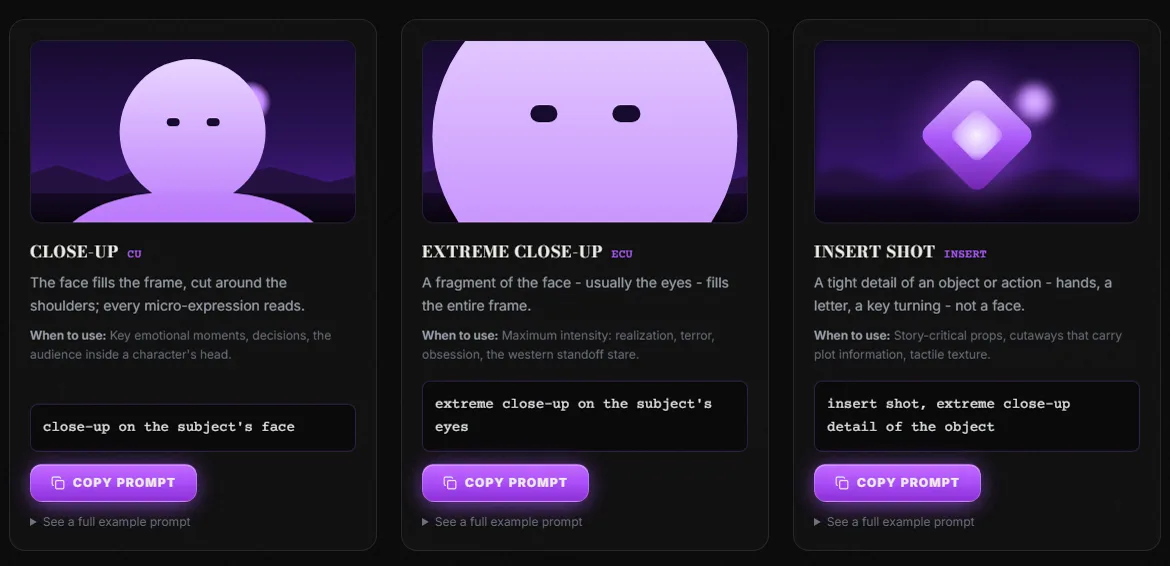
ScreenWeaver's shot size guide, the three framings ad boards use most, captured 4 September 2026.
The insert shot is the one to get right. Hands opening the pack, the liquid pouring, the button pressing, the label turning to camera. In a feature these are cutaways. In a commercial they are frequently the reason the commercial exists, and they are shot on a different day, on a tabletop stage, by a specialist, with the product supplied by the client under conditions somebody wrote down.
So board the inserts separately and clearly. Give them their own panel numbers rather than hiding them as "detail of above". The tabletop unit will work from those panels alone, without the rest of the board, and they need to survive being read out of context.
Close-ups on talent do the emotional work in five words or less of VO. Extreme close-ups earn their place when the product detail is the claim: the stitch, the seal, the grain.
Try it free
Try Screenweaver for free on your script
It is free. Import your existing project, get a clearer view of your outline, and regain control of your story structure in minutes.
Start FreeBoard the :30 so the cutdowns fall out of it
Almost no spot ships alone. A :30 usually arrives with a :15, often a :06, sometimes a vertical version for social. If you board those separately you will produce three inconsistent spots and shoot material three times.
Board the :30 as the parent, then mark every panel with the versions it survives into. Here are the first seven rows of a fifteen-panel board.
| Panel | Duration | :30 | :15 | :06 |
|---|---|---|---|---|
| 1 Hook, wide | 2.5s | yes | yes | yes |
| 2 Talent reaction, MCU | 1.5s | yes | yes | no |
| 3 Problem, insert | 2.0s | yes | no | no |
| 4 Product in use, CU | 2.2s | yes | yes | yes |
| 5 Demo detail, insert | 1.8s | yes | no | no |
| 6 Claim, MS with super | 3.0s | yes | yes | no |
| 7 End card | 3.0s | yes | yes | yes |
Two things fall out of a grid like that. You can see immediately whether the :15 still tells a story or has become a trailer for the :30, and you can see which panels are load-bearing, which is exactly the list the shoot day should protect when it runs late.
Add the vertical crop while you draw, not after. Mark a 9:16 safe box on each panel and check that the product and the super both sit inside it. This is the same discipline a music video board needs for its social cutdowns, and it costs nothing at the drawing stage.
The board is the approval document
On a film the storyboard is a plan. On a commercial it is closer to a contract. It goes to the agency, the agency takes it to the client, and the version that comes back with initials on it is the version people expect to see in the offline.
Changes are free while they are drawings. The single strongest argument for boarding a spot properly is that a client who wants the pack to face the other way costs you an eraser today and a reshoot in three weeks. Invite the note early.
And the board has to be legible to people who do not read boards. Agency producers do. Brand managers often do not, and marketing directors almost never do. Number every panel. Put the seconds in large type. Write the VO in sentence case so it reads like speech. If a panel needs a caption to be understood, write the caption. Elegance in a board is a private pleasure; clarity is the job.
Send it as a PDF with one page per group of panels, not as a single scrolling image, because it will be printed and it will be put on a wall.
Checklist before the board leaves your hands
- Durations written on every panel, and the total matches the sold length exactly.
- End card given two to three seconds of its own.
- First five seconds work standalone for skippable placements.
- Every super typed out verbatim, including any asterisk.
- Legal disclaimer given a hold time long enough to read.
- Product state named on every panel where the pack appears.
- Inserts numbered as their own panels for the tabletop unit.
- Cutdown column filled in for every version the campaign has sold.
- 9:16 safe box marked if a vertical version exists.
- Panel numbers and page numbers on every page of the PDF.
- One sentence at the top naming the spot, the length and the version date.
Tools for this
- Storyboard template generator for printable 16:9 panels with note lines under each frame; the storyboard template guide explains the 9 and 12 panel layouts for spots.
- Shot size guide when you want the standard term rather than a description the tabletop unit has to interpret.
- Video frames calculator if you are generating the shots rather than filming them, since generative models count frames while your board counts seconds. The approved panels then become the input when you generate AI video prompts from the script, one prompt per timed shot.
- ScreenWeaver's AI storyboard generator to turn the ad script into frames before you start arranging durations. The manual method is covered in how to make a storyboard from a screenplay, and the AI route in generating a storyboard from your screenplay.
FAQ
How many panels does a 30-second commercial storyboard need?
Subtract two to three seconds for the end card, then divide the remaining twenty-seven by your average shot length. That lands between eleven panels for a calm spot and roughly twenty-two for a fast one. Fifteen is a common middle. Count what your idea needs rather than filling a template.
Do I have to draw well to board a commercial?
No. Stick figures with correct framing beat beautiful drawings with vague framing every time. What the board has to communicate is shot size, product state, duration and text on screen. If drawing slows you down, generate the frames and spend your time on the durations and the supers, which is where boards actually fail.
What is the difference between a commercial storyboard and an animatic?
The board is still frames with durations written on them. The animatic is those frames cut to the actual timing with scratch VO and temp music over the top. The animatic is where you find out the demo is three seconds short. If the budget allows one, build it from the board rather than replacing the board with it.
Should the end card get its own panel?
Yes, always, with its own duration. It carries the logo, the offer, the URL and usually the legal line, and it is the only panel where someone has to read rather than watch. Two seconds is tight. Three is safer when there is a URL.
How do I board a spot before the script is locked?
Board the beats rather than the lines. The five beats in the table above survive most script revisions, so allocate seconds to hook, tension, demo, claim and end card, and leave the VO fields as placeholders. When the copy lands you fill the fields instead of redrawing the spot.
Can I board a 6-second bumper the same way?
The method holds, the proportions do not. Six seconds is about two ideas and a logo, so the beat table collapses to a hook and an end card with one shot between them. Board it as a single gesture. A bumper that tries to be a compressed :30 reads as a mistake.
Final Step
Build your next script with Screenweaver
Move from ideas to production-ready pages faster with timeline-native writing and AI-assisted story flow.
Try Screenweaver