Storyboard Template Generator
Printable sheets in your exact aspect ratio
Pick your delivery format, choose how many panels per page, and download a clean printable storyboard PDF. No signup, no watermark, and frames drawn at the real aspect ratio of your project instead of generic rectangles.
Storyboards only help if the frames match what the camera will actually capture. A composition planned in 4:3 breaks in 2.39:1, and a vertical TikTok short boarded in 16:9 loses its framing entirely. This generator draws every panel at your true ratio, on Letter or A4, with optional note fields for action and dialogue.
The PDF is generated entirely in your browser. Nothing is uploaded to any server.
Live preview
2 columns x 3 rows of 16:9 frames, with shot numbers on every panel.
How it works
The generator computes a print layout where every frame keeps your chosen aspect ratio exactly: it picks the column grid that gives the largest possible frames, sizes the page in landscape for wide ratios and portrait for vertical ones, numbers each shot, and adds ruled note lines when enabled. The live preview and the downloaded PDF share the same layout math, so what you see is what prints.
Choosing the right storyboard format
Match the template to the delivery, not the other way around. YouTube and television live in 16:9, cinematic projects in 1.85:1 or 2.39:1, and TikTok, Reels, and Shorts in 9:16. Boarding in the wrong ratio produces compositions that fall apart the moment they are reframed.
Panel count sets the rhythm of the board. Film work reads best at 3 to 6 panels per page, where each drawing carries weight and there is room to think. Commercials and fast-cut social content often run 8 to 12 smaller panels per page to show pacing across quick cuts.
The humble note field earns its space on set. Shot number, one line of action, a dialogue or sound cue, and a camera note per panel is the difference between a board a crew can shoot from and a stack of pretty drawings nobody can execute.
Who this is for
- Directors and DPs: sketch coverage in frames that match the actual delivery ratio before the shoot, not after the crop.
- Film students: hand in professional-looking boards without fighting a word processor's table tool the night before.
- Social and commercial teams: plan 9:16 verticals natively, with frames sized for the format instead of cropped from horizontal boards.
Start from the screenplay.Get the storyboard.
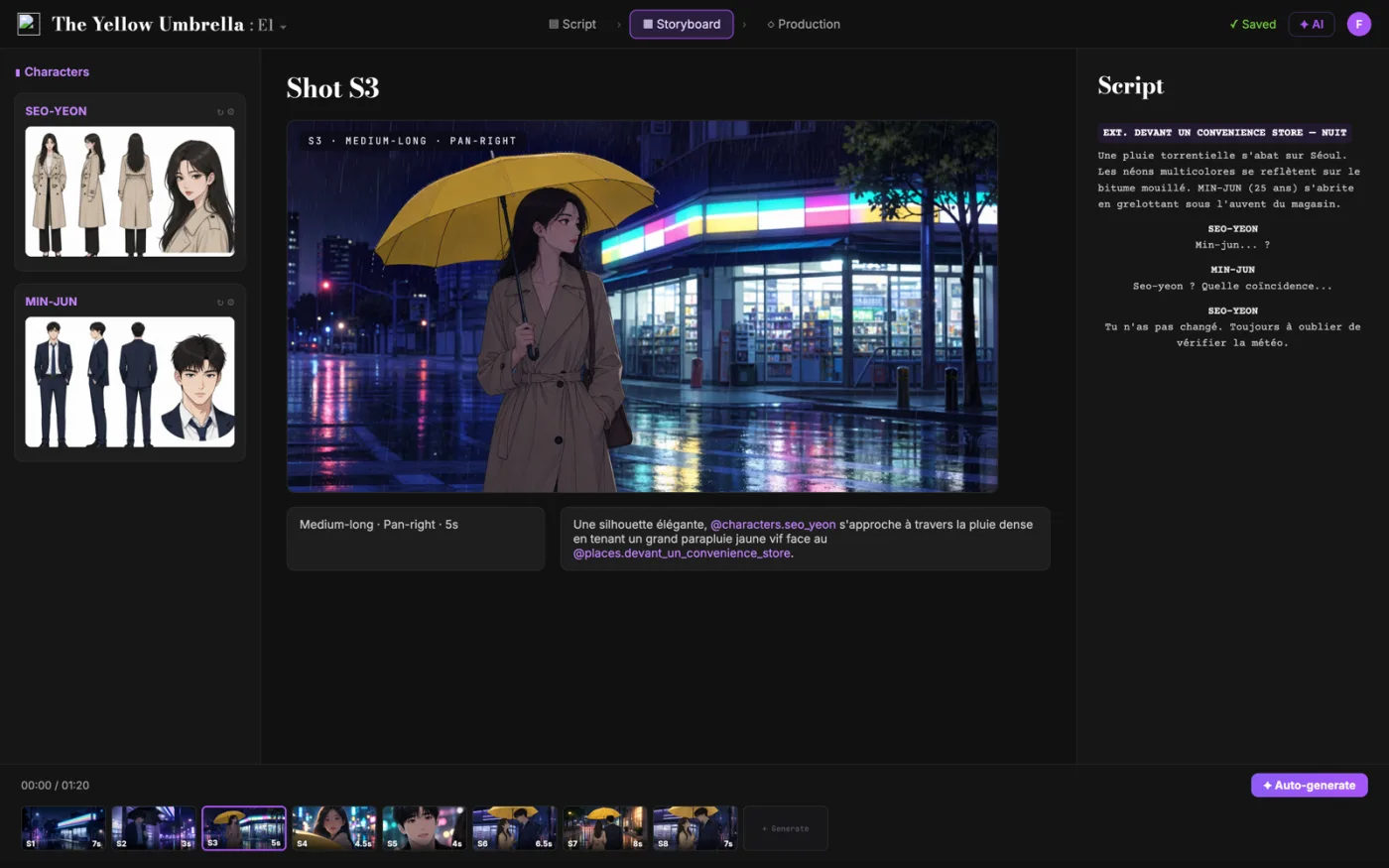
ScreenWeaver breaks your script into shots and generates the storyboard from it. You control framing, angle, movement and duration. Characters carry from shot to shot.
- $0, does not expire
- PDF and Final Draft export
- Mac, Windows, Linux, iPad
Storyboard Template Generator: the complete guide
It generates printable storyboard PDF sheets with frames drawn at your real aspect ratio, from cinematic 2.39:1 to vertical 9:16, with optional action and dialogue note fields under each panel.
For this workflow, the central problem is clear: most downloadable storyboard templates are static PDFs in one aspect ratio and one layout, so filmmakers redraw frames that do not match their actual delivery format. Left unresolved, this creates downstream friction and slower decisions. The practical target is a clean, printable storyboard sheet that matches your exact aspect ratio, panel count, and note-taking style.
Limitation to keep in mind: It produces blank boards for drawing and planning, not rendered artwork: the drawings, arrows, and camera notes are still yours to make.
Advanced workflow: Storyboard-first directors print wide-ratio sheets for the film pass and vertical sheets for social cutdowns of the same scene, so both framings get planned before the shoot instead of cropped after it.
Step-by-Step Workflow
- Pick the aspect ratio your project will actually deliver in, not the one the template happened to have.
- Choose panels per page: fewer, larger frames for detailed film boards, more for fast commercial pacing.
- Toggle note fields on if you write action and dialogue under each frame, off for pure thumbnails.
- Download the PDF and print as many sheets as the scene needs, or re-generate per sequence.
Use Cases By Profile
- Director: sketch coverage in frames that match the actual delivery ratio instead of generic rectangles.
- Film student: hand in boards that look professional without fighting a word processor's table tool.
- Social video team: plan 9:16 verticals natively instead of cropping a 16:9 board and losing headroom.
Common Mistakes To Avoid
- Boarding in 4:3 or generic rectangles and discovering the composition breaks in 2.39:1.
- Cramming twelve tiny panels per page for a drama that needs six readable frames.
- Skipping note fields, then writing camera directions in margins nobody can read on set.
Professional Best Practices
- Film boards read best at 3 to 6 panels per page; commercial and social boards can run 8 to 12.
- Number panels by scene and shot (3A, 3B) so boards stay sorted when pages get shuffled on set.
- Print one extra blank sheet per scene: the best idea often shows up while boarding.
Treat this tool output as a decision support layer, not a replacement for authorship. Great scripts are remembered for specific choices, emotional precision, and clarity of dramatic movement. Tools help by removing noise so your energy can go where it matters: character, conflict, escalation, and payoff. If you review outcomes after each pass and keep an explicit log of accepted changes, your workflow becomes faster and more predictable from draft to draft. That consistency is exactly what professional collaborators value: fewer surprises, clearer rationale, and a script that evolves with intent.
Extended FAQ
What aspect ratio should my storyboard be?
The same ratio your final video will deliver in: 16:9 for YouTube and TV, 2.39:1 or 1.85:1 for cinematic projects, 9:16 for TikTok, Reels, and Shorts. Boarding in the wrong ratio leads to compositions that break when reframed.
How many storyboard panels per page is standard?
Film work typically uses 3 to 6 panels per page so each frame stays readable. Commercials and fast-cut social content often use 8 to 12 smaller panels to show pacing across quick cuts.
Is this storyboard template really free?
Yes. Configure the sheet, download the PDF, and print it, with no signup and no watermark. The generation happens entirely in your browser.
Can I make a vertical 9:16 storyboard template?
Yes. Pick 9:16 and the generator lays out vertical frames on a portrait page, sized for TikTok, Reels, and Shorts planning, instead of forcing vertical framings into horizontal boxes.
What should I write under each storyboard panel?
The standard fields are shot number, a one-line action description, any dialogue or sound cue, and camera notes like movement or lens. The optional notes area under each frame is sized for exactly that.
Storyboard on paper or digitally?
Paper remains the fastest way to think through shots, especially for quick thumbnails. Many directors sketch on printed sheets first, then rebuild the keepers digitally where panels link to the script and shot list.
Frequently asked questions
The ratio your final video will deliver in: 16:9 for YouTube and TV, 1.85:1 or 2.39:1 for cinematic work, 9:16 for TikTok, Reels, and Shorts, 4:3 or 1:1 for specific platform and archival formats.
3 to 6 for film boards where each frame needs detail and annotation space, 8 to 12 for commercials and fast-cut social content where pacing across cuts matters more than per-frame detail.
Yes. Configure the sheet, download, and print as many copies as you need. Generation happens in your browser with no signup and no branding on the sheets.
Yes, pick 9:16 and the generator lays out vertical frames on a portrait page, sized for the format instead of forcing vertical framings into horizontal boxes.
The standard set: one line of action, any dialogue or sound cue, and camera notes like movement or lens. The shot number is already printed above each frame.
Related tools
Scene to Clip Splitter
Split a scene into AI video clips that fit your model's duration cap.
AI Video Prompt Generator
Build cinematic prompts for Veo, Sora, Runway, and Kling.
Shooting Schedule Calculator
Estimate how many shoot days your script needs.
Scene Card Generator
Create and export structured scene cards.
You can also browse the full library on /tools.
Core blog guides
- Idea → first draft (process hub)
- Screenplay format guide 2026
- Hidden costs of “free” software
- Affordable software & TCO
- Revision passes (structure → dialogue)
Film techniques
Film techniques to explore
Each one with a short clip, a screenplay excerpt and the shot list line.