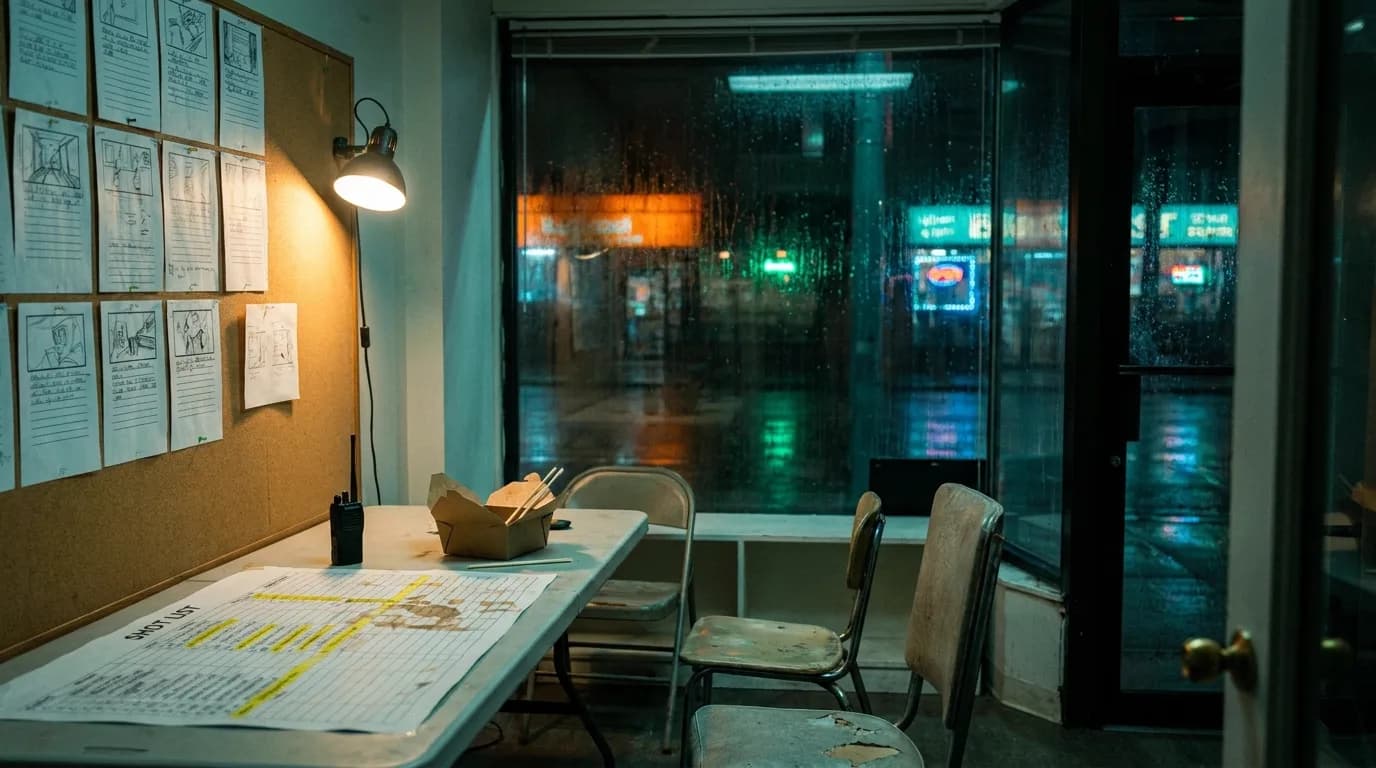

A music video storyboard runs on timecode, not page numbers. You mark the song's sections, decide how many panels each one earns, then draw only the frames the edit cannot survive without. Every panel carries a time in and a time out. If you want them drawn for you, that is what the AI storyboard generator is for, and if the shots themselves will be generated, the AI music video method picks up where this board leaves off.
What changes from a film board is that your structure arrived finished. The mix already decided where the turn happens, and no amount of boarding moves it.
The track is the spine
Load the song into whatever timeline you edit in, drop a marker at every section change, and write the timecodes down before you sketch anything. That list is your board's table of contents. If you have not worked out what each section owes the viewer, the story beats version of this problem covers the structural side, and the boards should come after the treatment is signed off, not before.
Panel counts I budget against, for a three and a half minute track:
| Section | Runs | Panels | What those panels have to prove |
|---|---|---|---|
| Intro | 0:00 to 0:18 | 4 to 6 | The image system: place, palette, who we are watching |
| Verse 1 | 0:18 to 0:52 | 8 to 10 | Behavior, and the first look at the performance setup |
| Chorus 1 | 0:52 to 1:20 | 6 to 8 | The signature image, at full strength, drawn properly |
| Verse 2 | 1:20 to 1:54 | 8 to 10 | The same world escalated, never the verse 1 board reused |
| Chorus 2 | 1:54 to 2:22 | 4 to 6 | Variations only. Mark the rest "as chorus 1" |
| Bridge | 2:22 to 2:48 | 6 to 8 | The rupture. This is the section people cut first and regret |
| Final chorus | 2:48 to 3:30 | 6 to 10 | The signature image with the meaning moved |
Forty to sixty panels for a three minute video is a working board. Under thirty and you are asking the crew to invent on the day. Over eighty and you are drawing shots you will never light.
Panel density is a function of shot length, not ambition
Music videos cut faster than anything else you will board. Divide the song's length in seconds by the average shot length you are aiming for and you get the real number of shots the edit will need.
| Average shot length | Shots in a 3:30 track | What that edit feels like |
|---|---|---|
| 1.0 s | 210 | Hard-cut performance, montage energy, exhausting past two minutes |
| 1.5 s | 140 | Standard pop-video pace |
| 2.0 s | 105 | Pop with room to breathe on the choruses |
| 3.0 s | 70 | Narrative-led, needs blocking that holds the frame |
| 4.0 s | 53 | One-idea-per-shot, closer to short film grammar |
| 6.0 s | 35 | Long-take territory. Board every single one |
You are not drawing 140 panels. You draw the shots that carry an idea and you tag the rest as coverage of an already-drawn setup. A repeated chorus angle gets one panel and a note saying it comes back at 1:54 and 2:48. That note is worth more than the drawing, because it tells the first AD the setup stays up.
What a music video panel carries that a film panel doesn't
Six fields. Skip any of them and someone on the day will guess.
| Field | Why it exists |
|---|---|
| Time in / time out | The only address a panel has. Shot numbers drift, timecode doesn't |
| Lyric or beat cue | "on the snare", "second 'I know'". The editor works to this, not to your shot number |
| Camera fps | Decides the whole day, because it decides playback |
| Playback speed | The number the playback operator sets. Wrong here means unusable sync |
| Look block | Wardrobe, hair, location. Groups the panels into shooting order later |
| Performance or concept | Which of the two passes this frame belongs to |
The lyric cue is the field people leave out and the one editors ask for first. A panel that says "wide, dolly in" is a suggestion. A panel that says "wide, dolly in, lands on the downbeat of the second chorus" is a shot.
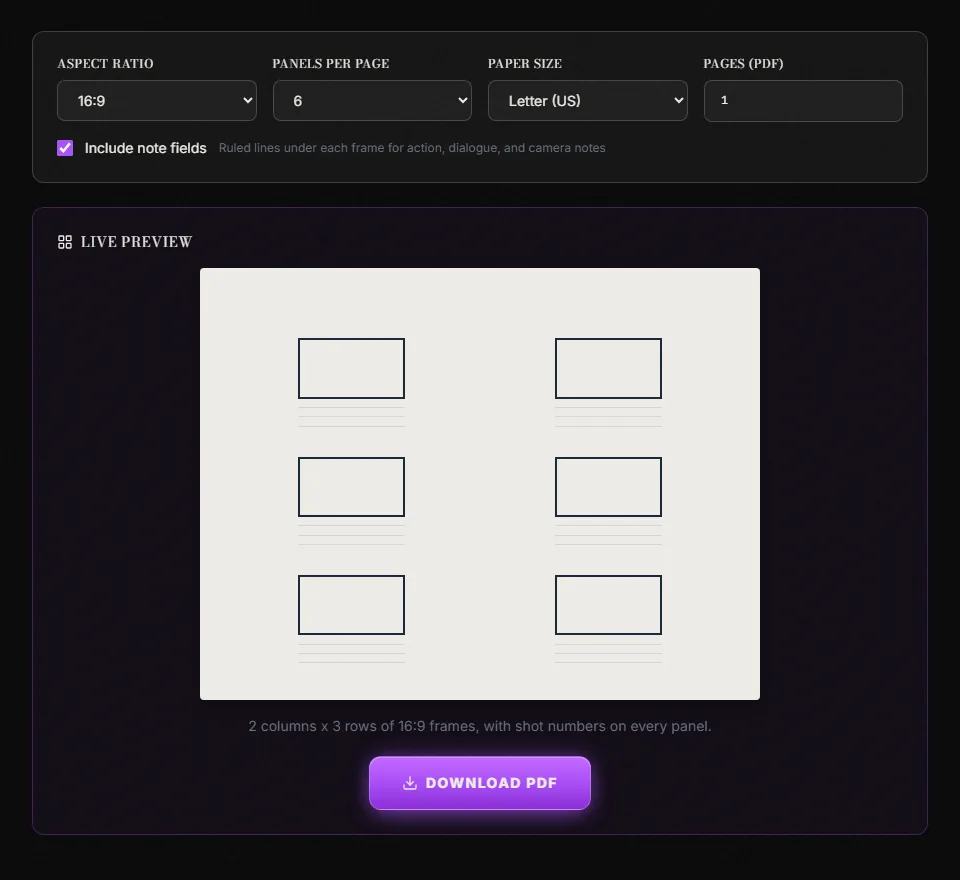
The storyboard template generator on screenweaver.ai, captured 3 September 2026. The aspect ratio menu covers 16:9, 1.85:1, 2.39:1, 4:3, 1:1 and 9:16; panels per page run 2, 3, 4, 6, 8, 9 or 12, on Letter or A4.
Use two panels per page for the hero frames you need the record label to look at, and nine or twelve for the coverage grid the crew carries. Same board, two printouts, and nobody on set is flipping through forty pages to find the bridge.
Two passes, boarded separately
Every music video is at least two shoots wearing one name. The performance pass covers the artist singing the whole song, usually more than once, in one or two setups. The concept pass covers everything else: the narrative, the dancers, the inserts, the location work.
Board them as separate documents that share a timecode column. Then the performance pass gets a coverage plan rather than a per-shot board, because you are shooting continuous takes of the full track and choosing angles, not shots. Wide for the verses, 50mm for the choruses, long lens for the bridge, one handheld pass for safety. That is four panels covering three and a half minutes, and it is honest about how that footage gets made.
The concept pass is where the drawing goes. Those frames get boarded the way a storyboard from a screenplay gets boarded, one panel per idea, because nothing in that footage repeats.
Speed: the math that decides your shoot day
Slow motion on a lip-sync shot is not a post decision. If the artist mouths the words at normal speed and you shoot at 48 fps, the mouth is wrong forever. The fix is old and it still works: speed the playback up by the same ratio you are overcranking.
Screen speed equals timeline fps divided by capture fps. Playback speed equals capture fps divided by timeline fps. Two divisions, and they decide what the playback operator loads on the day.
| Capture fps | Timeline | Screen speed | Playback speed on set |
|---|---|---|---|
| 48 | 24 | 50% | 2x |
| 60 | 24 | 40% | 2.5x |
| 96 | 24 | 25% | 4x |
| 120 | 24 | 20% | 5x |
| 50 | 25 | 50% | 2x |
| 12 | 24 | 200% | 0.5x |
Undercranking is the row people forget. Shoot at 12 fps against a half-speed track and the performer has to mouth the words in slow motion, which looks absurd in the room and cuts beautifully.
Give the artist a pitch-corrected version of the sped-up track, because nobody can sing along to a chipmunk, and give the playback operator the raw sped-up file so the timing stays exact. Write the conform on the panel too. In post the clip gets reinterpreted at the timeline rate rather than ramped by eye, and Adobe's own Interpret Footage documentation covers what that does to duration. Frame counts for a specific ramp are quicker on the video frames calculator than in your head at 6am.
Try it free
Try Screenweaver for free on your script
It is free. Import your existing project, get a clearer view of your outline, and regain control of your story structure in minutes.
Start FreeReorder the boards before you print them
The board is written in song order. The day is shot in setup order. Those are two different documents and the crew needs the second one.
Sort your panels by look block, then by location, then by lighting state, and print that version for the floor. Keep the song-order version for the director and the editor. On a one-day video with two locations and three wardrobe changes, the shooting-order board will jump from 2:48 to 0:14 to 1:31 in the first hour, and that is correct. The timecode field is what lets you do this without losing anything.
The order also tells you what to protect. Whatever you shoot last is what gets cut when you run out of light, so the bridge should not be last.
Mark the vertical crop while you are still drawing
A 9:16 cut is in almost every deliverables list now, and it is almost always an afterthought. If one is in yours, mark a vertical safe area on every panel where the artist is not centered, and be honest about which shots die in the crop. A two-shot at the edges of a 2.39:1 frame does not survive. Better to know that while you are still drawing than during the social edit three weeks later.
The same panel grid in 9:16 takes ten minutes to fill in for the twenty frames that actually matter.
Checklist before the boards leave your hands
- Every panel has a time in and a time out
- Every panel names a lyric or a beat, not just a bar number
- Capture fps and playback speed written on every high-speed or ramped panel
- Repeated chorus setups tagged with the timecodes they come back at, not redrawn
- Performance pass and concept pass separated, sharing one timecode column
- A shooting-order print exists alongside the song-order print
- Look blocks labeled so wardrobe can group the day
- Vertical safe area marked on any panel that will be cropped
- Total shot count sanity-checked against your target average shot length
- One page that lists only the frames the video cannot be delivered without
That last line is the one that saves the shoot. When the day collapses, and it will, someone has to know which frames are non-negotiable.
Tools for this
The storyboard template generator prints the grids in the aspect ratio you are shooting, including 9:16 and 2.39:1. If you are generating frames rather than drawing them, the storyboard-first workflow for AI video is the process that keeps the boards useful once the images are generated, and generating a board from a script covers the narrative side for concept passes with dialogue.
FAQ
How many panels does a music video storyboard need?
Forty to sixty for a three minute video, covering the shots that carry an idea. The edit will contain far more cuts than that, because repeated performance angles and coverage of an existing setup do not need their own panel. Tag repeats with the timecodes they return at instead of redrawing them.
Do I storyboard the performance footage?
Not shot by shot. Performance is shot as continuous takes of the whole song, so it gets a coverage plan: which lens, which angle, which section. Four to six panels usually covers a full performance pass. The concept pass is where per-shot boarding earns its time.
What playback speed do I use for slow motion lip sync?
Divide your capture frame rate by your timeline frame rate. Shooting 48 fps for a 24 fps timeline means playback at 2x, 96 fps means 4x, 120 fps means 5x. Give the artist a pitch-corrected copy so they can sing along, and give the playback operator the raw sped-up file.
Should the storyboard follow the song order or the shooting order?
Both, printed separately. The song-order board is for the director and the editor. The shooting-order board, sorted by look block and location, is what the floor works from. The timecode on each panel is what lets one become the other without anything getting lost.
What goes on a music video panel that a film panel doesn't have?
Time in and time out, the lyric or beat cue the shot lands on, the capture frame rate, and the playback speed. Film panels address shots by scene and shot number. A music video panel is addressed by timecode, because that is the only thing the song, the board and the edit all agree on.
Can I storyboard a video before the track is finished?
You can board the treatment, not the video. Section lengths move during the mix, and a board built on provisional timecodes has to be rebuilt anyway. Wait for the version that will actually be released, then mark the sections and start.
Final Step
Build your next script with Screenweaver
Move from ideas to production-ready pages faster with timeline-native writing and AI-assisted story flow.
Try Screenweaver