
A fight scene storyboard is drawn from the choreography, one panel per beat, with the line of action marked on every page. The script gives you the outcome and the tone. The stunt coordinator gives you the moves. The board is where the two meet the camera, and it is the only document on the shoot that tells the operator which side of the punch to stand on.
If you would rather have the frames drawn for you and spend your time on the choreography instead, the AI storyboard tool takes a scene and returns panels you can rearrange. The beat list still has to come first. Everything below is about building it.
Why a fight is the one scene you cannot skip boarding
Most live-action scenes never get boarded, and that is fine. A two-hander at a kitchen table survives on a shot list. A fight does not, for three reasons that have nothing to do with art.
The first is bodies. A stunt performer taking a fall needs to know where the camera is, because the fall is sold to the lens, and a fall sold to the wrong lens is a re-set with a tired performer on a hard floor. The second is time. Action cuts at roughly four seconds a shot on average, which means a ninety-second fight is twenty-plus setups, and twenty setups without a plan is a lost afternoon. The third is geography. A fight moves. The characters swap sides, the line of action rotates, and the only way to keep the audience oriented is to decide in advance where the camera lives at each beat.
Directors who board dialogue and skip the fight have it backwards. Drama can be found on the day. Choreography cannot.
Start from the beat list, not the script page
The screenplay is the wrong starting document. A well-written fight on the page is either blow-by-blow or big picture, and the guide to formatting fight scenes explains when each is correct. Neither version is a storyboard source. "They brawl, she wins" gives the artist nothing to draw. "She blocks. He kicks low. She grabs his leg" is closer, but a writer's beats are dramatic beats, and a fight needs physical ones.
The document you actually board from is the beat list, and it comes from whoever is designing the fight. On a funded production that is the stunt coordinator or fight choreographer. On a short it might be you and a friend with a gym mat. Either way, the format is the same: a numbered list where each line is one physical exchange with a clear cause and result.
| Beat | Action | Result | Who is on top |
|---|---|---|---|
| 1 | A shoves B into the doorframe | B stumbles, off balance | A |
| 2 | B swings wild, A ducks | A is inside B's reach | A |
| 3 | A drives a knee up | B folds, drops the knife | A |
| 4 | B grabs A's collar and headbutts | A staggers back, nose bleeding | B |
| 5 | Both scramble for the knife on the floor | B gets it | B |
| 6 | A kicks the knife hand into the radiator | Knife skids under the bed | Even |
The last column is the one people leave out, and it is the one that makes a fight readable. A fight is a story with reversals. If the "who is on top" column never changes hands, the scene is a beating, and beatings are boring after eight seconds. If it flips every beat, the audience loses track of the stakes. Two or three reversals across a one-minute fight is the shape that cuts well, and building it into the beat list means the coverage exists to cut it that way.
Number the beats and keep the numbers forever. They go on the panels, on the shot list, on the slate, and in the edit bins. A crew that talks in beat numbers wastes no time on "the bit where he falls."
What the professionals actually board: stuntvis
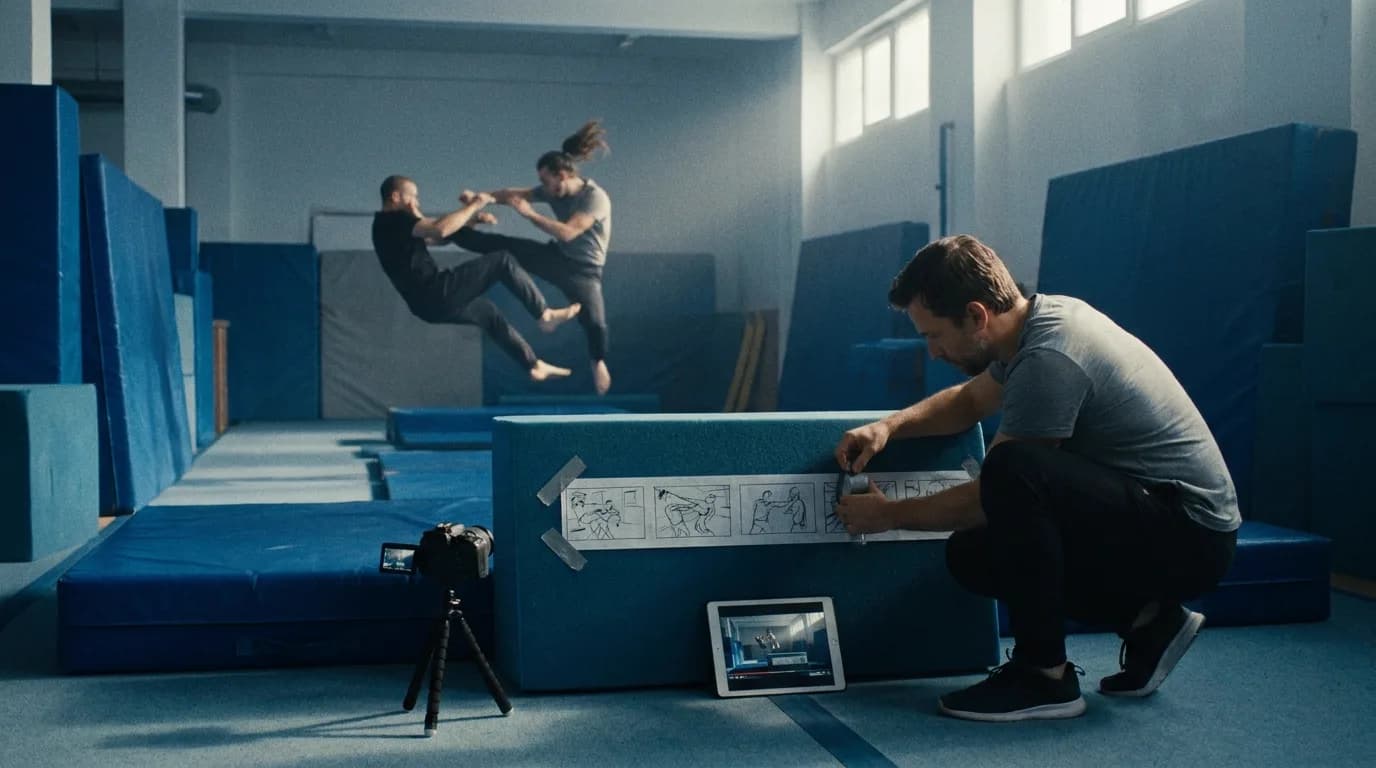
On big action productions the fight is rarely boarded in pencil first. It is shot. The stunt team rehearses the choreography in a gym with crash mats and cardboard standing in for the set, films it from the intended camera positions, and cuts it together with placeholder effects. The industry calls this stuntvis, and VFX Voice ran a long piece on it in 2018 with the artists who do it for a living.
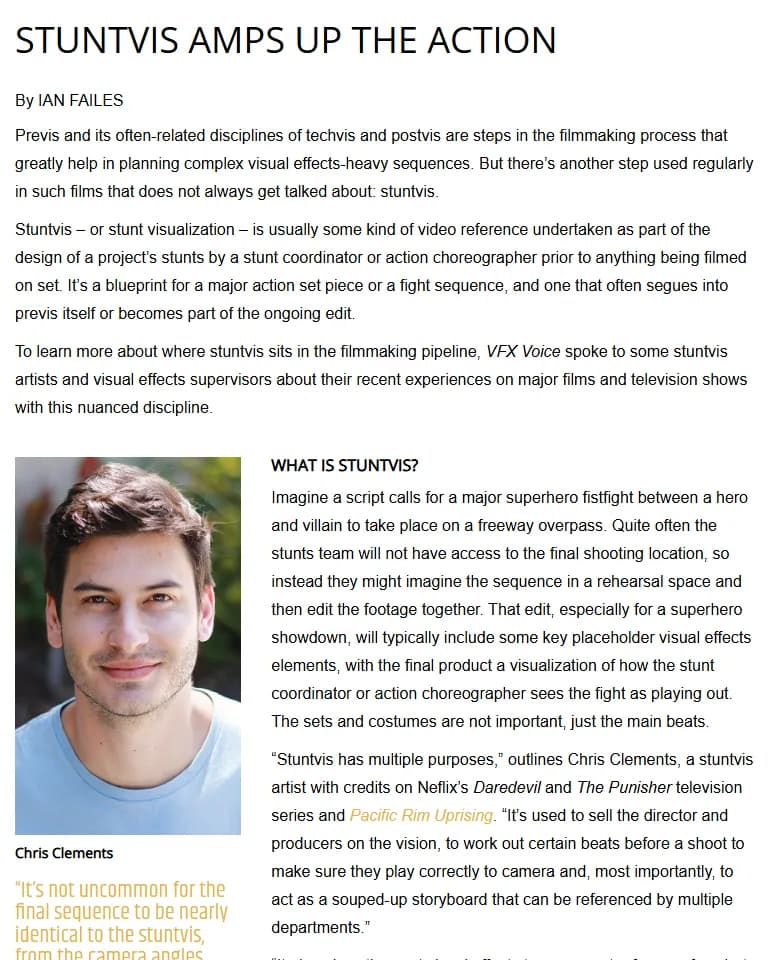
VFX Voice, "Stuntvis Amps Up the Action" (Ian Failes, 27 September 2018), captured 14 September 2026.
Chris Clements, whose stuntvis credits include Netflix's Daredevil and The Punisher and Pacific Rim Uprising, describes it in that article as something used "to sell the director and producers on the vision, to work out certain beats before a shoot to make sure they play correctly to camera," and, in his words, "to act as a souped-up storyboard." He also says it is not uncommon for the final sequence to be nearly identical to the stuntvis, down to the camera angles.
The practice predates the name. A 2016 PremiumBeat profile of 87eleven, the action design company Chad Stahelski and David Leitch founded before they directed John Wick, describes how the team would hear about a film in pre-production and turn up with a fully storyboarded action sequence, often with the stunt sequence already shot on video, as a way of winning the job.
The people with the most money and the most experience treat the fight board as a camera document. The angles are the point. And "board" and "rehearsal video" are the same thing at different budgets. If you have two performers and a phone, film the beats from the positions you intend to shoot from, pull stills, and you have a storyboard that already proves the choreography reads. If you have neither, draw it, but draw it from the camera's position, not from the choreographer's.
The panel budget: one per beat, plus the hits
The standard live-action estimate is one panel per shot plus one per significant camera move. Fights break that estimate in one direction only: upward. The frames-per-minute breakdown covers why the Animation Guild doubles its panel count for action-heavy shows, and live action inherits the same multiplier for the same reason. Action is more drawings than acting because more happens.
A practical way to budget a fight board:
| Panel type | When you need it | Rough count for a 6-beat exchange |
|---|---|---|
| Geography wide | Once per location change, and once after any reversal that moves the fight | 2 |
| Beat panel | One per numbered beat, drawn at the moment of contact or the moment of the miss | 6 |
| Reaction / result | The beat's consequence when it needs its own shot (a fall, a drop, blood) | 3 to 4 |
| Insert | Any object that matters: the knife, the hand on the doorframe, the foot on the stairs | 2 |
| Move start / end | Any tracking or whip pan that follows a body across the room | 2 to 4 |
| Overhead floor plan | One per page, drawn in the margin | 1 per page |
Fifteen to eighteen panels for six beats, which is about twenty seconds of screen fight. Scale that up and a minute-long fight is forty to fifty panels. Fifty panels sounds heavy until you weigh it against fifty setups on a stage with a stunt team on the clock, which is why the artist versus AI cost comparison treats action sequences as their own scenario.
Draw the beat panel at the frame of impact, or at the frame where the miss is clearest. A punch mid-flight is ambiguous. A fist stopped at a jaw with the head snapping is not. Artists with a comics background draw the impact by reflex. Directors sketching their own boards draw the wind-up, and the wind-up tells the camera nothing.
Screen direction: the line moves, and so must your camera
Every editor's nightmare with a fight is the cut where the fighters swap sides for no reason. The audience does not know why they are confused, only that they are. The cause is nearly always a camera that crossed the line of action, and the fix is a board that draws the line on every page.
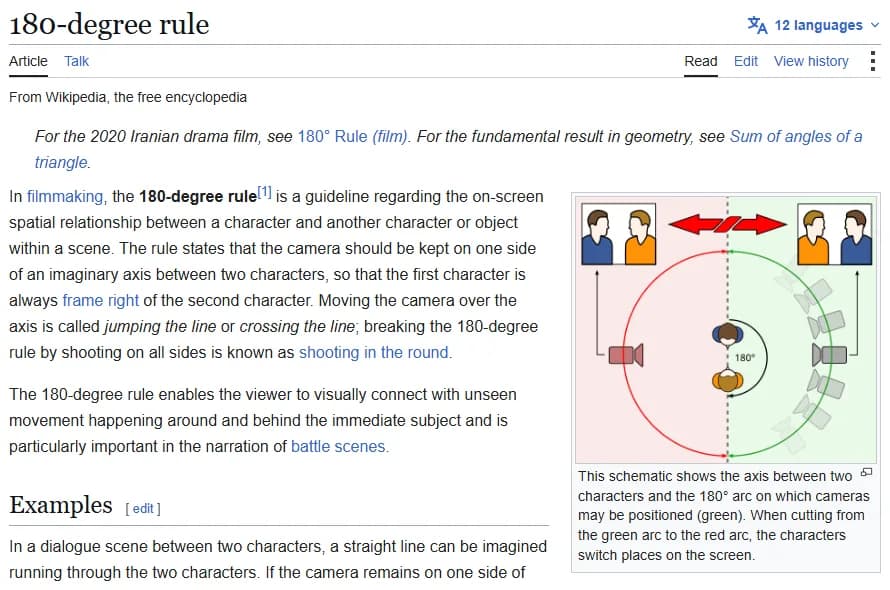
Wikipedia, "180-degree rule", captured 14 September 2026. The article notes the rule is "particularly important in the narration of battle scenes."
The 180-degree rule is simple with two people at a table: draw an imaginary axis through them and keep the camera on one side. A fight is harder because the axis rotates. When A spins B into the wall, the line through them has turned ninety degrees, and the camera position that was safe a beat ago is now across the line.
The board handles this with one habit. At the top or side of every page, draw a small overhead plan: the room as a rectangle, the two fighters as circles labelled A and B, the line through them, and the camera positions for that page's panels as small wedges. When the line rotates, draw a new plan. A page with three overhead plans on it is a page where the fight moved three times, and the operator can see the moves before anyone is bleeding.
You can cross the line on purpose in three ways, and the board should show each of them instead of leaving the problem to the edit:
- Move the camera across on screen. A tracking shot that arcs around the fighters from one side to the other resets the audience's map. Board it as two panels with the arc drawn on the overhead plan.
- Cut to a neutral shot on the axis. A frontal shot straight down the line, or a top shot, or an insert of the knife on the floor, belongs to neither side. Cut out to it, cut back on the other side, and nobody notices.
- Let a fighter cross the line for you. If B crosses in front of camera to the other side of A, the line has rotated and the audience watched it happen.
If your board never crosses the line, you have a fight that plays out in profile like a tennis match. The crime is crossing without showing your work.
Shot size by beat function
Fights use the whole shot size vocabulary faster than any other scene, and each size does one job. Pick by what the beat needs the audience to know.
| What the beat needs | Size | Why |
|---|---|---|
| Where everyone is, what is in reach | Wide or full shot | Geography is the promise; hits pay it off later |
| Two bodies in one exchange | Medium two-shot | Both fighters in frame proves nothing was faked with a cut |
| A hit that lands | Medium close-up on the receiver | The reaction sells the impact, the fist rarely does |
| A miss, a feint, a block | Medium on both | The audience has to see the geometry of the miss |
| A weapon, a grip, a foothold | Insert, extreme close-up | One frame, two seconds, and the audience now cares about the object |
| The end of a reversal | Cowboy or medium on the new winner | The moment the "who is on top" column changes hands gets its own frame |
Board the wide before you need it, and repeat it after the fight moves. Audiences forgive almost any cut if they know the room. Close-ups belong to the receiver of a hit, not the giver. The shot size reference tool has the nine standard sizes with framing lines if you want a card to pin above the desk.
Try it free
Try Screenweaver for free on your script
It is free. Import your existing project, get a clearer view of your outline, and regain control of your story structure in minutes.
Start FreeMovement: handheld is not a plan
"Handheld, chaotic" is the note most first-time action boards carry, and it is the note that produces unwatchable fights. Handheld describes how the operator holds the camera. It says nothing about what the camera does, and the board needs to say what the camera is doing at each beat even if someone is carrying it on a shoulder.
The moves that carry a fight, and how to mark them on the panel:
- Tracking with the aggressor. Two panels, start and end of the move, with the path drawn on the overhead plan. Use it when a fighter drives the other across the room.
- Whip pan between beats. Draw the streak lines and the panel it lands on. Whip pans hide the seam between two takes, which matters when the choreography is too dangerous to do in one.
- Push in on the reversal. A slow dolly in during the beat where the fight turns tells the audience something changed before the next hit confirms it.
- Locked-off wide for the big fall. Stunts that involve a real fall or a real hit are usually best in a static wide where the audience can see there was no cut. Write "static" on the panel. A blank panel gets read as an oversight.
If you are generating these shots instead of shooting them, the camera movement prompt library has phrasing for each move that video models respond to, which becomes relevant in the AI section below.
The notation set that keeps the stunt team alive
A fight board carries information no other board does, and it needs to be legible at a glance from three metres away on a cold morning. This is the minimum set, and it goes on every panel:
- Beat number, top left, matching the choreographer's list.
- A hits B written out. Arrows are not enough; "A" and "B" with a verb between them is unambiguous.
- Direction arrows for any body that moves, plus the camera move if any.
- Impact marker, a small star or burst where contact happens, so the operator frames for it.
- Safety note in a different colour: crash mat position, wire, rubber prop, fire, glass. If the stunt coordinator needs to know it, it goes on the panel, not in a separate email.
- Camera position letter that matches a wedge on the overhead plan.
- Static or move, always written, never implied.
Checklist before you print:
- Every beat on the choreographer's list has at least one panel.
- Every page has an overhead plan with the line of action drawn.
- Every camera position on a panel matches a wedge on that page's plan.
- Every reversal has a wide before it and a close-up after it.
- Every prop that matters has an insert.
- Every safety-relevant beat has the safety note in colour.
- Every panel says static or names the move.
- The panel count is within 20 percent of the budget you made from the beat list.
The free 16:9 storyboard template has a 6-panel layout with note lines under each frame, which fits fight notation better than the 12-panel grid. Six panels is one exchange per page, which is easier to read from a mat than a grid of twelve.
Boarding a fight for AI video
Fights are the hardest scene to generate, for reasons the board can partly solve. Video models generate in short clips, typically 8 to 10 seconds, and the two-body physics of a punch landing is exactly what current models get wrong most often: hands merge, a kick passes through a torso, the winner and loser swap faces mid-clip.
The board changes three things about how you work.
Clips map to beats rather than shots. A beat is two to four seconds of screen time. Two or three beats fit inside one generation. Board the fight by beats first, then group beats into clips that never exceed the model's cap. The scene to clip splitter does this arithmetic from scene text and writes the continuity header each clip needs to hand off state to the next one.
Put the impacts on the cuts. Since the contact frame is where models fail, board the fight so the contact lands on a cut wherever possible: the punch leaves frame in one clip, the head snaps in the next. Live-action editors hide weak hits this way all the time. AI production makes it mandatory.
Consistency is the whole problem. Two characters in close contact across twelve clips is the stress test for character drift. Lock the reference sheets for both fighters before you generate a single panel; the character consistency sheet builds the prompt block you paste into every clip. And keep the fighters' costumes visually distinct, one dark and one light, because the model uses colour to keep track of who is who, and so does the audience.
The AI storyboard walkthrough covers the general pipeline from script to generated panels. For fights, run it with the beat list as the input instead of the scene, one beat per prompt, and let the overhead plan tell you which angle to ask for.
Common failures
The board is drawn from the choreographer's seat. Beautiful panels, all from the front of the mat, none from where a camera can stand. Redraw from the wedge positions on the overhead plan.
Every panel is a medium two-shot. The fight reads, but it has no rhythm and the audience never feels a hit. Force at least one wide and one close-up into every exchange.
No overhead plan. The operator crosses the line in setup nine, the editor discovers it in week three, and the fix is a shot nobody boarded. Draw the plan.
The winner never changes. Six beats of A hitting B is a beating. Go back to the beat list and build in a reversal.
Wind-ups instead of impacts. Panels full of cocked fists tell the crew nothing about framing. Draw the frame of contact.
"Handheld" as the only camera note. Name the move or write static.
FAQ
How many storyboard panels does a fight scene need?
Roughly one panel per choreographed beat, plus a wide every time the fight moves, plus a reaction or insert for any hit or object that carries the story. For a 6-beat exchange that lands between 15 and 18 panels, and a one-minute fight usually runs 40 to 50. The Animation Guild doubles its standard panel rate for action shows, and live action inherits the same multiplier.
Do I storyboard the fight before or after choreography?
After. The choreographer's beat list is the source document, and boarding before it exists means redrawing everything once the moves are real. On larger productions the order is choreography, rehearsal, stuntvis video, then a board derived from the video for the departments that need a paper version.
What is stuntvis?
Stunt visualization: the stunt team rehearses the sequence in a gym with mats and stand-in set pieces, films it from the intended camera positions, and edits it with placeholder effects. It functions as a video storyboard, and the artists who make it report that final sequences often match it angle for angle.
How do I keep screen direction consistent in a fight?
Draw an overhead plan on every page with the line of action through the two fighters and the camera positions marked. When the fight rotates, draw a new plan. Cross the line only through a visible camera move, a neutral shot on the axis, or a fighter crossing frame.
Which shot sizes work best for a fight?
Wide to establish and re-establish geography, medium two-shots for exchanges so the audience sees both bodies, medium close-ups on the receiver for hits that land, inserts for weapons and grips. Close-ups on the puncher rarely sell an impact; the reaction does.
Can AI generate a fight scene storyboard?
Yes, and it works best when you feed it beats rather than the scene. One beat per prompt, an angle taken from your overhead plan, and locked character references for both fighters. Generating the whole fight as a single scene description produces panels that look like a fight without any of the geometry a crew or a video model needs.
Final Step
Build your next script with Screenweaver
Move from ideas to production-ready pages faster with timeline-native writing and AI-assisted story flow.
Try Screenweaver