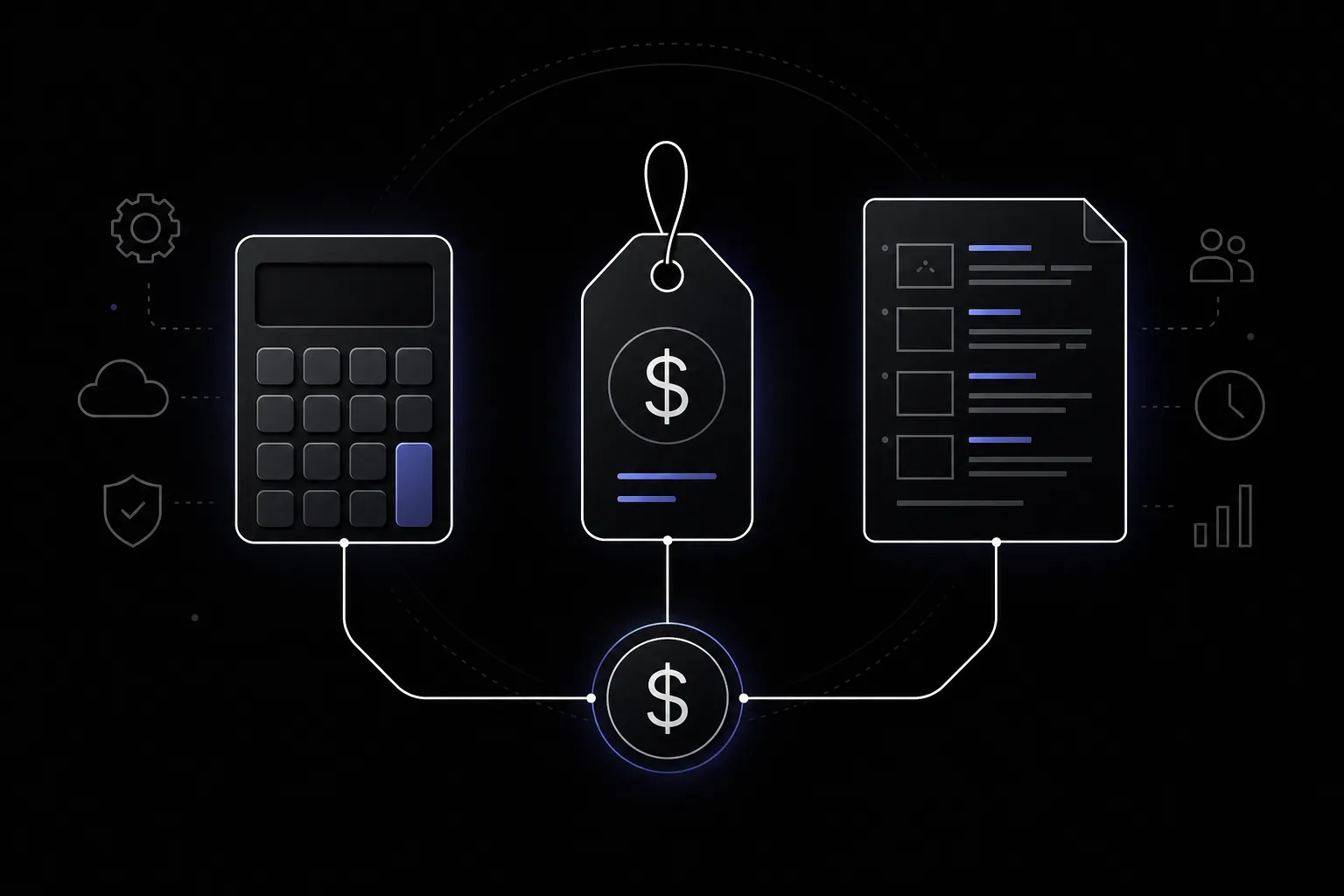

Prompt: Dark Mode Technical Sketch, calculator, price tag, and screenplay page icons connected by thin white lines on black; no 3D renders --ar 16:9
Search data piles up phrases like cheap screenwriting software, good screenwriting software, and professional screenwriting software in the same breath. That is not hypocrisy; it is three different fears. Cheap is “do not bankrupt me.” Good is “do not waste my time.” Professional is “do not embarrass me in a room.” This article is about total cost of ownership (TCO): licence + subscription + upgrades + time lost to crashes + exit tax when you leave. Vendor shootouts stay in best screenwriting software alternatives 2026. Here we run the spreadsheet.
Free tool: use the Fountain to PDF to export your Fountain file to a formatted PDF.
How to think about TCO before you buy
Step 1 - List what you actually do
Solo feature, room rewrite, pitch-only shorts, or all three? Co-writing and locked revisions change the math faster than a sale price.
Step 2 - Separate “write” from “hand off”
PDF for reads is cheap everywhere. FDX, Fountain, scene-number stability, and revision mode are where tiers bite. Exporting for production lists what handoff really asks for.
Step 3 - Model three years, not launch day
One-time purchase vs annual subscription vs “free until you need export.” Hidden costs of free screenwriting software is the honest mirror for zero-dollar tiers.
Step 4 - Price your own hour
If a $200 licence saves ten hours of format fighting a year, it is cheaper than your day job hourly rate almost every time. Screenwriter productivity and UI connects friction to clock time.
Platform angles (who pays what)
Indie feature writer
You need reliable PDF, optional FDX, and backups you control. Compare Fade In vs ScreenWeaver for native vs timeline-heavy workflows.
Writers’ room or partnership
Real-time sync and comment hygiene beat a “cheap” app that forks drafts. WriterDuet vs ScreenWeaver and real-time co-writing frame the trade.
“I might upgrade to Final Draft later”
Read Final Draft vs ScreenWeaver and industry tax when you sell before you assume the incumbent is the cheapest long path.
Try it free
Try Screenweaver for free on your script
It is free. Import your existing project, get a clearer view of your outline, and regain control of your story structure in minutes.
Start FreeStep-by-step: a simple TCO checklist
Step 1 Write down: projects count, collaborators, export formats, offline need.
Step 2 Check renewal price year two on subscriptions; teaser pricing lies quietly in FAQ footers.
Step 3 Search support forums for “lost work,” “sync conflict,” “export failed” for your shortlist.
Step 4 Export a test project to FDX and Fountain on day one, not day ninety. Fountain import/export if you live in plain text.
Step 5 Budget cloud and FDX safety the same way you budget software.
Operational section (numbers without fantasy)
We do not quote live prices; they change. We do insist on four line items: licence or subscription, upgrade path, time cost of workarounds, exit cost (can you bulk-export without a ransom screen?). When “cheap screenwriting software” hides a ransom screen at FDX o’clock, TCO explodes.
Outcome section
A good TCO decision sounds boring: “I know what I pay per year, what I can export, and where my backups sleep.” That is the win. Excitement belongs in the script, not in the billing portal.
Why this matters vs old shopping habits
Old habit: sort by lowest price on a chart. New habit: sort by lowest surprise. Surprises are midnight format bugs before a deadline, or learning your “cheap” stack cannot survive a showrunner’s revision pass. Overpriced subscription argues when recurring fees are rational, not evil.
Conclusion
Pick software like you pick crew: clear roles, clear deliverables, clear exit. For vendor-by-vendor opinion, stay in best alternatives 2026. For free-tier traps, hidden costs. For the writing spine before you spend money, idea to first draft. Free helpers live on the tools hub.
External reference (labour context): The Writers Guild of America publishes contract and work-condition context that shapes why rooms standardize on certain stacks; we are not affiliated, but their public materials are part of the real TCO of “professional” in North America.
Final Step
Build your next script with Screenweaver
Move from ideas to production-ready pages faster with timeline-native writing and AI-assisted story flow.
Try Screenweaver