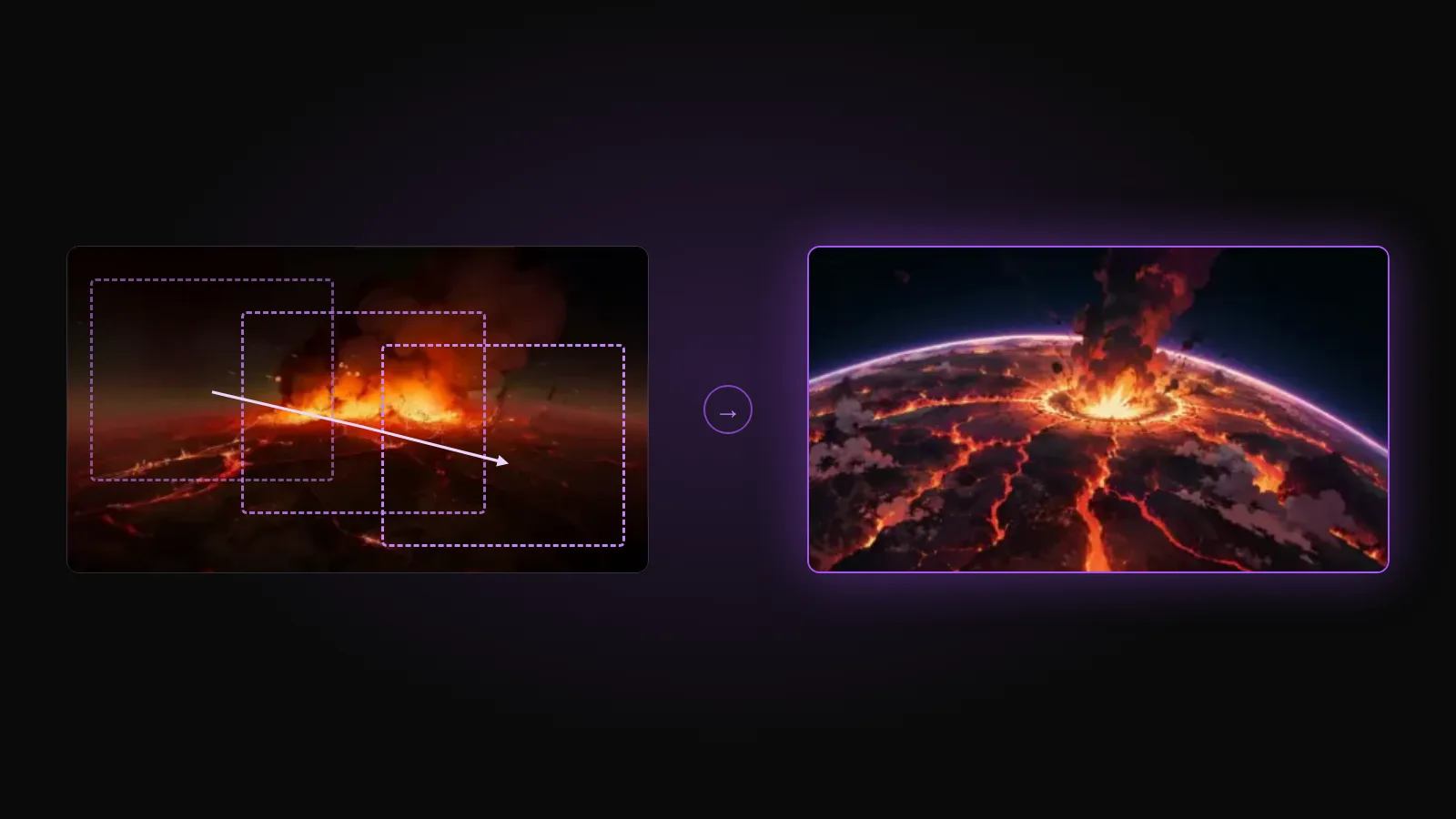

A motion comic keeps your panels and moves the camera across them, with voice, music and a little animation on top. An anime adaptation rebuilds the story as shots: new framings in 16:9, real movement inside the frame, timing decided in the edit. Choose the motion comic when the audience is your existing readers and the art is the point. Choose anime when you want to reach people who have never read the series, or to show a producer what the series looks like on screen. Many creators do both, in that order.
This is the format guide of the webtoon to anime cluster. If you have already chosen anime, go to the storyboard guide and the AI workflow.
What a motion comic is
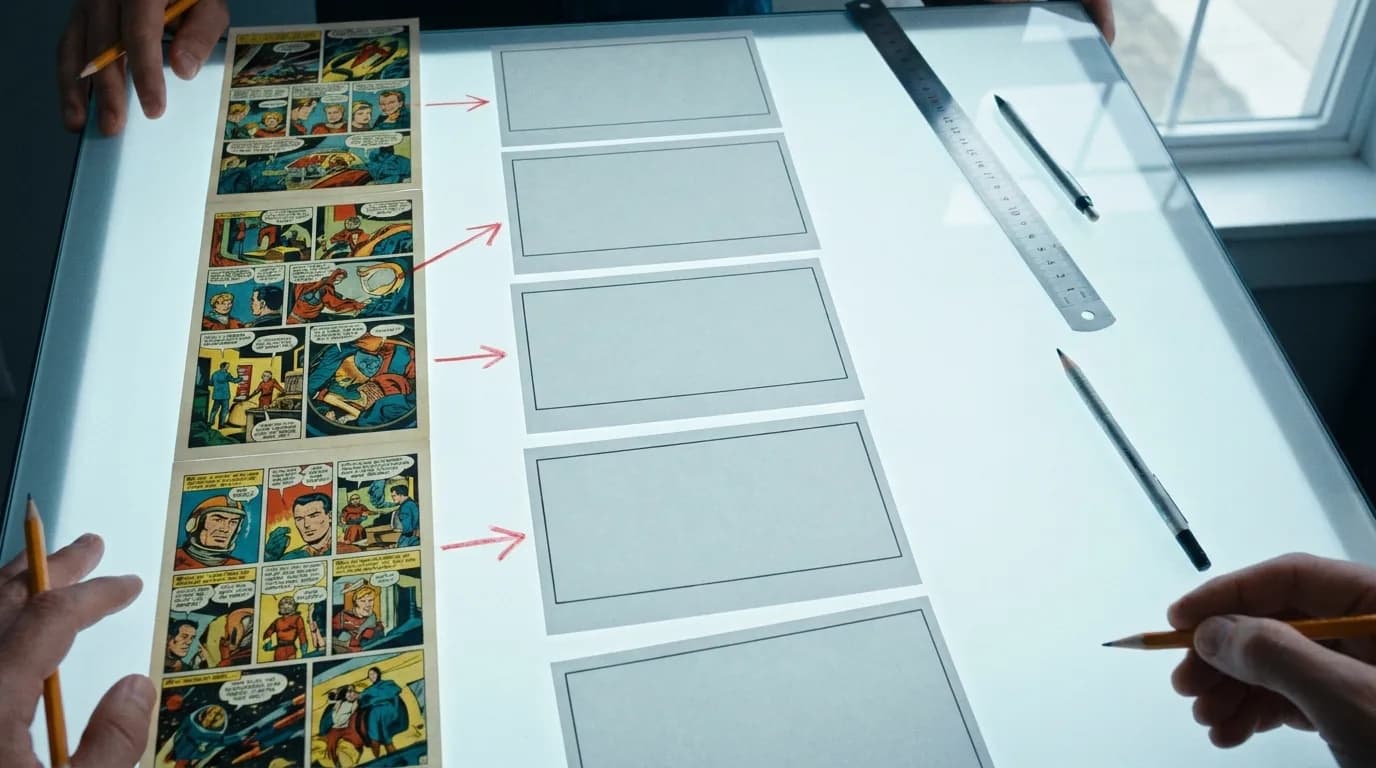
A motion comic is comic art put in motion without being redrawn as animation. The panels are expanded into full shots, the camera pans and pushes across them, layers are separated so the foreground slides over the background, and voice acting, sound effects and music carry the scene. The speech bubbles and lettering are usually removed so the art fills the frame.
The term took off in 2008, when Warner Premiere launched its motion comics with Watchmen and Batman: Mad Love, described in Warner's announcement as short-form digital content built from gentle animation of the still artwork, voice-overs and an orchestral score. Marvel followed with Astonishing X-Men: Gifted in 2009, and the format has been used since for film prequels and game tie-ins (overview).
The idea is older than the name: Marvel's 1960s The Marvel Super Heroes series added voices, music and very little animation to the original comic art.
What changes when it becomes anime
| Motion comic | Anime adaptation | |
|---|---|---|
| Starting point | The panels as drawn | A shot list rebuilt from the panels |
| Frame | The panel, cropped and moved across | New framings, chosen per shot |
| Aspect ratio | Often the page's own shape, or 9:16 for a vertical strip | 16:9 for most platforms and pitches |
| Movement | The camera moves; characters mostly do not | Characters move inside the frame |
| Timing | Set by the narration and the voice track | Set shot by shot in the edit |
| Lettering | Removed, voice replaces it | Removed, voice replaces it |
| Who it speaks to | Readers who already know the series | Viewers who have never read it |
| What a producer sees | Your art | Your series on screen |
The difference that matters is the second row. A motion comic never leaves the panel. An anime adaptation treats the panel as a storyboard reference and decides again where the camera is.
The vertical problem
A webtoon is a vertical scroll, and that changes the choice more than it does for a printed comic.
A vertical motion comic is close to the reading experience: the camera travels down the strip the way the thumb does, and a 9:16 delivery fits phones without reframing anything. If your readers are on mobile and the goal is to give them the chapter with sound, this is the shortest path. The short drama pipeline covers the 9:16 grammar if you go further in that direction.
A 16:9 anime cannot reuse the strip as it is. A tall panel holds a character from head to feet with empty space above; a wide shot needs the space on the sides. That is why the adaptation starts with a board, not with the panels: the storyboard guide shows how a vertical panel becomes one or several 16:9 shots, with the Imaginarium numbers as an example.
When the motion comic is the right call
- The audience is your readers. They want the chapter they know, with voices. They do not need new framings.
- The art is the selling point. A painted, detailed style survives best when it is not regenerated.
- The scene is dialogue, mood or reveal. Slow pushes, parallax and sound carry these well.
- You need it often. A weekly companion to each new chapter is realistic as a motion comic.
- The budget is close to zero. Fewer generations, fewer decisions, a shorter edit.
When anime is worth it
- You want new viewers. People who have not read the series judge it as a show, and a show is made of shots.
- You are pitching. A producer or a platform wants to see the series as it would air. The teaser guide explains what they check in those 60 to 90 seconds.
- The scene is action. A fight or a chase across five panels needs movement inside the frame, broken into shots.
- You are testing the adaptation itself. Pacing, framing and character motion are the questions a studio would ask, and only an animated pilot answers them.
The middle path: start as a motion comic, grow into anime
The two formats share more work than they seem to. Both need the script lifted from the bubbles, clean art without lettering, a voice track and a sound pass. If you build references from your own panels for the motion comic (characters, places, the colour card), those same references feed the anime shots later.
A practical order:
- Cut the chapter into its key panels and clean the lettering.
- Record or generate the voice track and lock the timing.
- Release the motion comic to your readers.
- Pick the strongest 60 seconds and board them in 16:9 as real shots.
- Generate those shots from the references you already have, and keep the motion comic panels next to them as the comparison.
In ScreenWeaver, the characters, places and objects you set up in step 1 become story elements that every shot cites, so the move from step 3 to step 5 is a new board, not a new project. The character consistency guide covers how to build those references.
Try it free
Try Screenweaver for free on your script
It is free. Import your existing project, get a clearer view of your outline, and regain control of your story structure in minutes.
Start FreeWhat AI changes, and what it does not
AI lowers the cost of both formats, but not in the same place. For a motion comic, it helps separate layers, extend a panel beyond its borders and add small movements (hair, cloth, weather) without redrawing. For anime, it generates each shot from a storyboard frame and the character references, which is the step that used to require a studio.
What it does not change: an anime made of panels with a slow zoom is a motion comic, whatever tool made it. Viewers feel the difference in the first ten seconds. If you call it anime, board it as anime. And whichever format you publish, say that AI was used, and check the rights before anything goes public.
Choose in five questions
- Who watches first? Your readers point to a motion comic; new viewers or a producer point to anime
- Where is it watched? Phones in a feed favour 9:16; a pitch or a platform favours 16:9
- What is the scene? Dialogue and mood work as a motion comic; action needs anime
- How often? A weekly release favours the motion comic; a one-off pilot can be anime
- What must it prove? That the art is beautiful, or that the series works on screen
FAQ
What is the difference between a motion comic and an anime?
A motion comic keeps the original panels and moves the camera across them, with voice, sound and limited animation. An anime adaptation rebuilds the story as new shots, usually in 16:9, with characters moving inside the frame and timing decided in the edit.
Is a motion comic cheaper than an anime adaptation?
Usually, because it reuses the panels instead of generating or animating every shot, and the edit is driven by the voice track. The cost guide breaks down where the money goes on the anime side.
Can I turn my webtoon into a motion comic with AI?
Yes. AI helps separate layers, extend panels and add small movements, and voice can be recorded or generated. Keep the art as drawn: the point of a motion comic is the original panels.
Should a webtoon motion comic be vertical or horizontal?
Vertical (9:16) if it is made for phones and for your readers, because it follows the strip. Horizontal (16:9) if it is a step toward an anime pilot or will be shown on a platform that plays landscape video.
Can a motion comic be used to pitch a webtoon adaptation?
It shows the art and the tone, but not how the series moves. For a pitch, a short animated teaser of the strongest sequence answers the questions a producer actually has. A motion comic can sit next to it as a sample of the source.
Is a slideshow with zooms an anime?
No. Panels with a camera drift across them are a motion comic, even when an AI made them. Anime means shots designed for the screen, with movement inside the frame.
Final Step
Build your next script with Screenweaver
Move from ideas to production-ready pages faster with timeline-native writing and AI-assisted story flow.
Try Screenweaver