
Keeping a world consistent across episodes is an archive problem before it is a prompting problem. Lock a show kit once (reference sheets, pinned descriptions, palette, model and settings), freeze every asset the moment an episode ships, and keep a written log of what each episode made true. Episode one is a film. Episode five is an audit with a story attached.
This is the episodic chapter of the AI filmmaking guide. The single-film craft, from script to delivery, lives in the how to make an AI film walkthrough and in the seven-day short film log. Everything here is about what changes when there is an episode two, then an episode nine, made months apart with tools that did not exist when you started.
What actually drifts between episode one and episode five
Four different failures get called "consistency" and they need four different fixes. Naming them separately is most of the work.
| Drift | What it looks like | What catches it | What it costs if you miss it |
|---|---|---|---|
| Asset drift | The cape sits shorter, the key on the breastplate moved two inches, the prop is gone | A side-by-side of the same character in every shipped episode | Regenerating shots an audience already accepted |
| Canon drift | A rule you established in episode two gets quietly broken in episode five | A canon log read before the outline, not after the board | A rewrite, or a comment section that stops trusting the world |
| Model drift | Same sheet, same prompt, different face, because the endpoint was updated | A bridge test on three archive shots before you commit an episode | An episode that does not cut against the one before it |
| Taste drift | Episode five is graded warmer and cut slower because you got better | A locked grade preset and one reference frame per environment | Five episodes that look like five different shows |
Asset drift is the famous one and the easiest. Inside a single episode it is covered in character drift in AI video and, for the board stage, in the storyboard consistency tutorial. I am not going to repeat those. The three below are the ones that only show up once you have a back catalogue.
Two series worth measuring against
Lost Garden is the solo end of the scale. A dark fantasy anime series made by one person, two episodes out: "The Awakening of the Lantern Knight" on 29 May 2026 at 17 minutes, "The King Beneath the Vault" on 15 September 2026 at 21 minutes. Episode two ran to around 400 shots for about $1,850 in generation, voices and music, with a stated goal of 24 episodes and roughly six weeks per episode. The director's full account of the pipeline is the closest thing to a public production log for an AI series, and the cost side is broken down in the AI film budget article.
The Eternaut is the studio end. Netflix's Argentinian adaptation of the 1957 comic, released on 30 April 2025, used generative tools for a shot of a building collapsing in Buenos Aires. Ted Sarandos told the earnings call that Netflix's Eyeline team worked with the show's creative team and finished the sequence about ten times faster than traditional VFX would have allowed, and that the shot simply was not affordable any other way on that budget. It was the first generative AI final footage in a Netflix original. One shot, in one episode, inside a conventional series pipeline.
Both matter here for the same reason. Neither of them treats generation as the thing that holds the show together. Lost Garden holds together because of documents written before generation. The Eternaut holds together because a VFX department owned the shot the way it owns any other shot.
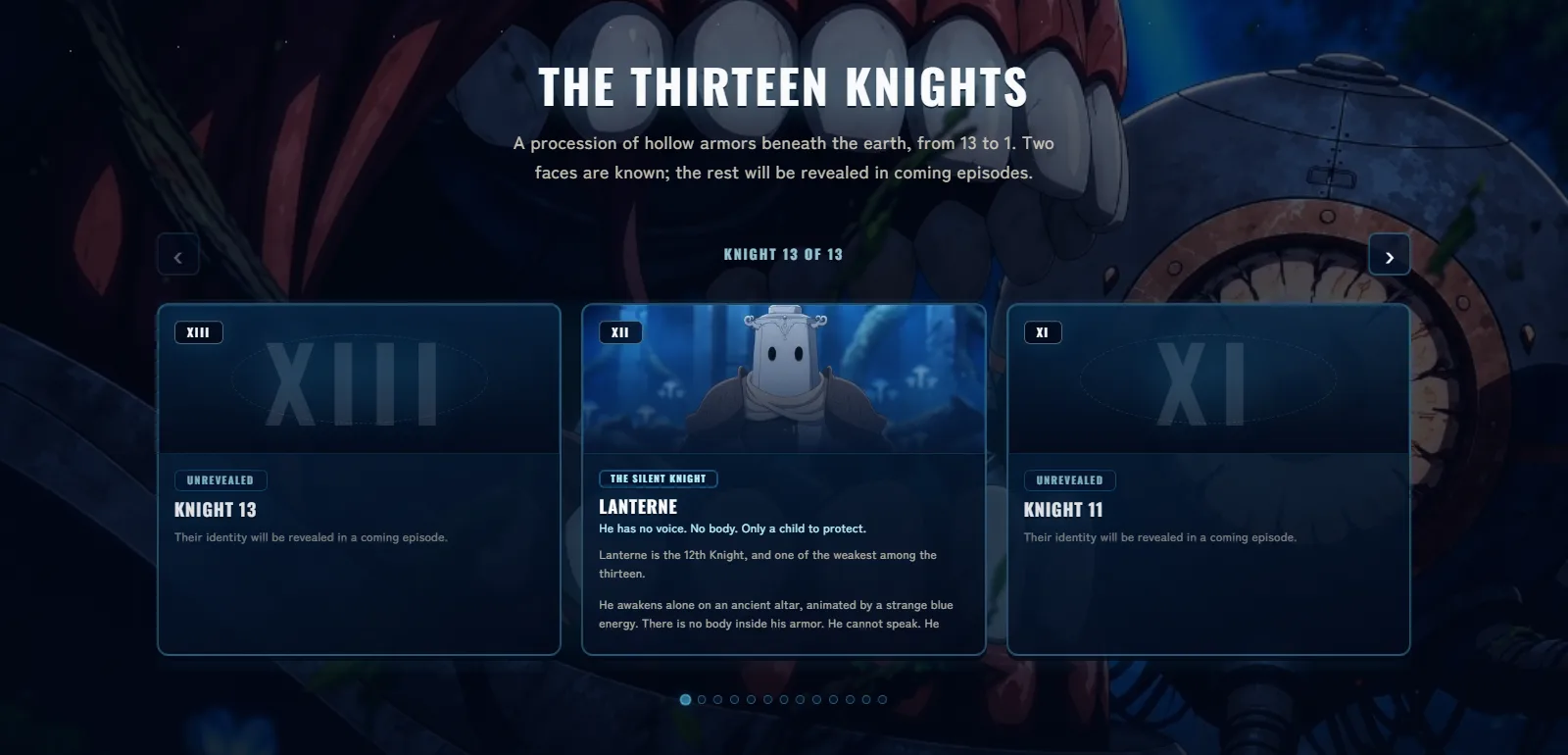
The Lost Garden site publishes a cast of thirteen knights while only two have appeared on screen. Captured 23 September 2026.
That carousel is a design decision worth stealing. The series commits publicly to thirteen characters, numbered, with eleven marked unrevealed. The count is now a constraint the writing cannot quietly walk away from, and the slots are canon before the designs exist. Deciding the shape of the cast early is cheaper than discovering in episode seven that you need a fourteenth knight and have already implied there are thirteen.
The show kit: what gets locked once
A show kit is the set of files that every episode reads from and no episode is allowed to improvise around. Build it during episode one, rebuild it properly after episode one ships, then stop touching it casually.
- A reference sheet per character. Front, profile, back, on a plain background, neutral pose, no dramatic lighting. The back view is the one that saves you when you need an over-the-shoulder in episode four. If a character gets close-ups, add a head study, because a full-body turnaround carries almost no facial information at that scale.
- A pinned description per character. One paragraph, containing the facts a model can actually act on, with props named individually. Props drift first: the hammer becomes an axe by board four unless it is written down and drawn.
- A play sheet per character. How they move, speak and react, and what they never do. This one is for you and your voice performers, not for the image model, and it is the document that keeps a character behaving like themselves across twenty hours of work spread over a year.
- A palette and a grade preset. Three or four named colours per environment, plus the grade you apply at the end. Write the hex values down. You will not remember them in March.
- A shot-length rule. Lost Garden cuts every two to three seconds because long shots fall apart, and the constraint became the style. Whatever yours is, it sets the shot count, which sets the budget, which sets the schedule. Changing it between episodes changes how the show reads.
- A model card. The exact endpoint, version, resolution, duration, seed policy and reference-image settings used for the episode. More on this below, because it is the item most people skip.
The character consistency sheet tool will get you a structured sheet and description from a written brief, which is a faster start than an empty document. The sheet is a specification, not a poster. If it looks good, you probably lit it, and every board that reads it will inherit that lighting.
Freeze on ship, version on change
An asset used in a shipped episode is frozen forever. That one line is what separates a series from a pile of films that share a cast.
You will want to improve a sheet. You will look at Serrure in November and see six things wrong with the armour. Fix them, by all means, but not in place. Save a new version, note which episode it enters, and leave the old one where it is so you can still regenerate a pickup shot for episode two next year and have it match.
A naming convention that has never let me down:
kit/characters/serrure/serrure_sheet_v3.png        # v3 enters at ep04
kit/characters/serrure/serrure_desc_v3.md
kit/characters/serrure/CHANGELOG.md                # v1 ep01-02, v2 ep03, v3 ep04+
kit/environments/bell_foundry/foundry_ref_v2.png
kit/models/ep04_model_card.md
The changelog is the part people leave out and then need. Three columns are enough: version, first episode, what changed and why. When a viewer says the armour looks different in episode four, you want to be able to say yes, here is what changed and here is when, rather than guessing.
The model will change under you
This is the drift that is specific to AI series production and the one nobody plans for. A six-week episode cadence means the endpoint you used in episode two may be deprecated, re-tuned or superseded by the time you start episode four. Same sheet, same prompt, different output.
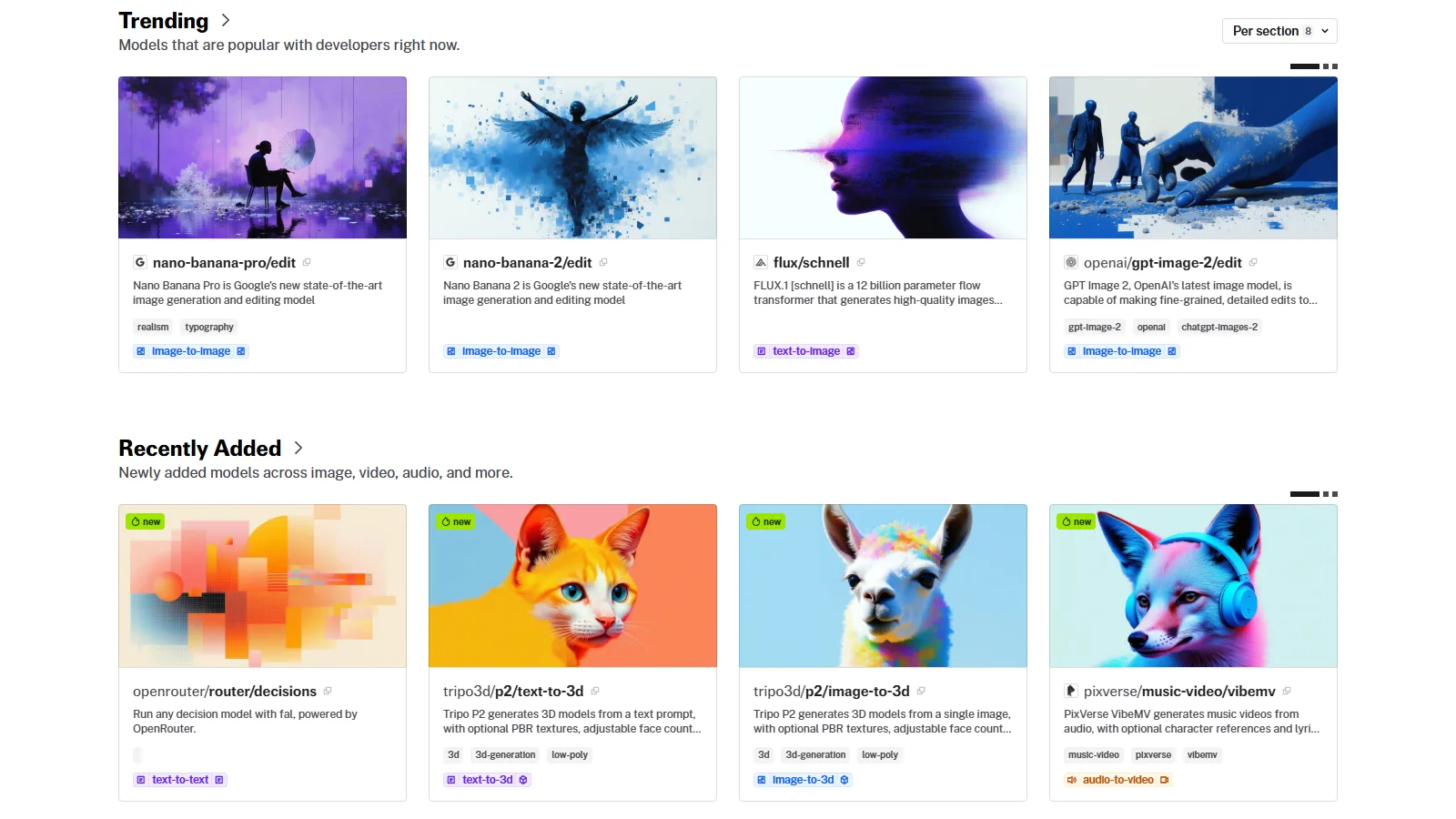
A single model marketplace on one ordinary day: four models badged new in the Recently Added row, and a Trending row already led by a newer edit model. Captured on fal.ai, 23 September 2026.
Three habits handle it.
Never change model mid-episode. Whatever appears, finish the episode on the stack you started it with. A visible seam inside an episode is much worse than a gradual shift between them, because the audience is watching a continuous scene when it happens.
Write the model card before the first generation, not after. Endpoint, version string, resolution, clip length, guidance settings, whether you are passing reference images and how many. If you cannot reproduce a shot from the card alone, the card is incomplete.
Run a bridge test before you switch. Pick three shots from the previous episode: a close-up, a wide with an environment, and your hardest character. Regenerate them on the new model with the same sheet and settings. Cut the results against the originals. If they sit in the same show, switch. If they do not, either stay put or accept that the change lands at a season break, where an audience will forgive it.
You can also sidestep part of the problem. Keep environments and establishing shots as rendered stills you re-use instead of regenerating them. A matte painting of the foundry generated once and panned across in the edit never drifts, because it is the same file in every episode.
Try it free
Try Screenweaver for free on your script
It is free. Import your existing project, get a clearer view of your outline, and regain control of your story structure in minutes.
Start FreeThe canon log
The writing side of consistency is older than any of this and the discipline is unchanged. A series bible covers premise, world and cast, and the components of a series bible are worth setting up properly before episode two.
What a bible does not do, on its own, is track what the finished episodes actually established. That is a separate running document, and it grows every time something ships.
| Fact | Episode | Where it is visible | What it now forbids |
|---|---|---|---|
| Medallions stay shut once the Unhooker is established | 1 | Altar scene, close-up on the clasp | No character may open one casually for a reveal |
| A named character has no head and no helm | 1 | Every shot they appear in | No hat, no dome, no borrowed helm, ever |
| A knight produces no light of his own | 1 | Cavern sequence | No glow effects on him, no lantern flare |
| Two of thirteen knights are publicly named | 2 | Site cast page and both episodes | Eleven slots are committed and cannot be renumbered |
Four columns, and the last one is the useful one. A canon log that only records facts is a wiki. A canon log that records what each fact forbids is something you can actually check an outline against in ten minutes. Read it before you outline the next episode, not after the boards exist, because a canon problem found at the board stage is a rewrite and a canon problem found at the generation stage is money.
Series worldbuilding has a trap in it, and it is an enjoyable trap. You will want to build the whole world out before episode three, and most of what you write will never reach a screen. Fix what the next two episodes actually touch, in the detail a generation needs, and leave the rest alone until an episode asks for it. The worldbuilding fact-check approach sets the right depth: research what the camera will see.
Voice and sound drift too
Faces get all the attention. A wrong voice is the thing a viewer actually catches, in the first second, because it reads as a different person.
If you are using synthetic voices, the voice id and its settings belong in the show kit next to the reference sheets, with the same freeze rule. Providers retire and retrain voices. Record the id, the stability and similarity settings, and a short reference line per character so you can A/B a new render against the old one.
If you are using human performers, the risk is the room rather than the voice. Six weeks between sessions means a different microphone position, a different room tone, a different time of day. Keep a thirty-second room tone recording per performer per episode, and ask for the same setup back. It costs one line in an email.
Music is the easy win and the one people skip: score a series with a small set of recurring themes rather than a fresh track per episode. A returning cue does more for the feeling of one continuous show than any amount of visual matching.
Ten checks before you generate episode N
Run this list at the start of every episode. It takes an hour and it has never once been a wasted hour.
- Read the canon log end to end. Check the new outline against the forbids column.
- Open the previous episode's model card. Confirm the endpoint still exists and still has the same version string.
- Bridge test: three archive shots regenerated on the current stack, cut against the originals.
- Pull every reference sheet the episode needs and confirm you are on the latest version for each.
- New characters get all three documents (sheet, description, play sheet) before any board exists.
- New environments get one reference still and three named palette colours.
- Confirm the shot-length rule and the aspect ratio have not quietly changed.
- Check the grade preset opens and still matches a reference frame from the last episode.
- Confirm voice ids, settings and performer availability.
- Budget the episode at your measured takes-per-kept-shot, not at your optimistic one. The AI video cost calculator turns shot count and takes into a number you can defend.
If a check fails, resolve it before boarding. Every one of these is cheap now and expensive in four weeks.
Vertical series play by slightly different rules
A vertical micro drama running seventy or a hundred episodes cannot carry this weight per episode, and it does not need to. Episodes are one to two minutes, the cast is small, the environments repeat, and the season grid is written before anything is generated. The trade is that the season plan has to be far more rigid, because there is no room to fix a structural problem in episode forty. That workflow is its own article: making a short drama with AI covers the season-first method, and short drama episode structure covers the per-episode beats.
Both formats agree on one thing. Whatever you lock, lock it before generation, and never improve it in place.
FAQ
How many episodes before consistency becomes a real problem?
Three. Episodes one and two are close enough in time and habit that memory covers the gaps. By episode three the first episode is old, your taste has moved, and at least one tool has been updated. Set up the kit and the canon log during episode two, while it is still cheap.
Can I just use the same seed for everything?
No. A seed reproduces a generation on one model with identical inputs, and it stops meaning anything the moment the endpoint version changes or the prompt shifts by a word. Reference sheets and pinned descriptions survive model changes. Seeds do not. Record the seed anyway, because when a shot does need a pickup a week later it can save you.
What do I do if a model I depend on is retired mid-series?
Finish the current episode on whatever you still have access to, even at lower quality, then treat the switch as a planned event at the episode boundary. Run the bridge test, decide what you will accept, and if the gap is large put the change at a season break where a shift in look reads as intentional. Keeping rendered stills for recurring environments limits how much a retirement can actually hurt you.
Should the consistency work live in the script tool or in a separate folder?
Wherever it is, the script must be able to reach it. The value of keeping characters, places and objects as story elements inside the screenplay, as ScreenWeaver does with its story elements and its canon-holding Documentalist agent, is that the same entity the script mentions is the one the board draws and the generator renders. A folder works too, as long as you actually open it. Drift almost always traces back to a document that existed and went unread.
How long should a series bible be for an AI production?
Shorter than you think, and more specific. One page of world rules, one page per main character split into the three documents, and a canon log that grows. Three hundred pages of lore that no generation ever reads is a hobby, not a pipeline.
Does any of this change if a studio is doing the VFX?
The documents move to other desks. Their shape stays the same. The Eternaut's collapsing building went through a VFX team with the same approvals and the same versioning any other shot gets, and that is why one generated shot sits inside a conventional series without announcing itself. If you are working alone, you are the department, and the discipline has to be written down because there is nobody to ask.
Final Step
Build your next script with Screenweaver
Move from ideas to production-ready pages faster with timeline-native writing and AI-assisted story flow.
Try Screenweaver