
You cannot board what has not happened. So a documentary storyboard covers only the authored parts of the film: recreations, archive sequences, motion graphics, titles, and the setups you control. Everything observational gets a coverage plan and a geography sketch instead. Confusing the two is how documentaries end up staged by accident.
If you are boarding the authored sequences, the AI storyboard tool will draw them. The judgement about which sequences belong on a board at all is the part below.
The honest division
Start by sorting your film into things you author and things you witness. The first list boards. The second does not, and pretending otherwise creates problems no drawing can fix.
| Element | Board it? | What you make instead |
|---|---|---|
| Recreation or dramatisation | Yes, fully | Nothing, this is fiction and boards like fiction |
| Archive sequence | Yes | A paper edit with frame grabs and a rights column |
| Motion graphics, maps, data | Yes | Nothing, the board is the brief for the designer |
| Titles and chapter cards | Yes | Nothing |
| Drone and establishing shots | Yes | A shot list with locations and times of day |
| Sit-down interview | Partly | A framing reference and a room plan, not a panel per answer |
| Verite or observational scene | No | A coverage plan and a geography sketch |
| Doorstep or unpredictable access | No | A contingency list, and a conversation with your lawyer |
The trap sits in row seven. A boarded observational scene is a wish, and a wish written down starts to feel like a plan, and a plan starts to feel like something you are entitled to make happen.
Nobody is going to ask you for one
Look at what a documentary fund actually asks an applicant for and the storyboard is not on the list. It asks for footage, which tells you something about what the form values.
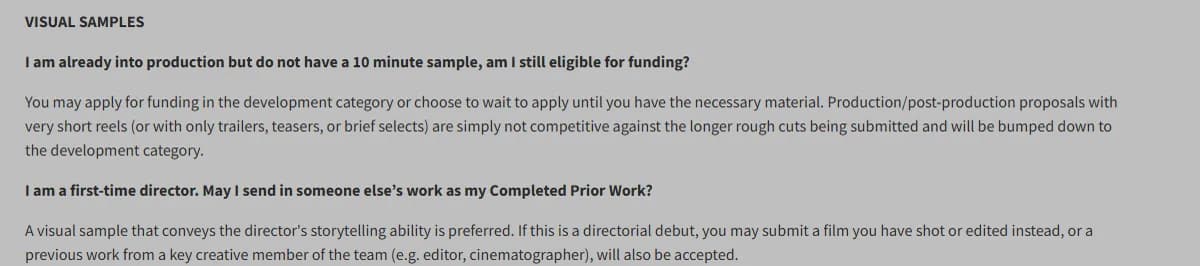
Sundance Institute, "Documentary Fund FAQ", captured 7 September 2026.
Read what that answer is really saying. A short reel of teasers and selects loses to a longer rough cut, because the fund is buying evidence that you can get access and shape a scene, not evidence that you can imagine one. A board proves nothing about access.
This is liberating rather than discouraging. Since the board is never a deliverable, it does not have to look like anything. It exists for the three people who need it: you, your editor, and whoever is building the graphics or shooting the recreation. Make it ugly and make it fast.
The one exception is the recreation-heavy commission, where a broadcaster paying for actors and a set will want to see what they are paying for before the shoot day. That board is a budget document and gets treated accordingly.
The four parts that genuinely board
Recreations. These are fiction sequences inside a nonfiction film. Full boards, shot lists, the works.
Archive sequences. An archive montage is a written sequence with pictures attached, and the pictures already exist. Board it as a paper edit: one row per clip, with a frame grab, the source, the duration, and the clearance status. The clearance column is not optional. A beautifully cut archive sequence built on a clip nobody can license is a sequence you will rebuild at the worst possible moment.
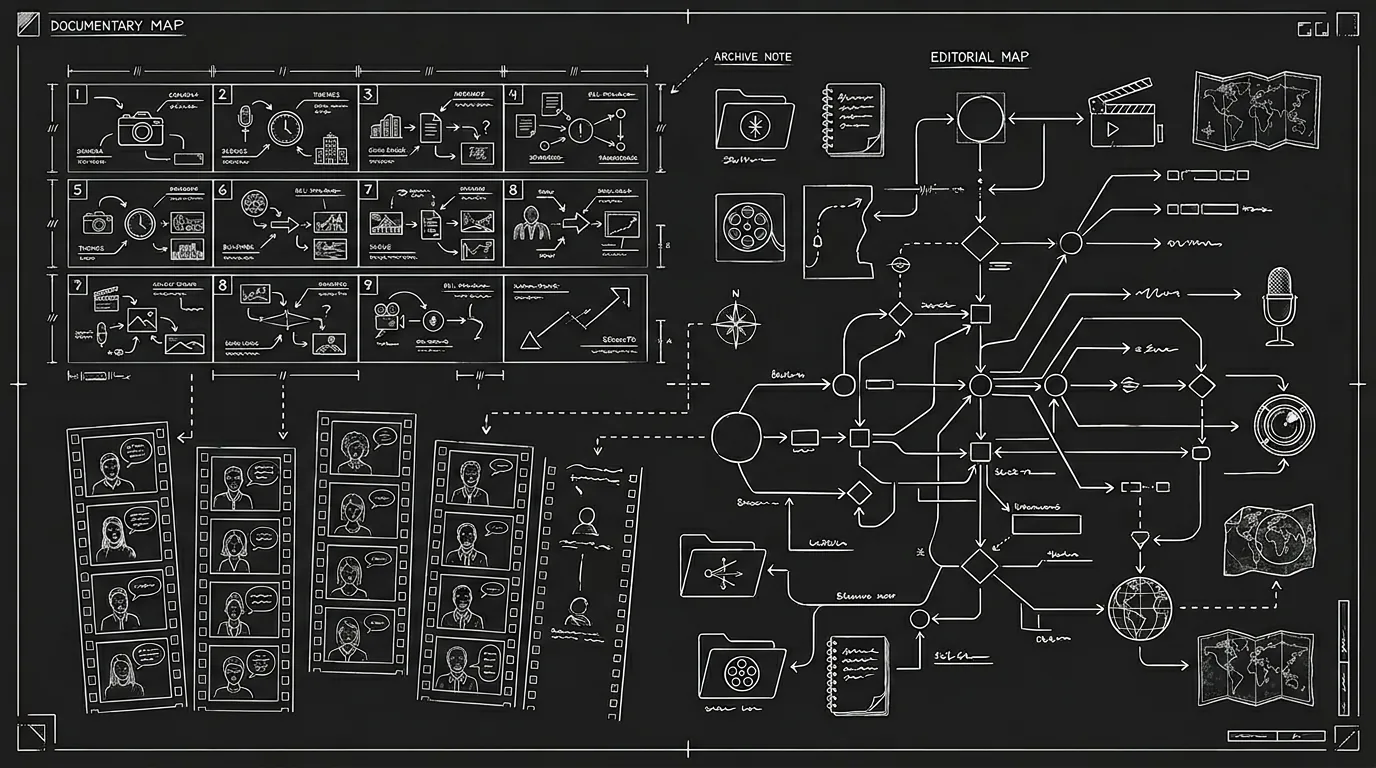
Motion graphics and data. Any map, chart, timeline or animated explainer needs a board, because a motion designer cannot start from a paragraph of intention. Draw the states, mark what appears when, and write the voiceover line that each state has to survive.
Controlled setups. Interviews, establishing shots, drone passes, macro inserts, anything where you choose the framing. These need reference frames rather than a narrative board. One panel showing the interview look for the film is worth more than forty panels guessing at answers.
Recreations are fiction, and the rules are written down
Board a recreation exactly as you would board a drama: staging, eyelines, coverage, screen direction. Then add the column that fiction does not need, which is what part of this is known and what part is invented.

FRONTLINE, "Journalistic Guidelines", captured 7 September 2026.
Two things in that text change how you board. Reenactments have to be clearly and unmistakably labelled or signalled whenever there is a significant chance a viewer would be confused, so the labelling is a design decision your board has to carry: desaturation, a slower frame rate, a deliberate artifice in the staging, or a caption. Decide it on the board, not in the grade.
The second is the dialogue rule. Where dialogue is created for a recreation, FRONTLINE requires academic experts to be consulted. If your board has a character saying a line, the line needs a source, and the source belongs in the panel's notes next to it. Boards that carry invented dialogue with no provenance are how a film ends up defending itself later.
The practical version: a recreation panel gets a small K or I in the corner. Known, or invented. Anything marked I gets a note saying where it came from and who signed off.
Verite does not board, it plans coverage
For observational work, replace the panel grid with three documents.
A geography sketch. Top-down, showing the room or the street, the doors, where the action is likely to start, and where your camera can stand without being in the shot or in the way. This is the single most useful piece of paper on a verite shoot and it takes four minutes to draw.
A coverage plan. If you have two cameras, write down who has the wide and who has the faces, and what triggers a switch. If you have one camera, write down what you will sacrifice, because you will sacrifice something.
A contingency list. What you shoot if the meeting is cancelled, the subject does not show, or the event turns out to be twenty minutes of paperwork. Every experienced documentary shooter has a version of this list in their head. Writing it down is how the rest of the crew gets access to it.
Try it free
Try Screenweaver for free on your script
It is free. Import your existing project, get a clearer view of your outline, and regain control of your story structure in minutes.
Start FreeThe line boarding can push you across
First-time documentary directors rarely get warned about this one. You board an observational scene because boarding feels like preparation. Then you arrive, the scene does not happen the way you drew it, and you find yourself nudging. Asking someone to walk in through that door again. Suggesting they say the thing they said off camera.
Each nudge is small. Together they turn a documentary into a lightly staged film that has not admitted to being one.
The defence is procedural rather than moral. Mark every speculative panel as speculative, in a colour or a corner label, and treat it as a question rather than a plan. A panel that says "does she look back at the house?" is research. A panel that draws her looking back at the house is a direction you have given yourself in advance.
Where AI frames help, and one place they must not go
Generated frames are genuinely useful in documentary, in a narrower band than in fiction.
They work for previsualising a recreation before you commit to a location, a period costume budget or a casting call. They work for pitching a graphics sequence to a commissioner. They work for the look book, the document that tells a cinematographer what the film should feel like, where nobody is going to mistake the frame for footage.
There is one thing I would not do under any circumstances, and I would push back on anyone who asked me to. Do not generate footage that could be mistaken for archive. Not as a placeholder, not for a rough cut, not with the intention of replacing it later. Placeholders survive. They get screened, they get sent to a funder, and eventually somebody forgets which shots were real. The labelling obligation in the guidelines above exists precisely because audiences cannot tell, and a rough cut that contains synthetic archive has already broken the thing the whole form runs on.
Some films go one step further and generate the recreation itself, labelled as such. Then the board becomes a continuity document: the reconstructed person has to keep the same face from panel to panel, and from decade to decade if the film jumps in time. The AI documentary generator page shows a six-shot recreation built that way from four reference sheets, and AI in documentaries: ethics and disclosure covers how to label it.
If you need to indicate a missing archive shot, use a slug: a black card with a text description and the intended duration. It reads as an absence, which is what it is. The related fiction workflows, where none of this applies, are in how to make a storyboard from a screenplay and, for animation, boards to blocking.
Checklist before the shoot
- Every sequence in the film is sorted into authored or observed.
- Recreation panels carry a known-or-invented mark, and every invented line has a source.
- The labelling treatment for recreations is decided and drawn, not left to post.
- The archive paper edit has a clearance column and it is filled in.
- Graphics boards name the voiceover line each state has to survive.
- Every observational location has a top-down geography sketch.
- The contingency list exists and the crew has read it.
- Speculative panels are marked as speculative, in a way that survives photocopying.
- No panel in the deck could be mistaken for footage that exists.
Tools for this
- Storyboard template generator for the recreation and graphics panels.
- Shot size reference when the coverage plan needs a standard term two operators will read the same way.
- Script breakdown checklist for turning a boarded recreation into a shoot day.
- ScreenWeaver for previsualising recreations and graphics sequences before anyone books a location.
- How to make a documentary with AI for the full workflow, from sourced script to labelled reconstruction.
FAQ
Do documentaries use storyboards at all?
Yes, for the parts that are authored. Recreations, archive sequences, motion graphics and title design are boarded in most documentary productions. Observational sequences are not, because the board would be a guess and guesses on paper have a way of becoming instructions.
What replaces the storyboard for observational scenes?
A geography sketch of the location, a coverage plan saying which camera holds what, and a contingency list for the day the event does not happen. Those three together do the job a board does in fiction, which is to stop the crew making decisions under pressure.
Should I storyboard my documentary for a funding application?
Probably not. Funders ask for a cut sample and a written proposal. Sundance's own FAQ says short reels of teasers and selects lose to longer rough cuts. Time spent boarding is time not spent shooting the scene that proves you have access.
How do I board a recreation responsibly?
Board it like a drama, then mark each panel for what is known and what is invented, note the source for any created dialogue, and decide on the board how the sequence will be signalled to the viewer as a reconstruction. Broadcaster guidelines generally require reenactments to be clearly labelled.
Can I use AI images in a documentary?
For previsualisation, look books and pitching graphics, yes. As anything a viewer might read as record, no. Generating footage that resembles archive is the one use I would refuse outright, because placeholders leak into cuts and a documentary that has lost track of which images are real has lost the argument it was making.
How detailed should a documentary board be?
Detailed for recreations, because a crew is going to shoot from it. Rough for everything else. Nobody outside your production will ever see this document, so spend the effort on the sequences where a drawing prevents a wasted shoot day.
Final Step
Build your next script with Screenweaver
Move from ideas to production-ready pages faster with timeline-native writing and AI-assisted story flow.
Try Screenweaver