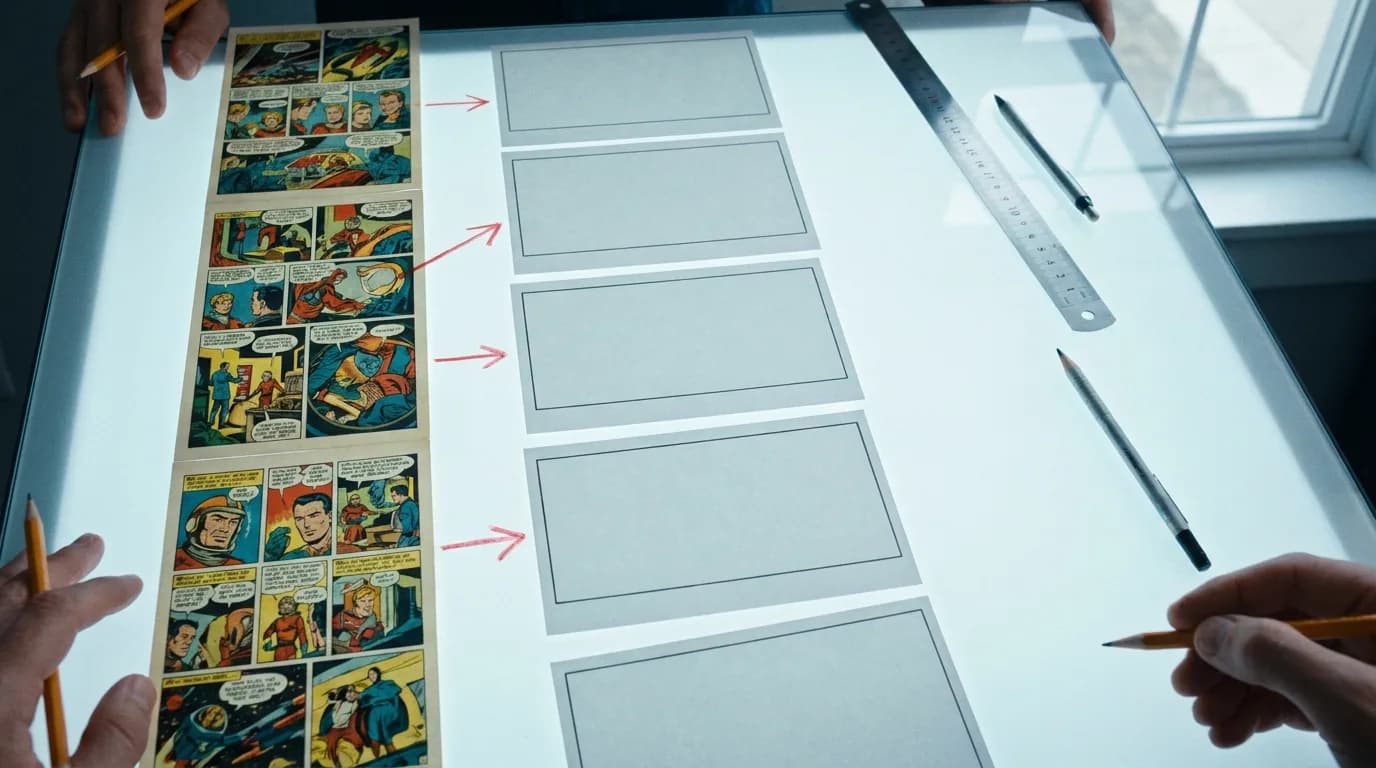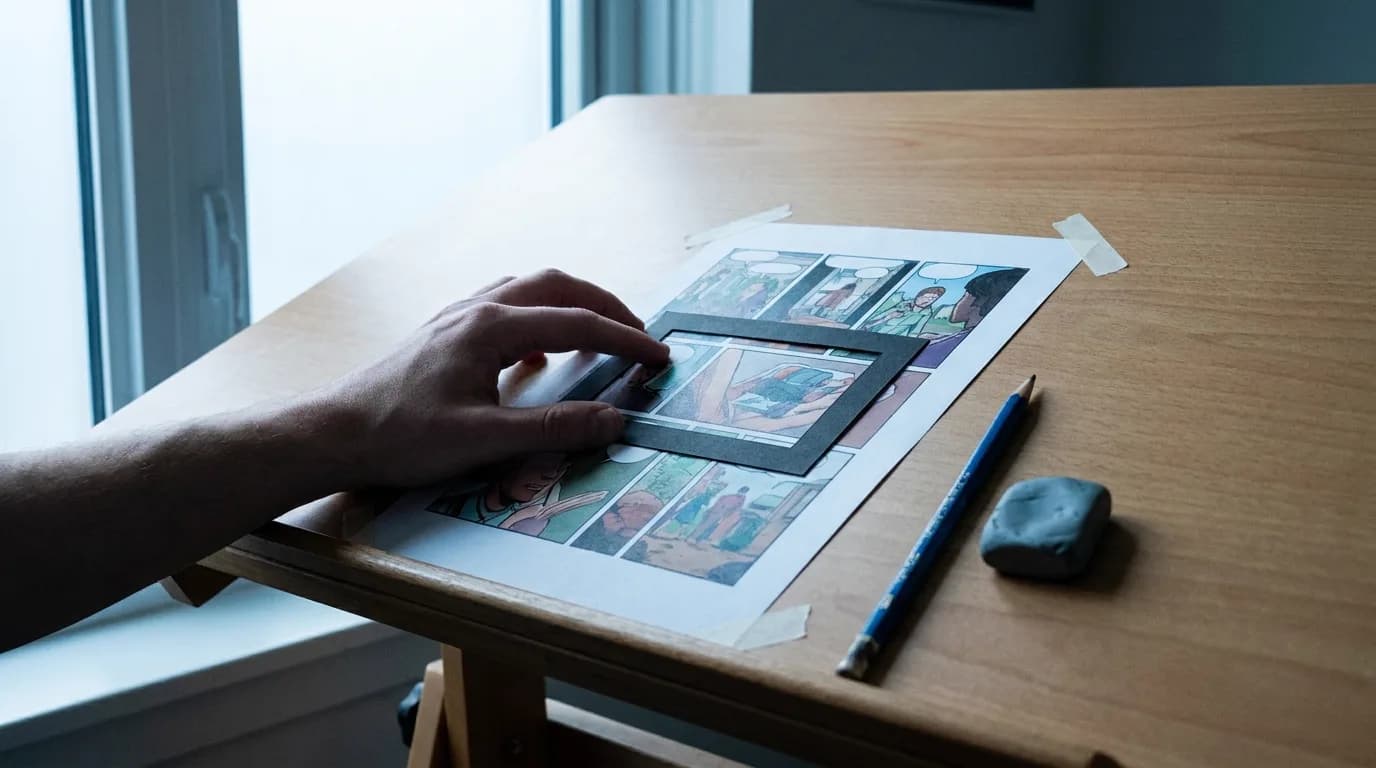

Storyboarding from a comic means walking every page and answering four questions per panel: is this one shot or several, what shot size is it, what does the gutter after it contain, and how does the panel's shape become a 16:9 or 9:16 frame. Answer them for a 22-page issue and you have 130 to 170 shots. The page composition the artist built is your reading order; it is not your cut.
This is the craft article under how to turn a comic into an animated series. The vertical-scroll version, for webtoons, is webtoon to storyboard; this one is about page-based comics, albums and manga, where the page itself is a unit of storytelling.
The page is a beat, not a shot
A comic artist controls time with three things a storyboard artist has to translate: panel size, gutter width, and the page turn.
| What the artist did | What it means in time | What it becomes on the board |
|---|---|---|
| A large panel | The reader lingers | A longer shot, or a slow push in |
| A row of small panels | Fast cutting | Short shots, one to two seconds |
| A wide gutter, or empty space | A pause | A hold, or a breath between cuts |
| A panel bleeding off the page | Scale, immersion | Your widest shot |
| The last panel before a page turn | A held question | A cut on a look, then the reveal |
| The first panel after a page turn | The reveal | The shot that answers it, given room |
| A splash page | A held image, the reader stops | A wide, then the details, three to five seconds total |
| A double-page spread | The biggest moment in the issue | A wide plus a slow move across it, plus inserts |
Read the whole issue once for rhythm before boarding a panel. Mark where the artist slowed down and where they sped up; those marks are your durations, and no amount of good frames fixes a board that ignores them.
One panel, one shot, until it isn't
Break the default in these cases and only these.
Split a panel when:
- It draws the middle of an action. Impact implies a wind-up before and a result after. Board all three.
- It has two subjects at opposite ends of the frame and the eye is meant to travel. Board the move or two shots.
- It contains dialogue from two characters. Reverse angles are cheaper than one two-shot that has to keep both faces on-model.
- It is tall and reads top to bottom. That is a tilt with a start and an end frame.
Merge panels when:
- They are the same framing with different lines. Three close-ups of one speaker are one shot with three lines.
- They draw a slow reveal across several panels (a door opening in four). In motion that is one shot.
- They are reaction panels of a group, one face each. One pan across the group, one generation instead of four.
Add shots the page never drew:
- An establishing shot at the top of every scene. Comics open on faces constantly because the previous scene ended a page turn ago. Viewers need to know where they are.
- An insert per scene: hands, an object, a detail. Comics draw these often; animators forget them.
A 22-page issue at five to six panels a page is around 120 panels and lands between 130 and 170 shots after this pass. The comic to animation calculator applies these ratios to any page count and returns shots, runtime and episodes.
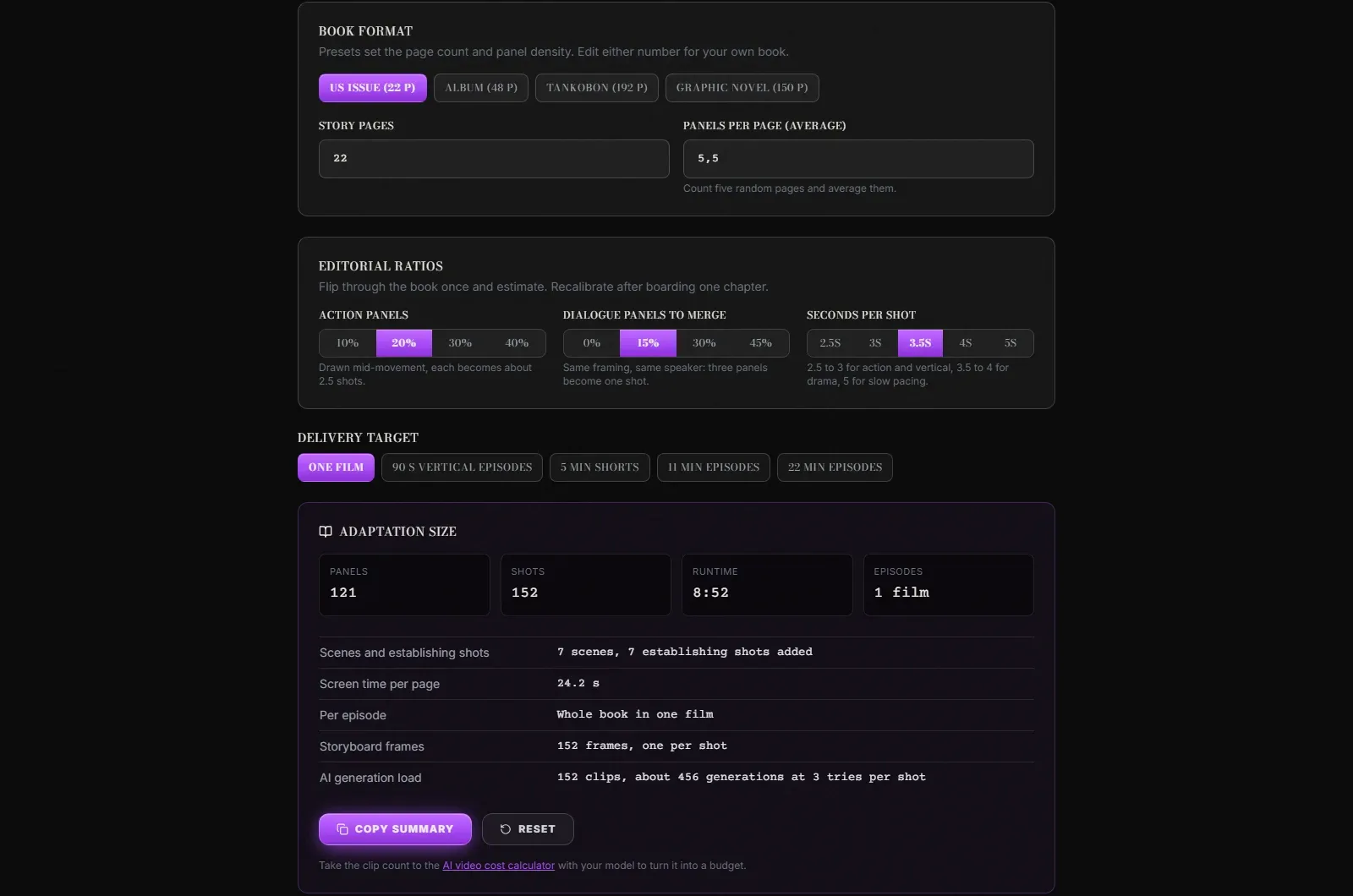
The comic to animation calculator on screenweaver.ai, captured 3 September 2026. Action share, merge share and seconds per shot are the three numbers this article is about; the presets cover a US issue, an album, a tankobon and a graphic novel.
Shot sizes: the page is mostly close-ups, and that is a problem
Comic panels skew toward mediums and close-ups because faces sell drama and pages are small. Animation needs wides too, or the audience never learns the geography.
| Panel type | Shot size | Reframe |
|---|---|---|
| Face filling the panel | Close-up | Crop. Free |
| Head and shoulders | Medium close-up | Crop |
| Waist up with background | Medium | Extend the sides a little |
| Full body small in the panel | Full or wide | Extend a lot, from the location reference |
| Environment only | Establishing wide | Usually a bleed or a splash. Reframe or tilt |
| Hands, object, detail | Insert | Crop. These make a cut feel professional |
| Nothing drawn: scene change | Add an establishing shot | The page skipped it. You cannot |
The shot size guide has the prompt phrasing that produces each framing in an image model.
Splash pages and spreads
A splash is where adapters lose the most. The artist gave the reader one huge image and let them wander in it for as long as they liked. On screen, a single wide frame held for four seconds is dull, and a single wide frame cut away from in one second wastes the artist's biggest moment.
Board a splash as a sequence: the widest frame first, held for two seconds; then two or three inserts of the details the artist packed in, in the order the eye travels; then back to the wide, or a slow move across it. A double-page spread gets the same treatment with a longer move. The comic adaptation guide covers what a splash means in a screenplay; on the board, it is three to six shots that add up to the reader's lingering.
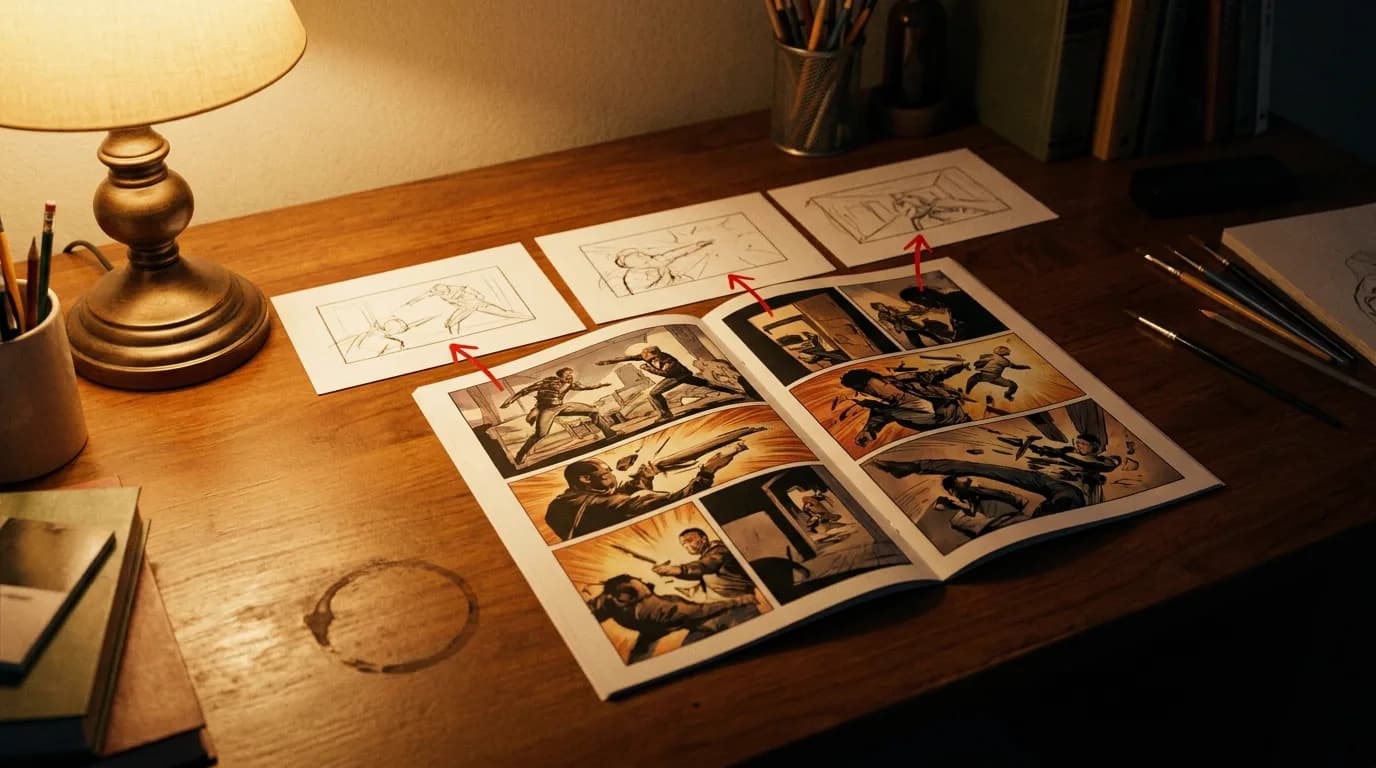
Reframing: panel shapes into one aspect ratio
Comic panels are whatever shape the composition wanted. Frames are 16:9 or 9:16, chosen once at the project level. Four moves cover every panel:
- Crop to the subject. Nine out of ten dialogue panels reframe this way and lose nothing.
- Extend the sides (or the top and bottom, for vertical) from the location reference. Check the painted background against a real panel of the same place.
- Convert the height or width into a move. A tall panel is a tilt. A very wide panel is a pan. Board the start and the end frames.
- Split a panel with two compositions into two shots, and let the cut do what the inset did.
Never letterbox a panel with black bars. It reads as a slideshow of the comic.
Manga adds a fifth consideration: reading order runs right to left, so a panel's internal composition often points left, and a naive left-to-right cut reverses the screen direction between shots. Keep the artist's screen direction inside each shot and let the cut order follow the story, not the page. The manga to anime article has the details.
Try it free
Try Screenweaver for free on your script
It is free. Import your existing project, get a clearer view of your outline, and regain control of your story structure in minutes.
Start FreeOnomatopoeia, balloons and captions
Lettering does not survive into the frame. Sound effects drawn into a panel become sound design and a note on the board card. Balloons become dialogue with a speaker and a duration, in balloon reading order, and the duration goes back into the shot: a balloon reads in a second and takes three to say. Captions become voiceover, or an establishing shot that shows what the caption said, which is almost always better.
What each board card carries
| Field | Why |
|---|---|
| Scene and shot number | The address |
| Source page and panel | So drift can be checked against the book |
| Shot size | The instruction models ignore most, so write it down |
| Reframe move (crop, extend, move, split) | Tells production whether background gets painted |
| Duration | From the rhythm pass: panel size, gutter, page turn |
| What moves | One movement, camera or subject, not both |
| Dialogue and speaker | From the balloons, in reading order |
| Characters in frame, by name | So the reference sheet attaches in generation |
The storyboard template generator prints 16:9 and 9:16 grids with note lines for exactly this. If you would rather have the frames generated from those cards, an AI storyboard generator working from the shot breakdown fills the grid, and the named characters keep their reference sheets.
A worked page
A typical six-panel comics page: a hallway confrontation.
| Panel | What the artist drew | Board |
|---|---|---|
| 1 | Wide of the hallway, bleed to the top, A small at the far end | Shot 1, establishing wide, slow push, 3 s |
| 2 | Close-up of B, angry, one balloon | Shot 2, close-up B, crop, line 1, 2.5 s |
| 3 | Medium of A, hands up, two balloons | Shot 3, medium A, crop, lines 2 and 3, 4 s |
| 4 | Large panel, B grabs A's collar, impact lines, sound effect | Shot 4a medium two-shot, B steps in, 1.5 s. 4b close on the hands, 1 s. 4c A's face, 1.5 s. The effect goes to sound |
| 5 | Small panel, A's eyes | Hold 4c for 2 s, then shot 5, extreme close-up eyes, 2 s |
| 6 | Last panel before the page turn: a figure in the doorway behind them, silhouette | Shot 6, over A's shoulder, the silhouette, 2 s. Cut. The next page's reveal gets its own shot with room |
Six panels became eight shots and about 20 seconds, which is 3.3 seconds a panel. For manga, the same board is the input of the AI anime video generator. Four or five pages boarded at that rate is a 90 second adaptation teaser, which is the shortest useful thing you can build from a book. Panel 4 alone became three because it drew the middle of an action. Panel 6 got the cut it was drawn for.
Checklist before the board goes to production
- Every shot has a source page and panel
- Every scene opens on a shot that says where we are
- No panel is letterboxed: cropped, extended, moved or split
- Action panels are split into before, during and after
- Same-framing dialogue panels are merged
- Splashes are sequences, not single frames
- Page turns are cuts on a look, with the reveal given room
- Lettering is out of the frame and in the sound or the dialogue
- Screen direction is consistent inside each shot, especially for manga
- Shot count sits near what the calculator predicted, or you know why not
FAQ
How many shots does a comic book page make?
Five to eight for a typical five- or six-panel page, after action panels are split, same-framing dialogue merged, and an establishing shot added where the scene changes. A 22-page issue lands between 130 and 170 shots. Splash pages count as three to six.
How do you storyboard a splash page?
As a sequence: the widest frame held for two seconds, then two or three inserts of the details in the order the eye travels, then back to the wide or a slow move across it. A single held frame wastes the artist's biggest moment; a single quick cut ignores it.
Do comic panels translate directly into shots?
Mostly, but the exceptions are where the work is. Action panels hide a before and after and become two or three shots. Same-framing dialogue panels merge. Every scene needs an establishing shot the page never drew because a page turn told the reader where they were.
How do you handle the page turn in animation?
The last panel before the turn was drawn as a held question; the first after it is the answer. Board them as a cut on a look, then the reveal with room to land, and score the turn. Page turns are the issue's act breaks.
What happens to sound effects and captions?
Sound effects go into the sound design and onto the board card as a note, never into the frame. Captions become voiceover or, better, an establishing shot that shows what they said. Balloons become dialogue in reading order with real durations.
What aspect ratio should a comic adaptation use?
Pick one at the project level, 16:9 for YouTube and pitches, 9:16 for a serialized phone release, and reframe every panel to it by cropping, extending, moving or splitting. Comics reframe to vertical more easily than you expect because most panels are already close-ups.
Final Step
Build your next script with Screenweaver
Move from ideas to production-ready pages faster with timeline-native writing and AI-assisted story flow.
Try Screenweaver