
A comic adaptation teaser is a 60 to 90 second animated sequence built from your own pages, made to find a producer rather than a broadcaster. Authors cannot submit projects to the European animation markets on their own. Knowing who the teaser is really addressed to changes what you put in it.
The craft of getting panels onto a timeline is covered elsewhere on this blog: comic to animated series for the full workflow, comic panels to storyboard for the shot breakdown. This is about the piece you make when the point is to be shown to someone.
Your teaser is not addressed to the buyer
Most authors imagine the teaser landing in front of a commissioner at a streaming platform. That is not the door it opens, and the rules of the actual market say so plainly.
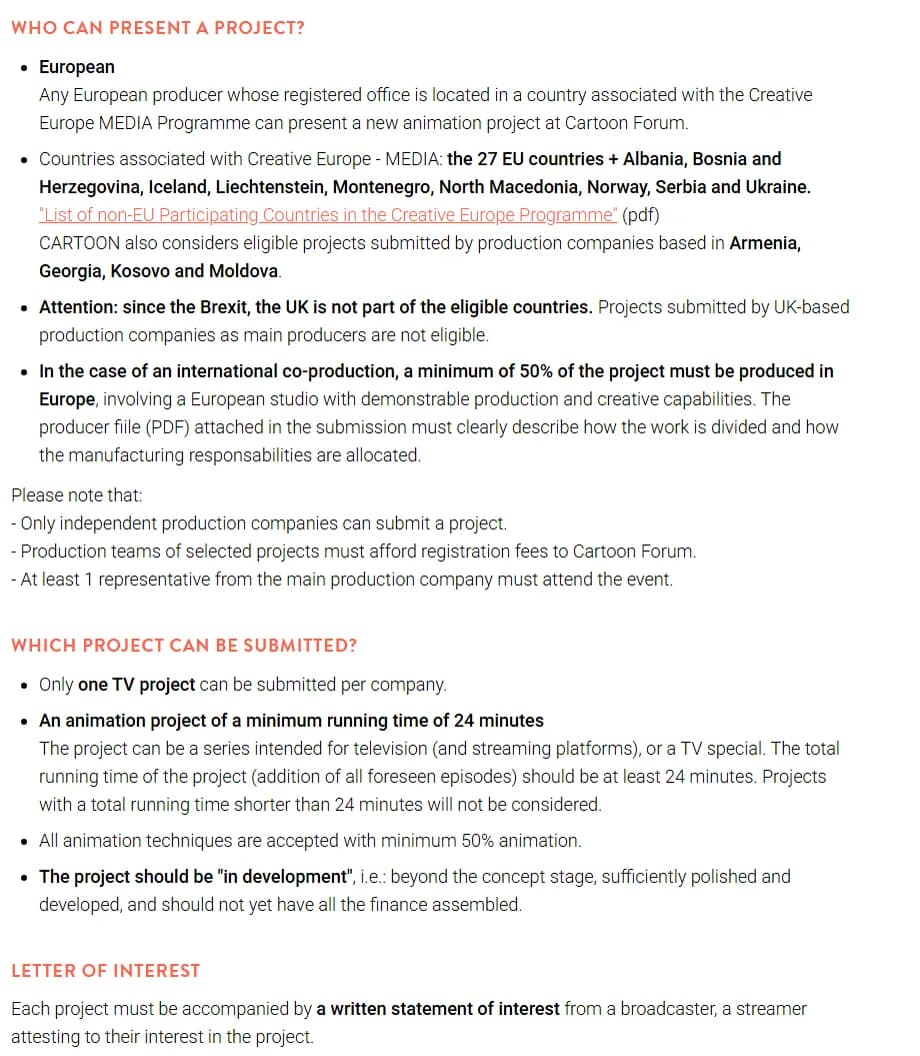
Cartoon Forum, "Regulations", captured 4 September 2026.
Read the list. Only independent production companies can submit a project. The producer has to be European, registered in a country associated with Creative Europe MEDIA, and since Brexit a UK company cannot be the main producer. The project needs a total running time of at least 24 minutes, at least 50 percent animation, and it has to be in development, meaning past concept and not yet fully financed. On top of that, every project must arrive with a written statement of interest from a broadcaster or a streamer.
An author with an album and a good idea satisfies none of that. You cannot register, you cannot bring the broadcaster letter, and you have nothing to put in the running-time column.
So the teaser is not a sales tool aimed at a network. It is the thing that makes a producer take a meeting, and the producer is the one who can do all of the above. Once you accept that, the piece you make changes shape. A producer is not asking whether your world is pretty. They already believe your world is pretty, because they have your book in their hands.
What a producer is checking in those 90 seconds
| What they are really testing | What the teaser has to show | The mistake authors make |
|---|---|---|
| Does this survive translation to motion? | Your characters moving and talking, not stills panning | A motion-comic reel with parallax on flat panels |
| Is there a series in it, or one book? | A world that implies more episodes than you shot | Adapting the ending, which closes the door |
| Can the style be produced at volume? | A look that stays consistent shot to shot | A single hero frame nobody could repeat 300 times |
| Who is this for? | A tone that names its audience in ten seconds | Ambiguity sold as sophistication |
| Is the author workable? | Restraint, a clear format proposal, no ego | A five-minute film with the whole first chapter |
The third row is the one that quietly kills projects. A producer looks at a beautiful frame and thinks about the four hundred more like it that a studio would have to make on budget. Consistency reads as competence. One gorgeous unrepeatable image reads as an accident.
Why 60 to 90 seconds, and not three minutes
Because of where it gets played. A Cartoon Forum pitching session runs a maximum of 20 minutes, with a 15 minute floor, plus five minutes on either side for people to enter and leave the room. Inside those 20 minutes the producer has to cover concept, characters, storylines, graphics, target audience, rights, the business plan, the budget and where the financing stands.
Your teaser is competing for time against the budget slide. Ninety seconds is generous. Three minutes means somebody cuts it while it plays, which is worse than it being short.
There is a production argument too. A 90 second teaser at an average of two seconds a shot is around 45 shots. Run your page count and panel density through the comic to animation calculator and you will see how little of your book that is. Roughly four to six pages of a Franco-Belgian album. Pick those pages well and 45 shots is plenty. Pick badly and 45 shots is a trailer for nothing.
Choosing the sequence is the whole decision
Do not adapt your opening. Openings establish, and establishing is the part a producer can already do in their head from the book.
Adapt the sequence that proves the most expensive risk in your project.
| If your book's risk is | Board the sequence where | Because it proves |
|---|---|---|
| The style will not hold in motion | Your most graphically distinctive scene moves | The look survives animation, not just a frame |
| It reads as too quiet for a series | Something actually happens, with stakes | There is an engine, not just an atmosphere |
| The lead is unlikeable on the page | The lead does one thing that earns sympathy | Casting and audience are solvable |
| The world is hard to explain | The world does something no dialogue could | The concept is visual, so it is sellable |
| Nobody believes the tone mix | The comedy and the dread sit in one scene | The tonal balance is a design, not an accident |
Two more rules I would not bend. Do not adapt the ending, because you are pitching a series and the ending is the one thing that says there is no more. And include at least one scene of two characters talking, however short, because dialogue in motion is where cheap adaptations fall apart and a producer knows it.
Building it from your own pages
The method is the same one in comic panels to storyboard, with three adjustments that only matter for a teaser.
Build the character references before anything else, from your own artwork rather than from prompts describing it. Your line is the asset. An adaptation that looks generically animated has thrown away the only thing that made a producer open the book.
Board the whole 90 seconds before generating a single shot. The temptation with a short piece is to generate the cool shot first and assemble around it, and the result always reads as a collection rather than a sequence. The same argument applies at any length, and it is laid out in storyboard first.
Cut it to a fixed length before you fall in love with anything. Decide 75 or 90 seconds on day one and hold it. Teasers grow, and a grown teaser is a short film that nobody asked for.
If your source is manga rather than a Western album, the reading direction and screentone problems are handled in manga to anime and they apply here too.
Sound does half the work
An animated teaser with no sound design gets read as a test. The same picture with music, three or four real effects and one line of voice gets read as a piece.
You do not need a composer. You need the sequence to stop feeling silent. If you can afford one thing, buy one voice: hearing your protagonist speak once does more for a producer than thirty extra seconds of picture, because it moves the project from drawing to character.
Declare the AI, because it is now a rule
If you build the teaser with generative tools and the project goes to a CARTOON event, disclosure is not optional.
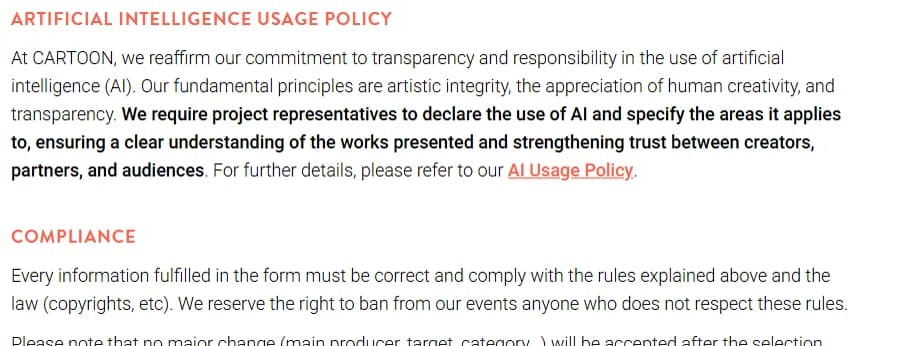
Cartoon Forum, "Regulations", artificial intelligence usage policy, captured 4 September 2026.
CARTOON requires project representatives to declare the use of AI and to specify which areas it applies to. Treat that as the floor rather than the ceiling. Tell your producer, in the first conversation, exactly which parts were generated and which were drawn. Producers who find out later stop returning calls, and the ones who hear it up front usually do not care, because what they are buying is your book and your authorship.
There is a practical version of the same honesty: keep your layered files and your original artwork. When a studio takes the project on, the teaser is thrown away and the book is what gets animated properly. The teaser only has to survive until someone says yes.
Try it free
Try Screenweaver for free on your script
It is free. Import your existing project, get a clearer view of your outline, and regain control of your story structure in minutes.
Start FreeWhat travels with the teaser
The teaser alone is not a submission, and a producer will ask what format you think this is. Decide before the meeting. A 46 to 62 page Franco-Belgian album is a 22 to 30 minute episode or a half-hour special, not a feature, and the reasoning behind that is in graphic novel to animated film.
That decision also determines which room your project eventually walks into.
| Event | For | When and where |
|---|---|---|
| Cartoon Forum | Animated TV series projects | 14 to 17 September 2026, Toulouse |
| Cartoon Movie | Animation feature projects | 2 to 4 March 2027, Bordeaux |
| Cartoon Springboard | Young talents in animation | 4 to 6 November 2026, Madrid |
CARTOON is a non-profit association based in Brussels, and its events are where European animation series and features are actually co-produced. Your producer goes to these. You go to find your producer, which for a comic author usually means festivals, your publisher's rights department, and the animation studios who have adapted books like yours before.
Rights, before you produce anything longer
If your album is published, the adaptation rights are frequently held or brokered by the publisher rather than by you. Check your publishing contract before you spend real money, and check it before you show the teaser widely, not after.
A short teaser of your own work is a low-risk thing to make. A pilot is not. If the contract is unclear, the conversation with your editor comes before the next production step, and it is a conversation that goes better when you have 90 seconds to show than when you have a proposal.
I am not a lawyer and this is not legal advice. It is the order of operations that keeps authors out of trouble.
Checklist before you show it
- Runs between 60 and 90 seconds, and you have held that length.
- Built from a sequence that proves a risk, not from the opening.
- Contains at least one exchange of dialogue in motion.
- Character design consistent across every shot, from your own references.
- Your line and color recognizable as yours, not as generic animation.
- Sound design and music present, plus one voice if the budget allows.
- A one-line format proposal ready: series, special or feature, and the running time.
- The AI question answered honestly before anyone asks it.
- Publishing contract checked for adaptation rights.
- Original artwork and layered files archived and safe.
- A one-page document with the logline, the format, the audience and your contact.
Tools for this
- Comic to animation calculator to turn page count and panel density into a running time before you commit to a format.
- Storyboard template generator for printable panels in your delivery aspect ratio.
- ScreenWeaver to board the sequence and generate the shots from your own references.
- Proof of concept shorts if you are weighing a live-action route instead, where the economics are different.
FAQ
How long should a comic adaptation teaser be?
Between 60 and 90 seconds. The constraint is the pitching session it has to fit inside, which at Cartoon Forum runs a maximum of 20 minutes covering concept, characters, budget and financing. Anything past two minutes gets cut while it plays.
Can I submit my comic project to Cartoon Forum myself?
No. Only independent production companies can submit, the main producer must be European under Creative Europe MEDIA, the project needs at least 24 minutes of total running time, and it must arrive with a written statement of interest from a broadcaster or streamer. Your teaser is what gets a producer interested enough to do all of that with you.
Should I animate the beginning of my book?
Almost never. The opening establishes, and a producer can already picture that from your pages. Adapt the sequence that answers the hardest doubt about your project, whether that is the style holding up in motion, the story having an engine, or the tone mix working.
Do I have to tell people I used AI to make it?
At a CARTOON event, yes: representatives are required to declare the use of AI and specify which areas it applies to. Beyond the rule, tell your producer in the first conversation. Most do not mind. All of them mind finding out later.
What if my publisher holds the adaptation rights?
Then the teaser is still worth making, because it is a short piece of your own artwork and it is what makes the rights conversation concrete. What you should not do is finance a pilot or approach studios before you have read your publishing contract and spoken to your editor.
Is a teaser better than a pitch deck?
They do different jobs and the teaser does not replace the deck. The deck carries the format, the audience, the episode count and the comparables. The teaser answers the only question a deck cannot: does this move.
Final Step
Build your next script with Screenweaver
Move from ideas to production-ready pages faster with timeline-native writing and AI-assisted story flow.
Try Screenweaver