
Every short drama episode has the same three-part shape: a hook in the first five seconds, one turn around sixty percent of the way through, and a cliffhanger in the last five seconds. A season is that shape repeated 40 to 100 times, with a handful of episodes carrying bigger turns than the rest: the paywall episode, the midpoint, the all-is-lost episode and the finale. Get the small shape right and pin the big ones, and the season holds.
The format on the page is covered in short drama script format. This article is about what the episodes do.
The shape of one episode
Ninety seconds, three obligations, in order.
| Section | Timing (90 s episode) | Obligation | What fails when it is missing |
|---|---|---|---|
| Hook | 0:00 to 0:05 | Conflict in the first image. The premise legible without sound | The viewer scrolls. Autoplay previews are muted |
| Middle | 0:05 to 0:50 | Each exchange raises the price of the premise | The episode feels like a scene from a longer show |
| Turn | about 0:54 | One change. A choice, a reveal, an arrival | The episode is a scene, not an episode |
| Fallout | 0:54 to 1:25 | The price of the turn, paid on screen | The turn reads as random |
| Cliffhanger | 1:25 to 1:30 | A question the viewer has to pay, or wait, to answer | Nobody watches episode 2 |
The turn sits at sixty percent, not at the end, because the cliffhanger is not the turn. The turn is a change the character makes; the cliffhanger is a change the world makes to them. If the same beat does both jobs the episode has one event and a black screen.
The four cliffhanger shapes
Producers on the vertical platforms describe cliffhangers in four shapes, and the InkTip guide for writers names them the same way: revelation, reversal, deadline, intrusion.
| Shape | What happens in the last five seconds | Example |
|---|---|---|
| Revelation | Someone learns something they cannot unlearn | The photograph stapled to the back of the contract |
| Reversal | The power or the relationship flips | The maid is the owner. The husband signs the divorce first |
| Deadline | A clock starts or runs out | "You have until midnight." The heart monitor flatlines |
| Intrusion | Someone or something arrives | The door opens. The ex-wife. The police. The real bride |
Rotate them. A season that ends every episode on a revelation trains viewers to expect one, and by episode 15 the reveals have no weight. The rotation is mechanical, and it should be, because it protects the season from the writer's favourite move. The episode planner assigns the shapes in rotation and pins the milestone episodes to the shape that fits them.

The pair rule: cliffhanger and next hook are one cut
The last five seconds of episode 12 and the first five of episode 13 are a single beat split by a title card. Episode 12 ends on the door opening; episode 13 opens on who is in it. Episode 12 ends on the photograph; episode 13 opens on her face.
Write them as a pair, board them as a pair, and cut them as a pair. The most common structural mistake in vertical scripts is ending an episode on the reveal and its reaction, then opening the next one on a new scene. The reaction is the next episode's hook. Withhold it.
The season: five movements, four pinned episodes
A feature has three or four big reversals across ninety minutes. A 70-episode vertical needs a reversal every ninety seconds and four of them bigger than the rest. Three-act structure gives you the big four and nothing for the 66 episodes between, which is why so many vertical seasons sag after the paywall: the writer spent the reveals early and has 50 episodes of middle.
Five movements, with episode ranges for a 70-episode season paywalled at episode 10:
| Movement | Episodes | Mission | Ends on |
|---|---|---|---|
| Hook | 1 to 3 | Premise fully legible, lead committed | The lead chooses. No more reacting |
| Setup to paywall | 4 to 10 | Every episode raises the price of the premise | The paywall cliffhanger: the strongest revelation of the first act |
| Escalation | 11 to 35 | The secret gets harder to keep, the rival gets closer, stakes go public | The midpoint reversal: the secret is out or the power flips |
| Collapse | 36 to 56 | Everything the lead built comes apart | All is lost: the deadline hits |
| Payoff | 57 to 70 | Confrontation, the reveal the audience waited for | Finale, then a button for season 2 |
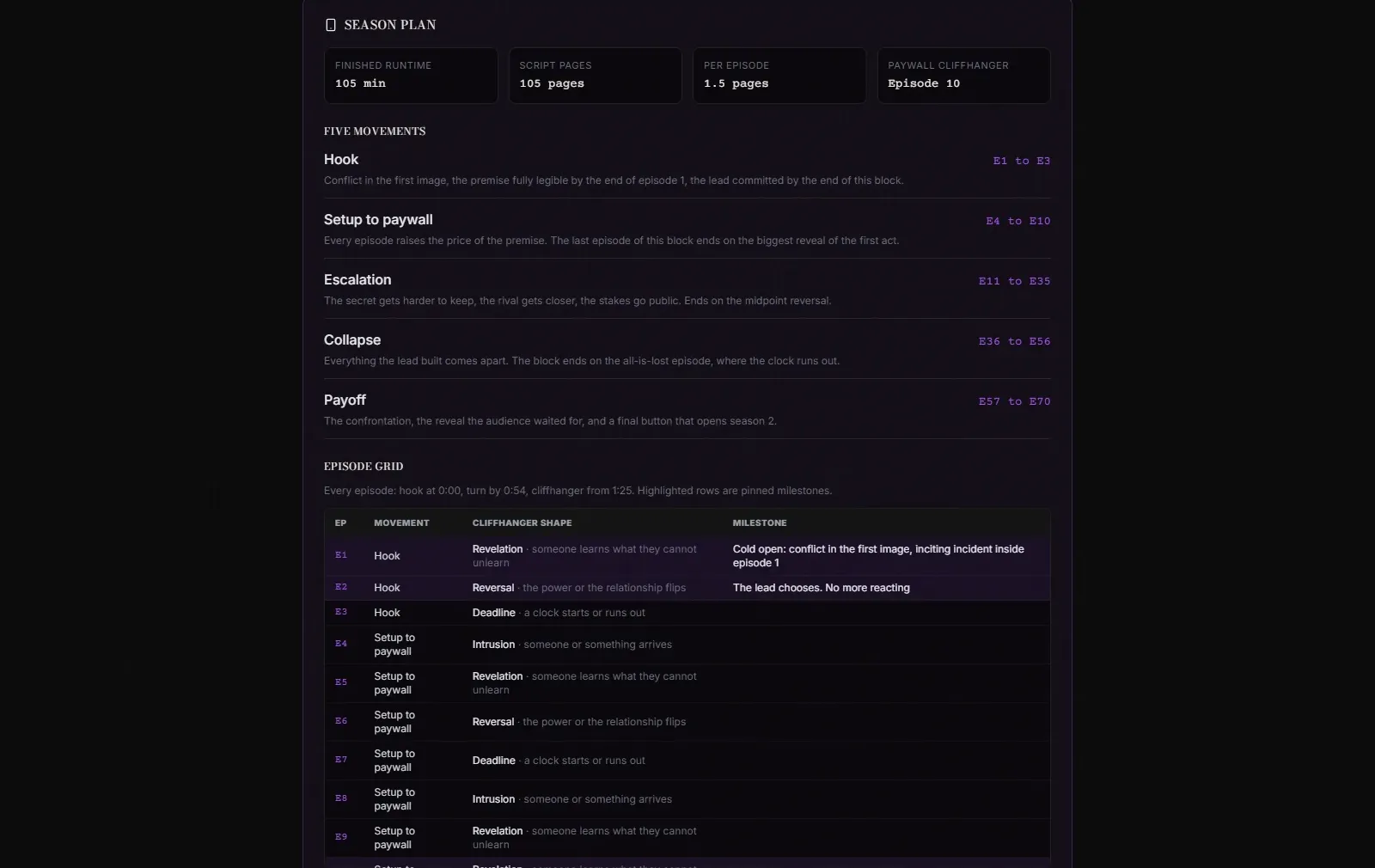
The season plan for 70 episodes at 90 seconds in the short drama episode planner, captured 3 September 2026. Highlighted rows are the pinned milestones; the cliffhanger column rotates the four shapes.
The four pinned episodes are the four a platform reads first. Write them before anything else. If the paywall episode and the finale are not the two strongest cliffhangers in the season, the plan is wrong and no amount of episode 23 will fix it.
Try it free
Try Screenweaver for free on your script
It is free. Import your existing project, get a clearer view of your outline, and regain control of your story structure in minutes.
Start FreeThe paywall episode
On the apps the first eight to twelve episodes are free and the rest cost coins. The last free episode decides the season's revenue, and its cliffhanger has one job: make the answer worth paying for.
It should be a revelation, not a deadline or an intrusion, because a revelation creates a specific question ("what is in the photograph") and specific questions convert. It should also be the first time the premise's central secret is threatened directly. Everything before it is the price rising; this is the first bill.
On social platforms with no paywall, the same episode still exists. It is the one where the casual viewer becomes a follower, and it lands at about fifteen percent of the run.
Episode density: how many turns a season needs
| Season | Episodes | Episodes with a pinned milestone | Ordinary episodes, each still needing a turn and a cliffhanger |
|---|---|---|---|
| Social pilot | 10 | 4 | 6 |
| Short social season | 30 | 6 | 24 |
| App commission | 70 | 7 | 63 |
| Long app season | 100 | 7 | 93 |
Sixty-three ordinary episodes is where the trope earns its keep. A contract marriage generates reversals on its own: every clause is a deadline, every witness an intrusion, every signature a reveal. An original premise with no engine gives you six reversals and then silence. The tropes article is about choosing an engine that produces 63 turns without inventing each one from scratch.
Structure mistakes specific to the format
- Ending consecutive episodes on the same cliffhanger shape. Rotate.
- Spending the central secret before the paywall. The paywall is the first threat to it, not its exposure.
- Writing a reaction at the end of an episode. It belongs at the top of the next one.
- Planning three acts. Plan five movements with a hard midpoint.
- A turn that is something happening to the lead. The turn is something the lead does. Things happening to them is the cliffhanger.
- Location changes inside an episode. One location per episode is the default; a second costs ten seconds you do not have.
- Episode 1 as setup. Episode 1 is the inciting incident, already in motion, with the setup smuggled into the fight.
Working the grid in practice
Build the grid first, in a tool or on cards, with an episode number, a movement, a cliffhanger shape and a one-line turn for every slot. Only then write pages, and write the four pinned episodes first. In ScreenWeaver the grid becomes the outline: one Episode node per slot, the scenes under it, the script pane beside it, and the storyboard generated per shot in 9:16 once the pages exist. The beat sheet for short films covers compression inside a single short; a vertical is that compression, seventy times, with a spine.
FAQ
What is the structure of a short drama episode?
Hook in the first five seconds, one turn at about sixty percent of the runtime, cliffhanger in the last five seconds. The turn is a change the character makes; the cliffhanger is a change the world makes to them. Ninety seconds, one location, two or three characters.
How do you write a cliffhanger for every episode?
Rotate four shapes so no two consecutive episodes end the same way: revelation, reversal, deadline, intrusion. Pin the milestone episodes to the shape that fits (the paywall and finale on revelations, the midpoint on a reversal, all-is-lost on a deadline) and let a trope with a built-in engine supply the rest.
Which episode should have the biggest cliffhanger?
The last free episode before the paywall, usually between 8 and 12, and the finale. Those two must be the strongest in the season. On social platforms without a paywall, the equivalent lands at about fifteen percent of the run, where a viewer becomes a follower.
How many episodes are in a vertical drama season?
Forty to 100 on the apps, with 60 to 70 a common commission. Ten to 30 for a social season. The structure is the same at any length; only the number of ordinary episodes between the pinned ones changes.
Should short drama episodes be structured in three acts?
No. Three acts give you the big reversals and nothing for the 60 episodes in between. Five movements with a hard midpoint, a paywall episode and an all-is-lost episode pin enough of the season that the ordinary episodes have somewhere to go.
Where does the midpoint go in a 70-episode season?
Episode 35, and it should be a reversal: the secret goes public or the power between the leads flips. Everything before it is the secret getting harder to keep; everything after it is the consequences.
Final Step
Build your next script with Screenweaver
Move from ideas to production-ready pages faster with timeline-native writing and AI-assisted story flow.
Try Screenweaver