
A six-minute AI short made solo costs about $110 in cash for one month of subscriptions and generation, and roughly 60 hours of your time. The cash line moves between $50 and $900 depending on the video model and how many takes you burn. The hours barely move at all. Every figure below comes from a pricing page captured on 20 September 2026 or from a published production log.
This is the budget chapter of the AI filmmaking guide and of the how to make an AI film walkthrough. The reroll multiplier that decides the biggest line is explained on its own in how much an AI film really costs. This article puts every other line next to it.
The reference case: $1,852 for 21 minutes
Start with a number somebody actually paid. Episode 2 of Lost Garden, a Japanese-style anime series made by one person, cost $1,852 and 65 hours for 21 finished minutes. The director's own account of the pipeline gives the breakdown: about 400 shots kept, around 2.4 generations per kept shot, so a little under a thousand generations. Generation credits were the largest line, voices and music came next, and the editing suite was free.
Two ratios fall out of that. Cash per finished minute: $88. Cash per hour worked: about $28. Keep the second ratio in mind the next time someone tells you AI films are free. The tools are cheap. The person doing 65 hours of work is where the money goes.
The stack was listed with the episode: script and storyboard in ScreenWeaver, image and shot generation with Dreamina and Seedance, character sheets in Midjourney, voices in ElevenLabs, music from Suno, edit in DaVinci Resolve and Filmora. That is the stack I have priced below, tool by tool, so you can see where $1,852 comes from and what a shorter film with fewer shots per minute costs instead.
The worked budget: a six-minute short, one month
Assumptions, stated once so you can swap your own. A six-minute short. Forty-five shots averaging eight seconds, which is the shot count the AI video cost calculator derives from those two inputs. One person, one billing cycle. Three takes per kept shot, the calculator's "typical" profile and close to the 2.4 Lost Garden measured. A budget video model billed per second through an API. Everything priced monthly, no annual discounts.
| Line | Tool | Plan and what it buys | Price as captured | Month one |
|---|---|---|---|---|
| Script and storyboard | ScreenWeaver | Screenwriter plan is free; Storyboard Beta unlocks board generation | $0 / $9.99 per month | $9.99 |
| Character sheets, environments | Midjourney | Basic, 3.3 hours of fast GPU time | $10 per month | $10 |
| Video generation | Seedance 1.0 Pro or Kling 2.6 Pro | 135 clips of 8 seconds at $0.07 per second | pay per second | $75.60 |
| Voices | ElevenLabs | Starter, 30,000 credits, commercial licence | $6 per month | $6 |
| Music | Suno | Pro, 2,500 credits, commercial use rights | 9 € per month (7.20 € on annual billing) | about $10 |
| Sound effects | ElevenLabs | included in the plan above | $0 | $0 |
| Edit, colour, mix | DaVinci Resolve | free version | $0 (Studio is $295, once) | $0 |
| Festival entries | Astana, Token, Next AI Film Festival | free to enter | $0 | $0 |
| Cash total | about $112 |
About $19 per finished minute, against Lost Garden's $88. Shots per minute explains the gap: 7.5 here, about 19 there, because anime cuts every two to three seconds. Shot count is the first number on any AI film budget, and it is set by the edit rhythm you choose in the script, not by anything you buy.
Line 1: script and storyboard
Writing costs nothing. ScreenWeaver's Screenwriter plan is free with unlimited projects and pages, PDF and Final Draft export. The board is the paid part: the Storyboard Beta offer is $9.99 a month on the homepage pricing section, and it generates panels straight from the screenplay. A Filmmaker plan is listed with pricing still to be announced, so the only number you can budget today is $9.99.
You can skip this line entirely. A board drawn on paper costs a pencil, and the artist versus AI storyboard cost comparison prices the alternatives. What you cannot skip is the board itself. Lost Garden's director puts it bluntly: every hour on the board saved something like five hours of generating shots the film did not need. At $0.07 a second, a wasted eight-second take is 56 cents. At five wasted takes per shot over 45 shots, that is $126 of takes a board would have prevented, more than the board costs.
Line 2: character sheets and environments
Midjourney has no free tier. The Basic plan is $10 a month for 3.3 hours of fast GPU time, Standard is $30 with unlimited relaxed image generation, Pro $60, Mega $120, all 20 percent cheaper on annual billing. Extra fast time is $4 an hour on every plan.
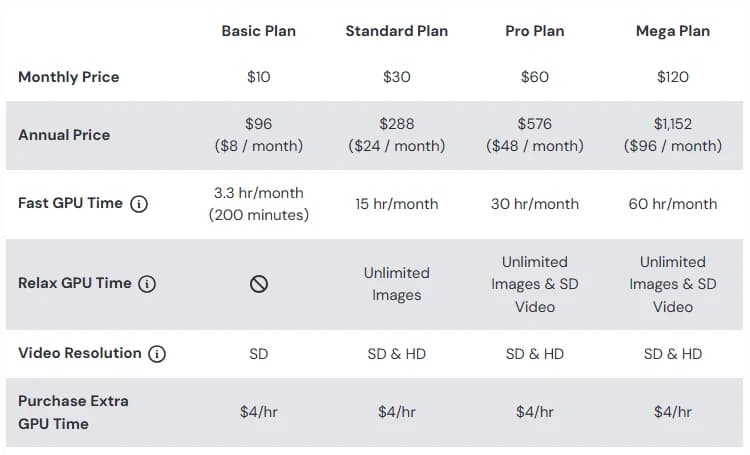
The plan table on docs.midjourney.com, captured 20 September 2026.
Basic is enough for a short. A character sheet with five views, three characters, two environments, plus rerolls, fits inside 200 minutes of fast time if you write the description before you generate rather than after. The reference method for character consistency is what keeps that number down.
One clause on the same page matters more than the price. Usage rights are "General Commercial Terms" on every plan, with a footnote: a company making more than $1,000,000 in gross revenue a year must be on Pro or Mega. A solo filmmaker can stay on Basic; a studio with that turnover cannot.
Line 3: video generation, the line that moves
This is the only line with a multiplier in it, and the multiplier is yours. The figures below are the calculator's output for 45 shots of eight seconds, using the September 2026 API rates in its dataset. Clean means 1.5 takes per kept shot, typical means 3, perfectionist means 5.
| Model (API rate per second) | Clean, 68 clips | Typical, 135 clips | Perfectionist, 225 clips |
|---|---|---|---|
| Runway Gen-4 Turbo ($0.05) | $27.20 | $54.00 | $90.00 |
| Seedance 1.0 Pro / Kling 2.6 Pro ($0.07) | $38.08 | $75.60 | $126.00 |
| Sora 2 ($0.10) | $54.40 | $108.00 | $180.00 |
| Veo 3.1 Fast ($0.12) | $65.28 | $129.60 | $216.00 |
| Veo 3.1 ($0.40) | $217.60 | $432.00 | $720.00 |
Read the table diagonally. A disciplined session on the most expensive model ($217.60) costs less than a sloppy one on a mid-priced model ($180). Discipline is worth more than model choice until you reach the premium tier, where the per-second rate takes over and a perfectionist month on Veo 3.1 costs more than everything else in this article combined.
Three caveats on the rates. Kling's $0.07 is with native audio off; turning it on doubles the rate. Sora 2's API has an announced sunset for late September 2026, so treat it as transitional. And these are API prices, which is what you pay through a developer platform; consumer apps sell the same models as monthly credit bundles, Dreamina included, and the bundle price is behind a login I will not quote from. If you buy credits in an app, divide the bundle price by the seconds it buys and use that as your per-second rate in the table.
The choice of model by shot type is a separate article, the Seedance 2 versus Veo 3 versus Sora 2 comparison. For this budget, the only decision is whether you can afford to be wrong. On a budget model you can. On Veo 3.1 you cannot.
Line 4: voices
ElevenLabs prices in credits, and one credit is one text character on its multilingual V2 models, which is what the pricing page's own FAQ states. Free is 10,000 credits a month. Starter is $6 for 30,000 credits and adds the commercial licence and instant voice cloning. Creator is $22 for 121,000 credits, shown at $11 for the first month, and adds professional voice cloning. Pro is $99. Prices exclude taxes.
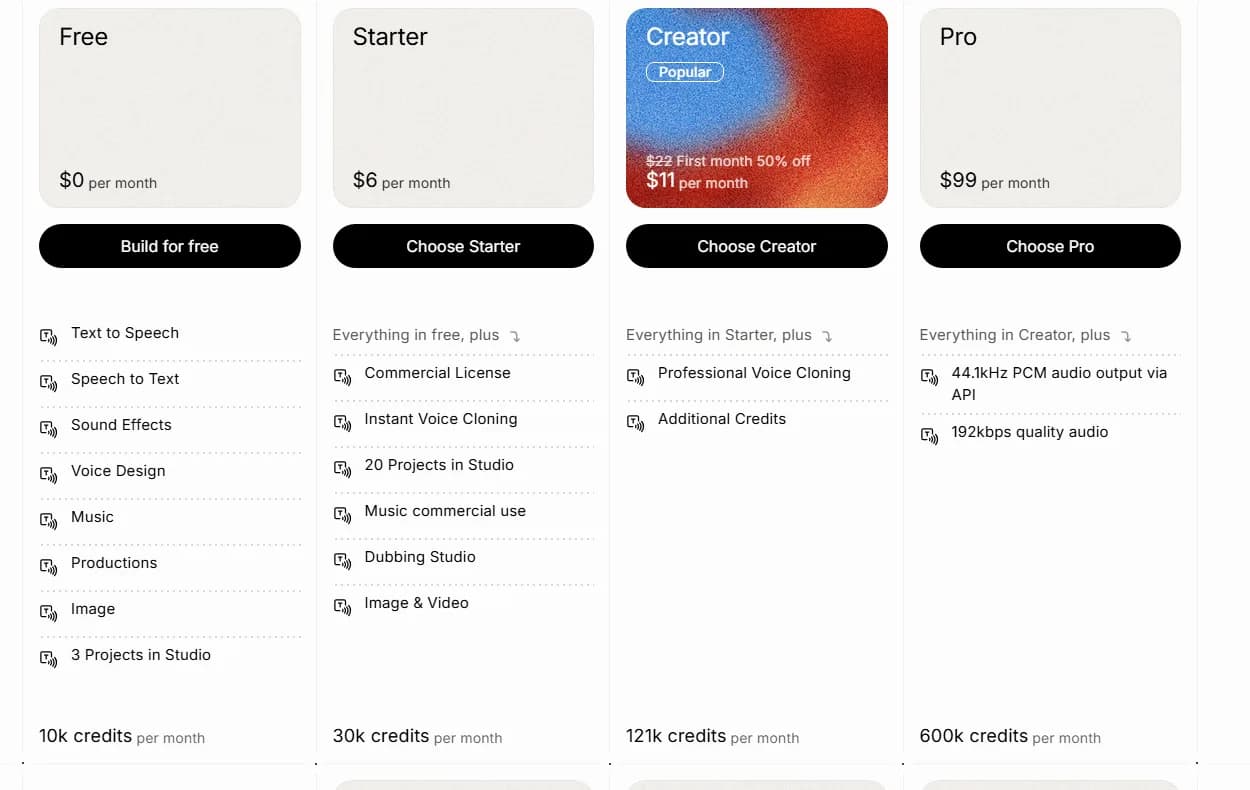
The Creative plan cards on elevenlabs.io/pricing, monthly billing, captured 20 September 2026.
Do the arithmetic for a short before you pick. Six minutes of film carries perhaps 600 words of dialogue, call it 3,500 characters. Generate every line five times while you hunt for the read you want and you have spent 17,500 credits. Starter covers that with room. Creator is for cloning a specific performer's voice from a studio recording, or for a series. Sound effects are on the free tier, so there is no separate line for them. How you lay those voices against generated mouths is in AI voices and lip sync for film.
The commercial licence is the reason Starter and not Free is in the budget. If the film goes to a festival or a channel with monetisation, you need it.
Line 5: music
Suno's pricing page, served to a European visitor with the annual toggle on, shows Pro at 7.20 € a month and Premier at 22 € a month. Each card says what annual billing saves (21.60 € and 72 €), which puts the monthly plans at 9 € and 28 €. Pro buys 2,500 credits, 20 song downloads and commercial use rights. Free gives 50 credits a day and, in the page's own words, "No commercial rights". Taxes are added at checkout.
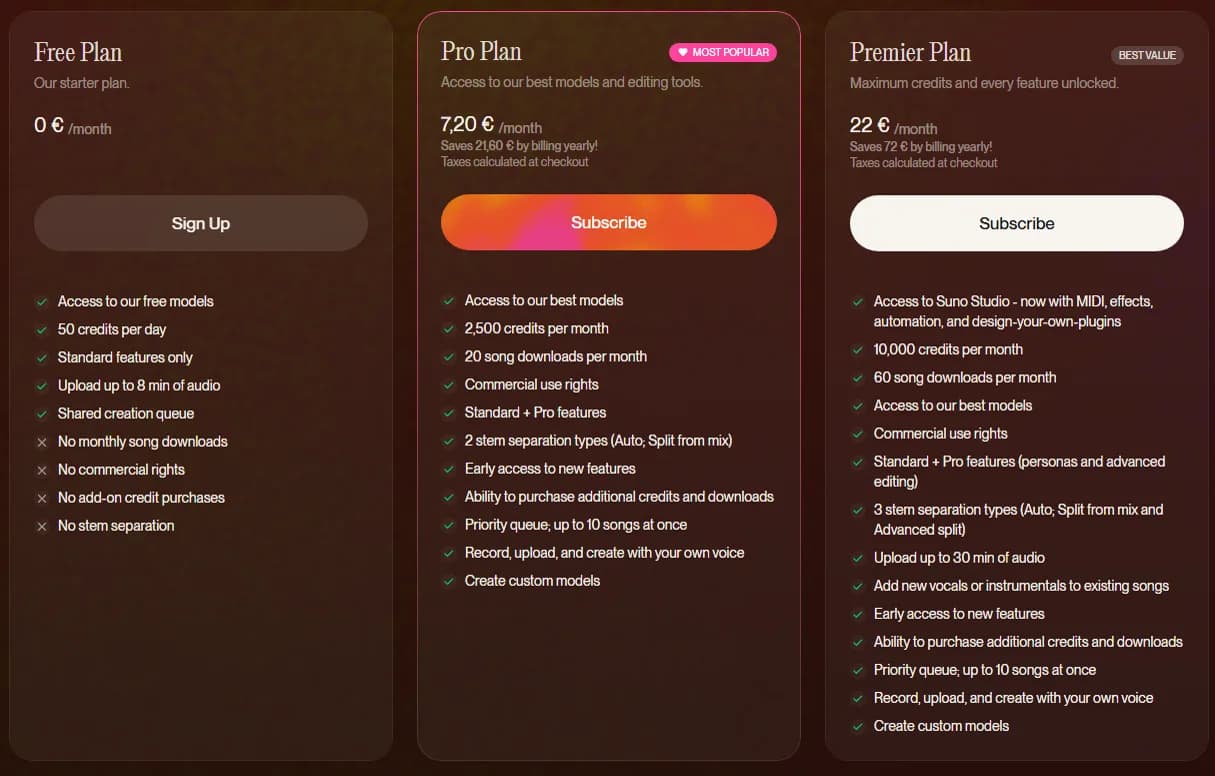
Plan cards on suno.com/pricing as served in Europe, annual billing selected, captured 20 September 2026.
A short needs one score cue, maybe a title theme, and a handful of rejected attempts. Pro for one month is the line. The same rule as voices applies: the free tier's output cannot be in a film you submit anywhere, so the $0 option is not really $0 for a film with a destination.
Try it free
Try Screenweaver for free on your script
It is free. Import your existing project, get a clearer view of your outline, and regain control of your story structure in minutes.
Start FreeLine 6: the edit is free, and that is not a compromise
DaVinci Resolve's product page offers two buttons: a free download and the Studio version at $295, one payment. The free version cuts, grades, mixes and delivers; the paid one adds the extra tools listed on the same page. For a six-minute short delivered to a festival portal, free is the professional choice, not the cheap one. Lost Garden's edit ran through it, with Filmora alongside.
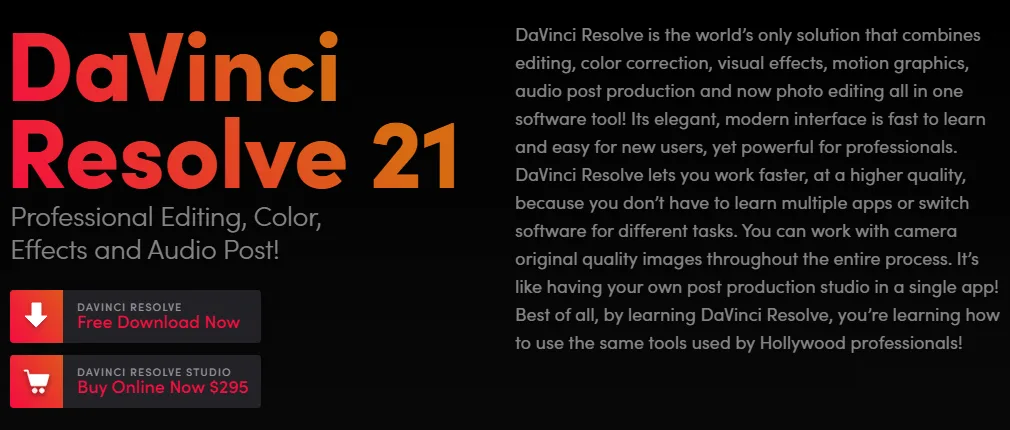
blackmagicdesign.com/products/davinciresolve, captured 20 September 2026.
Filmora, the second editor in the Lost Garden stack, lists Basic at $49.99 a year and a perpetual licence at $79.99 per platform. Buy it if Resolve's colour page scares you off. Otherwise skip the line.
Line 7: delivery and festivals
Traditional short film budgeting reserves money for a DCP and for entry fees. AI festivals have mostly removed the second. Astana's festival, with its $2,000,000 fund, charged nothing to enter. Token in Chicago is free. The Next AI Film Festival in Seoul is free. Sparknify starts free and rises towards the deadline. The full list with deadlines is in AI film festivals 2026, and the platforms that pay are in where to publish an AI film. Budget $0 and a delivery spec: format, resolution, disclosure statement. The disclosure part has rules of its own, covered in AI film disclosure rules.
Three budgets for the same film
Same six minutes, three appetites.
| Line | Floor | Working | Comfortable |
|---|---|---|---|
| Script and board | ScreenWeaver free, paper board, $0 | Storyboard Beta, $9.99 | Storyboard Beta, $9.99 |
| Reference images | Midjourney Basic, $10 | Midjourney Basic, $10 | Midjourney Standard, $30 |
| Video | Runway Gen-4 Turbo, clean, $27.20 | Seedance or Kling, typical, $75.60 | Veo 3.1, typical, $432 |
| Voices | ElevenLabs Starter, $6 | ElevenLabs Starter, $6 | ElevenLabs Creator, $22 |
| Music | Suno Pro, 9 € (about $10) | Suno Pro, 9 € (about $10) | Suno Premier, 28 € (about $33) |
| Edit | Resolve free, $0 | Resolve free, $0 | Resolve Studio, $295 |
| Festivals | $0 | $0 | $0 |
| Cash | about $53 | about $112 | about $820 |
| Hours (yours) | 60 | 60 | 60 |
The bottom row is the point of the table. Every column costs the same in hours, and the hours are the expensive part. Price your own time at $25 an hour and the labour line is $1,500 in all three columns. At $50 it is $3,000. The comfortable column buys the same film with a nicer video model and a colour page you may never open.
What live action would cost for the same six minutes
Filmustage's short film budgeting guide, published January 2025, puts a traditionally produced short at $700 to $1,500 per minute of screen time, so $7,000 to $15,000 for ten minutes, with camera rental at $150 to $500 a day, a DCP at $300 to $2,000 and $500 to $2,000 set aside for festival entries. Scale that to six minutes and you get $4,200 to $9,000.
Against $53 to $820 in cash, the comparison looks absurd, and it is partly unfair. The live action figure includes labour: a cinematographer, a sound recordist, an editor, each paid by the day. The AI figure excludes yours. Put the 60 hours back in at $25 and the AI short lands at $1,550 to $2,300 all-in, which still sits below the low end of live action, but by a factor of two or three, not a hundred. Anyone quoting a hundredth is not counting their own time.
What the pricing pages do not put in the headline
Reading every page above turned up five things that change the number you will actually pay.
Taxes come first. ElevenLabs states that prices exclude taxes and Suno adds them at checkout, so put your local VAT on every subscription line. Then introductory prices: ElevenLabs Creator is $11 in month one and $22 after, and a film that slips into month two pays the second figure. Annual discounts are the third trap. Midjourney's 20 percent and Suno's 21.60 € only exist if you pay the year upfront, which makes no sense for a one-month film, so take the monthly rate. Fourth, rights on free tiers: Suno's free plan says no commercial rights and Midjourney has no free plan at all, so a film with a destination cannot sit on $0 tiers. And last, revenue clauses. Midjourney's terms move companies above $1,000,000 a year onto Pro or Mega, irrelevant for a solo short and a real line for a studio.
The budget sheet, ten lines
Copy this into a spreadsheet before you subscribe to anything.
- Finished runtime in minutes, from the script's timing, not a guess.
- Shots per minute, from the board. This is the number that separates $19 and $88 a minute.
- Average clip length in seconds, capped by your model's maximum.
- Takes per kept shot you will allow yourself, written down as a cap.
- Per-second rate of your video model, API rate or bundle price divided by seconds bought.
- Subscriptions for one billing cycle each: board, images, voices, music, at monthly prices plus tax.
- The edit line, which should be $0 unless you can name the Studio feature you need.
- Festival fees, which for AI festivals in 2026 are mostly $0, plus one delivery spec per festival.
- Your hours, at a rate you would accept from a client.
- A 20 percent contingency on the video line only, because it is the only line that can surprise you.
Run the first five lines through the AI video cost calculator and the rest by hand. The whole sheet takes 15 minutes and it is the cheapest quarter hour of the production.
FAQ
How much does an AI film cost per minute?
Two published points: about $19 a minute for a six-minute short at 7.5 shots a minute on a budget model, and $88 a minute for Lost Garden episode 2 at about 19 shots a minute. Shots per minute and takes per shot explain almost all of the difference, not the tools.
Can you make an AI short film for free?
You can write it, board it on paper, and edit it in DaVinci Resolve for free. Voices, music and video generation on free tiers either lack commercial rights or run out of credits before a film is finished. A film you intend to submit anywhere needs about $50 in paid tiers for one month.
What is the most expensive part of an AI film?
Your time, by a wide margin, at any hourly rate above zero. In cash, it is video generation, which was the largest line of Lost Garden's $1,852 and is the only line with a multiplier in it.
Do I need DaVinci Resolve Studio?
No. The free version edits, grades, mixes and exports a festival-ready file. Studio is $295 once and adds tools most six-minute shorts never touch.
Why is a budget model sometimes more expensive than Veo?
Because takes multiply the rate. A perfectionist month on Sora 2 at $0.10 a second ($180) costs less than a disciplined month on Veo 3.1 at $0.40 a second ($217.60), but a sloppy month on Veo ($720) costs more than the rest of the production combined. You control the multiplier. The vendor sets the rate.
Are these prices still right?
They were captured on 20 September 2026 from each vendor's pricing page, screenshots included above. AI pricing changes monthly. Re-check the page before you subscribe, and treat the structure of this budget, not its figures, as the part that lasts.
Final Step
Build your next script with Screenweaver
Move from ideas to production-ready pages faster with timeline-native writing and AI-assisted story flow.
Try Screenweaver