AI Video Cost Calculator
Budget your AI film per finished minute, not per clip
This AI video cost calculator estimates what an AI-generated film really costs to make, built for AI filmmakers, agencies, and studios budgeting a project before generating a single clip. Pick a model, enter your shot count or finished runtime, and get a total that includes the one number providers never publish: your retries.
Published prices are per clip, and they assume every take is a keeper. Nobody works that way. AI filmmakers routinely generate 2 to 5 versions of a shot before one survives the edit, so a 60-shot short at 3x retries means 180 generations, not 60. That retry multiplier, not the per-second rate, is what decides whether your film costs $40 or $400.
Everything runs in your browser. No project data is sent to any server. Pricing checked September 2026 against public API and plan pages; provider prices change monthly.
How many clips you generate per shot that makes the cut. Clean 1.5x fits locked storyboards and image-to-video workflows. Typical 3x matches what most AI filmmakers report. Perfectionist 5x is where character consistency and lip sync hunts land.
Your film budget estimate
$25.20 estimated total
Clips generated: 72 (for 24 kept shots)
Raw generation cost: $25.20
Cost per finished minute: $12.60
Finished runtime: 2 min
Same brief on other models
Identical shot count, clip length, and retries. Self-hosted models are excluded because they have no per-clip price.
| 3 cheapest | Total |
|---|---|
| Runway Gen-4 Turbo | $18.00 |
| Kling 2.6 Pro | $25.20 |
| Seedance 1.0 Pro | $25.20 |
| 3 premium | Total |
|---|---|
| Sora 2 Pro | $180 |
| Veo 3.1 | $144 |
| Pika 2.2 | $115 |
Pricing checked September 2026 (dataset 2026-09).
How it works
The calculator multiplies your shot count by the retry multiplier to get total generations, prices each generation at the model's published per-second rate (normalized to your clip length), then adds 30% if you toggle the audio and upscale pass. Dividing by finished runtime gives cost per finished minute, the number that lets you compare a 2-minute spec ad against a 10-minute short on equal terms. Prices come from public API pages and, where only subscription credits exist, from a mid-tier plan's effective credit price, marked as an estimate.
How much does AI video actually cost?
Per-clip prices look harmless: Veo 3 costs about $0.40 per second at the standard tier, so a 5-second clip is $2.00, and a Sora 2 price per video runs about $0.50 at 720p through the API. But an AI film budget estimate built on first-take pricing is fiction. At a typical 3x retry ratio, a 5-minute short with 60 shots means 180 generations. On a premium model that is a few hundred dollars; on a budget model like Kling or Seedance, closer to $20 to $40.
The second trap is credits versus API pricing. A Kling credits calculator or Runway Gen 4 pricing per clip conversion depends on which plan you bought: credits on a mid-tier subscription usually cost more per clip than raw API rates, and unused credits expire. Where a provider only sells credits, this AI video cost calculator converts a mid-tier plan into an effective per-clip figure and labels it as a credit-based estimate rather than pretending it is a hard price.
Self-hosted open models change the equation entirely. Wan costs nothing per clip; you pay for GPU time instead, which favors exactly the workflow AI film demands: unlimited retries. If your retry multiplier lives at 5x, the cost to make an AI short film on rented GPUs can undercut every closed model, at the price of setup time and slower iteration. Run the comparison table both ways before committing a budget.
Who this is for
- AI filmmakers: budget a short realistically before pitching it, with retries priced in instead of discovered halfway through generation.
- Agencies and studios: quote AI video work per finished minute and defend the number with a model-by-model comparison.
- Producers evaluating models: see whether a premium model's hit rate justifies its price against a budget model at a higher retry count.
Start from the screenplay.Get the storyboard.
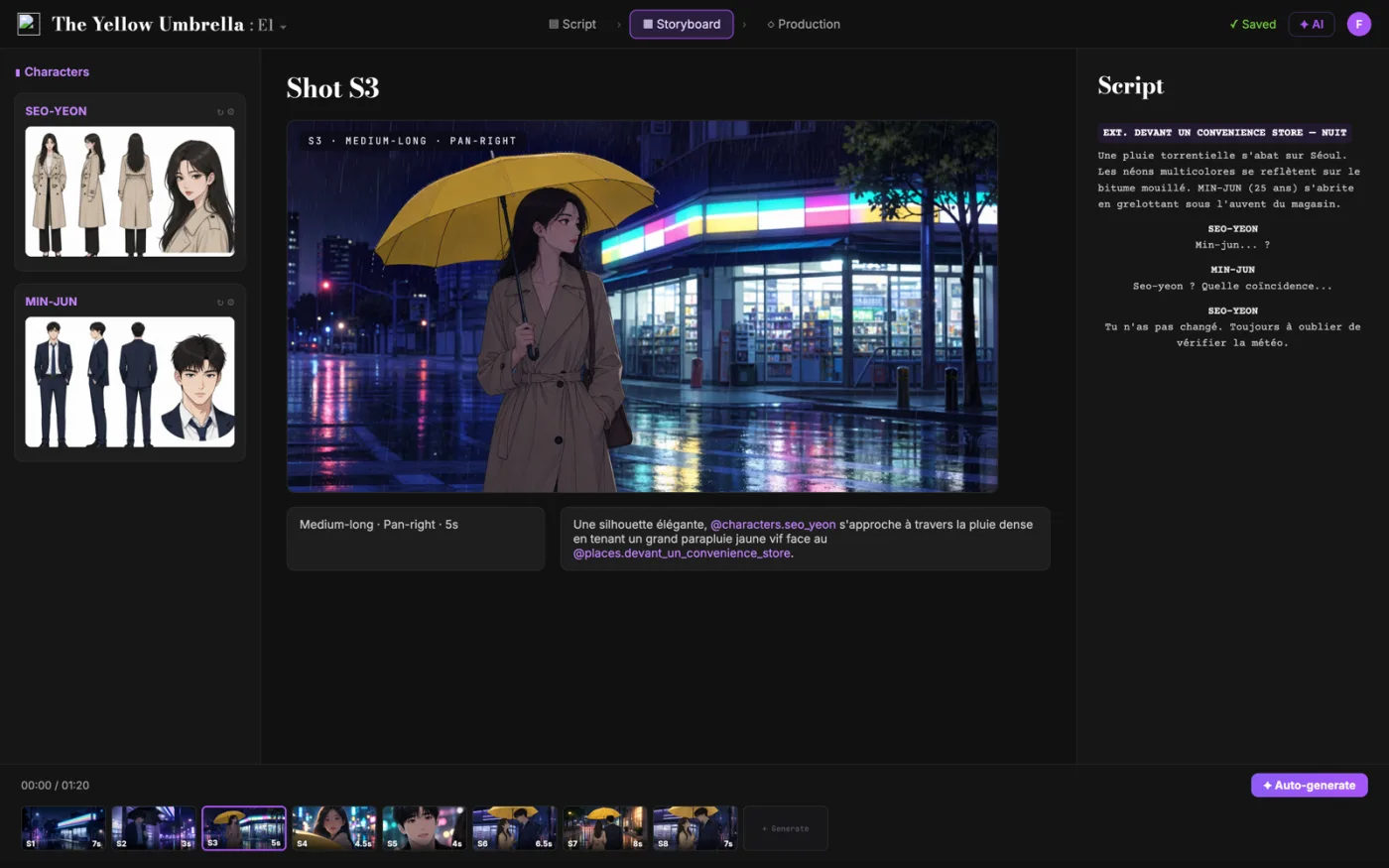
ScreenWeaver breaks your script into shots and generates the storyboard from it. You control framing, angle, movement and duration. Characters carry from shot to shot.
- $0, does not expire
- PDF and Final Draft export
- Mac, Windows, Linux, iPad
AI Video Cost Calculator: the complete guide
It converts shots, clip length, and a realistic retry multiplier into total generation cost on any major model, then compares the same brief across the cheapest and premium options.
For this workflow, the central problem is clear: AI video is priced per clip on first-take assumptions, so real project budgets blow up on retries nobody accounted for. Left unresolved, this creates downstream friction and slower decisions. The practical target is a defensible total and cost per finished minute for an AI film, with retries priced in and a model-by-model comparison.
Limitation to keep in mind: It estimates generation cost only: editing time, paid stock, licensed music, and provider price changes after the dataset date are outside its scope, so treat it as the generation line of a budget.
Advanced workflow: Advanced teams run the estimate once per retry profile to get a best, expected, and worst case, then assign models per shot type: budget models for coverage, premium models for hero shots.
Step-by-Step Workflow
- Size the project by shot count, or by finished runtime and average shot length if you are pre-storyboard.
- Pick the model you plan to shoot on and set the average clip length you actually generate.
- Choose the retry profile that matches your standards: 1.5x clean, 3x typical, 5x perfectionist.
- Read the comparison table before committing: the same brief on another model is often a 10x price difference.
Use Cases By Profile
- AI filmmaker: price a festival short before generating, so the retry budget is a decision instead of a surprise.
- Agency producer: quote client work per finished minute with a dated, model-by-model cost basis behind the number.
- Studio lead: compare a premium model at low retries against a budget model at high retries before locking a pipeline.
Common Mistakes To Avoid
- Budgeting from published per-clip prices without a retry multiplier.
- Comparing subscription credit plans against API rates as if they were the same price basis.
- Ignoring the free self-hosted lane when the workflow is retry-heavy.
Professional Best Practices
- Draft on a cheap or fast tier and reshoot only kept shots on the premium model; the blended rate drops fast.
- Track your real keep ratio for one project, then replace the default 3x with your own number.
- Recheck prices monthly: the dataset is stamped September 2026 and this market reprices constantly.
Treat this tool output as a decision support layer, not a replacement for authorship. Great scripts are remembered for specific choices, emotional precision, and clarity of dramatic movement. Tools help by removing noise so your energy can go where it matters: character, conflict, escalation, and payoff. If you review outcomes after each pass and keep an explicit log of accepted changes, your workflow becomes faster and more predictable from draft to draft. That consistency is exactly what professional collaborators value: fewer surprises, clearer rationale, and a script that evolves with intent.
Extended FAQ
How much does a 5-minute AI short film cost?
At a typical 3x retry ratio and 5-second shots, a 5-minute short needs about 60 kept shots and 180 generations. That runs roughly $60 to $75 on budget models like Kling or Seedance, around $110 on Veo 3.1 Fast, and $360 to $450 on premium tiers like Veo 3.1 standard or Sora 2 Pro, before sound and upscaling.
What is the cheapest AI video model in 2026?
Among closed models, Runway Gen-4 Turbo at about $0.25 per 5-second clip and Kling 2.6 Pro or Seedance at about $0.35 lead on price. Open-source Wan is cheaper still if you count only GPU time, but you pay in setup and iteration speed.
How many clips do I need to generate for one minute of AI film?
One finished minute at 5-second shots is 12 kept clips. At the typical 3x retry ratio that means 36 generations, and a perfectionist 5x pass pushes it to 60. This is why cost per finished minute, not per clip, is the honest budget unit.
When does self-hosting an open model beat paid APIs?
When retries dominate. A rented 24GB+ GPU at roughly $0.50 to $1.00 per hour makes each extra take nearly free, so at 5x retry ratios self-hosted Wan often undercuts every closed model. Below 2x retries on short projects, API pricing usually wins on convenience.
What does a Sora 2 video cost through the API?
In September 2026, Sora 2 runs about $0.10 per second at 720p, so $0.50 for a 5-second clip, and Sora 2 Pro from $0.30 to $0.50 per second by resolution. OpenAI has announced an API sunset for late September 2026, so app credits are the forward path.
Does 4K or upscaled output change the budget much?
Yes. Native 4K is currently a Veo 3.1 standard feature at premium per-second rates, and separate upscale passes on other models add a step. The calculator's 30% audio and upscale toggle approximates that finishing overhead on top of raw generation.
Frequently asked questions
At September 2026 prices, a typical 3x retry workflow lands between roughly $10 and $50 per finished minute on budget models (Kling, Seedance, Hailuo) and $100 to $500 on premium tiers (Veo 3.1 standard, Sora 2 Pro), before sound and upscaling. The retry ratio moves the number more than the model choice does.
Through the Gemini API in September 2026, Veo 3.1 standard runs $0.40 per second at 1080p with audio, and Veo 3.1 Fast runs $0.12 per second. That is $2.00 versus $0.60 for a 5-second clip, which is why many filmmakers draft on Fast and finish on standard.
Because published prices assume first-take success and real workflows do not. AI filmmakers commonly report keeping one clip out of two to five generations once character consistency, motion, and continuity are judged. 1.5x fits tightly storyboarded image-to-video work; 5x fits perfectionist passes and dialogue sync.
Usually not per clip. Credit plans bundle app features and expire monthly, so their effective per-clip price on a mid-tier plan often exceeds raw API rates. This calculator converts credit plans to per-clip figures and marks them as estimates so you can compare honestly.
The optional 30% pass covers a separate audio, music, or upscale step, which matches what solo AI filmmakers typically spend on top of generation. It does not cover your editing time or paid stock; treat the output as the generation line of your budget, not the whole budget.