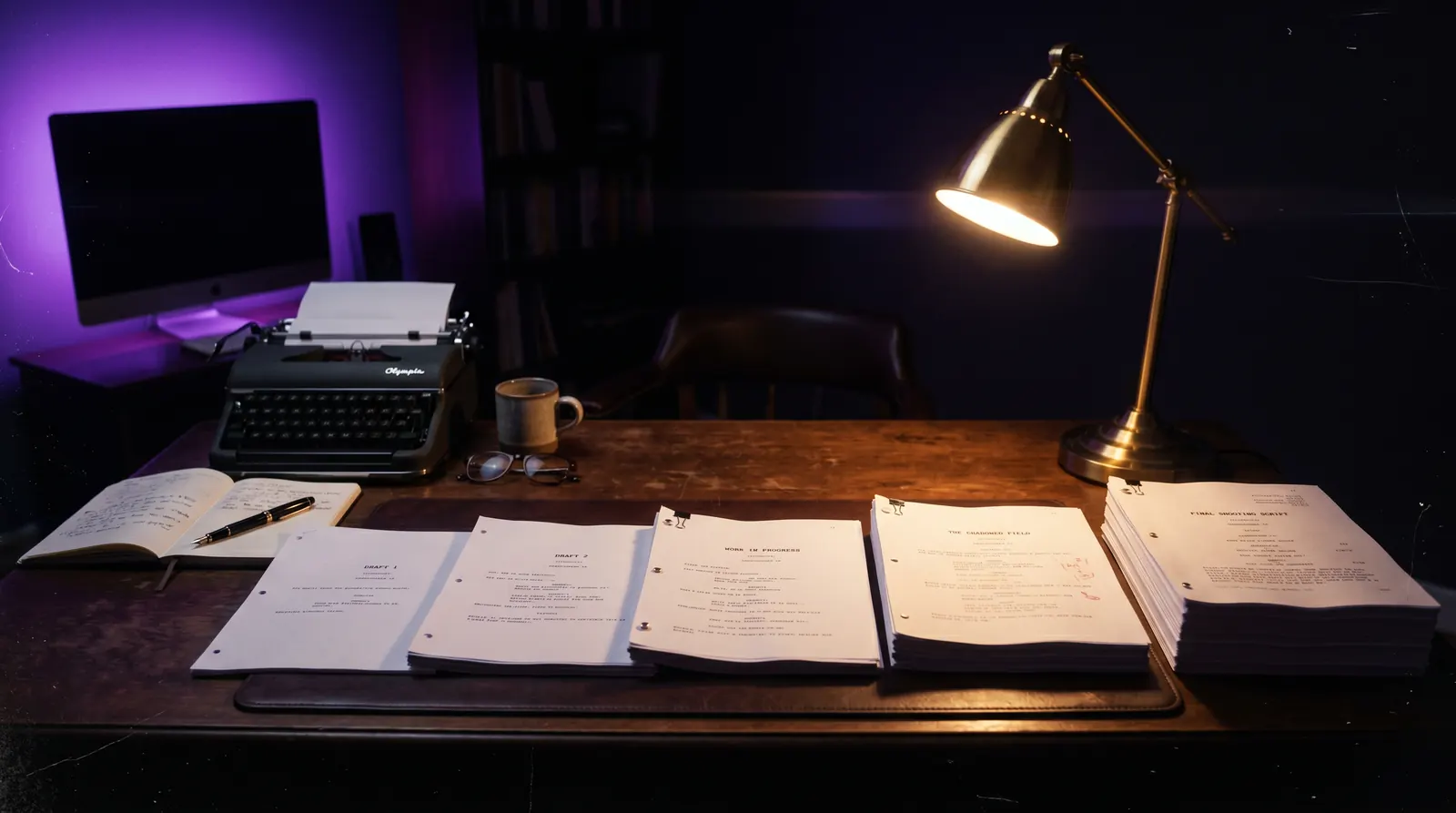

Short answer: a 30-second commercial script runs about 60 to 75 spoken words, and a 60-second spot runs about 130 to 150 words, based on a natural voiceover pace of roughly 2.5 words per second. Page count does not apply the way it does to features or TV: most 30-second scripts fit on half a page in two-column AV format, and even a 60-second spot rarely fills a full page.
The precise answer, by length
Commercials are timed in words and beats, not pages, because the format itself, two-column audio/video, packs far more into a page than a screenplay does.
| Spot length | Spoken word count | Typical page length | What fills the rest |
|---|---|---|---|
| 15 seconds | 30-38 words | Well under half a page | Mostly visual beats, minimal dialogue |
| 30 seconds | 60-75 words | About half a page | Setup, one turn, tagline |
| 60 seconds | 130-150 words | Close to a full page | Room for a second beat or testimonial |
| 90 seconds | 195-225 words | 1-1.5 pages | Rare outside branded content and pre-roll |
For how this compares to page-based formats like features and TV, see How Long Should a Script Be?. For the timing logic behind the words-per-second convention, Script Timer: How to Time a Screenplay Accurately covers the same math applied to dialogue-heavy scenes.
The nuance that changes the answer
Word count is a starting point, not a guarantee, for two reasons specific to commercials.
Silence and visuals eat seconds too. A 30-second spot is not 30 seconds of talking. Product shots, logo holds, and reaction beats can take a third of the runtime without a single word of dialogue, so a script written to the full 75-word ceiling can still run long once the director's visual pacing is added on top.
Read pace is not fixed. 2.5 words per second assumes a natural, unhurried voiceover read. A slower, more deliberate read for a luxury or pharmaceutical spot can drop that to 2 words per second, cutting the usable word count by 20 percent for the same runtime. A brisk, energetic read for a retail or youth-targeted spot can push past 3 words per second. Always time a read aloud at the pace the spot will actually use before locking the script.
Try it free
Try Screenweaver for free on your script
It is free. Import your existing project, get a clearer view of your outline, and regain control of your story structure in minutes.
Start FreeHow to check yours in seconds
Do not guess whether your script fits its slot by eyeballing the word count. Paste your script into the free Script Time Calculator to check your pacing against the runtime you are writing for.
Free tool: the Script Time Calculator estimates runtime from page count or pasted script text in seconds, no signup.
FAQ
How many words is a 30-second commercial script?
About 60 to 75 spoken words at a natural voiceover pace of roughly 2.5 words per second. Scripts with a slower, more deliberate read style should target the lower end of that range.
Does a 60-second commercial need a full page?
Close to it, but rarely a full page exactly. Two-column AV format packs more per page than a screenplay, so 130 to 150 words of dialogue plus visual direction commonly fits just under one page.
Why does my commercial script read fine but run long on camera?
Word count alone does not account for silent visual beats: product shots, logo holds, and reaction shots that take screen time without dialogue. Time a full read aloud, including planned pauses, before assuming the page matches the runtime.
Is there a one-page-per-minute rule for commercials like there is for features?
No. Commercials are timed by words per second and by beat, not by the page-to-minute convention that applies to screenplays, because the two-column AV format is far denser than standard screenplay format.
Final Step
Build your next script with Screenweaver
Move from ideas to production-ready pages faster with timeline-native writing and AI-assisted story flow.
Try Screenweaver