
An AI commercial goes from brief to a broadcast master in seven phases: script, board, cast, generation, edit, clearance, delivery. Generation is the shortest phase and the one everybody talks about. Clearance is the one that decides whether the spot airs. A 30-second spot has been done end to end in three days for about $2,000; two weeks is the honest planning figure.
This article is the commercial chapter of the AI filmmaking guide and of the how to make an AI film walkthrough. Those cover the craft of generating shots. This one covers what an ad adds on top: a client, a claim, a regulator, and a delivery spec.
Two ads that actually aired
Start with the two cases that have public numbers, because they sit at opposite ends of the budget.
The Kalshi spot ran during Game 3 of the 2025 NBA Finals, in June 2025. PJ Accetturo made it with Google's Veo 3, using Gemini to turn shot descriptions into prompts, in two to three days from idea to air. It cost about $2,000. He reported 300 to 400 generations to get 15 usable clips, which is roughly 25 takes per kept shot. Kalshi had been quoted six to seven figures by production companies, and the network approved the ad for broadcast. The NPR write-up has the background.
Coca-Cola's 2025 holiday campaign is the other end. Secret Level and Silverside AI made two AI versions of Holidays Are Coming, one built for the US market. Coverage of the studio's behind-the-scenes video reported around 70,000 generated clips for a spot of roughly 20 finished shots. Jason Zada, Secret Level's founder, put the team at about 20 people against the 50 or so a conventional version would need. Two production details matter more than the headline number: there are no speaking characters in the ad, and the logo was composited by hand because generated text still comes out wrong.
Kalshi kept one clip in 25. Coca-Cola, on the reported numbers, kept far fewer. The film side of this blog measures 2.4 takes per kept shot on a narrative short. Ads burn ten times that, because every frame has to survive a client, then a clearance body, then a broadcast QC. Budget for it from the start; the cost mechanics are in AI film production cost.
The workflow at a glance
| Phase | Deliverable | Who signs it off | Realistic days for a :30 | What the model does |
|---|---|---|---|---|
| 1. Brief to script | A/V script, claims list | Client, legal | 2 | Nothing yet |
| 2. Board and animatic | Panelled board, timed animatic | Client | 2 | Generates panels from the script |
| 3. Cast and product | Character sheets, product plates | Client, brand team | 1 | Generates the cast, never the product |
| 4. Generation | Kept clips, generation log | Director | 2 to 3 | The visible work |
| 5. Edit, sound, mix | Rough cut, then loudness-compliant mix | Client | 2 | Voices, music, some sound design |
| 6. Clearance | Script approval, substantiation, roughcut, final | Clearance body or network | Runs from day 1 | Nothing |
| 7. Delivery | Clocked master, cutdowns, verticals | Media agency | 1 | Nothing |
Clearance is not a phase at the end. In the UK it starts with the script, before a single frame exists. And the model is idle for four of the seven rows. The reason the Kalshi spot took three days is that Kalshi wrote the dialogue, approved fast, and aired on a network that said yes. Those are client behaviours, not model features.
Phase 1: the brief becomes a script and a claims list
Write the spot in two columns. The A/V format puts video on the left and audio on the right, and it exists because a commercial is timed to the second. A :30 carries 60 to 75 spoken words; the commercial script length guide has the per-second arithmetic. Prompts come later. Every prompt will be derived from a video-column line, so a vague line makes a vague prompt.
Then do the thing film scripts never need: pull every claim out of the script into a list. "Fastest charger in its class", "clinically proven", "20 percent off until Sunday". Each one will need evidence, and the time to know that is now. Clearcast, the body that vets every commercial airing on UK television, asks to see the initial script first and almost always asks for substantiation of the claims before it green-lights production. In the US there is no single pre-clearance body, but network standards departments review spots before air and the FTC acts on deceptive claims afterwards, so the same list serves you there.
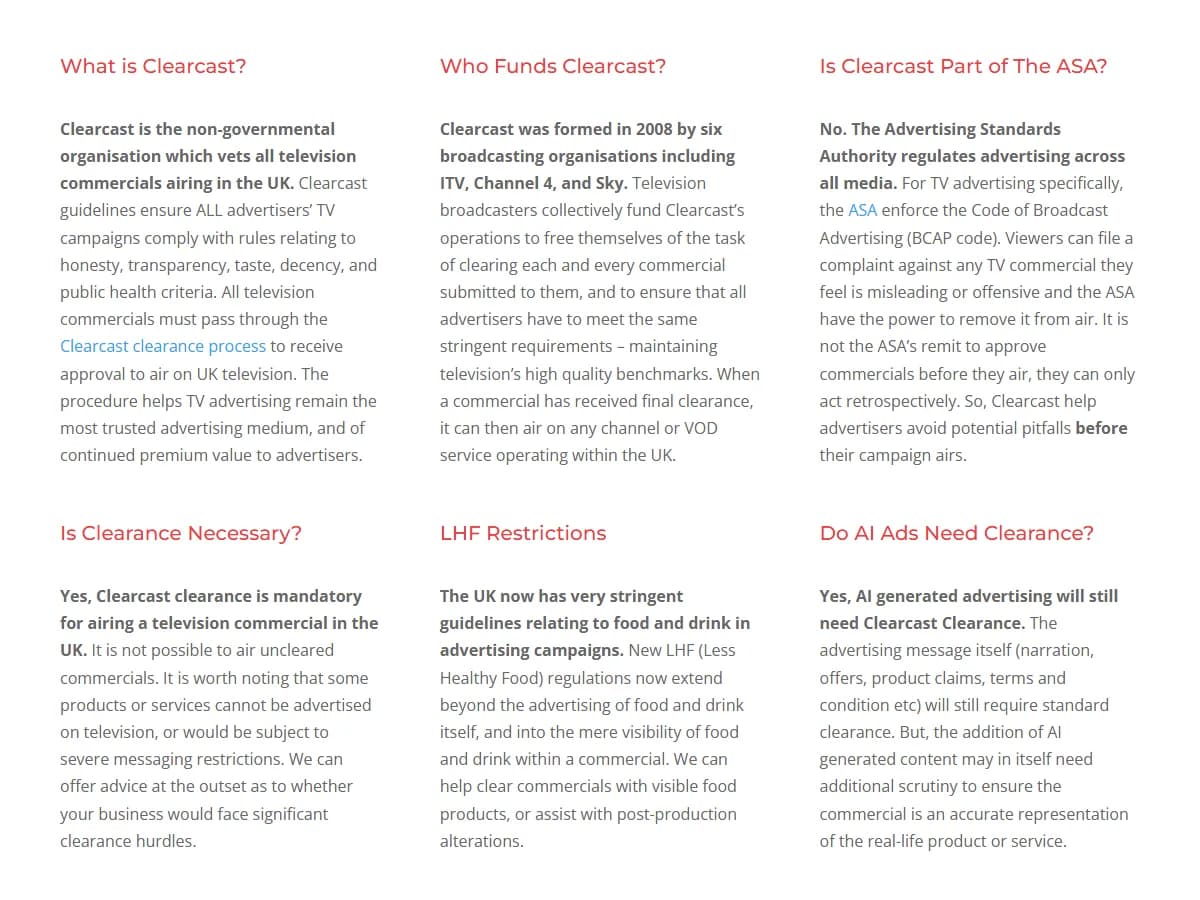
The Clearcast clearance FAQ on jms-group.com, a UK production company that handles submissions, captured 21 September 2026. Note the last box.
The product on screen has to be the product. A generated demonstration that shows the thing doing something it does not do is a misleading demonstration under the same BCAP rules as a faked practical one. Decide in the script which shots will contain the real product and mark them. Those become composite shots, and they change the board.
Phase 2: the board is the approval document
Board the :30 before generating anything. The commercial storyboard guide covers the panel count, the first five seconds and how to board a :30 so the :15 and the :06 fall out of it. What matters here is the board's second job: it is the artefact the client approves, and from then on the model's job is to reproduce it.
Generate the panels from the script so each one carries the framing, the character reference and the product placement, then cut them into a timed animatic against a scratch voice track. If the animatic reads at 29 seconds with the legal supers on screen long enough to be read, you have a spot. If it reads at 34, no amount of generation will fix it, and you have found out for the price of an afternoon.
The generation log starts here too. Number every panel. Every clip you generate later inherits the panel number, so when the client asks why shot 7 changed between roughcut and final, you can answer.
Phase 3: casting a synthetic cast, plating a real product
For people, build one reference sheet per character before generating a single clip, then cite it in every prompt. The reference method for character consistency is the same as for a short film, with one addition: never build a sheet from a real person's likeness without a signed release. A generated face that resembles a real actor is a claim you cannot substantiate and a legal exposure you did not budget for.
For the product, do not generate it. Shoot it, or use the brand's existing packshots, and composite it into the generated shots. Coca-Cola's studio did exactly that with the logo. Models still mangle label typography, bottle proportions and the exact red of a brand colour, and clearance will notice before the client does. Plan the composite: a generated table, a real bottle, a matched shadow. The character drift article explains why a product drifts across clips even when a face holds.
Phase 4: generation, with a take budget agreed in advance
Agree the take budget with whoever pays before you open the model. The two aired spots give the range: 25 takes per kept shot at the disciplined end, and a number with four zeros at the other. A useful working set for a :30 with 15 kept clips of eight seconds, at the API rates in the AI video cost calculator's September 2026 dataset:
| Model (rate per second) | 5 takes per kept shot, 75 clips | 10 takes, 150 clips | 25 takes, 375 clips |
|---|---|---|---|
| Seedance 1.0 Pro or Kling 2.6 Pro ($0.07) | $42 | $84 | $210 |
| Veo 3.1 Fast ($0.12) | $72 | $144 | $360 |
| Veo 3.1 ($0.40) | $240 | $480 | $1,200 |
The right-hand column at the bottom is roughly the Kalshi profile, and it lands near the $2,000 he quoted once you add editing time and the subscriptions around it. What the table does not show is that the take count is not evenly spread. Two or three shots, usually the ones with the product in hand or a specific gesture, eat half the budget. Board them tighter, generate them first, and if one will not land in 40 takes, change the shot rather than the seed.
Generate from the board, one panel at a time, with the character sheet cited in every prompt. Split the script into clip-length pieces with the scene to clip splitter so no clip asks the model for more than one action in eight seconds. Keep dialogue off camera or on a cutaway unless you have tested lip sync on this model with this character; the AI voices and lip sync guide is honest about where that stands. Coca-Cola avoided speaking characters altogether, and they had 20 people.
Phase 5: edit, voice, music, and a mix that passes QC
Cut against the animatic, which already has the timing the client approved. If a generated clip is beautiful and two seconds too long, the animatic wins.
Voice and music go through the same commercial-rights check as the pictures. Use a voice service on a plan that includes a commercial licence, and a music service on a plan that grants commercial use rights; the plan-by-plan detail is in the production cost breakdown. A free-tier voice in a paid spot is the kind of thing that surfaces in a rights audit a year later.
Then the mix, which is where AI ads made by filmmakers fail broadcast QC for reasons that have nothing to do with AI. US broadcast commercials fall under the CALM Act, which references the ATSC A/85 recommended practice and a target of -24 LKFS. UK and most European broadcasters work to EBU R128: -23 LUFS, with a true-peak ceiling of -1 dBTP. Both measure with the same ITU-R BS.1770 meter, so one meter covers both, but the targets differ by one LU and the peak ceilings differ too. Export a master per territory. Nobody in the chain will re-mix a spot that arrives one LU hot; it comes back.
Try it free
Try Screenweaver for free on your script
It is free. Import your existing project, get a clearer view of your outline, and regain control of your story structure in minutes.
Start FreePhase 6: clearance and disclosure, running from day one
The UK process is the clearest one to learn from, even if you never air there.
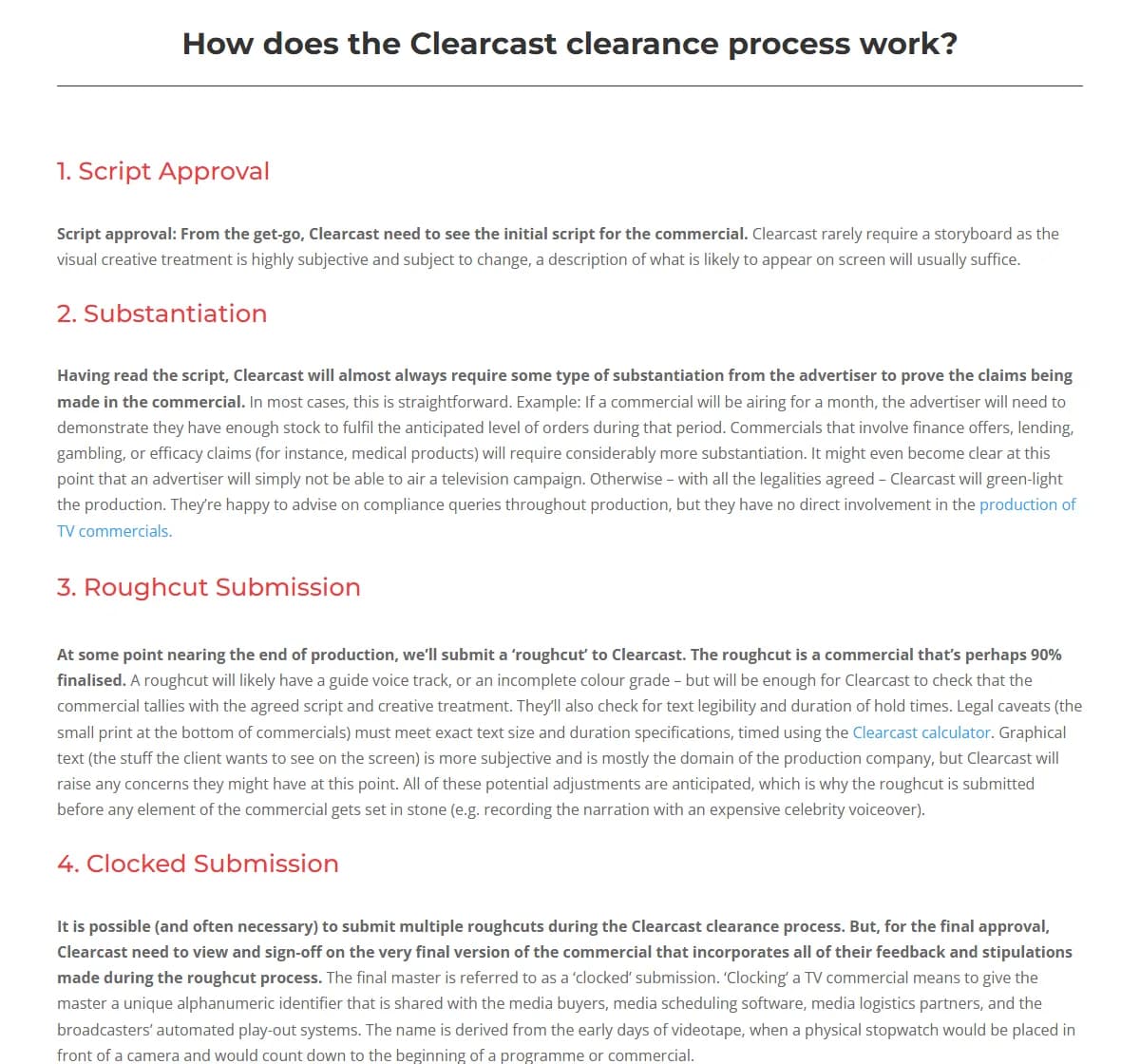
The four steps of Clearcast clearance as laid out on jms-group.com, captured 21 September 2026.
Four gates. Script approval, where Clearcast reads the script and rarely needs the board. Substantiation, where every claim on your list gets evidence, and where a finance, gambling or health claim gets much more scrutiny than a stock-level one. Roughcut, submitted at about 90 percent finished with a guide voice, where they check the spot matches the approved script and that legal supers meet size and hold-time rules. And the clocked submission, the final master carrying a unique identifier that the broadcaster's play-out system will recognise.
Two AI-specific points from the same page. AI-generated advertising still needs clearance, and the AI content may need extra scrutiny to make sure the commercial accurately represents the real product. And the page states that gen-AI content must be declared to viewers in the supers, the small print at the bottom of the commercial. Broadcasters are not hostile to any of this: Channel 4 launched its Smart Ad Engine in November 2025, a free generative service for small advertisers with Clearcast submission offered as a paid add-on, and Sky Media followed with an AI toolkit in January 2026. When the broadcasters sell the tool, the clearance path is real.
Then the layer above the broadcaster. In the EU, Article 50 of the AI Act applies from 2 August 2026, which was seven weeks ago. Deployers of AI systems must inform people when they are exposed to deepfakes, and providers must add machine-readable marks to generated content. The Commission's guidelines and the Code of Practice on transparency of AI-generated content spell out what counts.
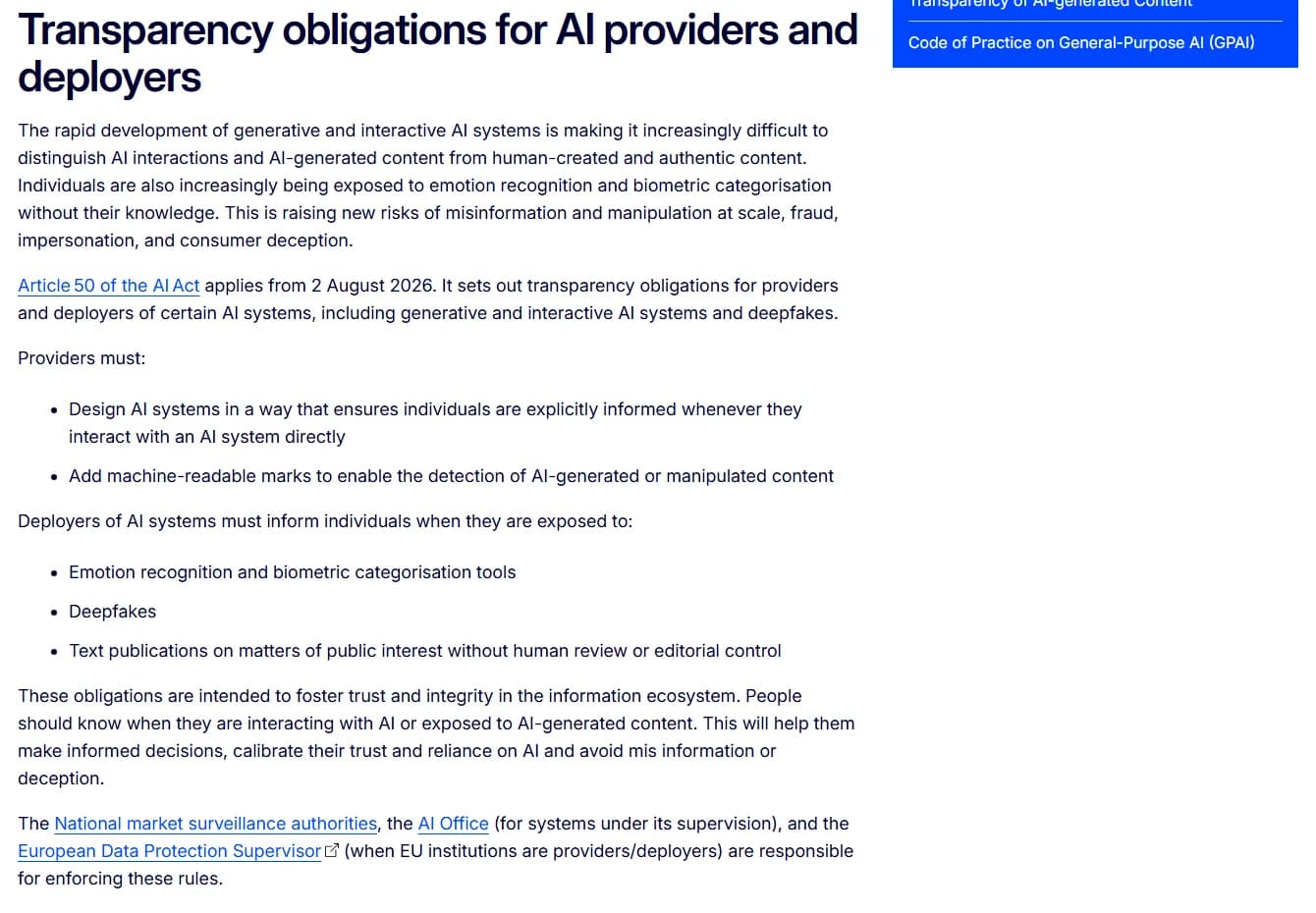
The transparency obligations section on digital-strategy.ec.europa.eu, captured 21 September 2026.
A spot with a synthetic presenter who looks like a real human is squarely the case the article was written for, and a label is the cheapest compliance measure you will ever buy. A stylised animal spot is a different question, and one to put to the client's lawyer rather than to a blog. The platform side, meaning YouTube's altered content toggle and Meta's AI labels for the digital versions of the same spot, is covered in AI film disclosure rules.
Phase 7: delivery, and the paperwork that travels with the file
The media agency wants a clocked master per territory, cutdowns at :15 and :06, a 9:16 vertical for social, and, increasingly, a note on what was generated. Build the last item from the generation log you started in phase 2: panel number, model, date, seed where the model exposes one, and which shots contain the real product. It answers the client's provenance question, it is the substantiation trail if a demonstration is queried, and it is what an Article 50 conversation will ask for.
Check the model's usage terms against the client, not against yourself. Runway states that content made on its paid plans can be used commercially, with product advertising listed among the examples, and that the free plan carries no commercial rights. Midjourney's terms require companies above $1,000,000 in annual gross revenue to be on its Pro or Mega plan. A freelancer on a $10 plan generating for a client above that line has a problem the client will discover at the worst moment. Read the terms of every model in the chain in the client's name, once, and put the answers in the delivery note.
Checklist before the master leaves the building
- Claims list written at script stage, each claim with its evidence attached.
- Product shots identified as composites, real product plated, no generated label typography in the final.
- Character sheets built from consented references only; no real-person likeness without a release.
- Animatic timed at length with legal supers held long enough to read.
- Generation log complete: panel number, model, date, takes generated, take kept.
- Voice and music on plans with commercial rights; plan names recorded.
- Mix at -24 LKFS for US broadcast, -23 LUFS and -1 dBTP for EBU R128 territories; one master per target.
- Gen-AI declaration in the supers where the clearance body asks for it; AI label on the platform versions.
- Model usage terms checked against the client's revenue and use case, in writing.
- Clock number or industry identifier on the final master; cutdowns and vertical delivered with it.
Tools for this
The AI video cost calculator turns a shot count and a take profile into a generation budget before you pitch it. The scene to clip splitter breaks the A/V script into single-action clips of the length your model generates. The AI character consistency sheet builds the reference sheet each prompt will cite. And ScreenWeaver generates the board itself from the screenplay, which is where the panel numbers come from.
FAQ
How long does it take to produce a 30-second commercial with AI?
Three days is the fastest documented case, the Kalshi NBA Finals spot, with a client who wrote the dialogue and approved fast. Two weeks is the honest figure for a client with legal review and a clearance body in the loop, because script approval and substantiation happen before generation, and the roughcut and final go back to the clearance body after it.
How much does an AI commercial cost?
The Kalshi spot cost about $2,000 for 15 kept clips from 300 to 400 generations. At September 2026 API rates, generation alone for a :30 runs from about $40 on a budget model with disciplined takes to $1,200 on a premium model at 25 takes per kept shot. Voices, music, editing time and the person doing the work sit on top. The AI film production cost breakdown prices each line.
Does an AI-generated ad need clearance to air on TV?
In the UK, yes, through Clearcast, exactly like any other commercial, with extra scrutiny on whether the generated content accurately represents the real product. In the US, network standards departments review spots before air. The claims in the script are what get checked; how the pictures were made changes which shots get a second look.
Do I have to tell viewers the ad was made with AI?
Where it airs decides. A UK clearance page states that gen-AI content must be declared in the supers. In the EU, Article 50 of the AI Act, in force since 2 August 2026, requires deployers to inform people when they are exposed to deepfakes. On YouTube and Meta the digital versions carry the platforms' own altered-content labels. Label it; the cost is a line of small print.
Can the product itself be generated?
Do not. Composite the real product, or the brand's existing packshots, into generated shots. Generated label text, proportions and brand colours are still unreliable, and a demonstration that shows the product doing something it cannot do is a misleading demonstration under the same rules that apply to a faked practical one.
Which AI video model is best for commercials?
The one whose usage terms allow your client to use the output commercially, first. After that, pick by shot type: the Seedance, Veo and Sora comparison covers strengths per shot. For most :30s, the take budget matters more than the model, because two or three product shots will consume half of it whichever model you choose.
Final Step
Build your next script with Screenweaver
Move from ideas to production-ready pages faster with timeline-native writing and AI-assisted story flow.
Try Screenweaver