
Animation runs on 60 to 72 storyboard panels per minute of finished film, a figure the Animation Guild publishes for television boards. Live action has no fixed number: it is one panel per shot plus one per camera move, which works out to anywhere from 4 to 30 panels per minute depending on genre. Both numbers have cases where they lie, and the lies are expensive.
Frame count is the first thing a board tells you about a project's cost and schedule, before a single drawing exists. Whether the panels come from a storyboard artist or from the AI storyboard tool, the count is what you budget against. So it is worth getting right.
The numbers, by medium
| Medium | Panels per minute | Where the figure comes from |
|---|---|---|
| TV animation, cleaned-up boards | 60 to 72 | Animation Guild time requirements (20 to 24 board pages per minute) |
| TV animation, action-heavy show | 120 to 144 | Same source, which says to double the count for action |
| Feature animation, all drafts | Several hundred to over 1,000 | WALL-E was built from about 125,000 drawings for a 98-minute film |
| Live-action drama | 4 to 8 | One panel per shot at a 10 to 15 second average shot length, plus moves |
| Live-action action sequence | 15 to 30 | One panel per shot at a 4 second average shot length, plus moves and inserts |
| Commercial, :30 | 22 to 44 (11 to 22 for the spot) | Boards run 11 to 22 panels for 27 usable seconds |
| Music video | 10 to 30 | Cut rate of the track, one panel per cut |
| AI-generated film | 12 to 20 | One panel per generated clip, clips of 3 to 5 seconds |
Two different questions hide in that table. Animation asks how many panels the production needs to ship, because the board is the film's blueprint and every shot has to exist on paper before layout starts. Live action asks how many panels the director needs to draw, because most shots never get boarded at all. Mixing those up is how you arrive at absurd numbers, like a 90-minute drama needing 6,000 frames.
Animation: the Animation Guild figure
The most concrete public number comes from a 2016 post on the Animation Guild's site, IATSE Local 839, where a veteran television board artist laid out the physical time it takes to produce cleaned-up panels from a script.
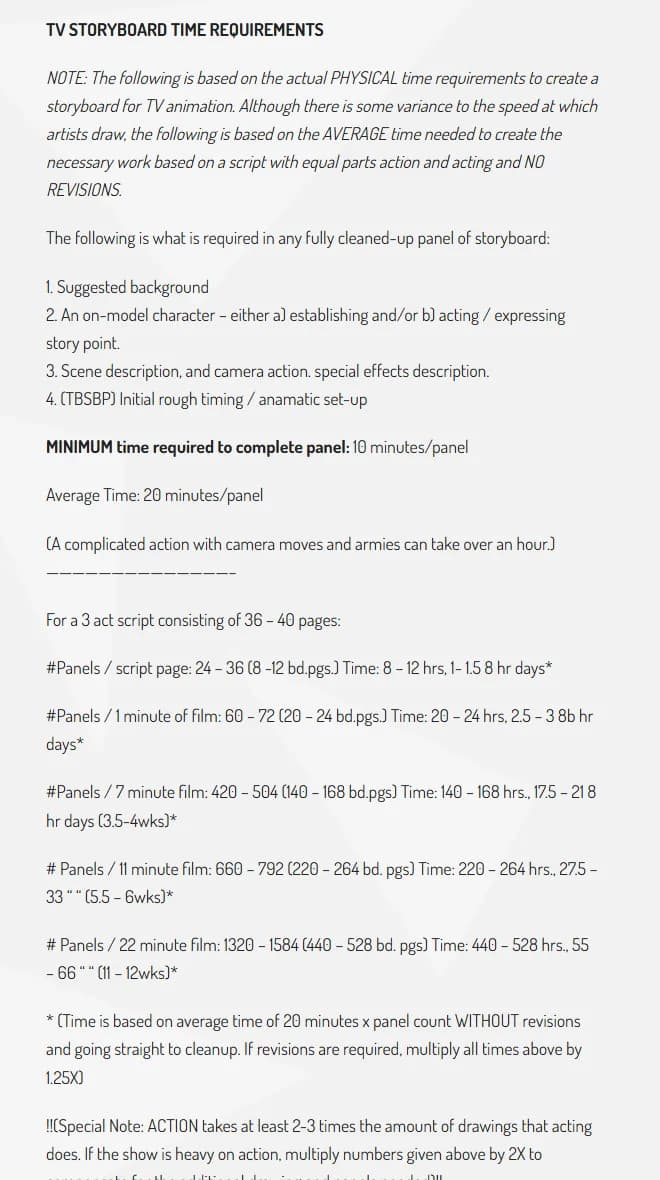
The time requirements section of the Animation Guild post by Steve Hulett, published 16 March 2016, captured 12 September 2026.
The key ratios:
- 24 to 36 panels per script page, which is 8 to 12 board pages at three panels a page.
- 60 to 72 panels per minute of film, or 20 to 24 board pages.
- 10 minutes minimum per panel, 20 minutes on average, with no revisions.
Run those through an episode and you get the schedule the post is actually arguing about. A 7-minute short is 420 to 504 panels and 140 to 168 hours of drawing. An 11-minute episode is 660 to 792 panels. A 22-minute episode is 1,320 to 1,584 panels, 440 to 528 hours, or 11 to 12 weeks for one artist working 40-hour weeks. The post adds two multipliers worth memorising: 1.25x for revisions, and 2x for an action-heavy show, because action takes two to three times the drawings that acting does.
Notice what the 60 to 72 figure includes. Each panel in that count is a cleaned-up drawing with a suggested background, an on-model character, a scene and camera description, and (in Storyboard Pro) initial timing. It is not a thumbnail. Thumbnails run faster and looser, and the post's own formula charges them at 0.75x the finished-board hours.
The figure also assumes a script with equal parts action and acting, at roughly one page per minute. That assumption ports across from screenwriting, and it carries the same caveats: a page of dense description plays longer than a page of quick dialogue. The one-page-per-minute accuracy test goes through where the rule bends, and every bend moves the panel count with it.
Why feature animation blows the number up
The 60 to 72 rate is for panels that ship. Feature studios count something else: every drawing produced across every version of every sequence. That is why the Pixar numbers look impossible next to the Guild ratios. Boords reports, citing The Art of WALL-E, that WALL-E was built from about 125,000 storyboard drawings, against a typical Pixar production of 50,000 to 75,000. For a 98-minute film, 125,000 drawings is roughly 1,275 per minute.
Nobody drew 1,275 panels for a single minute of finished film. They drew the same minute ten or twenty times, in story reels that were screened, torn down and rebuilt. The final reel of any given sequence is closer to the Guild rate. The difference between the two numbers is the cost of iterating on story before animation, and it is the reason the animatic exists. (Where the animatic sits next to the board and 3D previs is laid out in previs vs storyboard vs animatic.)
Live action: count shots, not minutes
There is no storyboard-per-minute rule for live action because live action boards shots, and shot counts vary by a factor of four across genres. The right method is to estimate shots first.
Stephen Follows analysed a crowd-sourced database of films released between 1997 and 2016 and found the average feature contains 1,045 shots. Genre moves that number a long way. Action films average 1,913 shots at a 4-second average shot length. Horror sits at the other end with a 15.7-second average, almost four times longer. Drama runs around 15 seconds, comedy around 10, thrillers 10, sci-fi 6.2.
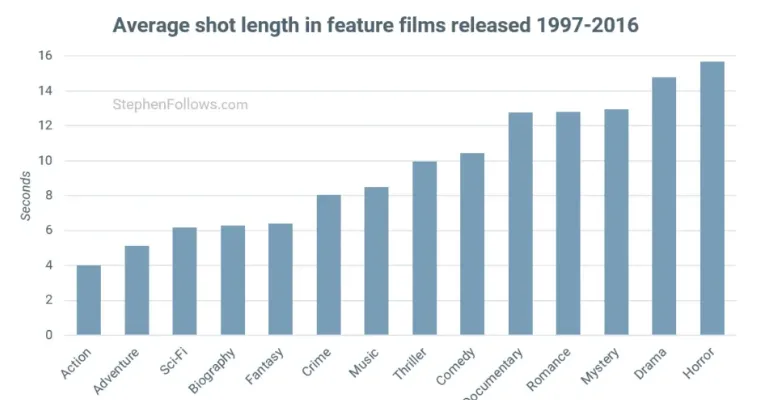
Average shot length by genre, from Stephen Follows' article of 3 July 2017, captured 12 September 2026.
Divide 60 by the average shot length and you get shots per minute: 15 for action, 6 for a thriller, 4 for a drama. Then apply the rule of thumb: one panel per shot, plus a panel for each significant camera move or reframe inside a shot, plus one for any insert the tabletop unit will shoot on its own.
| Genre | Average shot length | Shots per minute | Panels per minute, boarded fully |
|---|---|---|---|
| Action | 4.0 s | 15 | 18 to 30 |
| Sci-fi | 6.2 s | 10 | 12 to 20 |
| Thriller | 10 s | 6 | 7 to 12 |
| Comedy | 10.4 s | 6 | 6 to 9 |
| Drama | 14.8 s | 4 | 4 to 8 |
| Horror | 15.7 s | 4 | 4 to 8 |
The right column assumes you board the whole minute, and on a live-action film you usually should not. A two-hander at a kitchen table can shoot from a shot list and a floor plan; the shot list vs storyboard comparison has the checklist for which scenes earn panels. On most features, the boarded scenes are the action, the VFX, the stunts and anything with a crane, which means the real per-minute average across the whole film is much lower than the table, and much higher inside the sequences that matter.
A practical shorthand for a live-action feature: multiply the boarded scenes' page count by the genre's shots per minute, then add 30 percent for moves and inserts. A 12-page chase in an action film comes out around 12 x 15 x 1.3, or roughly 230 panels. At 15 to 20 minutes a panel that is one to two weeks of a storyboard artist's time, which is the number a producer wants before they ask about rates.
Try it free
Try Screenweaver for free on your script
It is free. Import your existing project, get a clearer view of your outline, and regain control of your story structure in minutes.
Start FreeCommercials and music videos: the cut rate decides
Short-form flips the logic again. A :30 spot has 27 usable seconds after the slate and the end card, and its board is short enough that every panel is drawn. Boards for a :30 run 11 to 22 panels depending on the cutting style, which is 22 to 44 per minute if you scale it up, and the commercial storyboard guide has the full duration table for :06, :15, :30 and :60.
Music videos board to the track. Count the cuts you intend per chorus and per verse and that is the panel count; a performance-heavy video with long takes might need ten panels per minute, a fast-cut pop edit over thirty. The music video storyboard workflow starts from the waveform for exactly this reason.
AI-generated film: one panel per clip
This is the newest case and the one with the cleanest arithmetic. Video generation models produce clips of a few seconds each, so the storyboard and the shot list collapse into the same document: each panel is the first frame of one clip.
At 3 to 5 seconds a clip, a minute of finished film is 12 to 20 panels, and the count is not an estimate, it is the production plan. In ScreenWeaver, the shot breakdown returns a duration per shot and defaults to four seconds when the script gives no hint, which makes 15 panels per minute the working average; the script-to-storyboard walkthrough shows where that duration field lives. Cost tracks the count directly, since each rendered panel spends credits, so trimming a scene from 18 shots to 14 at the shot-list stage is a real saving, before any image exists.
In ScreenWeaver
Make this shot in ScreenWeaver
The pipeline behind the Medium shot clip of our film techniques library. Click the nodes to see how they are set.
Click a node to see its settings, drag it to move it.

What moves the number
Thumbnails are not panels. An artist thumbnailing a sequence at 30 per page is exploring, not delivering. Count only the panels that survive into the animatic or the shooting board, or your schedule will be off by a factor of three.
Dialogue scenes need fewer than you think. Two characters, one location, standard coverage: a master, two singles, two over-the-shoulders. Five panels can cover a three-minute scene if the blocking never changes, because the board's job there is geography, not rhythm. The how-to guide for boarding a screenplay suggests three to six panels per dialogue scene as a floor.
Camera moves multiply panels. A single dolly-in from wide to close is one shot and at least two panels, start frame and end frame. A crane that tilts down and pushes in is three. Boards in anime notation solve this with an arrow inside the frame and a time column, which is why an e-konte page can carry more information per panel than a Western board.
Aspect ratio changes the page, not the count. A 2.39:1 board fits fewer panels per sheet than 16:9 at the same readable size, so a 400-panel sequence is more pages, not more drawings. The free storyboard template covers which panels-per-page layout fits which format.
Revisions are where the money goes. The Guild multiplier of 1.25x for revisions is conservative for anything with a client. A commercial board that goes through agency, client and legal can be drawn three times over. Budget the redraws, not the first pass.
How to estimate yours
- Get the runtime. If you only have a script, paste it into the script time calculator and take the minutes, not the page count; a dense action page plays longer than a minute and a fast dialogue page shorter.
- Pick the medium row from the first table. Animation uses 60 to 72 per minute for everything; live action boards only the scenes that need it.
- For live action, estimate shots per minute from the genre's average shot length, then add 30 percent for moves and inserts.
- Multiply by the boarded minutes only.
- Apply the multipliers: 1.25x if the board will be revised, 2x for action-heavy animation.
- Decide the page layout last, with the storyboard template generator, which lets you set panels per page from 2 to 12 without changing the count.
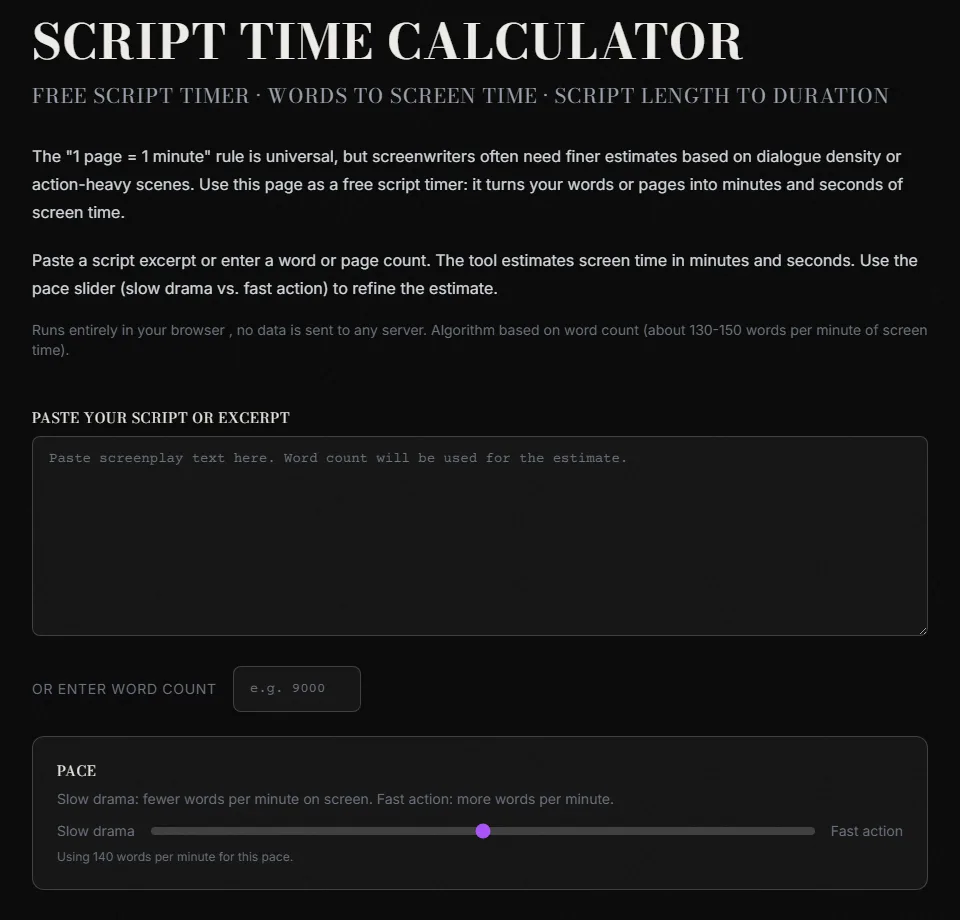
The script time calculator on screenweaver.ai, captured 12 September 2026. It runs in the browser and estimates screen time from word count at 130 to 150 words per minute.
A worked example. A 24-minute animated pilot, moderate action: 24 x 66 is about 1,580 panels at the midpoint, times 1.25 for a round of notes, so roughly 2,000 panels and, at 20 minutes each, around 660 hours of board work before cleanup. The same 24 minutes as a live-action thriller with two boarded set pieces totalling six minutes: 6 x 6 x 1.3 is around 47 panels, a comfortable two days for an artist. Same runtime, a forty-fold difference in drawings. That is why the medium row matters more than any other line in the estimate.
FAQ
How many storyboard panels does a 90-minute film need? For animation, use the Guild ratio: 90 x 60 to 72 is 5,400 to 6,480 cleaned-up panels for the final reel, before counting revisions. For live action, count only the boarded scenes; a drama might board 15 minutes at 4 to 8 panels a minute, so 60 to 120 panels, while an action film boarding 40 minutes at 18 to 30 a minute needs 700 to 1,200.
How many storyboard frames per scene? Three to six for a standard dialogue scene, one per shot plus one per camera move for anything else. A scene's panel count follows its shot count, not its page count, so a one-page fight can need more panels than a five-page dinner.
How long does it take to draw one storyboard panel? The Animation Guild post puts a cleaned-up television panel at 10 minutes minimum and 20 minutes on average, with complicated action panels running over an hour. Rough thumbnails are faster; finished, shaded presentation boards for a commercial can take much longer per frame.
Do AI storyboards change the panel count? No. They change the time and cost per panel, not how many the film needs. One panel per generated clip still means 12 to 20 per minute of finished AI film, and a live-action board generated from a script still has to cover one panel per shot.
Is the 60 to 72 figure the same for feature animation? For the panels that ship, roughly yes. For total drawings produced, no: feature studios iterate whole sequences many times in story reels, which is how WALL-E reached about 125,000 drawings for 98 minutes.
Final Step
Build your next script with Screenweaver
Move from ideas to production-ready pages faster with timeline-native writing and AI-assisted story flow.
Try Screenweaver