
Luma Dream Machine is worth paying for if you produce campaigns, concepts or mood pieces from a brief and you like working on a shared board. Its own Ray models are strong, and its agents plan and generate in parallel. It is a weaker buy for a film. 1080p burns credits four times faster than 720p, the cheapest plan is $30 a month with no free tier on the pricing page, and nothing on the board holds a screenplay.
If you are still comparing tools, our script-to-video tools comparison covers the field. The side-by-side table of Luma and ScreenWeaver is on the Luma alternative page. This review covers what each plan buys in seconds and what App Store reviewers report.
Every figure below comes from lumalabs.ai/pricing and from the Luma Dream Machine listing on the US App Store, read on 27 October 2026.
The verdict
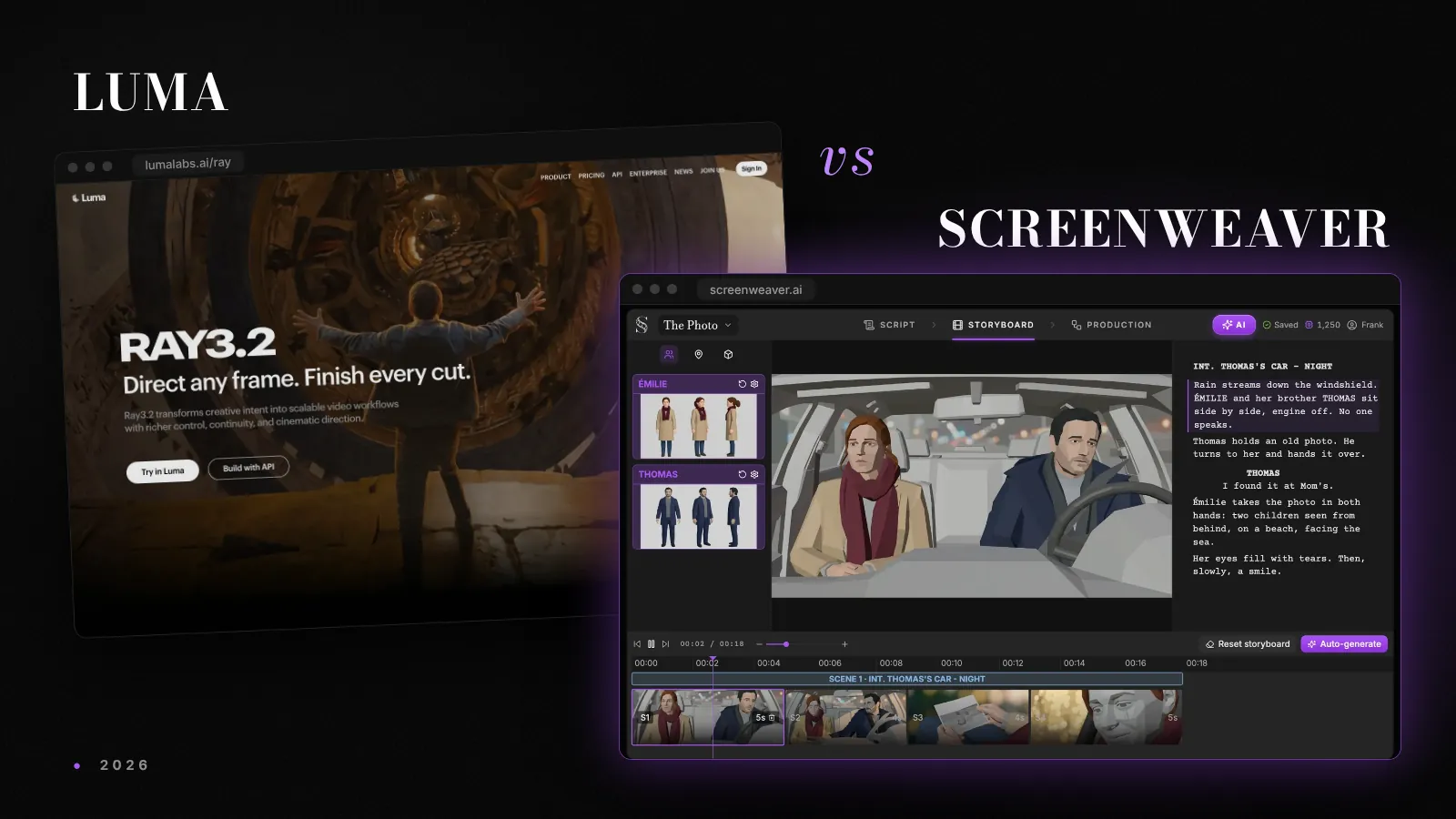
Luma builds its own video models, the Ray family, and wraps them in Luma Agents that brainstorm, pick models, generate in parallel and edit on an infinite board. Ray3.2 and Ray3.14 sit next to partner models: Veo 3.1, Kling 3.0 and 4.0, Seedance 2.0 and 2.5, MiniMax H3 and image models. Master Reference Assets keep characters, products and logos stable across variations.
| You are | Best fit | Cost |
|---|---|---|
| Exploring concepts | Plus | $30/mo, or $25/mo billed yearly |
| Producing campaigns weekly | Pro | $90/mo, or $75/mo billed yearly |
| Running a creative team at volume | Ultra | $300/mo, or $250/mo billed yearly |
| Shared credits, SSO | Team or Enterprise | On request |
| Writing and shooting a whole film | A script-first tool | See the verdict below |
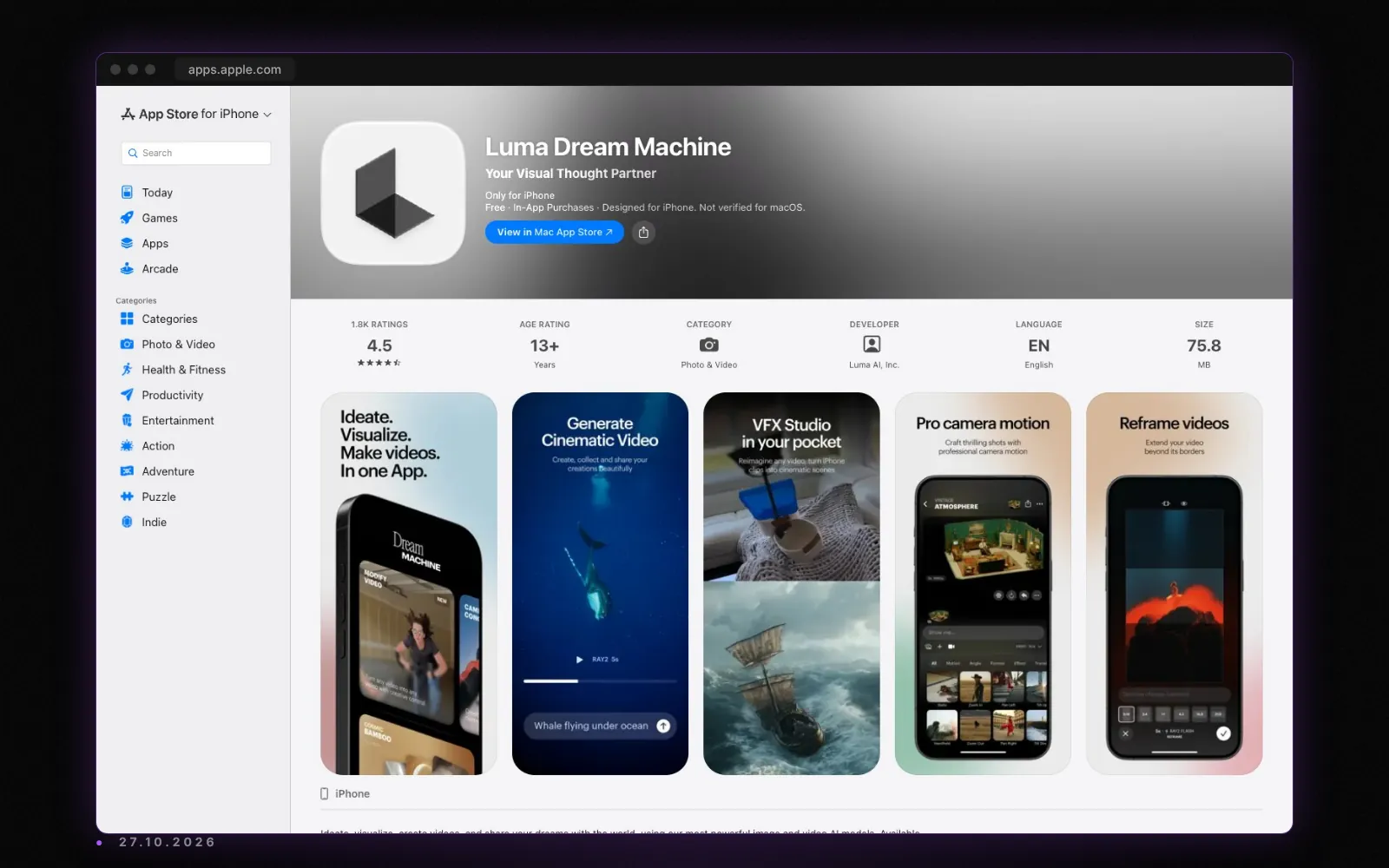
The Luma Dream Machine iPhone app holds 4.5 out of 5 from about 1,800 ratings on the US App Store.
What Luma does well
Ray3.14 is cheap at draft quality. At 4 credits a second in Draft and 10 at 540p, you can explore an idea widely before committing. That matters, because exploration is where most credits go.
HDR and EXR. Ray3.2 outputs HDR and HDR plus EXR, which is rare at this price and useful if footage goes to a colorist.
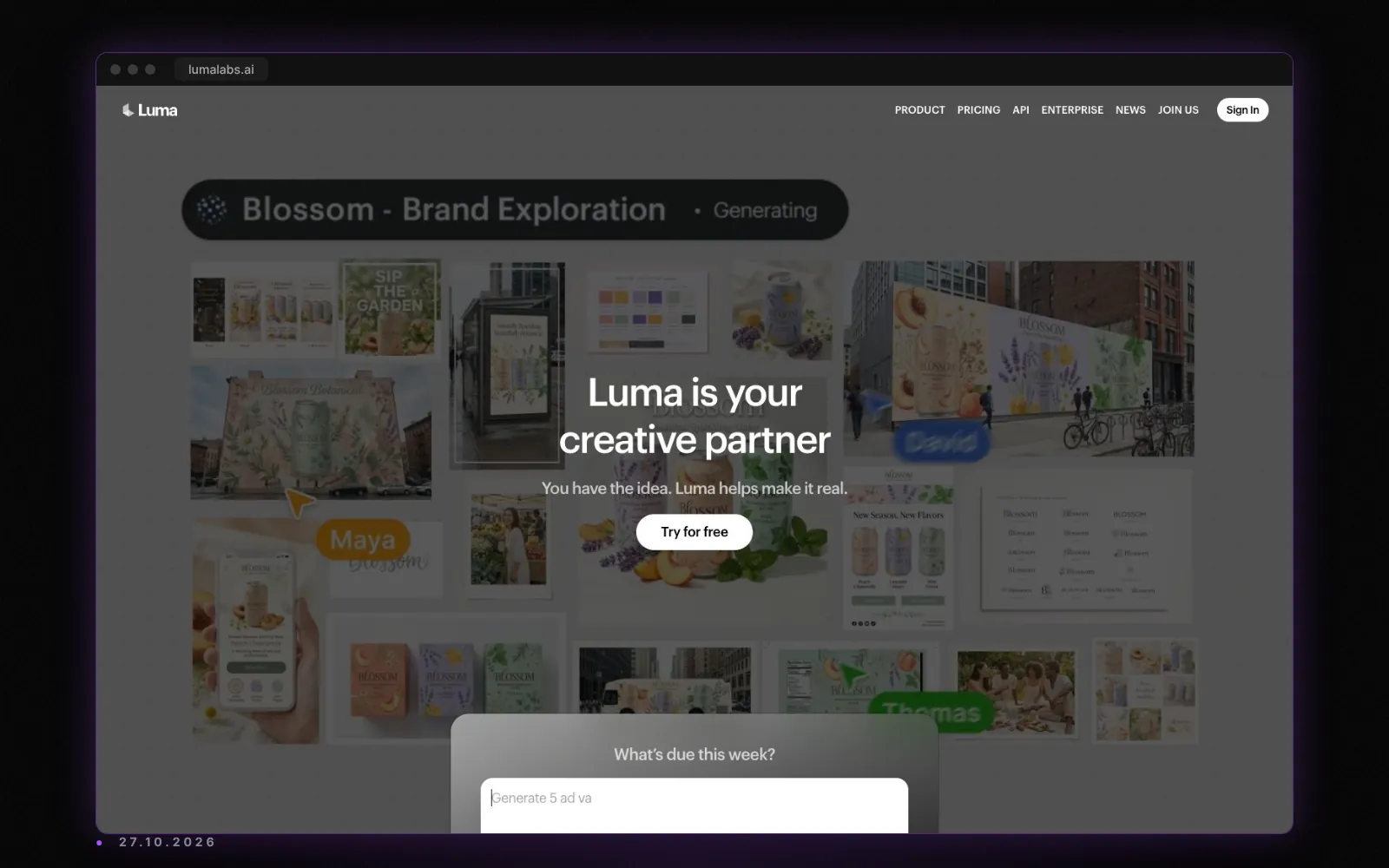
Agents on a board. You brief the agent, it proposes directions, generates variations in parallel and keeps them on one board that collaborators can edit as guests. For a campaign with many deliverables, that layout beats a chat.
References that hold. Master Reference Assets keep a face, a product or a logo consistent, and the app adds consistent characters from a single face image.
Where Luma costs you
Resolution multiplies the price. Ray3.14 text or image to video costs 20 credits a second at 720p and 80 at 1080p. Ray3.2 costs 100 credits per 5 seconds at 720p and 400 at 1080p, and HDR doubles that again. A plan that looks generous at 720p shrinks fast at delivery resolution.
Partner models are expensive here. Veo 3.1 costs 140 credits a second without audio and 280 with it. Seedance 2.5 at 1080p costs 191 credits a second.
No free plan on the pricing page. The entry plan is Plus at $30 a month. The App Store lists a Lite tier at $9.99, so the cheapest way in may be the phone.
No screenplay. Brainstorm mode helps plan, and boards hold characters, story arcs and episodes, but there is no screenwriting editor and no script file import.
Luma pricing 2026: what the credits buy
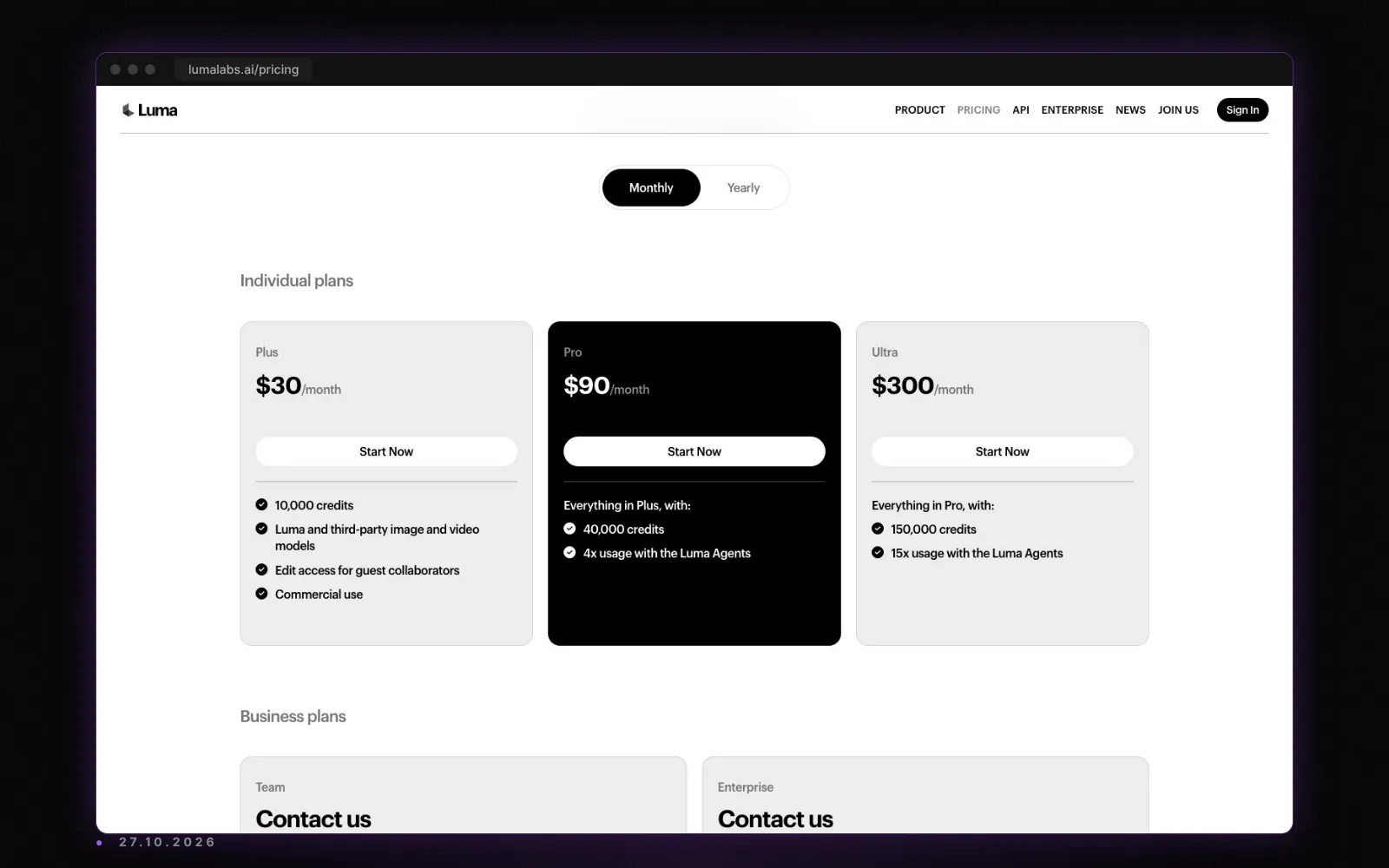
| Plan | Price | Credits | Ray3.14 720p | Ray3.14 1080p |
|---|---|---|---|---|
| Plus | $30/mo ($25 yearly) | 10,000/mo | about 8 min | about 2 min |
| Pro | $90/mo ($75 yearly) | 40,000/mo | about 33 min | about 8 min |
| Ultra | $300/mo ($250 yearly) | 150,000/mo | about 125 min | about 31 min |
Minutes are our arithmetic from Luma's published credits per second for Ray3.14 text or image to video in SDR, before any reroll. Pro and Ultra also raise how much you can use the Luma Agents, 4 and 15 times the Plus allowance.
On Plus, a credit costs $0.003. Ray3.14 at 1080p comes to about $0.24 a second, or $14.40 a minute if every take works. At 720p it is about $3.60 a minute. Count two or three takes per kept shot for a realistic budget. The arithmetic behind that is in the real cost of AI film credits and rerolls.
In the iPhone app, Luma lists Lite at $9.99, Plus at $29.99 and Unlimited at $94.99, with yearly versions at $95.99, $289.99 and $919.99, and credit packs at $4. The listing does not state billing periods next to each item.
Try it free
Try Screenweaver for free on your script
It is free. Import your existing project, get a clearer view of your outline, and regain control of your story structure in minutes.
Start FreeWhat App Store reviewers say
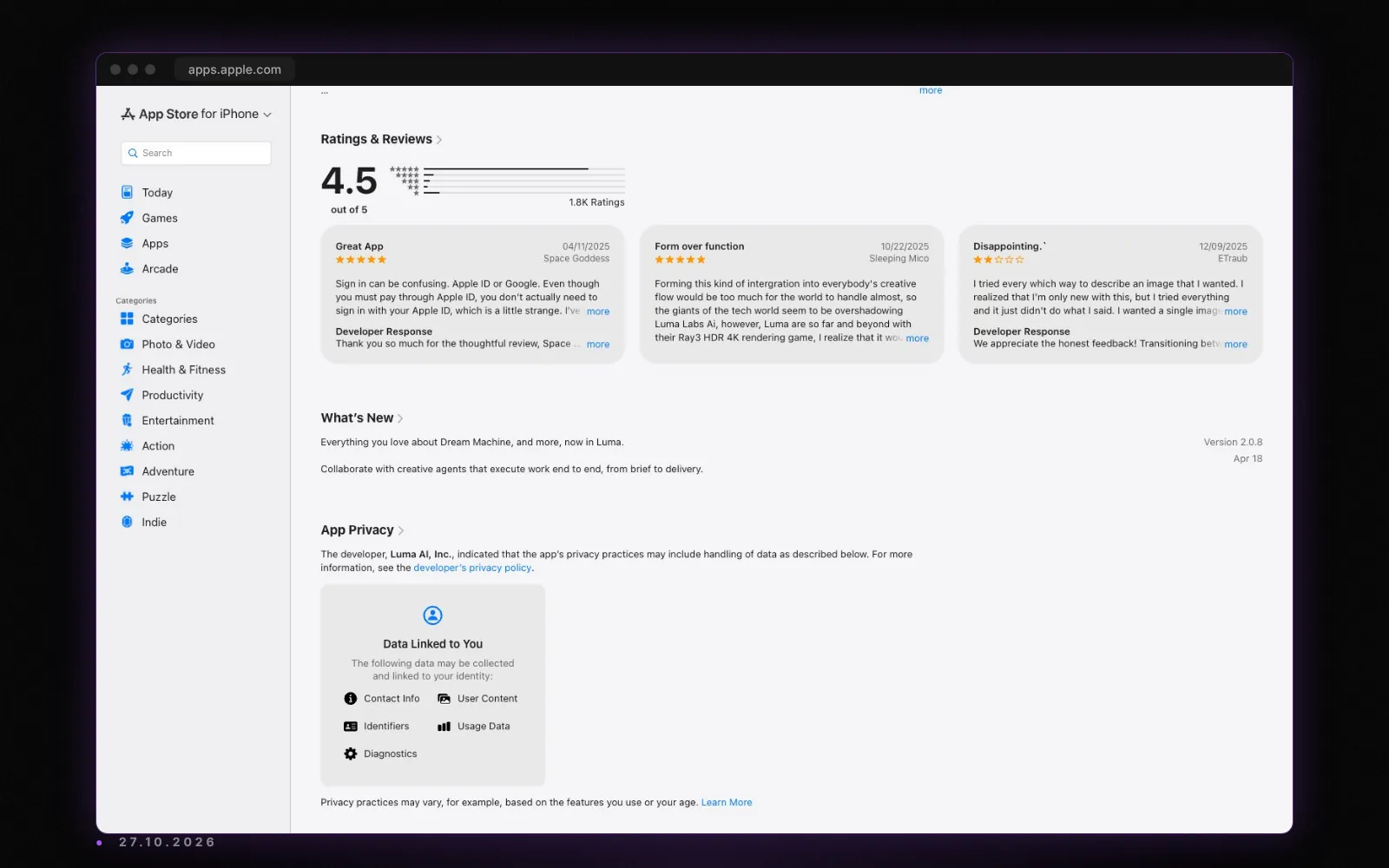
People praise the image quality, the Modify tool that edits images and video with text, and the board. The recurring complaints:
- Few generations per month for the price, and limits on retries.
- Results that do not match the prompt, and corrections that are hard to land.
- Sign-in confusion between Apple and Google accounts, creating duplicate accounts and mismatched subscriptions.
- Slow support replies, which Luma attributed to a backlog from rapid growth.
Who should pick which plan
- Plus suits concept work at 720p and draft quality.
- Pro is the working tier for campaigns delivered at 1080p.
- Ultra is for teams generating at volume with the agents.
- Lite in the app is the cheapest test if you only want to see Ray output on a phone.
Alternatives worth checking
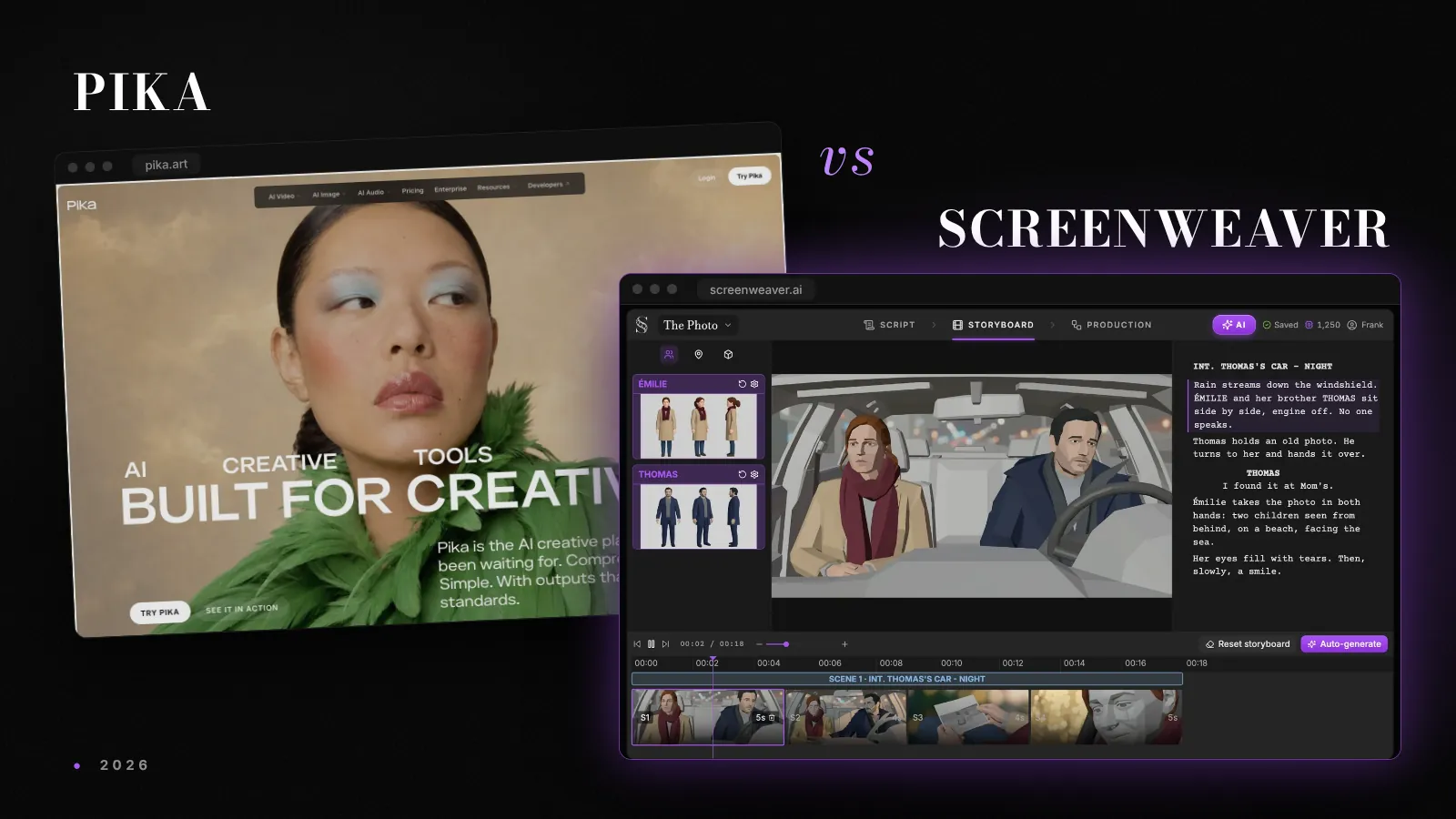
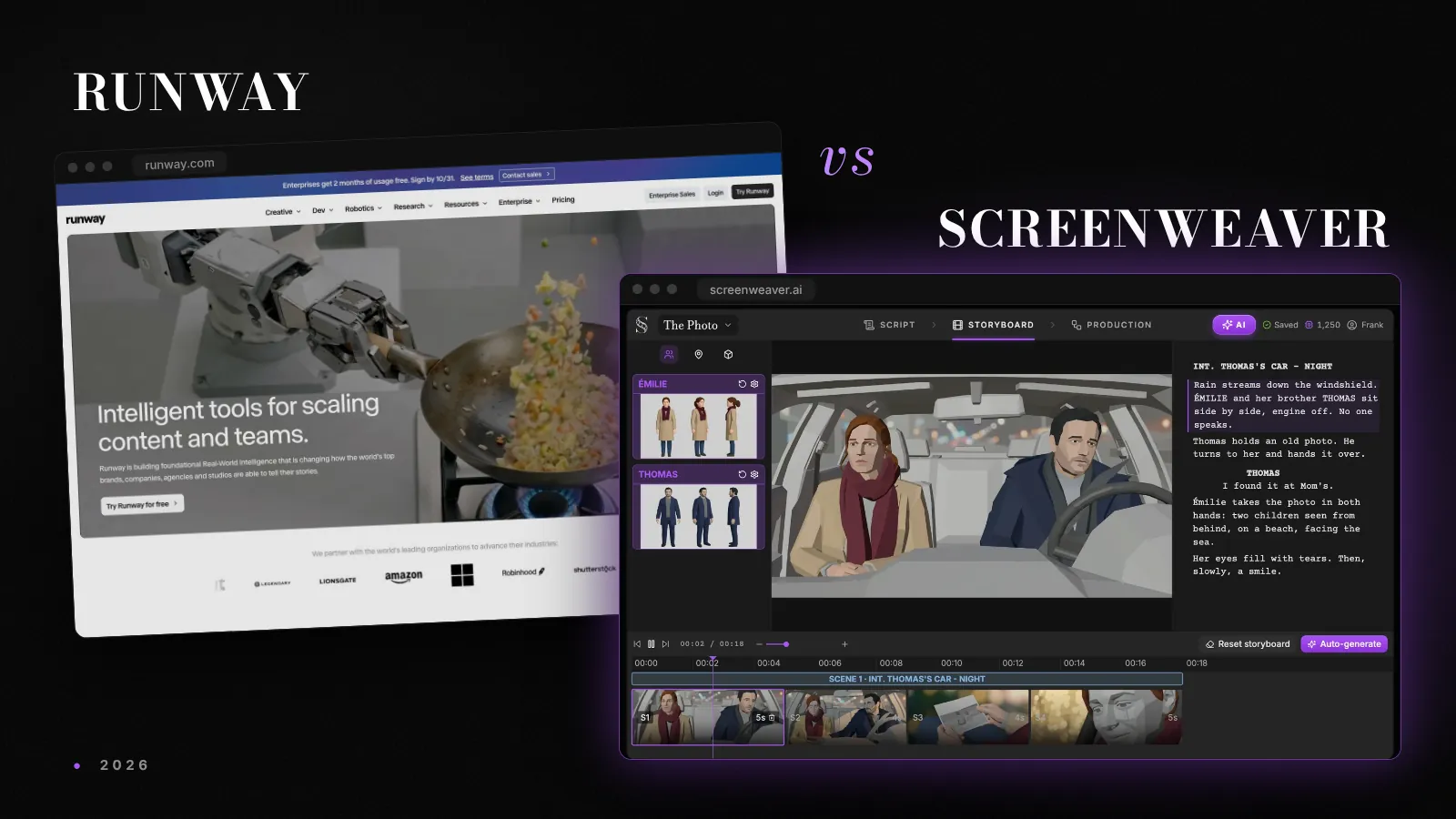
For a broader toolbox with finishing tools, see Runway. For motion-heavy shots, see Kling. For effects and a lower entry price, see Pika. For weekly explainers on a timeline, see invideo.
Final verdict: Luma or ScreenWeaver?
Luma is the better pick for campaigns, concepts and mood pieces from a brief, where a shared board and HDR output pay off. If your project starts from a screenplay, ScreenWeaver is the stronger fit. Writing is free on the Screenwriter plan, with PDF and Final Draft export. The Auteur plan, at $39.99 a month, generates the storyboard from your screenplay and runs Seedance 2.5, Veo 3.1, Kling 3.0 and other models on each shot, with your characters kept from shot to shot. The full comparison is on our Luma alternative page.
FAQ
How much does Luma Dream Machine cost in 2026?
Plus is $30 a month with 10,000 credits, Pro $90 with 40,000 and Ultra $300 with 150,000. Billed yearly, they come to $25, $75 and $250 a month. Team and Enterprise are on request.
Does Luma Dream Machine have a free plan?
The pricing page lists no free plan. The iPhone app sells a Lite tier at $9.99.
How many seconds of video does a Luma plan buy?
At Ray3.14 720p, 20 credits a second, Plus buys about 8 minutes a month and Pro about 33. At 1080p, 80 credits a second, that falls to about 2 and 8 minutes, before rerolls.
What are Ray3.2 and Ray3.14?
Luma's own video models. Ray3.14 is the cheaper, faster one, from 4 credits a second in Draft. Ray3.2 adds HDR and EXR output at a higher price.
Is Luma Dream Machine on Android?
Luma lists an app for iPhone, Mac with Apple silicon and Apple Vision. We found no Android app listed.
Can Luma write a screenplay?
No. Its agents help brainstorm and its boards hold story arcs and episodes, but there is no screenwriting editor or screenplay file import.
Final Step
Build your next script with Screenweaver
Move from ideas to production-ready pages faster with timeline-native writing and AI-assisted story flow.
Try Screenweaver