
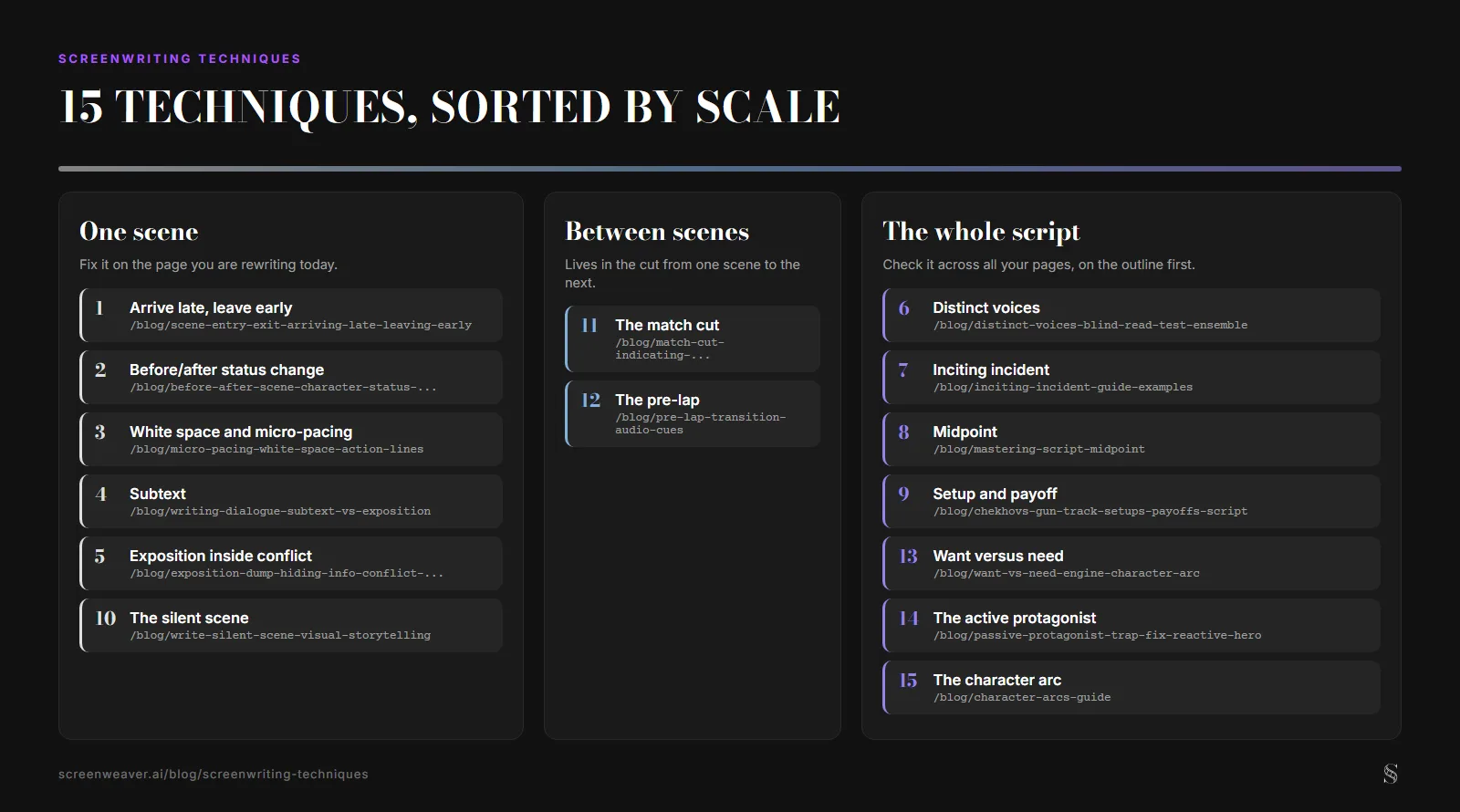
Screenwriting techniques are the small, repeatable decisions that make a page read faster and play better on screen: where a scene starts, what a character refuses to say out loud, which image carries the turn. This index covers fifteen of them, grouped by scale, each with a short definition, a worked example and a link to the full guide.
If you're still facing a blank page, start with how to write a screenplay from idea to first draft. Everything here assumes you already have scenes and want them to work harder.
The 15 techniques at a glance
| # | Technique | Works at the scale of | What it fixes | Full guide |
|---|---|---|---|---|
| 1 | Arrive late, leave early | Scene | Slow openings, trailing endings | Scene entry and exit |
| 2 | Before/after status change | Scene | Scenes where nothing shifts | The before/after scene |
| 3 | White space and micro-pacing | Scene | Dense action blocks that readers skim | Micro-pacing |
| 4 | Subtext | Scene | On-the-nose dialogue | Dialogue that doesn't sound like exposition |
| 5 | Exposition inside conflict | Scene | Information dumps | The Pope in the Pool |
| 6 | Distinct voices | Whole script | Characters who all sound alike | The blind read test |
| 7 | Inciting incident | Whole script | A story that never really starts | The inciting incident |
| 8 | Midpoint | Whole script | A sagging second act | Mastering the midpoint |
| 9 | Setup and payoff | Whole script | Endings that feel unearned | Chekhov's gun |
| 10 | The silent scene | Scene | Talking where an image would do | Writing a silent scene |
| 11 | The match cut | Between scenes | Flat transitions | The match cut |
| 12 | The pre-lap | Between scenes | Scene changes that stall momentum | The pre-lap |
| 13 | Want versus need | Whole script | Goals with no inner stakes | Want vs need |
| 14 | The active protagonist | Whole script | A hero things happen to | The passive protagonist trap |
| 15 | The character arc | Whole script | A lead who ends where they started | Character arcs 101 |
One scene to practise on
Techniques are easier to see on a real page, so every example below works on the same scene. We wrote it for this guide, and we wrote it badly on purpose. Ines runs the bakery her late father left her. Her brother Sami turns up before dawn because he owes money.
INT. ROSA'S BAKERY - NIGHT

The bell over the door rings. SAMI (30s), soaked, steps in.

SAMI
Hey, Ines. How are you?

INES (30s), flour to the elbows, looks up from the dough.

INES
Sami! I'm fine. It's four in the morning.
What are you doing here?

SAMI
I need to ask you something. I owe Karim
six thousand euros and he wants it by Friday.

INES
You know Dad left me the bakery and you're
still angry about that.

SAMI
I'm not angry. Can you lend me the money?

INES
No. Goodbye, Sami.

Sami leaves. Ines goes back to the dough.
Everything in it is clear, and none of it plays.
Scene techniques
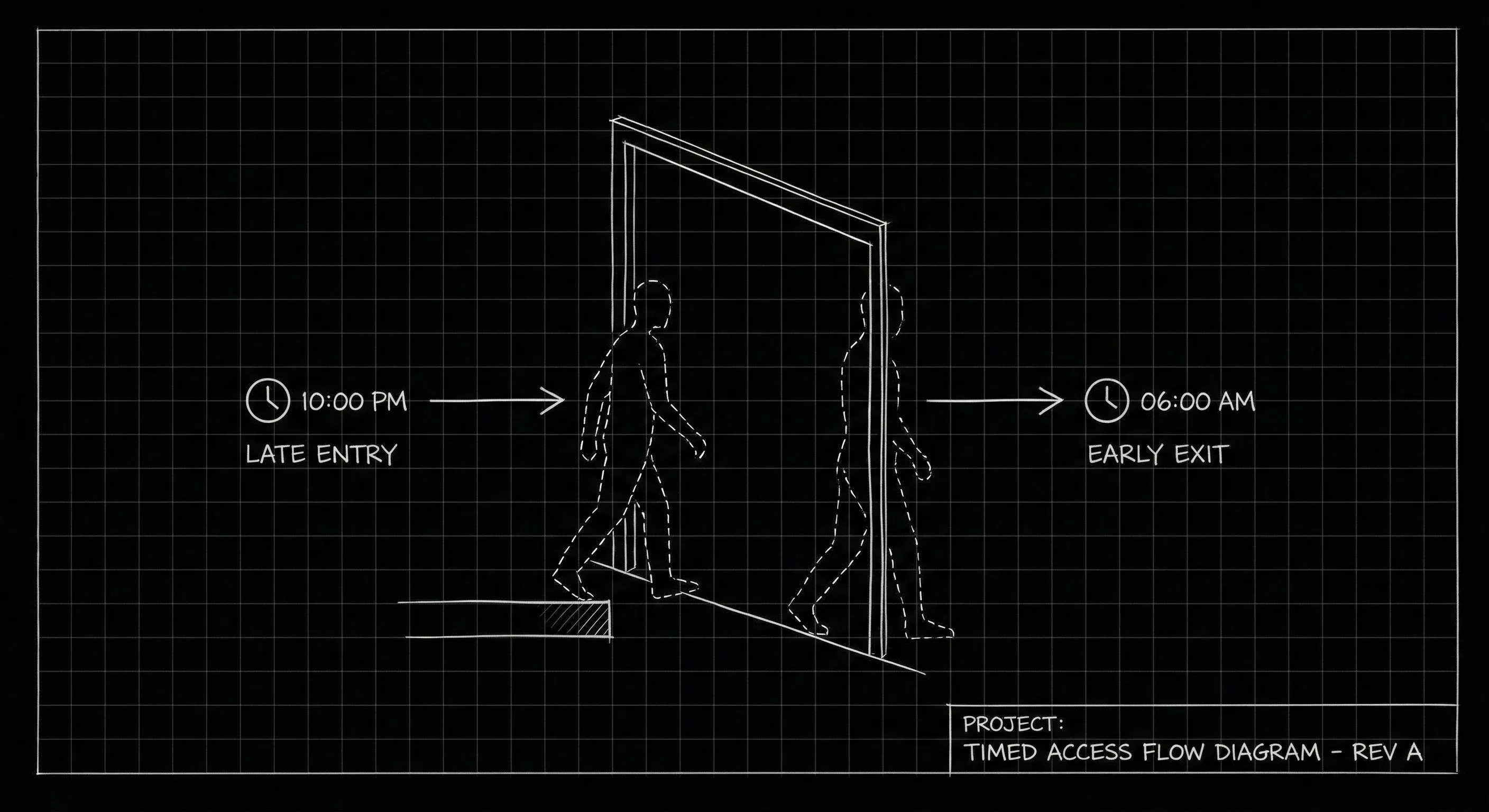
1. Arrive late, leave early
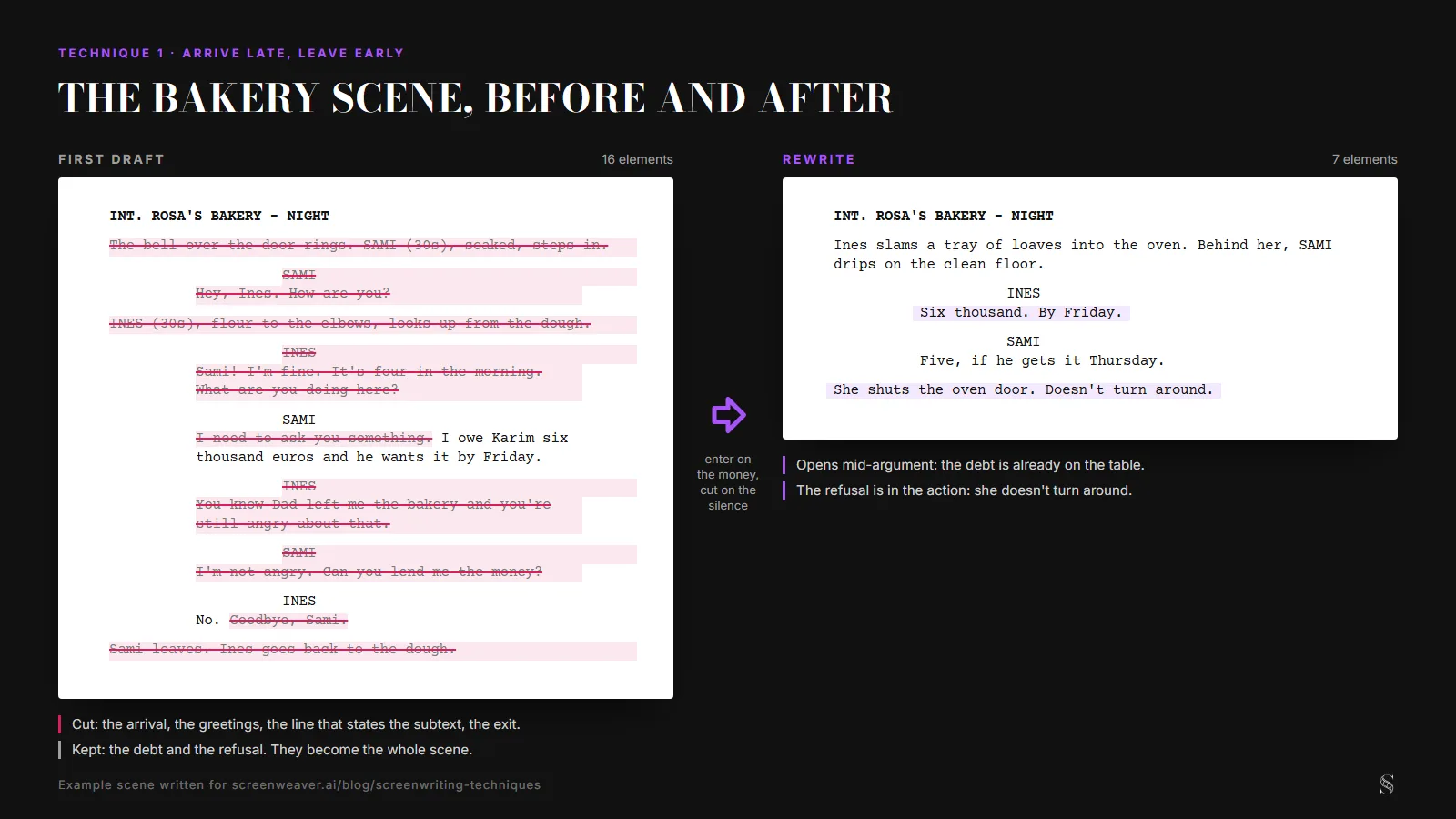
Start the scene at the last possible moment before something changes, and cut as soon as the change has landed. The greetings, the small talk and the goodbye are the first lines to go.
Our scene doesn't need the bell, the "how are you" or the exit. Join it with the money already on the table:
INT. ROSA'S BAKERY - NIGHT

Ines slams a tray of loaves into the oven.
Behind her, SAMI drips on the clean floor.

INES
Six thousand. By Friday.

SAMI
Five, if he gets it Thursday.

She shuts the oven door. Doesn't turn around.
Less than half the length, and the reader arrives mid-argument. The full method, including when a slow entry is worth keeping, is in the guide to scene entry and exit.
2. The before/after status change
A scene should leave at least one character in a different position from where it found them. The strongest way to show it is a physical before and after, with no line explaining it.
Give Sami a set of keys to the bakery, kept from their father's time. He walks in using them. He walks out after leaving them on the counter. Nobody mentions the keys, and the audience still knows he's given something up. More examples in the before/after scene.
3. White space and micro-pacing
Line breaks set the reading speed. Short action paragraphs read fast and land like cuts; a six-line block slows the reader down, and readers tend to skim it.
When the oven timer goes off in the middle of the argument, give it a line of its own:
The timer BEEPS.

Neither of them moves.
Two short lines, two beats of silence. The micro-pacing guide shows how to use this without turning the page into poetry.
Dialogue techniques
4. Subtext
Characters talk around the thing that matters instead of naming it. The audience works out the real subject, and that small effort is what keeps them leaning in.
"You know Dad left me the bakery and you're still angry about that" states the subtext outright. Try:
SAMI
Is Dad's starter still alive?

INES
I feed it every morning.
The line is about sourdough. The scene is about who stayed. See how to write dialogue that doesn't sound like exposition for the full method, and the art of subtext for more examples.
5. Hide exposition inside conflict
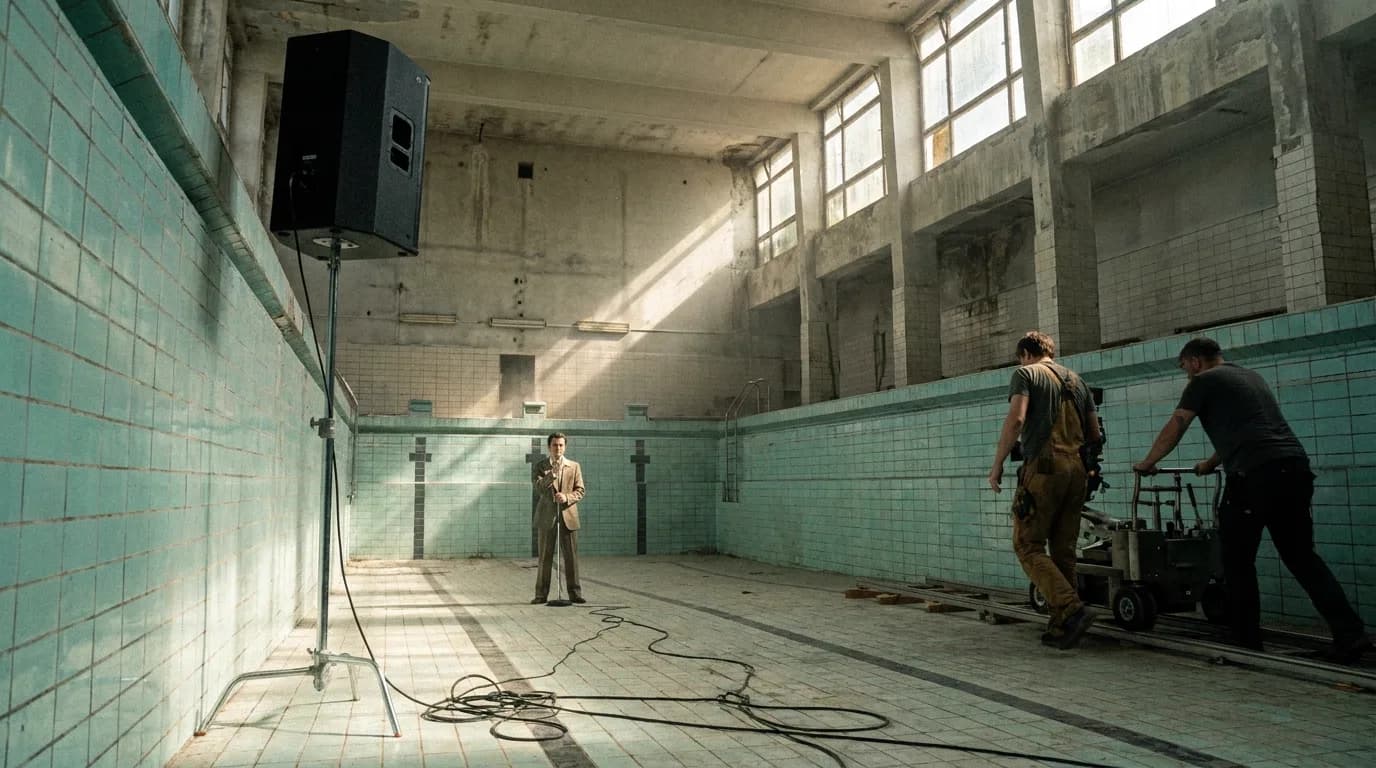
When the audience needs a fact, deliver it while something else holds their attention. The classic name for this is the Pope in the Pool: the information arrives while the viewer is busy watching something more interesting.
The debt details can come out while Sami tries to open the till and Ines slaps the drawer shut. The viewer watches the struggle and takes in "six thousand" and "Karim" on the way. The Pope in the Pool guide has more ways to stage it.
6. Distinct voices
Cover the character names on a page. If you can't tell who is speaking, the voices haven't separated yet.
Ines talks in short commands about the work in front of her. Sami bargains, and he talks in numbers. "Five, if he gets it Thursday" could only be his line. Run the blind read test on a full scene to check yours.
Once the dialogue is fixed, paste the scene into the action vs dialogue ratio tool. It shows what share of the page is action and what share is talk, which is a quick way to spot a scene that has turned into two people reading lines at each other.
Try it free
Try Screenweaver for free on your script
It is free. Import your existing project, get a clearer view of your outline, and regain control of your story structure in minutes.
Start FreeStructure techniques
7. The inciting incident
The inciting incident is the event that knocks the protagonist's life off balance and forces a response. In a feature it usually lands early in the script, and the full guide covers where and why.
If this is Ines's film, Sami's night visit is the inciting incident. Her ordinary routine, the 4 a.m. dough, is interrupted, and she can't go back to it unchanged.
8. The midpoint
The midpoint sits halfway through the script, around page 55 of a 110-page feature, and changes what the story is about or what it costs. It stops the second act from becoming a list of obstacles.
For Ines, the midpoint could be finding out the debt was taken out in the bakery's name. Until then she's been deciding whether to help her brother. After it, she's fighting for the shop. The midpoint guide shows how to build one without breaking the plot.
9. Setup and payoff
Anything that matters at the end should be planted earlier, ideally when the audience isn't paying it much attention. A payoff with no setup reads as a cheat, and readers notice the setups you never pay off too.
Sami's keys are a setup. In the last act, Ines can hand them back to him. If you plant several of these, track them; the Chekhov's gun guide shows a simple way to do it.
Visual techniques
10. The silent scene
Some turns play better with no dialogue at all. The audience watches behaviour and reads the meaning themselves.
The morning after the argument, Ines bakes alone. She makes two coffees out of habit, then pours one down the sink. How to write a silent scene covers how to format it so a reader stays with you.
11. The match cut
A match cut links two scenes through a shared shape, movement or sound, so the edit itself makes a point. On the page it's written as a transition, MATCH CUT TO:, and used sparingly.
Ines punches down the dough with her fist.

MATCH CUT TO:

EXT. CAR PARK - NIGHT

A fist hammers on Sami's car window. KARIM.
The match cut guide explains when the transition earns its place.
12. The pre-lap
In a pre-lap, the sound or dialogue of the next scene starts before the current scene ends. It pulls the audience forward across the cut.
As Ines slides the first loaves onto the rack, we hear Karim before we see him: "Thursday works." Then we cut to the car park. See the pre-lap transition for the formatting.
Character techniques
13. Want versus need
What a character wants is the goal they chase on screen. What they need is the change they resist, and the story usually forces them to choose between the two.
Ines wants to keep the bakery exactly as her father left it. She needs to let her brother back in, even if that costs her the bakery as it was. The want vs need guide shows how the gap drives an arc.
14. The active protagonist
The protagonist makes choices that move the story. A hero who only reacts to what happens to them turns the script into a sequence of events.
In the first draft, Ines just says no. An active Ines makes a counter-offer: Sami works the morning shifts until the debt is paid, starting today. Now she's driving the scene. The fixes are in the passive protagonist trap.
15. The character arc
The arc is how the protagonist changes from first page to last: positive, negative or flat. Every technique above feeds it, because each scene moves the character a step.
Ines starts the film locking the door at 4 a.m. and ends it handing Sami his keys. That's a positive arc in two images. For the three arc types, read Character arcs 101, and for where they sit in the larger shape of the script, the three-act structure guide.
Where to track these in your outline
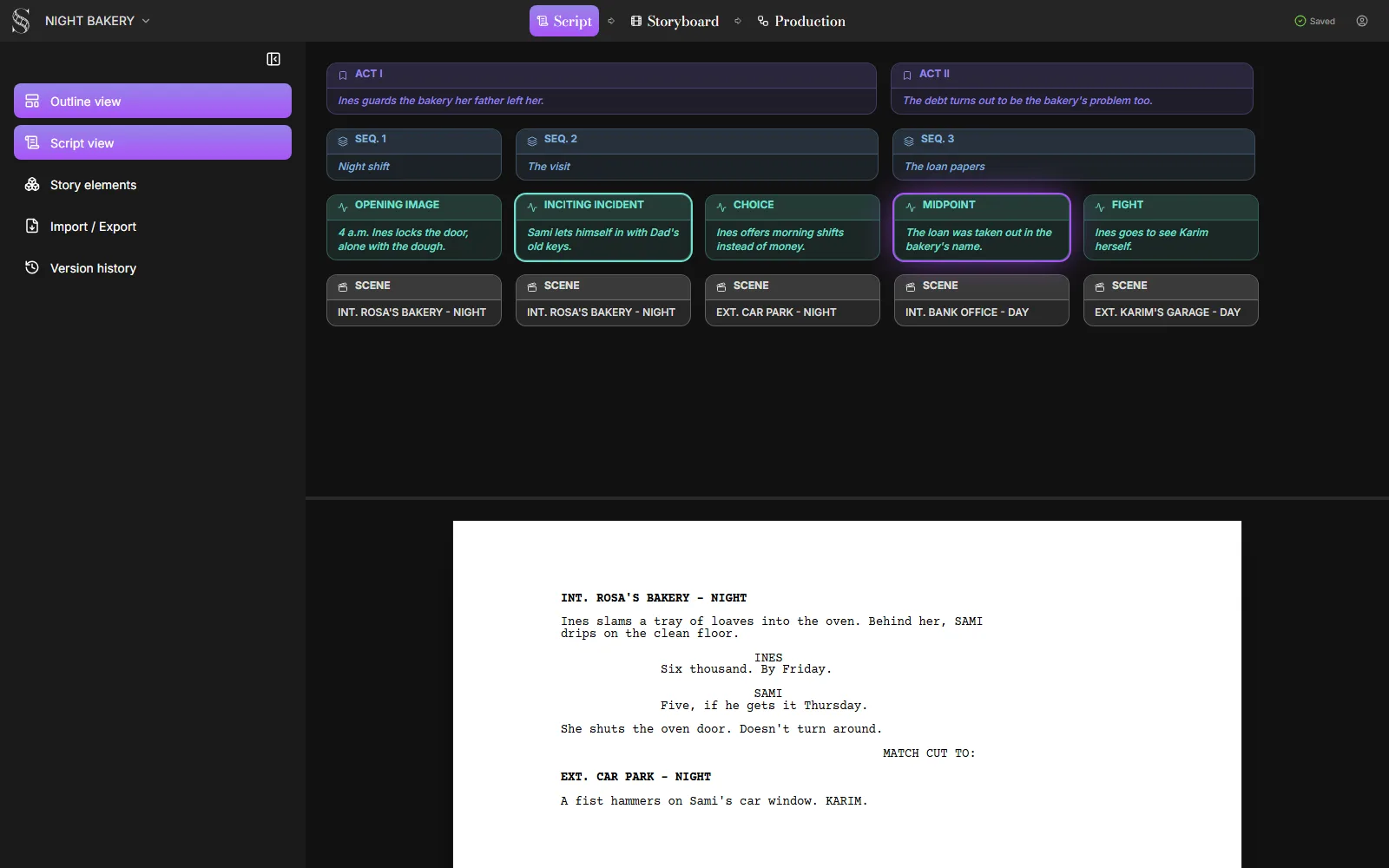
Structure techniques are easier to manage when you can see them. In ScreenWeaver's Script tab, the card view sits above the screenplay editor with one track per level: act, sequence, story beat and scene. Mark the inciting incident and the midpoint as story beat cards and you can check at a glance whether they sit where you meant them to. The editor and outline are part of the free Screenwriter plan. If you'd rather work on paper, index cards on a wall do the same job.
A rewrite checklist
Use it on one scene at a time, not the whole script at once.
- Does the scene start after the greetings and end before the goodbyes?
- Is at least one character in a different position at the end?
- Are any action paragraphs longer than four lines? Break them up.
- Is any line saying exactly what the character feels? Find the sideways version.
- Is a fact delivered while something else holds attention?
- With the names covered, can you tell who's speaking?
- Is there a beat that would play better with no dialogue?
- Has every object that matters later been planted earlier?
- Does the protagonist make a choice in this scene, or only react?
- Does the scene move the protagonist's arc a step?
FAQ
What are the most important screenwriting techniques? For a first rewrite, start with arriving late and leaving early, subtext and the active protagonist. They go after slow scenes, on-the-nose dialogue and heroes who only react, which are the easiest problems to spot on a first read. Structure techniques like the midpoint matter more once the scenes work.
How many screenwriting techniques should I use in one scene? As many as the scene needs and no more. A two-line transition might only need a pre-lap. A key confrontation might use arriving late, subtext, a status change and a setup at once. Stacking techniques the scene doesn't need makes it feel engineered.
Are screenwriting techniques the same as structure? No. Structure is the overall shape of the story, such as the three acts or the eight sequences. Techniques are the tools used inside that shape. Some, like the inciting incident and the midpoint, are structural beats; others, like subtext and white space, work line by line.
How do I practise screenwriting techniques? Take one scene you've already written and rewrite it once per technique, the way this guide does with the bakery scene. Then read both versions aloud. The difference is usually obvious within a page.
Do these techniques work for TV and short films? Yes. Scene and dialogue techniques work the same way at any length. Structure techniques scale down: a short film still needs an inciting moment and a turn, just over a few pages, and a TV episode often opens with a cold open built on arriving late.
Final Step
Build your next script with Screenweaver
Move from ideas to production-ready pages faster with timeline-native writing and AI-assisted story flow.
Try Screenweaver