Anton Chekhov wrote to a friend: "If you say in the first chapter that there is a rifle hanging on the wall, in the second or third chapter it absolutely must go off. If it's not going to be fired, it shouldn't be hanging there."
This principle, what we now call "Chekhov's Gun", applies to every element in your screenplay. Every prop, skill, relationship, piece of dialogue, and character trait you introduce is a promise. Fulfill the promise, and the story feels tight, designed, inevitable. Fail to fulfill it, and the story feels loose, accidental, unsatisfying.
The challenge: a feature screenplay has hundreds of these promises. How do you keep track? How do you ensure every setup has a payoff, and every payoff has a setup?
Cinematic workflow frames
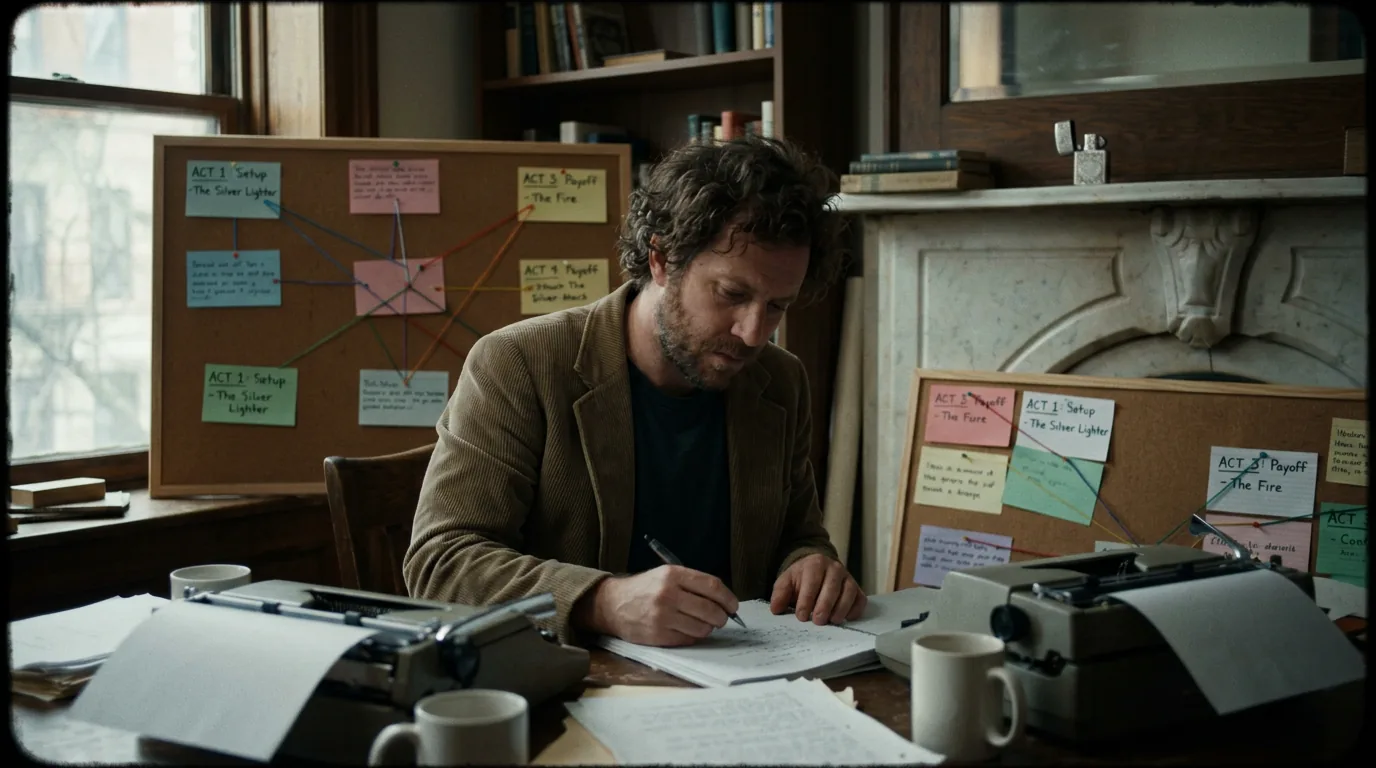
These two visuals work as a pair: the first shows Cinematic workflow still, first angle, 35mm film grain, and the second shifts to Cinematic workflow still, second angle, 35mm film grain - compare them briefly, then move on.
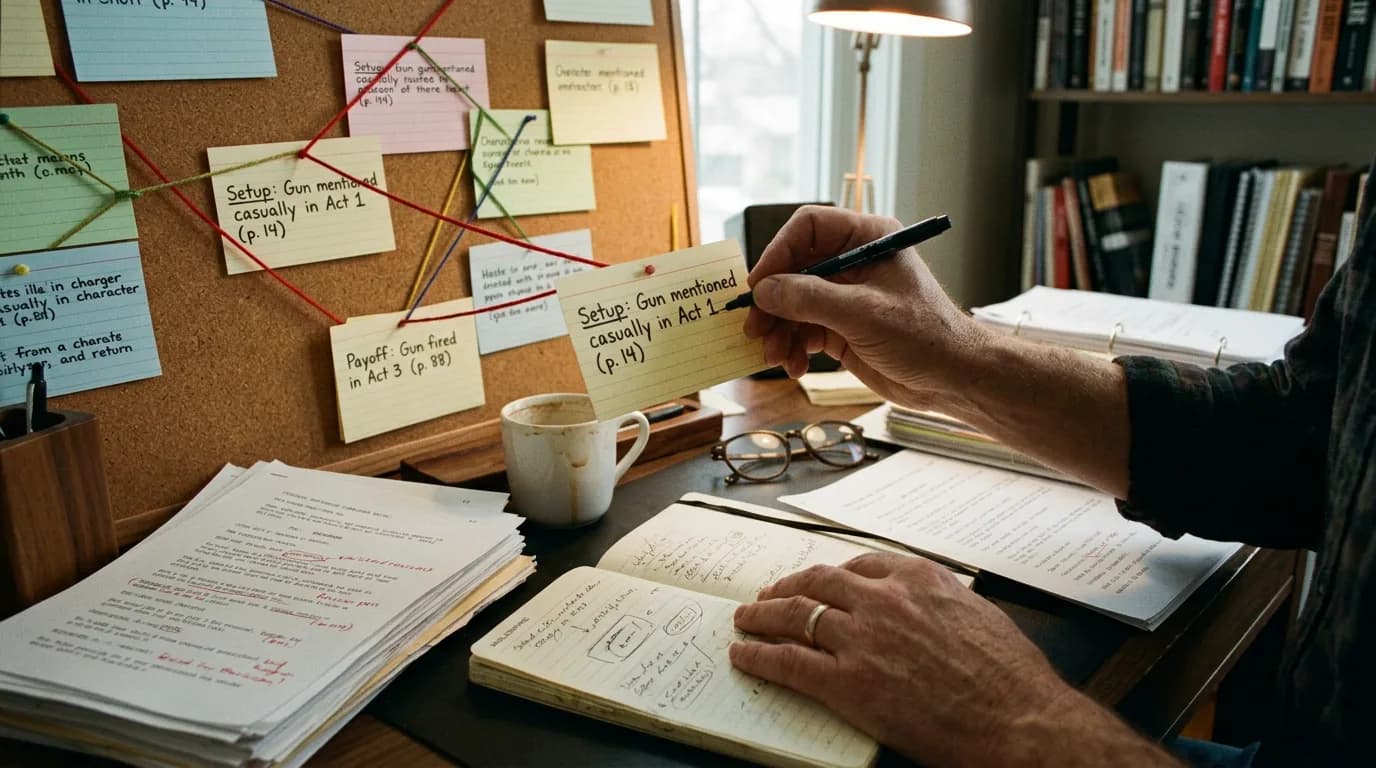
What Counts as a Setup?
A setup is anything that creates an expectation:
Objects. The gun on the wall. The vial of poison. The inherited watch.
Skills. A character mentions they can pick locks. Another was a paramedic.
Relationships. The brother hasn't spoken to the family in ten years. The ex-wife still has a key.
Weaknesses. The hero is afraid of heights. The antagonist can't resist a gamble.
Dialogue. Someone says, "If you ever need anything..." Someone mentions a place, a name, an event.
Visual details. A photograph on the mantle. A scar on someone's hand. The route they take to work.
If the audience notices something, they expect it to matter. If it matters, you need a payoff. If it doesn't pay off, you've either planted something that should bloom, or you've distracted them with narrative noise.
What Counts as a Payoff?
A payoff is the fulfillment of the expectation:
The gun fires. The object is used at a critical moment.
The skill saves them. The lock-picking becomes essential.
The relationship erupts. The estranged brother returns at the crisis point.
The weakness costs them. The fear of heights makes them freeze at the crucial moment.
The dialogue echoes. "If you ever need anything..." is called in. The promise is kept.
The detail resolves. The photograph is explained. The scar is the result of something we finally see.
The payoff should feel earned. The audience thinks: "Oh, that's why they showed us that." The satisfaction comes from the click of connection.
A Table: Types of Setups and Payoffs
| Setup Type | Example Setup | Example Payoff |
|---|---|---|
| Object | An antique letter opener on the desk | The letter opener is used as a weapon in Act 3 |
| Skill | "I used to be a nurse." | She performs emergency surgery on the wounded protagonist |
| Weakness | He's terrified of water | The climax requires crossing a flooded tunnel |
| Relationship | Father abandoned the family | Father returns with crucial information, must be trusted |
| Dialogue | "Don't ever go to the basement." | In the climax, she must go to the basement |
| Visual | The recurring image of a red door | Behind the red door is the answer to the mystery |
The Two Deadly Sins
Sin #1: The Orphan Payoff
Something happens in Act 3 that has no setup. The hero produces a skill, an object, or a relationship that was never established. The audience thinks: "Where did that come from?"
Example: The protagonist suddenly speaks fluent Mandarin to negotiate with a villain, but we've never seen them speak or study Mandarin.
Fix: Go back and plant the setup. A line in Act 1: "My mother was from Beijing; she made me learn." Now the payoff is earned.
Sin #2: The Unfired Gun
Something is prominently established but never used. The audience keeps waiting for it to matter, and it never does. They leave unsatisfied, sensing loose ends.
Example: A character makes a big deal about their allergy to peanuts. It's mentioned twice. But peanuts never appear in the story. The audience expected a choking scene that never came.
Fix: Either add the payoff (peanuts appear at a crucial moment) or cut the setup (remove the allergy references).
Building a Tracking System
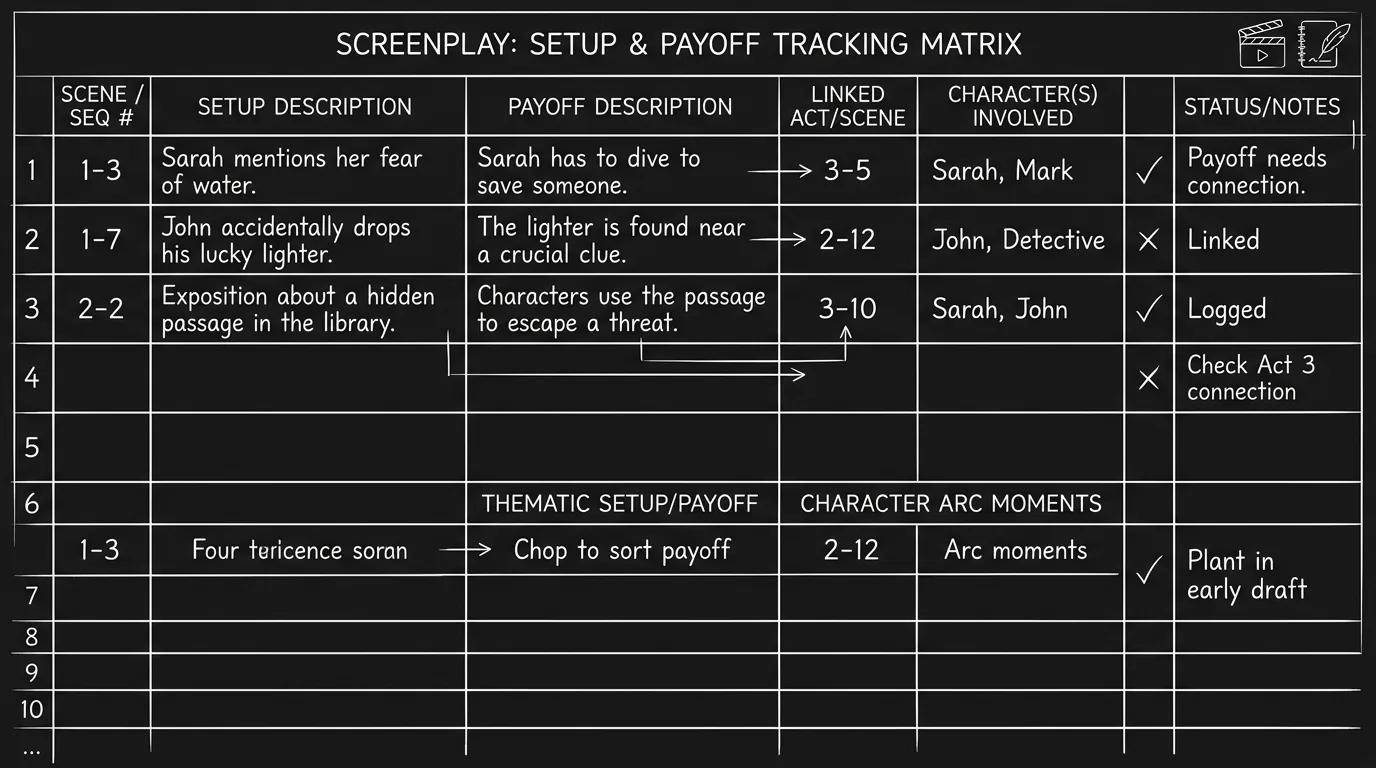
For complex screenplays, you need a system. Here's one approach:
Step 1: Create a Setup/Payoff Log
Two columns. Left: the setup (what it is, where it appears). Right: the payoff (what it is, where it appears). If the right column is empty, you have an unfired gun.
| Setup | Page | Payoff | Page |
|---|---|---|---|
| Gun in nightstand | 3 | Gun used to threaten intruder | 78 |
| Sarah's fear of flying | 12 | Climax requires getting on a plane | 95 |
| Dad's watch | 8 | Watch stops a bullet (saved by luck/love) | 102 |
| Mention of hidden room | 22 | ??? | , |
When the right column has "???" or ", ", you have work to do.
Step 2: Review During Revision
After each draft, update the log. Are there new setups without payoffs? Are there payoffs without setups?
Step 3: Color-Code
In your script file, highlight setups in one color and payoffs in another. This makes them visually trackable during reads.
The Art of the Subtle Setup
The best setups don't feel like setups. They feel like natural story elements, until the payoff arrives, and suddenly they reveal their purpose.
Technique: Embed in Action
Don't make the setup a neon sign:
Obvious: "That's Dad's old gun. He always kept it loaded. It's right there in the drawer."
Subtle: "She opens the drawer for a pen, pauses. Dad's gun. She closes the drawer."
The subtle version establishes the gun without telegraphing "THIS WILL BE IMPORTANT."
Technique: Double Duty
The best setups do two things at once. They establish story information and accomplish a scene goal:
Example: A scene establishes that the protagonist is a terrible cook. This is comedic; it deepens character. But later, when she serves dinner to a killer and he chokes on her food, we realize the comedy was setup.
The cooking was doing double duty: character plus future plot.
Try it free
Try Screenweaver for free on your script
It is free. Import your existing project, get a clearer view of your outline, and regain control of your story structure in minutes.
Start FreeThe Art of the Satisfying Payoff
The payoff should feel like a relief and a surprise, both at once.
The callback. Explicitly echo the setup:
Setup: "If you ever need to hide, remember: the cellar has two exits."
Payoff: She runs into the cellar. We remember. She knows about the second exit.
The reversal. The setup creates one expectation; the payoff subverts it:
Setup: The protagonist is terrified of guns.
Payoff: At the climax, she picks up the gun, but can't fire. Her fear isn't overcome; it's tested. She finds another way.
The escalation. The payoff is bigger than expected:
Setup: A small lie the protagonist told.
Payoff: The lie spirals into catastrophe, ending her marriage.
The "Trench Warfare" Section: What Goes Wrong
Failure Mode #1: Too Many Setups
The first act is crammed with promises: a gun, a skill, a sister, a weakness, a mystery photo, a missing dog. The audience can't track them all, and neither can you.
How to Fix It: Prioritize. Which setups are essential to plot? Keep those. Which are character color? Keep one or two. Cut the rest.
Failure Mode #2: The Payoff Is Too Late
A setup on page 5 pays off on page 105. The audience has forgotten.
How to Fix It: Either move the setup closer to the payoff, or remind the audience with a "refresh", a subtle reference mid-story that keeps the setup alive.
Failure Mode #3: The Payoff Is Too Obvious
The setup is so prominent that the audience sees the payoff coming from a mile away.
How to Fix It: Misdirect. Give the setup an apparent purpose that's not its real purpose. The audience thinks the gun is for X; it's actually for Y.
Failure Mode #4: Coincidental Payoffs
The payoff feels convenient rather than inevitable. The character just happens to have the right skill at the right time.
How to Fix It: Make the setup more organic. If the character needs to be a pilot in Act 3, make their pilot identity part of who they are throughout, not just a line in Act 1.
Failure Mode #5: Forgetting Your Setups
You rewrote the script so many times that you cut the setup and kept the payoff, or vice versa.
How to Fix It: Use the tracking log. Update it after every revision. Trust the document, not your memory.
Case Study: Tracking Setups in Back to the Future
Back to the Future is a masterclass in setups and payoffs:
| Setup | Payoff |
|---|---|
| The clock tower is struck by lightning (opening) | Marty uses the lightning to power the DeLorean |
| Doc's dog is named Copernicus | Minor, but establishes Doc's scientific personality |
| "If you put your mind to it, you can accomplish anything." | George punches Biff, character arc completion |
| Marty plays guitar | His guitar performance at the dance is crucial to his parents meeting |
| The DeLorean needs 1.21 gigawatts | The lightning strike provides exactly that |
| Doc wears a bulletproof vest | He survives the Libyans because he remembered Marty's letter |
Every setup earns its payoff. Every payoff has a setup. The script feels tight because nothing is wasted.
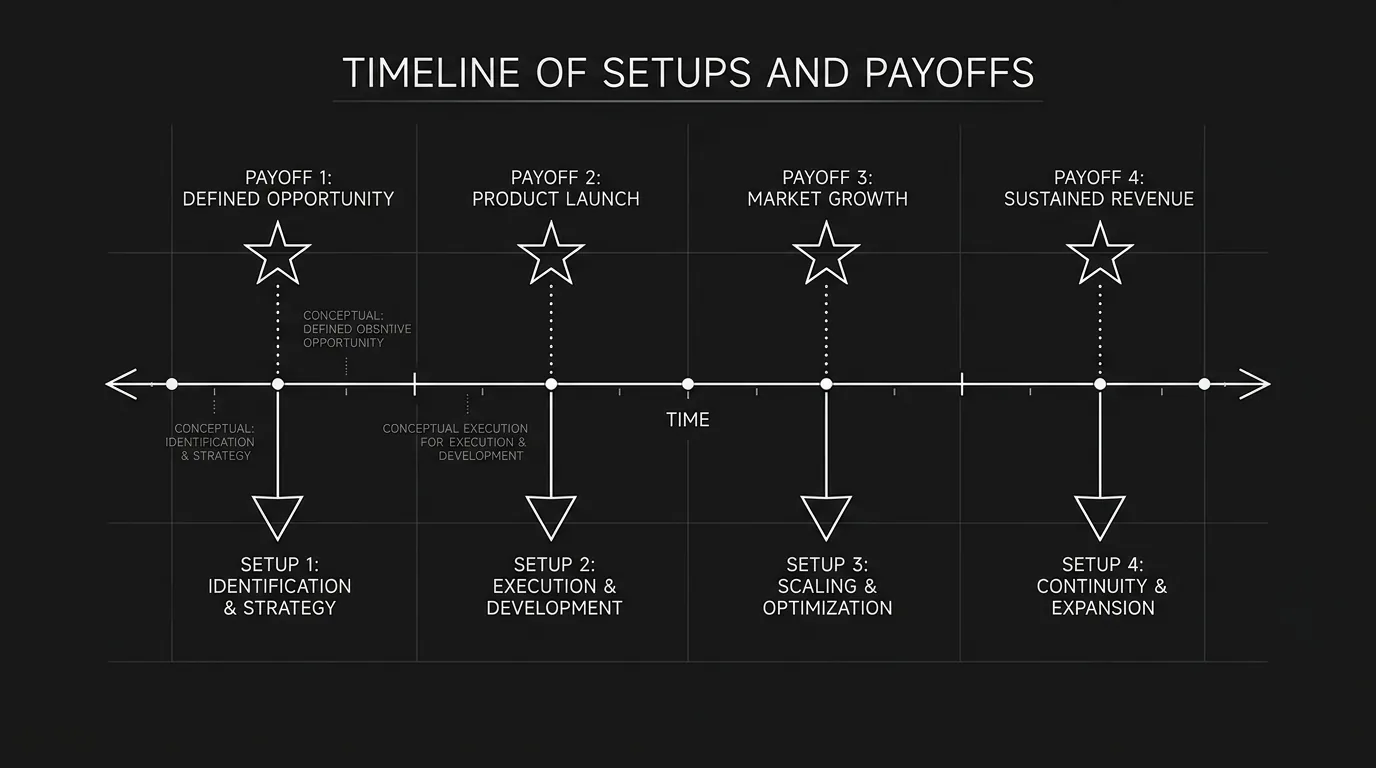
Tools for Tracking
Spreadsheets. Google Sheets or Excel with columns for setup, page, payoff, page, and status.
Index cards. Physical cards with setups in one color, payoffs in another. Lay them out; draw connection lines.
Script software. Some programs allow tagging or color-coding scenes. Use this to mark setups and payoffs.
Revision checklist. Include "verify all setups have payoffs" and "verify all payoffs have setups" in your draft review process.
The Perspective: Every Promise Matters
Chekhov's Gun isn't just about guns. It's about everything. Every detail in your script is a contract with the audience: "I'm showing you this because it matters."
When you honor those contracts, when setups pay off and payoffs are earned, the audience experiences story as design. Everything feels intentional. The world you've created has rules, and those rules are followed.
When you break the contracts, orphan payoffs, unfired guns, the audience experiences story as accident. They trusted you to know what you were doing, and you didn't.
The tracking work isn't glamorous. It's spreadsheet work, revision work, attention-to-detail work. But it's what separates professional scripts from amateur ones. The pros don't let anything slip through. Every rifle on the wall will fire. Every promise will be kept.
Make your promises. Keep your promises.
That's the job.
[YOUTUBE VIDEO: A screenwriter breaking down the setup/payoff structure of a well-crafted film, showing how the tracking system reveals the underlying architecture.]
Further reading:
- For writing character introductions that become setups, see introducing a character: descriptions that attract A-list actors.
- If you're working with visual transitions as payoffs, see the match cut: indicating a transition on the page.
- Lessons from the Screenplay has detailed setup/payoff analyses at youtube.com/@LessonsFromTheScreenplay{:rel="nofollow"}.
Final Step
Build your next script with Screenweaver
Move from ideas to production-ready pages faster with timeline-native writing and AI-assisted story flow.
Try Screenweaver