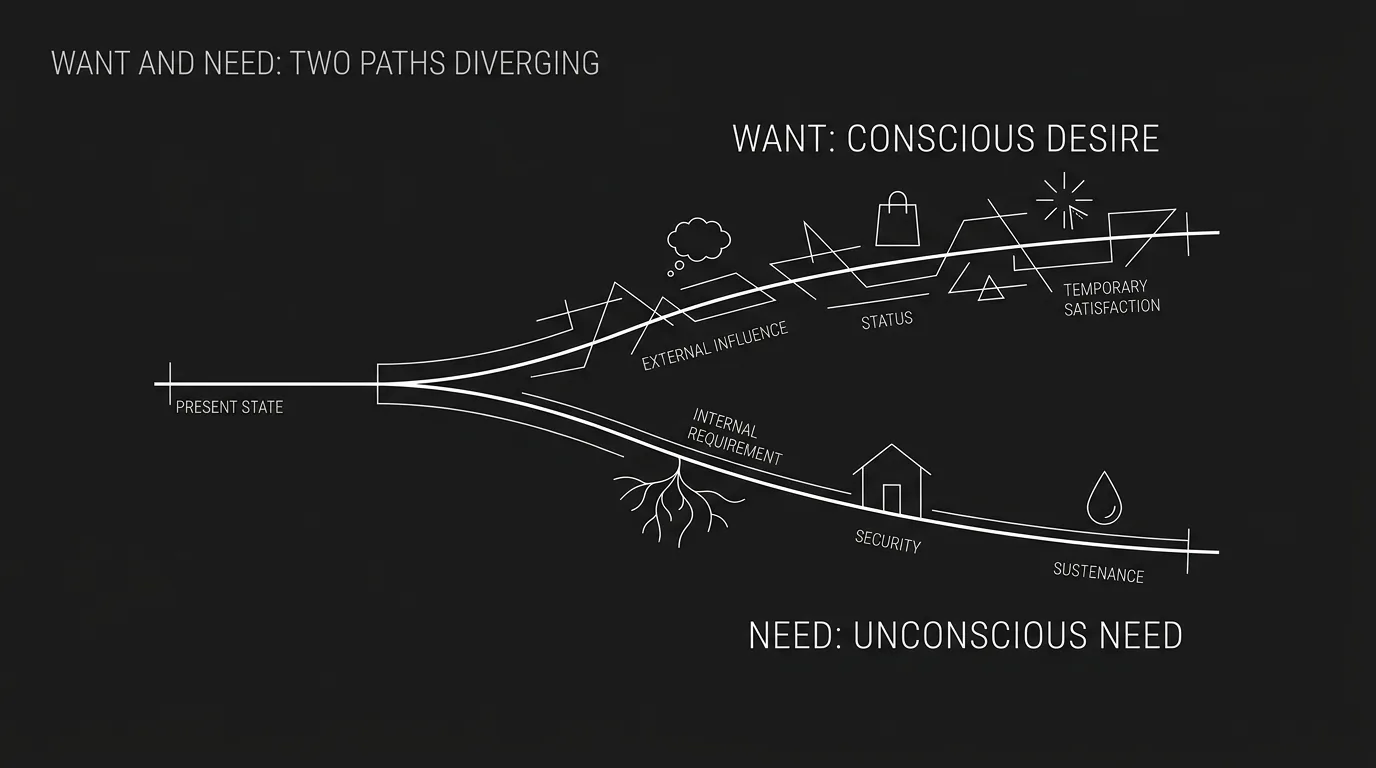

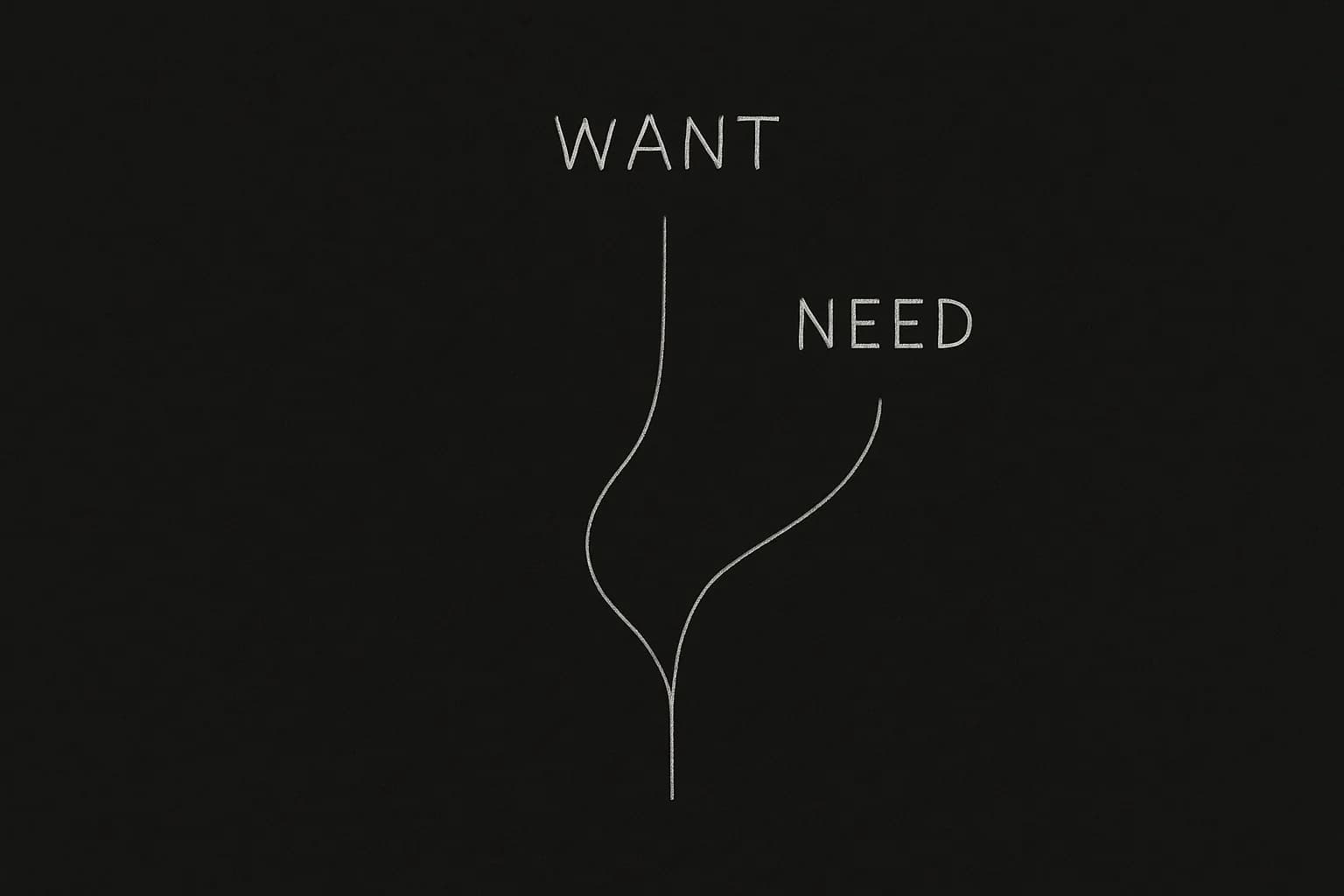
Your protagonist wants the promotion. They need to stop defining themselves by the job. They want to win the case. They need to learn that being right isn't the same as being free. They want the girl. They need to become someone who can be loved. The want is what they're chasing on the page. The need is what would actually fix them, and they don't know it, or they're fighting it. That gap is the engine of character arc. When the want and the need are the same thing, there's no inner conflict. When they're opposed, every victory that satisfies the want can deepen the need. Here's how to build that engine and why it matters.
The best character arcs aren't about getting what you want. They're about discovering you needed something else, and paying the cost of that discovery.
Think about it this way. In life we often pursue the wrong thing. We think the job will make us feel enough. We think the relationship will fill the hole. The story version of that is the want: visible, conscious, plot-driving. The need is the correction. Usually the character resists it until the story forces a choice. Give them the want and they'll run. Give them the need and they'll change, or refuse to, and that refusal can be the tragedy. Our guide on character arcs breaks down flat, positive, and negative arcs; the want/need tension is what makes the positive arc feel earned and the negative arc feel inevitable. This piece is about designing the two so they pull against each other.
Why Want and Need Have to Be Different
If the character wants to be a better parent and needs to be a better parent, there's no internal conflict. The plot might be hard, obstacles, antagonists, but the character isn't at war with themselves. The audience gets a straight line: they try, they fail, they try again, they succeed. Fine for some stories. Not enough for a character-driven arc. The moment the want and the need diverge, you get friction. The character pursues the want. The story (and the need) keeps getting in the way. They have to sacrifice the want to get the need. Or they get the want and discover it's empty. Or they refuse the need and keep the want, and we feel the cost. That's when the arc lands.
The want should be concrete and external. Something we can see them chase. Win the trial. Get the promotion. Save the kid. Find the killer. The need should be internal and often invisible to the character at the start. Learn to ask for help. Accept that you can't control everything. Stop using work to avoid feeling. The need is often the flip side of a flaw. The character who needs to stop being a lone wolf might want to win the heist alone. The character who needs to forgive themselves might want to catch the villain who got away. Same story. The want drives the plot. The need drives the change.
Relatable Scenario: The Lawyer Who Has to Win
Your protagonist is a trial lawyer. They want to win the case. That's clear. That's the plot. But what do they need? If the need is "win the case," there's no arc, just a sequence of obstacles. So you dig. Maybe they need to learn that winning at any cost has cost them their family, their ethics, their sleep. So the want (win) and the need (stop defining yourself by winning) are in conflict. The story can give them a case where the only way to "win" is to do something that would destroy the thing they're really fighting for. Now the climax isn't just "did they win?" It's "did they choose the need over the want?" They might win the case and lose themselves. Or they might throw the case and finally be free. The arc lives in that choice. For more on protagonists who drive the story, see passive protagonist: the want is what gives them something to do; the need is what gives the doing meaning.
Relatable Scenario: The Parent Who Wants to Protect
They want to keep their child safe. That's the want. It's also noble. So where's the need? Maybe the need is to let go, to accept that they can't control everything and that overprotection is its own kind of harm. Now the want (protect, control, shield) and the need (let go, trust, allow risk) are in direct opposition. The plot might put the child in danger. The character's instinct is to clamp down. The arc is whether they can do the harder thing: step back. When they finally do, it's not because they stopped caring. It's because they learned that the need was more important than the want. That's a positive arc. If they never learn, if they clamp down until the child rebels or something worse happens, that's a negative arc. Same engine. Different outcome.
Relatable Scenario: The Detective Who Wants the Truth
They want to solve the case. Find out who did it. The need might be to accept that some truths destroy more than they heal, or that the truth they're chasing is the wrong one. Maybe the need is to stop using the job to avoid their own life. So they want the answer. They need to ask a different question. The story can force a moment where getting the truth means hurting someone they love, or where the truth reveals something about themselves they didn't want to see. The want/need engine turns the plot into a character test. For stories where the protagonist's flaw is central, our guide on fatal flaw fits here: the need often involves overcoming or succumbing to that flaw.
The Trench Warfare Section: What Beginners Get Wrong
Making the need too vague. "They need to be happy." "They need to find themselves." Those aren't playable. The audience can't see "happy." They can see "ask for help," "admit they were wrong," "walk away from the job." Fix: State the need as a behavior or a choice. They need to say the thing they've never said. They need to refuse the thing they've always accepted. They need to put the relationship before the win. Concrete. One sentence.
Making the want and need the same. If they want to save the town and need to save the town, you have a plot. You don't have an arc. Fix: Ask what the character is wrong about. What do they think will fix them? That's the want. What would actually fix them? That's the need. If both answers are the same, invent a flaw. The character who wants to save the town might need to learn they can't do it alone, so the want is "save the town," the need is "accept help." Now they're different.
Revealing the need too early. If the character states their need in Act 1 ("I know I work too much"), there's nothing to discover. The need should be invisible or denied at the start. The audience might sense it. The character doesn't have to. Fix: Let the character pursue the want with full conviction. Let the need emerge through failure, loss, or a mentor. The character resists the need until the story forces a choice.
Letting the character get both without cost. Some scripts give the protagonist the want and the need in the climax. They win the case and become a better person. No sacrifice. It can feel like a cheat. The best arcs often force a choice: you can have the want or the need. Not both in the same way. Fix: Consider a climax where they have to give up the want to get the need. Or they get the want and it's empty, so the need becomes clear. Cost makes the arc land.
Ignoring the need in the climax. The plot climax might be "do they defeat the villain?" The character climax should be "do they choose the need?" If the need never gets a choice, the arc is unfinished. Fix: Build a moment in the climax where the character faces the need. They can embrace it (positive arc), refuse it (negative arc), or pay a price for it. But the need has to be in the room.
Try it free
Try Screenweaver for free on your script
It is free. Import your existing project, get a clearer view of your outline, and regain control of your story structure in minutes.
Start FreeWant vs. Need: A Practical Table
| Element | Want | Need |
|---|---|---|
| Visibility | Conscious; character can state it | Often unconscious or denied |
| Type | External, concrete (win, get, save) | Internal, behavioral (accept, let go, ask) |
| Role in plot | Drives the action | Drives the change |
| Conflict | Character pursues it | Story (or flaw) blocks or complicates it |
| Climax | Often at stake in the plot | At stake in the character's choice |
Design both. Then make sure the climax puts the need in the character's hands, even if they drop it.
Step-by-Step: Building the Want/Need Engine
First: State the want in one sentence. What does the character think they're after? Win, get, save, find. Second: Ask what's wrong with them. What flaw keeps them from being okay? (If you've read our fatal flaw guide, use that.) Third: Turn the flaw into the need. What would they have to do or believe to overcome it? That's the need. Fourth: Check that the want and need pull against each other. If getting the want would make the need easier, you might have them aligned; if getting the want would make the need harder, you have tension. Fifth: In the climax, create a moment where the character must choose, between the want and the need, or between the old self (want) and the new self (need). The choice is the arc. Sixth: In Act 1, show the character committed to the want. Don't let them state the need. Let the audience feel it through failure and cost.
Flat Arcs and the Want/Need Rule
In a flat arc, the protagonist doesn't change. They're right from the start; the world changes around them. So do they have a need? Often the need is societal or external: the world needs to see what the character already sees. The character's want might be to fix the world, win the fight, or prove the point. The "need" isn't inside them, it's the change they bring. So the engine is slightly different: the want is still concrete (save the town, win the case). The "need" is the world's: to accept the truth the character carries. Our guide on character growth types goes deeper on when to use flat, positive, and negative arcs.
The Perspective
The want is what they chase. The need is what would fix them, and they don't know it or they fight it. Design both. Make them pull against each other. Put the need in the climax as a choice, not a side effect. When the character has to give up the want to get the need (or when they get the want and find it empty), the arc lands. That's the engine. Everything else is execution.
Final Step
Build your next script with Screenweaver
Move from ideas to production-ready pages faster with timeline-native writing and AI-assisted story flow.
Try Screenweaver