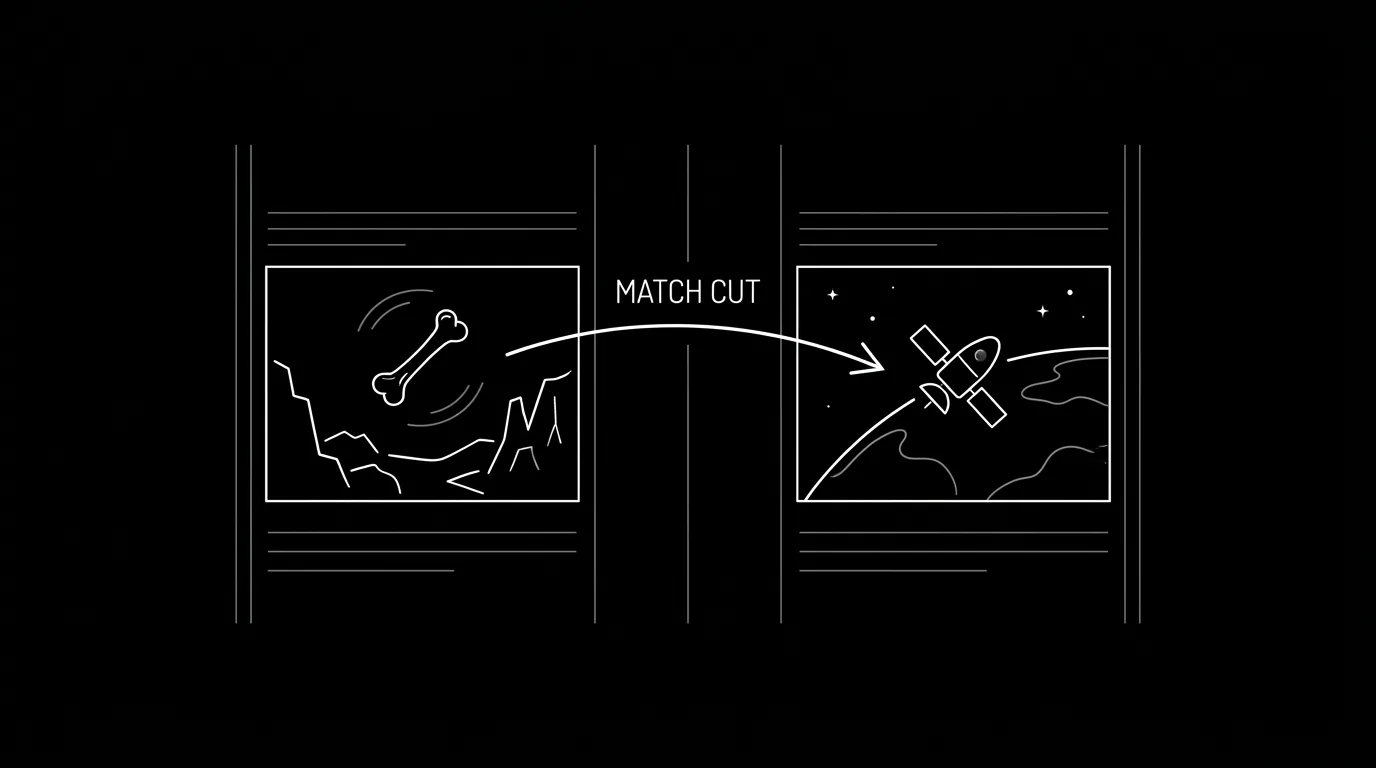

A bone spins through prehistoric sky. It rises, tumbling end over end. At its apex, a cut, and suddenly we're watching a space station orbit Earth. Same shape. Same rotation. Forty thousand years of human evolution in a single edit.
This is a match cut: a transition that links two shots through visual or auditory similarity. The bone becomes the station. A scream becomes a train whistle. A slamming door becomes a judge's gavel. The technique is as old as cinema, and when executed well, it's exhilarating.
But how do you write it? The match cut is a visual concept, and screenwriting is words on a page. Can you indicate a match cut without overstepping into directing? And if so, how do you do it elegantly?
Cinematic workflow frames
These two visuals work as a pair: the first shows Cinematic workflow still, first angle, 35mm film grain, and the second shifts to Cinematic workflow still, second angle, 35mm film grain - compare them briefly, then move on.
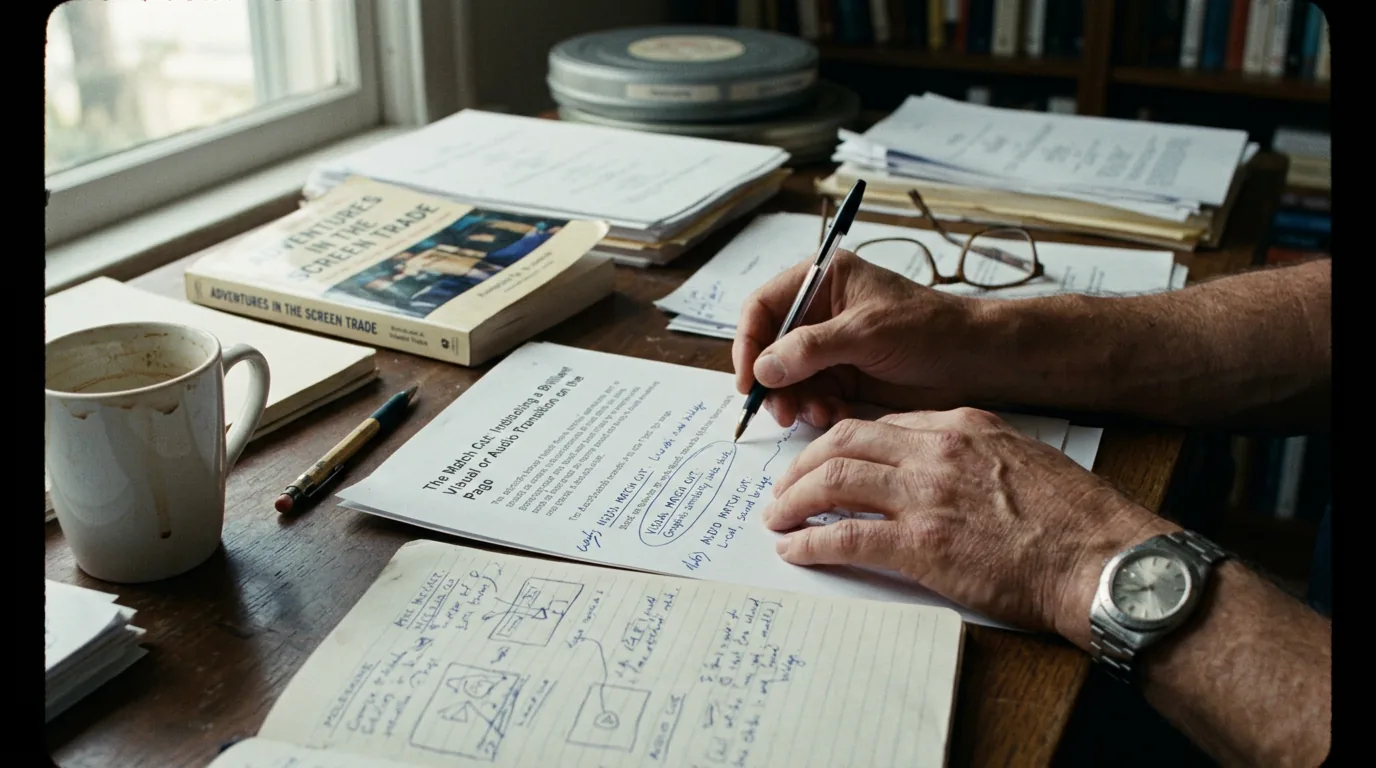
What Makes a Match Cut Work
A match cut connects two shots through:
Visual similarity. Shape, movement, composition. The bone and the space station share a shape and spin.
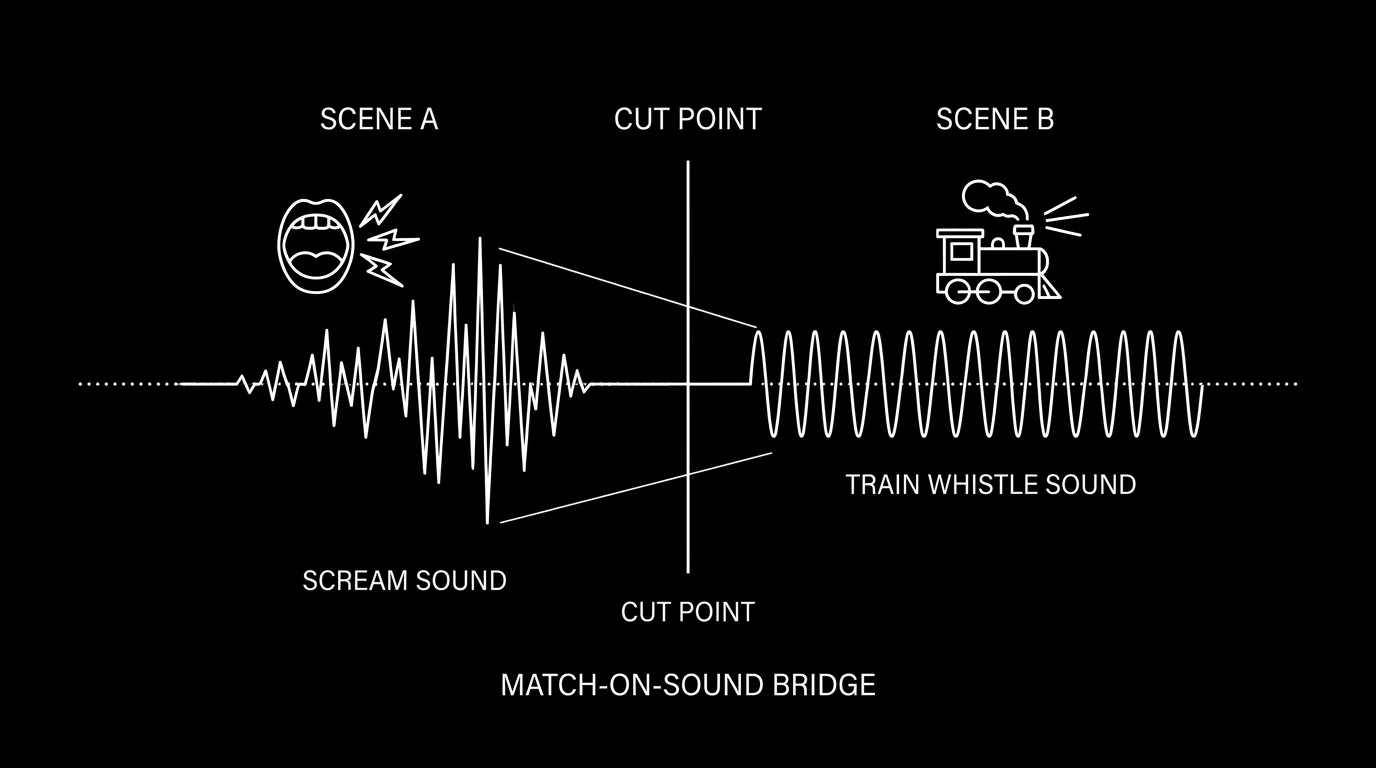
Audio similarity. A sound in one scene continues or transforms into a sound in the next. A scream becomes a kettle whistle.
Thematic resonance. The match isn't just visual, it means something. The bone-to-station cut isn't arbitrary; it's about tools, technology, humanity's journey.
The best match cuts are both surprising and inevitable. You didn't expect the connection, but once you see it, it feels perfect.
The Writer's Dilemma: Directing on the Page
Here's the tension: match cuts are editorial and directorial choices. In a spec script, you're generally discouraged from over-specifying shots and edits. "CUT TO:" is often omitted entirely. "MATCH CUT TO:" is even more prescriptive.
But match cuts are also storytelling choices. They create meaning, thematic connections that the writer conceived. If you don't indicate the match cut, the director might not realize it's there.
The solution: indicate the match cut, but do it with craft. Make it feel like narrative rather than technical direction.
Option 1: The Explicit MATCH CUT TO:
If the match cut is essential to your story, you can use the explicit transition:
Example:
EXT. DESERT – DAWN
The SUN rises over endless sand, a perfect orange disc.
MATCH CUT TO:
INT. PRISON CELL – DAY
A CLOCK on the wall, same round shape, same orange hue. Time in a box.
Notes:
- "MATCH CUT TO:" makes the intent explicit.
- The action description reinforces the visual connection ("same round shape, same orange hue").
Use this when the match cut is structurally important, when the meaning depends on the audience making the connection.
Option 2: The Implied Match (No Transition Tag)
You can suggest a match cut through description alone, trusting the reader to see the connection:
Example:
EXT. TRAIN STATION – DAY
Maria SCREAMS as the train pulls away,
EXT. JUNGLE – DAY
A PARROT SHRIEKS, echoing the same pitch, the same desperate note.
The matching sound (scream → shriek) creates an implied match cut. You didn't write "MATCH CUT TO:" but the reader hears the connection.
This is subtler, appropriate for spec scripts where you want to minimize technical language.
A Table: Types of Match Cuts and How to Write Them
| Match Type | Example | How to Write |
|---|---|---|
| Shape match | Bone → space station | Describe shared shape in both scenes |
| Movement match | Spinning wheel → spinning dancer | Describe shared movement |
| Audio match | Scream → siren | Describe sound at end of Scene A and start of Scene B |
| Composition match | Face in frame A, face in same position in frame B | Describe the framing similarity |
| Thematic match | Wedding ring → handcuffs | Let the juxtaposition speak |
Writing the Setup and Payoff
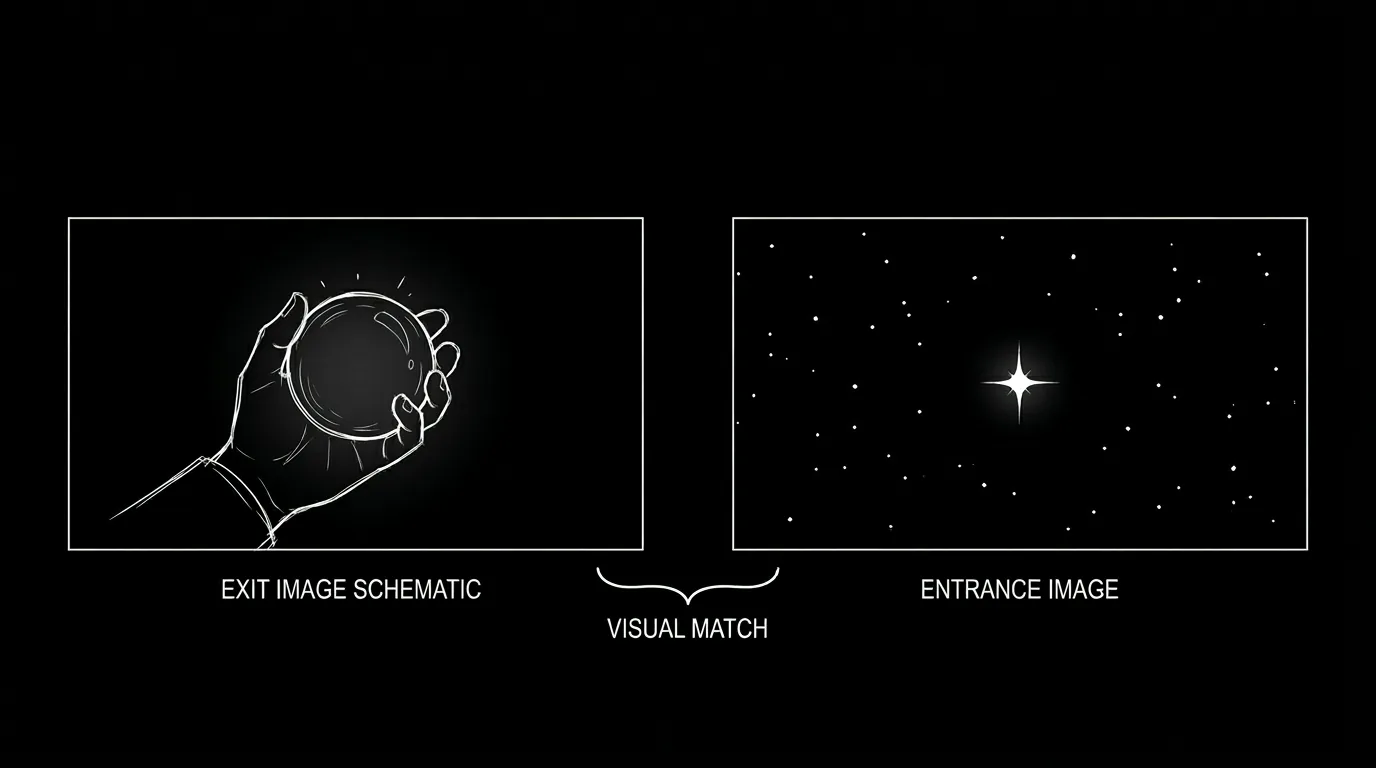
A match cut has two halves: the exit from Scene A and the entrance to Scene B. Both must be written deliberately.
Scene A exit: End with the image or sound that will match.
Scene B entrance: Begin with the matching element.
Example:
EXT. ROOFTOP – NIGHT
Elena holds the DIAMOND up to the moonlight. It catches the glow, a perfect star in her hand.
EXT. SPACE – CONTINUOUS
A real STAR blazes in the void. The camera pulls back to reveal a space station.
The diamond becomes the star. No "MATCH CUT TO:" needed, the description does the work.
Try it free
Try Screenweaver for free on your script
It is free. Import your existing project, get a clearer view of your outline, and regain control of your story structure in minutes.
Start FreeAudio Match Cuts
Sound-based match cuts connect scenes through auditory continuity:
Example:
INT. HOSPITAL ROOM – NIGHT
The HEART MONITOR FLATLINES. A single, endless BEEP.
INT. APARTMENT – MORNING
An ALARM CLOCK BEEPS. Sarah slaps it off, opens her eyes.
The flatline becomes the alarm clock. The sound carries from death to awakening. The match creates meaning: mortality and morning.
Example:
INT. COURTROOM – DAY
The JUDGE'S GAVEL slams, CRACK!
EXT. PRISON YARD – DAY
A BASEBALL BAT hits a ball, CRACK!
Sound connects judgment to incarceration. The crack of authority becomes the crack of captivity.
The "Trench Warfare" Section: What Goes Wrong
Failure Mode #1: Arbitrary Match
The match cut connects two images that share shape, but there's no meaning. A wheel becomes... another wheel. So what?
How to Fix It: Every match cut should mean something. The connection should illuminate character, theme, or story. If it's just clever, cut it.
Failure Mode #2: Over-Explaining
"The bone spins (NOTE: This will match cut to the space station, symbolizing the evolution of humanity's tools)."
How to Fix It: Trust the reader. Write the bone. Write the station. Let the match speak for itself.
Failure Mode #3: Unclear Matching Element
Scene A ends with a crowded frame; Scene B opens with something else entirely. The intended match is lost in visual noise.
How to Fix It: End Scene A on the matching element specifically. The last image should be the matching image.
Failure Mode #4: The Match Disappears in Production
You indicated the match cut, but the director didn't prioritize it. The connection is lost in editing.
How to Fix It: Make the match cut narratively important, not just stylistically cool. If the story depends on the connection, it's more likely to survive.
Failure Mode #5: Using MATCH CUT in Spec
The spec script is littered with "MATCH CUT TO:" and "SMASH CUT TO:" and other directorial language. Readers grow annoyed.
How to Fix It: Use explicit transitions sparingly. Reserve "MATCH CUT TO:" for moments that truly require it. Otherwise, imply through description.
Famous Match Cuts and Their Scripts
2001: A Space Odyssey – Bone to Station:
Kubrick's script (with Arthur C. Clarke) doesn't use "MATCH CUT TO:" The transition is described through action and visual continuity. The bone is thrown; the station orbits.
Lawrence of Arabia – Blown Match to Sunrise:
Lawrence blows out a match. Smash cut to the desert sunrise. Same color, same shape, epic scale shift. The script emphasizes the match (the flame) and the desert (the sun).
Requiem for a Dream – Pupil Dilations:
Repeated match cuts of dilating pupils connect drug use across characters. The script uses the repetition to create rhythm and connection.
These examples show that match cuts can be indicated through careful description, not necessarily explicit tagging.
The Perspective: Editing as Writing
The match cut challenges the boundary between writing and editing. You're making an editorial decision on the page, specifying how two shots connect.
Some argue this isn't the writer's job. The director and editor will figure it out. And sometimes that's true.
But sometimes the match cut is the idea. The connection between the bone and the station isn't a production choice, it's the thesis of the film. The writer should indicate it because the writer conceived it.
The rule isn't "never write match cuts." The rule is: write them when they matter, write them elegantly, and trust that skilled collaborators will recognize the vision.
Your job is to make the connection visible on the page, so that when the director reads it, they see the movie.
[YOUTUBE VIDEO: An editor and writer discussing how match cuts are conceived in scripts and executed in post-production, with before-and-after examples from films.]
Further reading:
- For continuous shots without cuts, see the oner: describing a continuous take without cluttering the page.
- If you're working with split screens, see split-screen: modern formatting for frantic thrillers.
- Every Frame a Painting has visual essays on editing techniques at youtube.com/@everyframeapainting{:rel="nofollow"}.
Final Step
Build your next script with Screenweaver
Move from ideas to production-ready pages faster with timeline-native writing and AI-assisted story flow.
Try Screenweaver