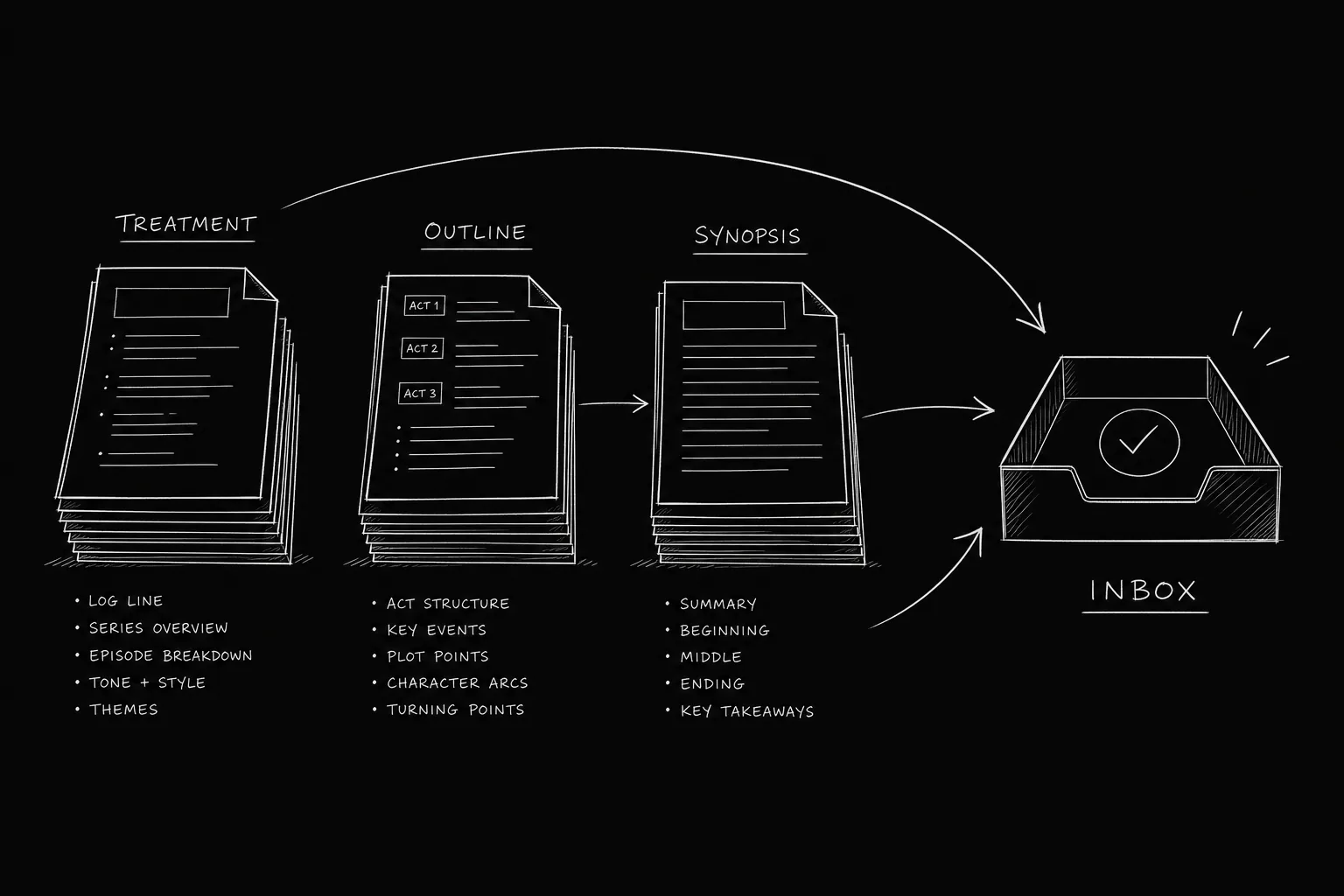

Build the beat sheet first, the outline second, and the treatment only when someone is going to read it. The beat sheet tests whether the story has a shape. The outline turns that shape into scenes you can sit down and write. The treatment sells the result in prose. Doing them in any other order costs you weeks.
That order is not a matter of taste. It comes from how much each document costs to change, and the gap between the three is far wider than most writers expect until they have paid it once. A beat that moves on a one page sheet costs you a pencil stroke. The same change inside a nine page treatment means rewriting half the prose, and most writers quietly refuse to make it. If you want the page targets behind the beats, they live in the 15-beat breakdown with page numbers.
The three documents at a glance
| Beat sheet | Outline | Treatment | |
|---|---|---|---|
| Length | 1 page, 15 rows | 3 to 10 pages | 3 to 12 pages, sometimes more |
| Format | One line per beat | Scene list, often with sluglines | Continuous present tense prose |
| Question it answers | Does this story hold up? | What am I writing on Monday? | Why should anyone pay for this? |
| Audience | You | You, sometimes a co-writer | Producer, exec, manager, contest |
| Cost to change | Minutes | An hour | A day or more |
| Symptom when it is wrong | You feel bored reading it | You keep skipping scenes | Readers ask what the movie is |
Two of these documents exist to help you work. The third exists to be read by somebody who can say yes or no, and that difference drives most of the order.
Beat sheet: the structural x-ray
A beat sheet is one page with a line per beat. Fifteen lines if you use the Save the Cat model, fewer if you work in acts or sequences. Each line names a job the story has to do at roughly a known point in the running time. The whole value is that you can see the film in a single glance, which is exactly what a fifteen page document takes away from you. If you want the reasoning behind each beat rather than the page math, the beat by beat explanation covers what each one is for.
What it catches:
- A midpoint that is just another scene, so act two sags
- Two beats doing the same emotional job back to back
- A protagonist who makes no real decision until page 70
- An ending that resolves a question the opening never asked
What it will not catch: dialogue, tone, whether your dinner scene is any good. It checks whether the structure holds weight. Quality of the writing is a different question, and you answer it later. Writers who dislike beat sheets usually dislike one specific commercial template rather than the idea of checking your structure on a single page, which is a different argument again.
The honest cost is that a beat sheet can lie to you. Fifteen filled rows look finished. You can produce a technically correct sheet for a story nobody wants, and the sheet will not say a word about it. Run your beats against page targets with the beat sheet calculator, then read the sheet top to bottom and ask whether you would watch it. If the answer is a shrug, fixing the outline will not save you.
Outline: the scene plan
The outline is where the beats become work. Fifteen beats turn into forty to sixty scenes, each with a location, the people in it, and the thing that changes by the end of it. Some writers add sluglines and act breaks. Some keep it to one sentence per scene. Both work. What matters is that every line tells you what to type when you sit down.
A good outline has a specific texture. Each entry contains a verb that belongs to a character, not to the plot. "Maya finds the second ledger" is an outline line. "The truth about the money comes out" is a wish. The second version feels productive and produces nothing, because it never tells you who is in the room.
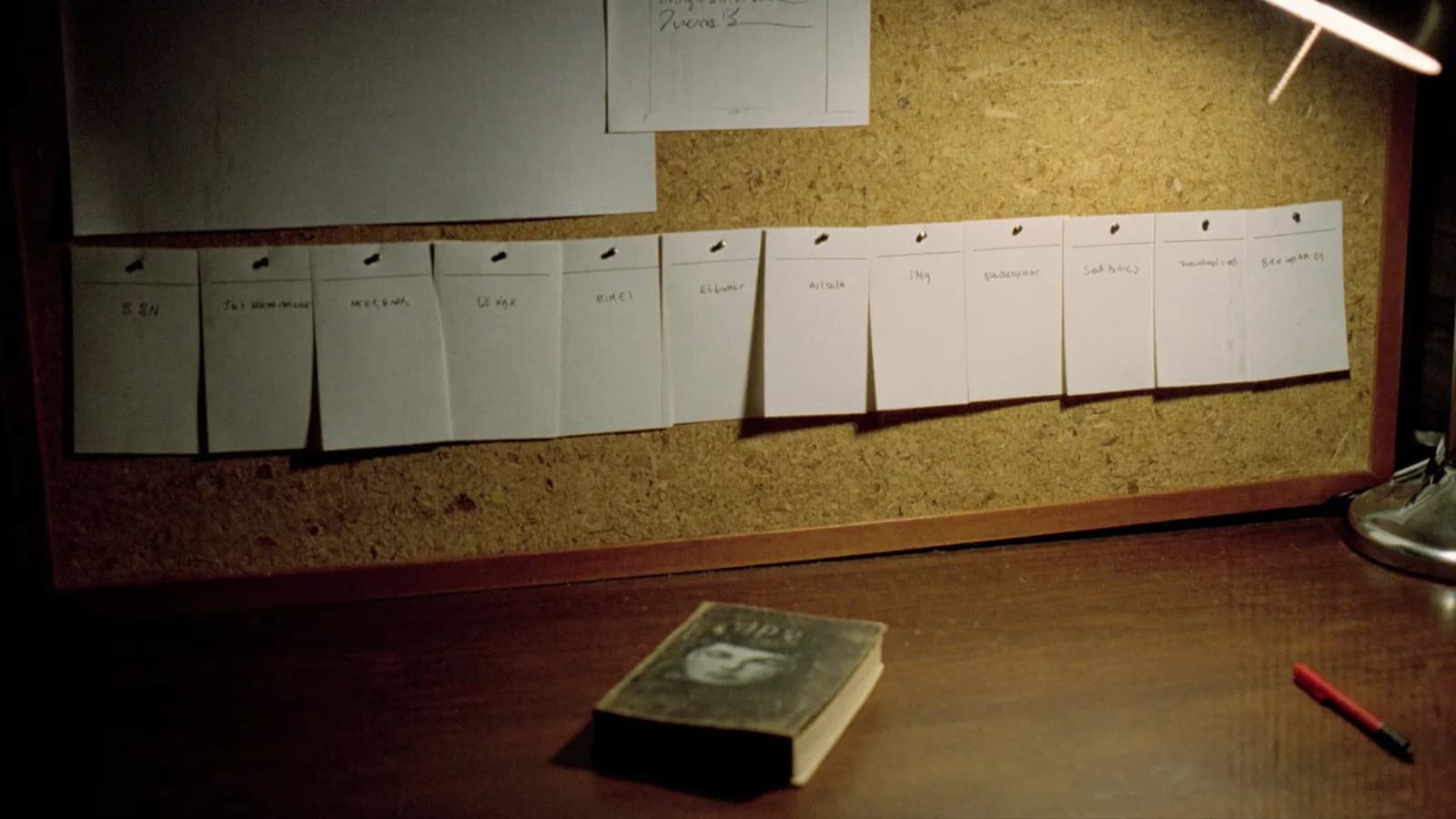
Cards on a wall are the same document in another shape, and choosing between the list and the board is a question of how your head works rather than which one is correct. The beat boards versus outlines comparison goes into that split. Television changes the arithmetic again, since act outs have to land on specific pressure points, which is why the 60-minute drama pilot outline treats them separately.
Where outlines go wrong:
- Written before the beats, so you get a list of events with no shape and discover on page 55 that the story has no engine.
- Too detailed. A twenty page outline is a first draft in disguise, written in a format nobody can shoot or buy.
- Too vague. Twelve lines for a feature is a beat sheet wearing a different hat.
- Never revised. The outline is a live document, so when scene 31 dies in the draft the outline should change that same day.
If you want structure to page mapping while you build the scene list, the screenplay outline builder does the arithmetic so you can keep thinking about the story. For a worked example of the layer above it, the filled beat sheet template for a 110 page feature shows what the sheet looks like before it becomes scenes.
Treatment: the document that has to persuade
A treatment is prose. Present tense, no scene numbers, and dialogue only when a line genuinely earns its place. It reads like the film as experienced rather than the film as planned, and its job is to make a busy reader want the script. Length varies by who asked and why. Short treatments run three or four pages. Development treatments for a feature commonly land somewhere between eight and twelve. Nobody agrees on a single number, so matching what the reader asked for beats hitting a page count you read on a forum.
The treatment is the only one of the three that leaves your hard drive, which changes how you should handle it. It has a reader and a decision attached, and matching the document to that moment is its own craft problem. The what to send and when guide handles that side, and the feature treatment walkthrough handles the prose itself.
Writing the treatment first feels wonderful and is usually a trap. Prose flatters weak structure. You can write a gorgeous paragraph about a second act that does not function, and you will believe it, because good sentences are convincing. Then you spend three weeks defending those sentences instead of fixing the story underneath them.
The exception is real and worth naming. Some writers think in prose and cannot find the story any other way. If that is you, write a rough treatment as a discovery draft, then set it aside and build the beat sheet from whatever survived. That is not the same as sending it.
What doing it backwards actually costs
| Order used | What usually happens |
|---|---|
| Beat sheet, outline, treatment | Changes stay cheap. The treatment describes a film that works. |
| Outline first, no beat sheet | Scene list with no shape. The sag shows up in the draft, not on the page. |
| Treatment first | You write the structural problems into beautiful prose, then defend them. |
| Treatment only, no outline | The script wanders. Scenes exist because the prose implied them. |
| Beat sheet only, straight to pages | Fine on short forms. On a feature you improvise 50 scenes. |
That last row deserves a caveat, because plenty of working writers skip the outline on purpose and go from a sheet to pages. It is a legitimate method if you draft fast and rewrite hard. On a short film it is often the right call, since ten pages is small enough to hold in your head. On a 110 page feature with a producer waiting, skipping the outline mostly means writing the outline later, in script format, at ten times the cost.
Try it free
Try Screenweaver for free on your script
It is free. Import your existing project, get a clearer view of your outline, and regain control of your story structure in minutes.
Start FreeWhich one to build first, by situation
| Your situation | Build first | Then |
|---|---|---|
| New idea, nothing written | Beat sheet | Outline, then draft |
| Manager asked for a take by Friday | Beat sheet, then treatment | Outline once they say yes |
| Draft exists and act two sags | Beat sheet of what you wrote | Revised outline of act two only |
| Adapting a book or article | Outline of source events | Beat sheet, then a new outline |
| Pitching in a room next week | Beat sheet, then talking points | Treatment if they ask to read |
| Writing a short | Beat sheet | Straight to pages |
| Contest deadline in three weeks | Outline | Skip the treatment entirely |
| Co-writing with someone | Outline you both sign off on | Split the scenes |
The adaptation row is the one people get wrong most often. Source material arrives with its events already in order, so the instinct is to beat it out immediately. Do the reverse. List what actually happens in the book first, then find the fifteen beats hiding inside it, then build the outline that leaves out two thirds of the book. Beating out a novel before you have inventoried it means beating out your memory of the novel.
The 90-minute version of all three
Starting cold, this sequence gets you to a usable outline without a month of prep.
- Minutes 0 to 10. Write the logline. If you cannot, the beat sheet will not fix it.
- Minutes 10 to 30. Fill only five beats: opening image, catalyst, midpoint, all is lost, final image. Leave the rest blank.
- Minutes 30 to 40. Read those five out loud. If the midpoint does not change what the protagonist wants, stop and fix it before you go on.
- Minutes 40 to 60. Fill the remaining beats. Check the page targets with the calculator.
- Minutes 60 to 85. Expand each beat into scenes. One line per scene, each with a name and a verb.
- Minutes 85 to 90. Mark the three scenes you have no idea how to write. Those three are where the script will fight you.
The treatment is not on this list on purpose. Write it when a person asks for it, and write it from a finished outline, because a treatment with a working structure underneath it takes an afternoon instead of eating a week and still reading thin.
FAQ
Is a beat sheet the same as an outline?
No. A beat sheet is roughly one page and names the structural jobs the story has to do. An outline is three to ten pages and lists the scenes you will write. The beat sheet is a diagnostic, the outline is a work plan. Writers who use the words interchangeably usually end up with a twelve line document that is too vague to write from and too long to check at a glance.
Can I skip the beat sheet if I already have an outline?
You can, but run the reverse test first. Reduce your outline to fifteen lines on one page. If that page reads as a story with a working middle, you never needed the sheet. If the compression feels impossible, your outline is a list of events rather than a structure, and the exercise will show you exactly where.
How long should a treatment be?
Ask the person who requested it, and treat that answer as the spec. Short treatments run three or four pages, development treatments for features are commonly eight to twelve, and some producers want two. The ranges are wide enough that guessing is a bad bet, and guessing wrong reads as a writer who does not know the room.
Do I need a treatment if I already have a finished script?
Only if somebody asks, which happens more than you would expect. Execs use treatments to check a story without spending two hours, and packaging teams use them to brief people who will never open the script. Write it from the finished script rather than from your old prep documents, since the script is the thing you are selling.
Does the order change for television?
The documents change more than the order does. Pilots still start with beats, but those beats have to land on act outs, and the outline carries more weight because staff outlines get approved before anyone writes pages. Series work also adds documents the feature world does not use, like the series bible, which sits above all three.
Where do index cards fit?
Cards are an outline in a different physical form, useful when you need to see the whole thing at once and reorder it by hand. Some writers card out the beats, some card the scenes, and both are fine. Cards are a thinking surface rather than a fourth document, so they replace part of the outline stage instead of adding a step.
Final Step
Build your next script with Screenweaver
Move from ideas to production-ready pages faster with timeline-native writing and AI-assisted story flow.
Try Screenweaver