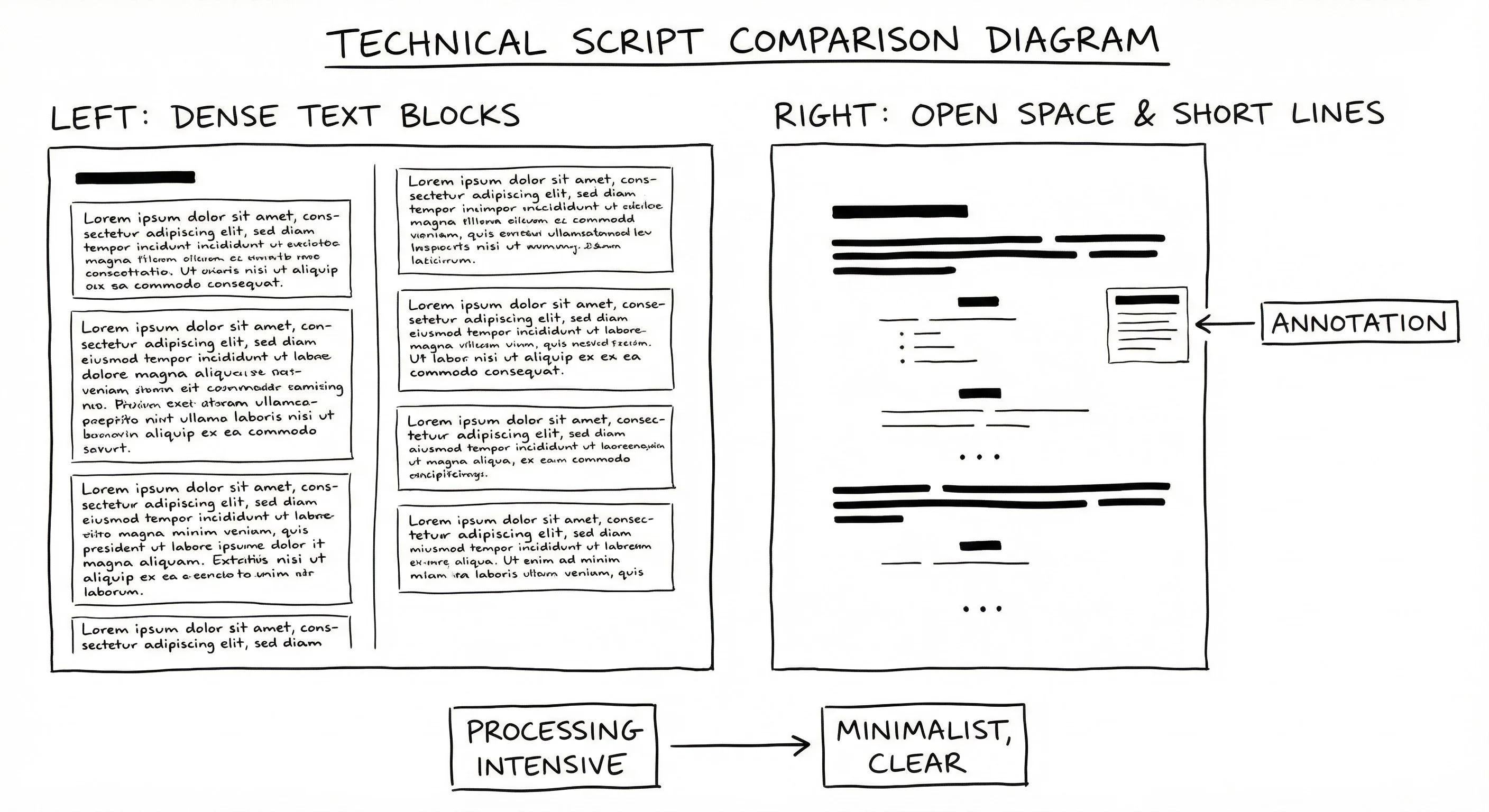

The reader’s eye moves down the page. You can’t control how fast they read,or can you? Micro-pacing is the craft of using layout on the page to speed them up or slow them down. Dense blocks of action make the eye work. White space and short lines create breath and emphasis. What you put in a paragraph, and how you break it, changes the rhythm of the read. Not in a gimmicky way. In a way that serves the moment.
The script isn’t just words. It’s a visual object. How it looks shapes how it feels.
Think about it: a chase sequence written in one long block of action reads like sludge. The same sequence, broken into short, punchy lines,each beat on its own,reads like a heartbeat. Conversely, a quiet moment of realization written in a flurry of one-line paragraphs can feel frantic. Sometimes you want the reader to slow down. You want them to sit in the silence. So you give them a block. A paragraph that doesn’t let them off the hook. White space and action line length are the levers. Use them.
What White Space Actually Does
White space is the empty space between blocks of text. In a screenplay, that means the gaps between action paragraphs, between action and dialogue, and sometimes within a paragraph when you break a line. When there’s a lot of white space, the page feels light. The eye moves quickly. Short lines and single-sentence paragraphs create pause,each line gets a moment. When there’s little white space, the page feels dense. The eye has to work. The reader slows down. They’re in the thick of it.
So: more white space often equals faster read in the sense that the eye jumps from beat to beat. But it also equals more emphasis per beat. A single line surrounded by space stands out. So white space can speed the overall pace (we’re not lingering in long paragraphs) while also making individual moments land harder. Dense blocks slow the read and can convey overwhelm, confusion, or immersion in a single sustained action. The trick is to match the layout to the intended effect.
Action Lines: Length and Rhythm
Action lines describe what we see. They’re not prose. They’re instructions that will become images. So the length of your action lines,and how you group them,affects how the reader experiences the scene. One long paragraph of action says “this is one continuous flow.” The reader doesn’t stop until the paragraph ends. Several short paragraphs, or short lines, say “these are distinct beats.” The reader pauses at each. So for a fight, a chase, or a rapid sequence of events, many writers use short lines. Hit. React. Move. Next. For a slow burn,someone walking through an empty house, or a long take of a face,a longer, unbroken block can hold the reader in that moment.
Here’s the catch. If every action block is three lines or fewer, the script can feel choppy. If every block is a wall of text, the script can feel heavy. Variety is the goal. Vary the length of your action blocks so that the page has rhythm. Speed up for intensity. Slow down for weight.
A Practical Comparison
| Layout choice | Effect on read | Best for |
|---|---|---|
| Short lines, lots of white space | Fast, emphatic; each beat lands | Chases, fights, quick cuts, reveals |
| Long paragraphs, little white space | Slower, immersive; sustained tension | Creeping dread, long takes, confusion |
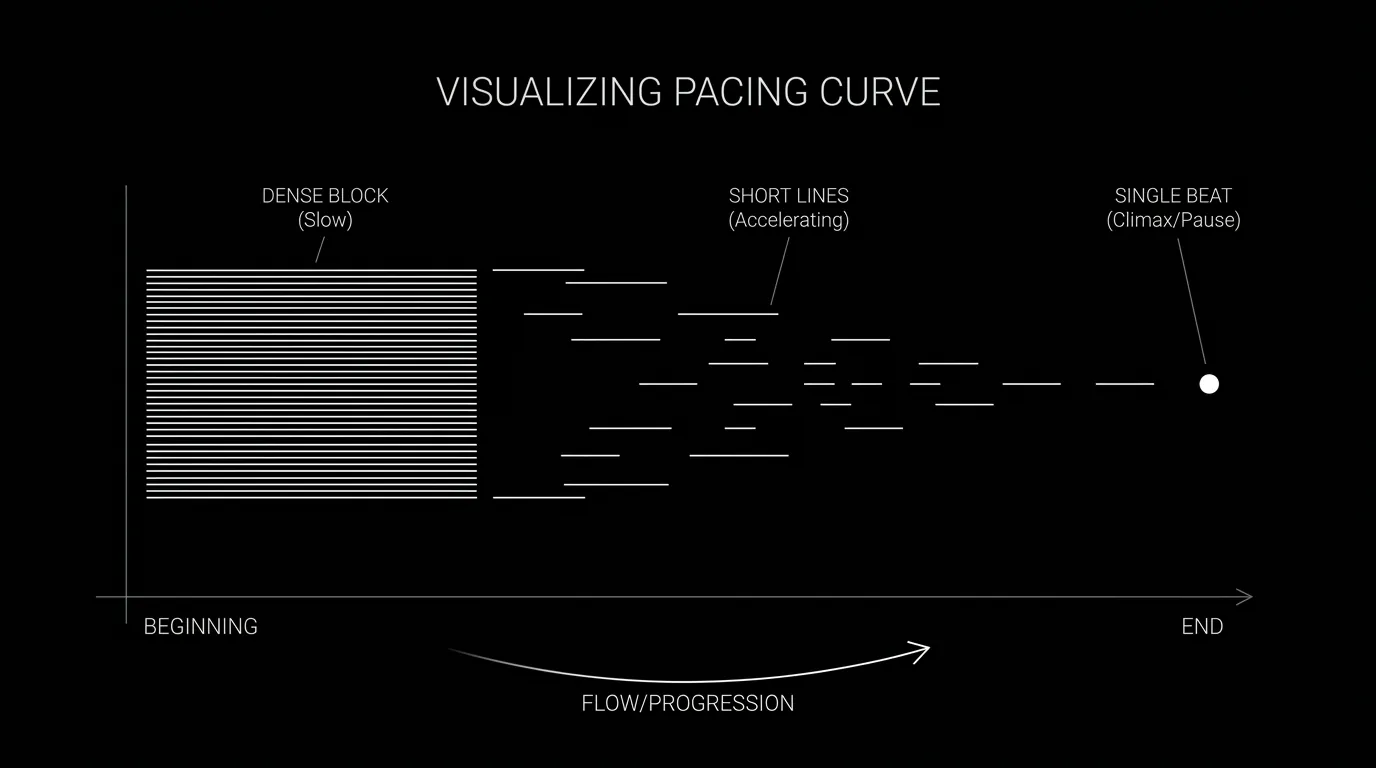
| Mixed: short then long | Contrast; emphasis then immersion | Building to a climax, then holding |
| Single-line “paragraphs” | Maximum emphasis; almost like a list | Key moments, one image per line |
None of this is arbitrary. It’s tied to what the scene is doing. A horror script might use dense blocks when the character is walking down the dark hallway,we’re in the dread with them. Then short, sharp lines when the thing appears. The layout mirrors the experience. As with writing the jump scare, the way you format the moment can make the reader flinch before a single frame is shot.
Relatable Scenario: The Heist Sequence
You’re writing a heist. The team has sixty seconds. Alarms, guards, locks. If you write it as one long paragraph, the reader’s eye glides over it. The urgency is in the content but not in the form. Rewrite it so that each beat is its own line or short block. “Marcus picks the lock.” “Ten seconds.” “Guard turns the corner.” “Sarah freezes.” “Five seconds.” “Click.” “They’re in.” The white space between each line creates a pause,a beat,and the accumulation of short lines creates speed. The reader’s pulse goes up because the page is breathing in short bursts. That’s micro-pacing.
Try it free
Try Screenweaver for free on your script
It is free. Import your existing project, get a clearer view of your outline, and regain control of your story structure in minutes.
Start FreeRelatable Scenario: The Aftermath of Bad News
Your protagonist has just been told they’re fired. Or their partner is leaving. The scene that follows could be a flurry of short lines: “She doesn’t move.” “The door closes.” “Silence.” “She looks at the contract on the desk.” “Then the window.” That works,it’s fractured, like her state of mind. Or you could write one long paragraph: she sits, the room around her, the sound of the door closing still in the air, the contract, the window, the city outside, none of it making sense yet. The reader is stuck in the moment with her. No escape. Both are valid. The choice depends on whether you want the reader to feel the fragmentation or the weight of one unbroken moment.
The Trench Warfare Section: What Beginners Get Wrong
Using short lines for everything. Every action is one line. The script looks like a list. After a while the reader stops feeling the emphasis,because everything is emphasized. Nothing stands out. Fix: Reserve short lines for moments that need to pop. Use longer blocks for build-up and for moments you want the reader to sit in.
Writing walls of action. One paragraph runs for half a page. No break. The reader’s eye gets tired. They skim. They miss the one important detail buried in the middle. Fix: Break action into logical beats. A new beat,a new thought, a new image, a new action,often deserves a new paragraph. If the block is long, ask: can this be two or three blocks? The white space will give the reader a place to breathe and will highlight the key images.
Ignoring the relationship between dialogue and action. Dialogue naturally creates white space (each speaker gets a line). So when you have a long stretch with no dialogue, the action blocks do all the work. If those blocks are all the same length, the read becomes monotonous. Fix: Vary action block length in dialogue-light scenes. Use a short line for the one visual that matters in the middle of the exchange.
Over-breaking for tension. You want the reader on edge, so you break every sentence into its own line. But if the content isn’t tense, the layout feels melodramatic. Fix: Match the layout to the actual content. Short lines amplify tension; they don’t create it. If the scene is calm, let the blocks be longer. Save the fragmentation for when the story earns it.
Forgetting that the director and actor read this too. The way you break action can suggest rhythm and pause. A single line of action,“He doesn’t move.”,suggests a beat. A long paragraph suggests a continuous take or a more fluid interpretation. You’re not just pacing the reader; you’re giving clues to how the moment might play. Fix: When you want a specific rhythm (e.g., a beat of silence), use the layout to suggest it. One line. Then space. Then the next beat.
Step-by-Step: Pacing a Key Scene
Take a scene you’ve already written. Identify the emotional or narrative peak,the moment that must land. Read the action leading to it. If the lead-up is one long block, consider breaking it into shorter blocks as you approach the peak, so that the peak itself can be one or two lines surrounded by space. Now look at the peak. Is it buried in a paragraph? If so, give it its own line or two. Let the white space around it do the work. Then look at what follows. If you want the reader to sit with the aftermath, consider a longer block. If you want to move on quickly, keep the aftermath short and get to the next scene. You’re conducting. The layout is your baton.
How This Fits With Scene Length and Act Structure
Micro-pacing operates at the level of the paragraph and the line. It doesn’t replace scene-level pacing,arriving late and leaving early,or act structure. It’s the layer underneath. You can have a short scene that feels long because every block is dense. You can have a long scene that reads fast because it’s broken into many short beats. So when you’re revising, look at both: which scenes stay and which go, and within the scenes that stay, how the page is built. White space and action line length are the fine adjustment. Use them last, after the big cuts, to tune the read.
The Perspective
The reader doesn’t consciously notice that you used more white space on page 47. They just feel that the scene moved. Or that it held. Micro-pacing is the craft of making the page feel the way the story feels. When you get it right, the script doesn’t just tell the story,it performs it.
Final Step
Build your next script with Screenweaver
Move from ideas to production-ready pages faster with timeline-native writing and AI-assisted story flow.
Try Screenweaver