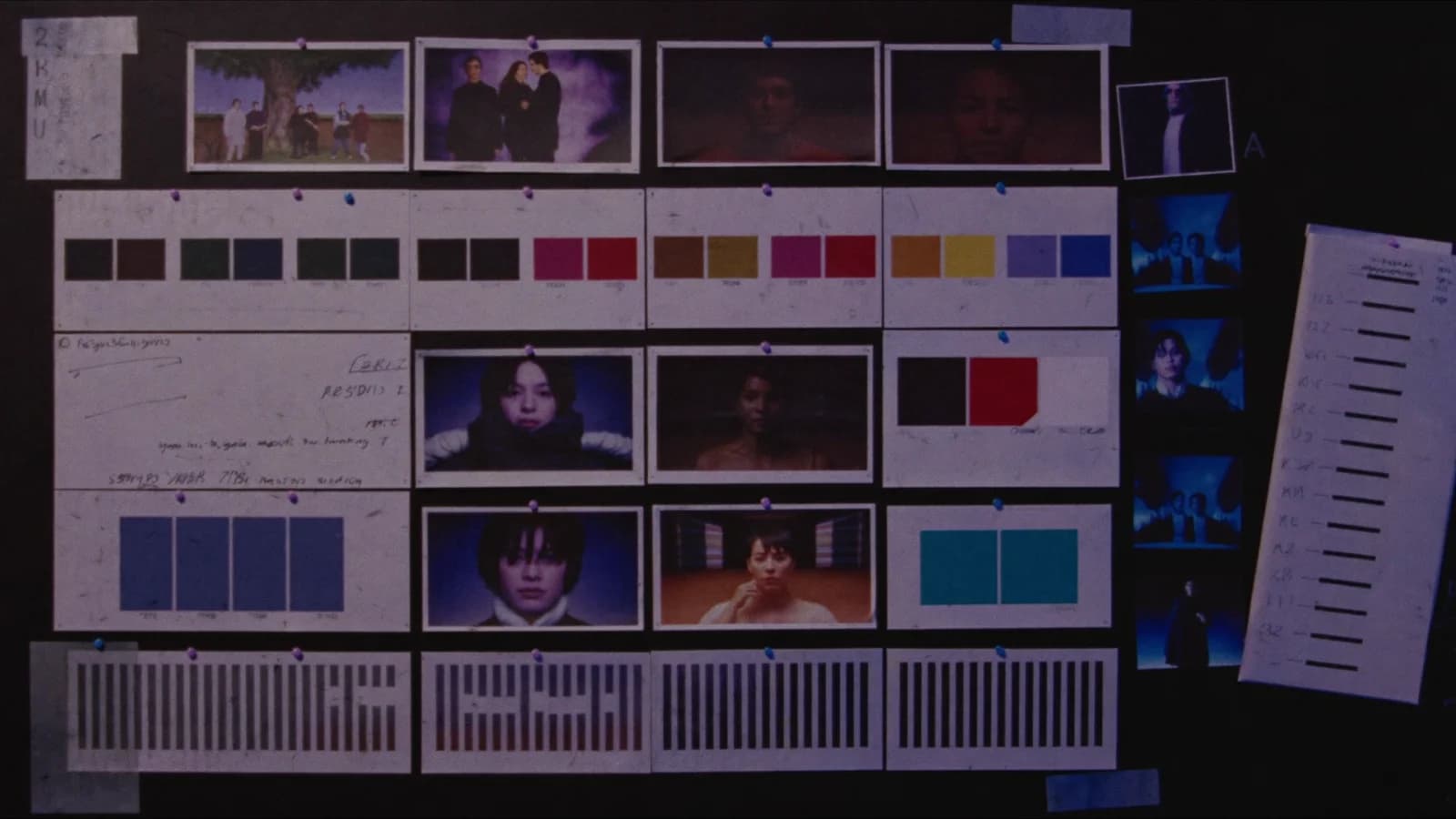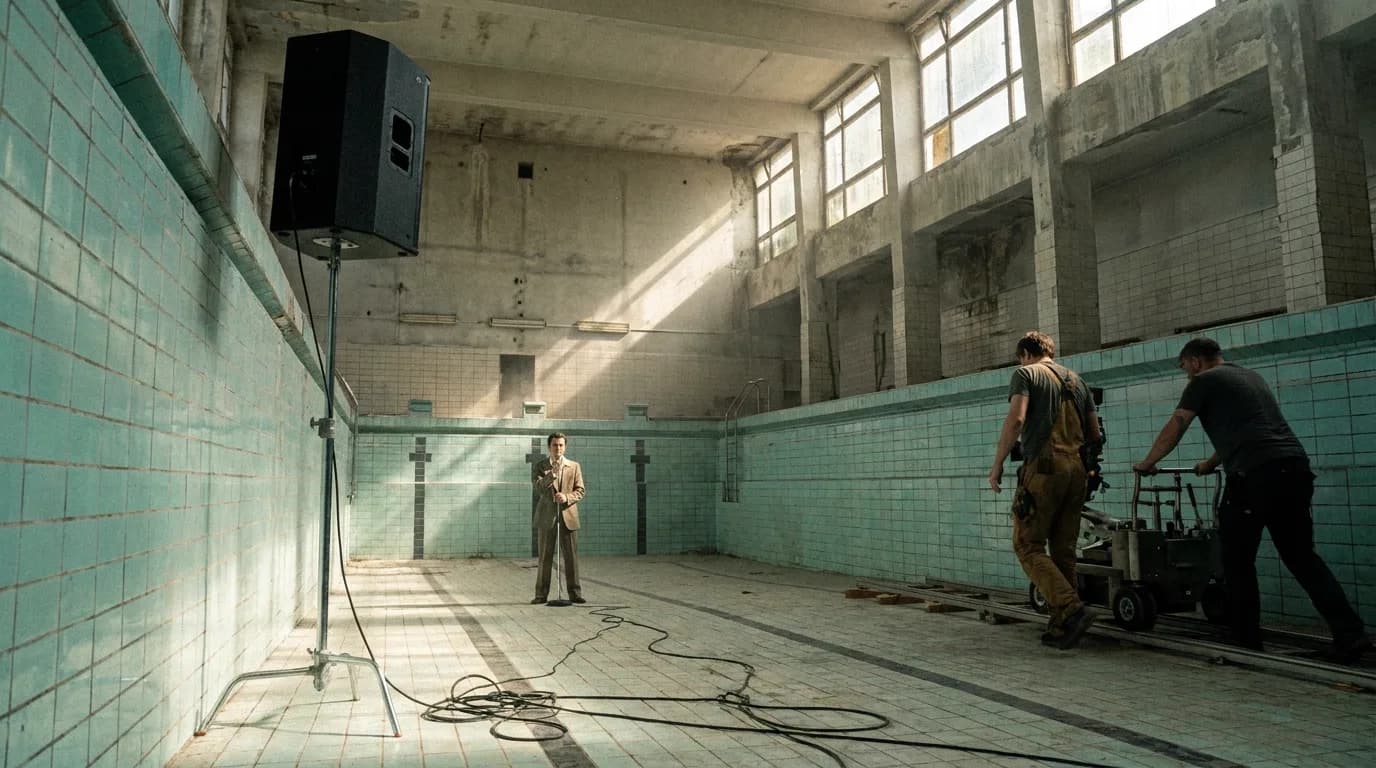

A music video takes its structure from the song, not from a three-act template. Intro, verse, chorus, bridge, outro: those sections are your fixed beats, and each one owes the viewer a visual turn. Six or seven is plenty for three and a half minutes. None of them can be a line of dialogue.
That constraint is the whole craft here. In a screenplay you decide where the midpoint falls. In a music video the mix has already placed it, at 1:47, whether your idea is ready or not, and the audience has heard that moment forty times before they ever watch your version. If you have never built a beat sheet at all, the 15-beat feature version is the reference this borrows from. Cut about nine beats and stop asking anyone to speak.
The song is the beat sheet
Song sections do the same work act breaks do in a script. They mark where energy changes, and an audience feels those changes whether or not the picture cooperates. Cutting against them is a real choice, but you have to make it on purpose, once, not by accident four times.
| Song section | Structural job | What the picture owes it |
|---|---|---|
| Intro | Establish the world and the rules | The image system: place, palette, who we are watching |
| Verse 1 | State the want | Behavior that shows what this person is missing |
| Chorus 1 | Deliver the promise | The signature image of the whole video, at full strength |
| Verse 2 | Complicate | The same world, degraded or escalated, never repeated flat |
| Bridge | Break it | The only genuine turn: a decision or a rupture |
| Final chorus | Return, changed | The signature image again, but the meaning has moved |
| Outro | Land the aftertaste | One held image the viewer keeps |
The intro and the outro are where most directors get lazy, which is the wrong place to save energy. The intro is your entire audition for the next fifteen seconds of attention, and the outro is what someone describes to a friend two days later.
A worked map
An invented 3:32 pop track, mapped out so you can see the shape before you build your own. The song is made up for this article. The timings are the kind you get by marking section boundaries in any editor.
| Timecode | Section | Beat | Visual turn |
|---|---|---|---|
| 0:00 - 0:14 | Intro | Establish | Empty apartment, curtains moving, no one home yet |
| 0:14 - 0:45 | Verse 1 | Want | She moves through the flat touching things that are not hers |
| 0:45 - 1:10 | Chorus 1 | Promise | She is on the roof, city behind her, the video's signature frame |
| 1:10 - 1:41 | Verse 2 | Complicate | Same rooms, now with someone else's shoes by the door |
| 1:41 - 2:06 | Chorus 2 | Escalate | Roof again, wider, weather has turned |
| 2:06 - 2:32 | Bridge | Break | She takes the key off the ring and leaves it on the counter |
| 2:32 - 3:12 | Final chorus | Return | Roof, but she is walking out of frame instead of standing in it |
| 3:12 - 3:32 | Outro | Aftertaste | The empty apartment from the intro, curtains still moving |
Seven rows. That is a complete video, and every row is one sentence long. If you cannot write your video like this, the problem is not the budget.
Three structures, and which one your track can carry
Almost every music video is one of three things, or a deliberate blend of two. Pick before you write, because the three fail in completely different ways.
| Structure | What it needs | Where it fails | Shoot shape |
|---|---|---|---|
| Performance | A performer who is genuinely good on camera, and one strong location idea | Boring by minute two if lighting and camera never change | One location, many setups, long day |
| Narrative | A story that survives with zero dialogue, plus coverage | Runs out of coverage and repeats shots to fill the second half | Multiple locations, tight schedule, highest risk |
| Concept | One process, texture, or transformation carried all the way through | Reads as a mood reel with no reason to keep watching | Controlled, often the cheapest, hardest to sustain |
The predictable failure is pitching narrative and shooting performance. A narrative treatment wins the job because it sounds like a film, then the schedule collapses on the day and the edit gets rescued with performance takes anyway. If you have one day and one artist, the strongest move is a performance video with a single structural idea underneath it, rather than a story that needs eleven scenes to land.
The hybrid worth trusting is performance plus one narrative thread that only turns twice. Chorus sections are performance. Verses carry the thread. The bridge is where the thread pays off. That shape survives contact with a real schedule.
Making a turn without a line
A story beat in a script is often a decision spoken out loud. Take that away and you have seven devices left. Most videos use two and wonder why nothing lands.
Behavior. What the person does when nobody is performing for anyone. Folding, packing, deleting, staying very still. The strongest device on this list, and the one that gets skipped most.
Object. A single object that moves through the video and changes owner or changes place. The key on the counter in the map above is carrying more structural weight than any camera move in the same video.
Location. Moving from interior to exterior, or from a place someone controls to a place they do not, reads as a turn instantly. Audiences track space before they track plot.
Wardrobe and makeup. A change between verse and bridge stays legible at phone size, which matters, because most people watch these on a phone. Use it for meaning. The clothing credit is a side effect.
Cut rhythm. Cutting on every fourth beat in verse one and every beat in the bridge changes the emotional temperature without changing a single thing in front of the lens. Cheapest structural tool you have.
Then there is camera and light, which most directors treat as texture rather than structure. Wide for isolation, close for pressure: if the closest shot in the whole video arrives in the final chorus, the distance is doing structural work. Same for palette. One shift, placed at the bridge, is worth more than a palette that changes every eight bars. Building meaning out of behavior and image instead of speech is the same discipline as writing a silent scene in a script, and it transfers over intact.
None of these need a budget. They need a decision made before the shoot day.
Try it free
Try Screenweaver for free on your script
It is free. Import your existing project, get a clearer view of your outline, and regain control of your story structure in minutes.
Start FreeBuilding the map before the treatment
The beat map comes first, the treatment deck second, and if the video will be generated rather than shot, the guide to making an AI music video is built on this same map. A deck built on top of a solid map writes itself. A deck built to hide the absence of a map is why some pitches feel like ten pages of mood board and no video.
- Get the final mix, not the demo. Section boundaries move between versions, and you are about to key every beat to them.
- Mark every section boundary in seconds. Write them down. This is the only part of the process that is pure clerical work and it takes ten minutes.
- Write one sentence per section describing what we see. Not what it means, what we see.
- Assign each section a turn from the list above. If two adjacent sections use the same device, change one.
- Check chorus differentiation. If chorus one, two, and three are the same shot from the same angle, you have a performance video pretending to be a narrative.
- Count locations against schedule hours. Then cut one location.
For steps 3 and 4, mapping turns against fixed timing points is what the Beat Sheet Calculator does for a script, and the arithmetic works the same whether your fixed points are page numbers or timestamps. Once the map is locked, boarding it is fast, and the AI storyboard tool will take the sentence you wrote per section and give you frames to put in the deck. Turning that map into panels the crew can shoot from is covered in the music video storyboard guide.
Four ways this falls apart
Three identical choruses. The song repeats. The picture must not. Each chorus needs a different scale, or the same image carrying a meaning it did not carry the first time. This is the most common problem in first videos.
A story that needs a line. If your idea requires the audience to know that the two characters are siblings, and there is no way to show it, the idea is wrong for the medium. Test every beat by asking what a viewer with the sound off would understand.
A bridge spent on a costume change. The bridge is the only section the song gives you for a real turn. Spending it on a wardrobe reveal with no consequence wastes the one structural gift in the track.
Beats that need a location you have for forty minutes. Count the setups your map implies, not the locations. A rooftop that appears three times at three different scales is three setups, and the light will have moved between them.
The twenty-minute beat map check
Run this before anyone books anything.
- Every song section has exactly one sentence attached to it
- The intro sentence establishes place, palette, and subject in one image
- Chorus one contains the frame you would put on the thumbnail
- Verse two shows the same world changed, not the same world again
- The bridge contains a decision or a rupture, not a transition
- The final chorus repeats an earlier image with different meaning
- The outro is a single held image, not a fade
- No beat requires spoken information to be understood
- Two adjacent beats never use the same turn device
- The setup count fits the hours you actually have
Ten checks. If eight pass, shoot it. If five pass, fix the map before anyone books a crew.
FAQ
How many story beats does a music video need?
Six to eight, one per song section. A three and a half minute pop track has roughly seven sections, so seven beats covers it. Trying to fit fifteen feature-style beats into three minutes gives you a trailer, not a video.
Does a music video need a story at all?
No. Performance and concept videos work without one and always have. What every music video needs is structure, meaning something that changes across the runtime. A story is one way to get that. A process, a transformation, or an escalating light and camera plan are others.
How do I structure a video for a song with no clear chorus?
Mark energy changes instead of named sections. Ambient and experimental tracks still have points where density or vocal presence shifts, and those are your boundaries. The method does not change, only the labels do.
Should the beats match the lyrics?
Rarely literally. Illustrating lyrics line by line is the fastest way to make a video feel small. Match the emotional turn of a section, then let the picture say something the lyric does not. That gap is the whole reason to shoot a video instead of posting the audio over a still.
How is this different from a beat sheet for a short film?
A short film beat sheet compresses fifteen feature beats into ten pages, and you still choose where each one lands. In a music video the mix has already placed them. If you want the compression logic itself, the short film beat sheet guide covers it in detail.
What do I hand the artist first, the beat map or the treatment?
The treatment, always. The beat map is your working document and it is too blunt to pitch with. But the map is what makes the treatment specific, because it lets you write "at 2:06 the key goes on the counter" instead of "we see her let go of the past". For what belongs in the deck itself, see the treatment length guide.
If you want the musicological vocabulary behind these section names, Wikipedia's song structure entry covers how the conventions differ by genre. For directing purposes, the seven labels above are enough.
Final Step
Build your next script with Screenweaver
Move from ideas to production-ready pages faster with timeline-native writing and AI-assisted story flow.
Try Screenweaver