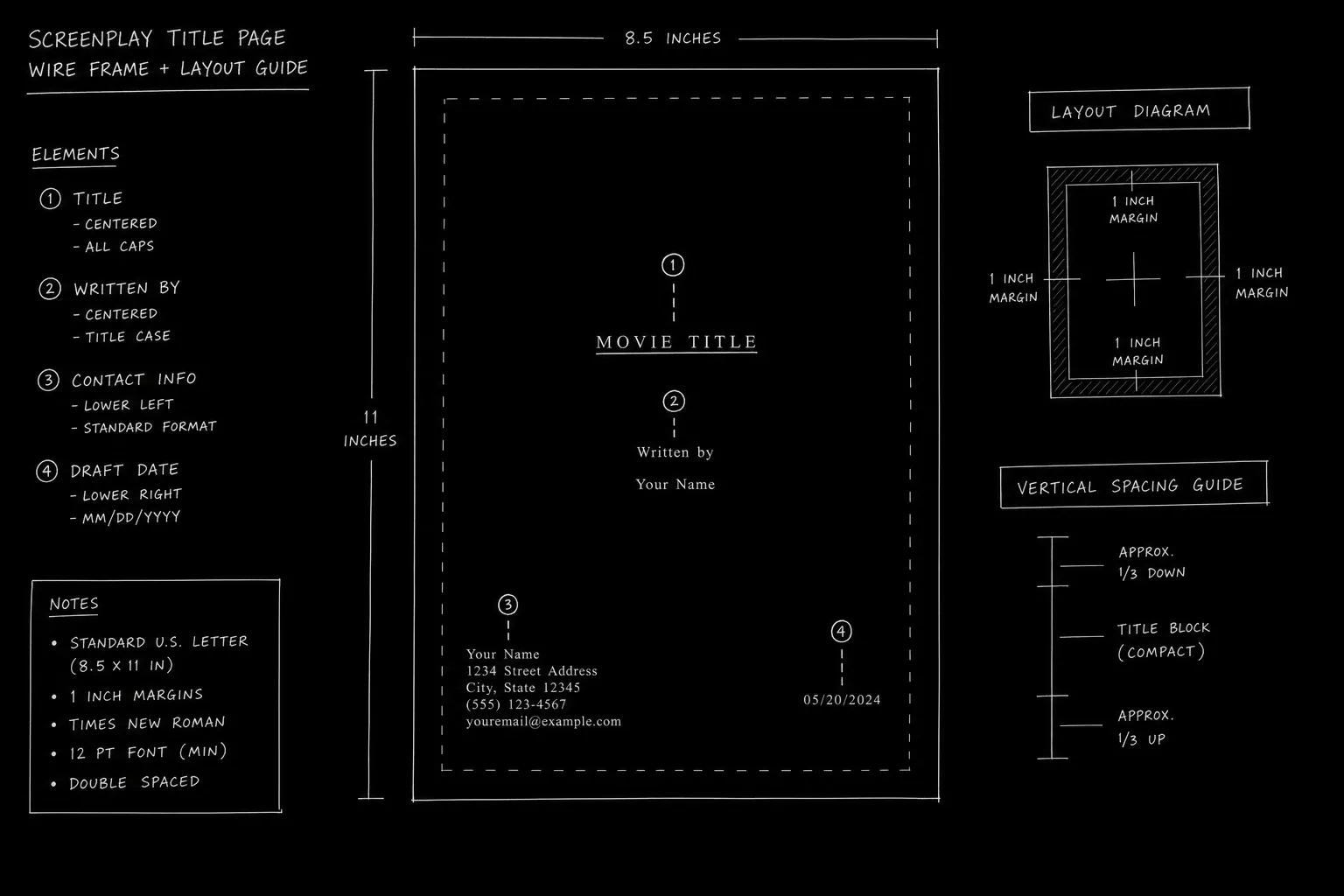

The short answer: screenplay format is a protocol, not a style choice, Courier 12pt, one page ≈ one minute, sluglines that name INT./EXT., location, and time, action in present tense, and a title page that follows the template. Readers use format to judge professionalism before they judge your story. This hub collects every formatting guide we publish, from the fundamentals to the weird edge cases nobody teaches.
Start with the Screenplay Formatting Guide 2026, then dive into whatever your current scene is fighting you on.
The fundamentals
- Screenplay Formatting Guide 2026, the master reference.
- Screenplay title page format for a spec script, your first impression, formatted right.
- What is a slugline? Definition, format and examples, the scene heading explained from zero.
- Scene heading mistakes: the slugline checklist
- Screenplay runtime: the one-page-per-minute guide
- Spec script vs shooting script, what belongs on the page at each stage.
- Feature film script length in 2026
Free tools: format the paperwork in seconds, Title Page Maker, Slugline Formatter, and Script Time Calculator. Free, no signup.
Dialogue on the page
- Formatting voiceover and narration, V.O. without the crutch.
- Voice-over vs off-screen: V.O. vs O.S., the difference that trips everyone.
- Dual dialogue and overlapping arguments
- Phone calls: intercut vs one-sided and intercut vs dual dialogue
- Foreign languages and subtitles
- Text messages: three clean methods
- Whispered dialogue and hushed scenes
Time, structure, and transitions
- Flashbacks and dream sequences with clear transitions
- How to format a montage and series of shots vs montage
- Intercutting scenes and parallel action
- Split timelines in one scene
- Showing simultaneous action in two locations
- The match cut on the page
- Pre-lap transitions and audio cues
Try it free
Try Screenweaver for free on your script
It is free. Import your existing project, get a clearer view of your outline, and regain control of your story structure in minutes.
Start FreeScreens, media, and modern life
- Zoom calls and video conferences and FaceTime scenes
- On-screen notifications and alerts
- Title cards, chyrons, and lower thirds
- News broadcasts and found-footage horror
- Surveillance and bodycam footage
Format by medium
- Sitcom format: multicam vs single-camera
- Broadcast TV act breaks, teasers, and tags
- Writing a musical: lyrics and song cues
- Audio fiction and narrative podcasts
- Fountain: plain-text screenwriting, import and export, pair it with the free Fountain to PDF converter.
FAQ
What is standard screenplay format?
Courier 12pt on US Letter (or A4), sluglines in the INT./EXT. LOCATION – TIME pattern, action lines in present tense, character names centered above dialogue, and roughly one page per minute of screen time. The conventions exist so any reader, anywhere in the industry, can scan your script the same way.
Does formatting really matter to readers?
Yes, before anyone judges your story, they see your pages. Non-standard format signals inexperience and can get a script set aside unread, especially in contests and coverage. The good news: format is entirely learnable, and software enforces most of it.
Do I need special software for correct formatting?
It helps enormously. A dedicated screenwriting tool auto-formats sluglines, dialogue, and pagination as you type, ScreenWeaver does this for free with PDF and Final Draft export. Word processors can imitate the look but break pagination, margins, and industry exports.
Where do I start if my formatting is a mess?
Read the Formatting Guide 2026, run your sluglines through the Slugline Formatter, rebuild your title page with the Title Page Maker, and check your length against the Script Time Calculator. Four fixes cover most of what readers notice.
Final Step
Build your next script with Screenweaver
Move from ideas to production-ready pages faster with timeline-native writing and AI-assisted story flow.
Try Screenweaver