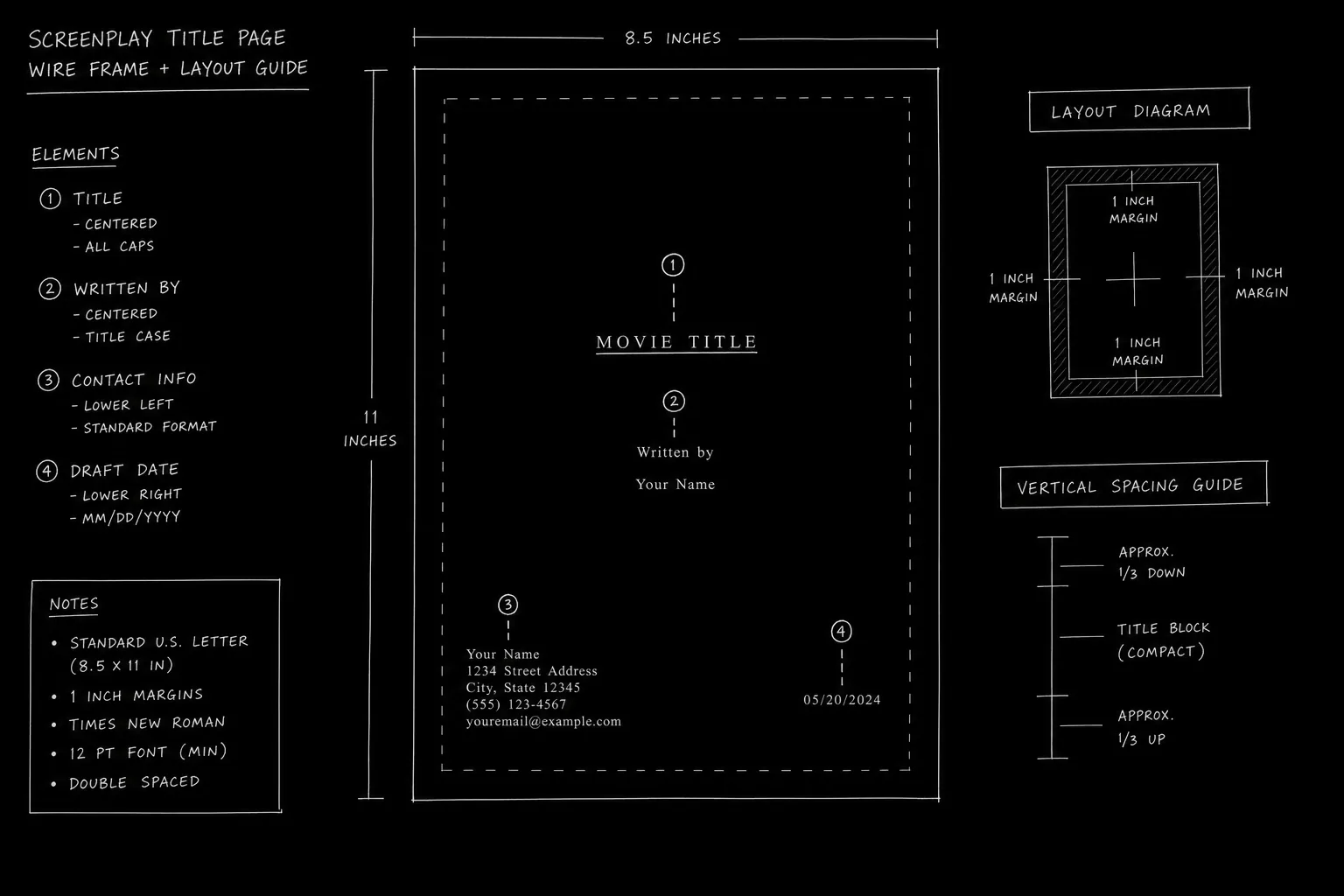

Short answer: if you put a WGA registration number on a title page at all, it goes in the bottom-right corner, one inch from the right margin and one inch from the bottom, well clear of the byline block on the left. But most working screenwriters leave it off a spec title page entirely, because it adds no legal protection and can read as a rookie tell to a professional reader.
That answer splits into two separate questions writers usually mean to ask at once: where does the number physically sit on the page, and should you even print it there. The placement question has a clean, mechanical answer. The should-you question is a judgment call the industry has mostly already made, and it is worth understanding why before you type anything in that corner.
The precise answer, term by term
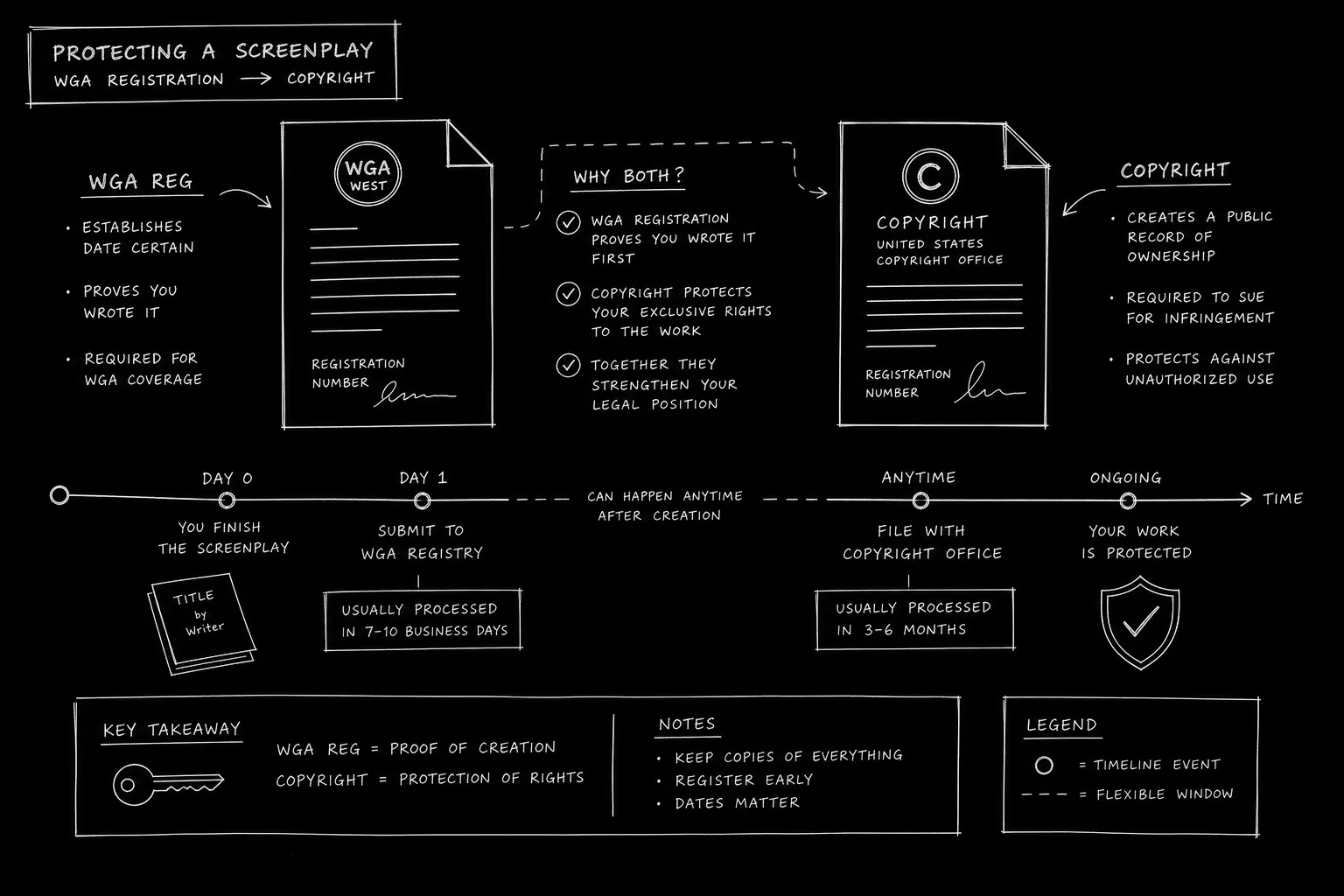
Registration with the Writers Guild of America is not the same thing as copyright, and the number it produces is not the same thing as a title page requirement. Here is what each piece actually is.
| Term | What it is | Where it belongs |
|---|---|---|
| WGA registration number | A dated receipt number from the WGA West or WGA East registry, proving you deposited this draft on a given date | Bottom-right corner of the title page, 1" from the right and bottom margins, if used at all |
| "Registered WGA" notice | A plain text line instead of the number itself | Same corner, or occasionally lower-left near the copyright line |
| Byline and contact block | Your name, "Written by," and contact info | Lower-left, standard on every spec title page |
| Copyright notice | A formal copyright claim line | Rare on a spec; more common on a submitted production draft |
The full mechanics of registering with the WGA, what it protects against, and how it differs from a federal copyright filing are covered in WGA Script Registration vs Copyright: What Screenwriters Need to Know. This article assumes you already have a number in hand and are deciding what to do with it on the page.
The actual current numbers, for context
As of this writing, WGA West registration runs $20 for the general public and $10 for WGA members, covers a single draft for a five-year term, and can be renewed for another five years at the then-current rate within a window that opens three months before expiration and extends three months after. None of that changes where the number sits on your title page. It only tells you what you are looking at if a fee schedule or renewal notice references "the term" or "the current rate."
The nuance that changes the answer
Here is the part most formatting guides skip: whether to print the number at all is a bigger decision than where to print it.
Placement, if you use it. The standard convention is the bottom-right corner of the title page, mirroring the bottom-left contact block on the opposite side. One inch from the right edge, one inch from the bottom edge, small type, no bold, no border around it. Some writers use the words "Registered, WGA" instead of the raw number; either is read the same way by anyone who notices it.
Why most professionals skip it. Registration proves you deposited a specific draft on a specific date. It does not grant additional legal rights beyond what you already have the moment you write something down, and it does not substitute for copyright registration if you ever need to sue over infringement. Readers, agents, and managers who see the industry every day know this. A number stamped in the corner of a spec script does not protect you any more than leaving it off, and to an experienced reader it can quietly signal that the writer is newer to the business and possibly anxious about theft rather than confident about story. That perception costs you nothing measurable, but it costs you something.
When it belongs on the page. A few contexts still call for it. Some contests and fellowships explicitly request a registration or copyright reference in their submission instructions, in which case follow their instructions exactly rather than defaulting to habit. Attorneys handling a dispute sometimes want the number documented on the physical draft they are reviewing. And some writers who are early in a project, sending material to unknown collaborators before any contract exists, print it as a personal comfort measure even knowing it is not legally load-bearing. None of these are wrong reasons. They are just different from "every script needs one," which it does not.
What never changes. Whether or not you include a registration number, the rest of the title page stays exactly as strict as always: no artwork, no tagline, no draft date on a spec, nothing beyond title, byline, and contact information. If you are unsure what belongs on that page at all, the full field-by-field breakdown is in Screenplay Title Page Format for a Spec Script in 2026, and nine real annotated examples are in Screenplay Title Page Examples: 9 Real Layouts Annotated.
Where writers get this wrong
A few recurring mistakes show up often enough to name directly.
Putting the number in the same corner as the byline. The bottom-left corner already carries your name, "Written by," and contact information. A registration number crammed into that same block looks cluttered and makes the page harder to scan at a glance, which defeats the point of a title page in the first place. If you use the number, keep it isolated in the opposite corner.
Using a large or bold font for the number. The registration number, if present, should be quiet. Small type, no bold, no box around it, no color. Anything louder draws a reader's eye to the one piece of information on the page least relevant to the story they are about to read.
Confusing a registration number with a copyright notice. A WGA registration number and a formal copyright notice (something like a copyright symbol, year, and your name) are two different systems from two different institutions, and they do not automatically imply each other. Printing one does not mean you have the other, and a script can carry neither, either, or both depending on what the writer has actually filed. If you are unsure which one a specific submission is asking for, read the request literally rather than assuming they mean the same thing.
Assuming every production draft follows spec rules. Once a script moves past the spec stage into active development or production, the title page itself often changes shape entirely, gaining draft labels, revision colors, and dates that a spec never carries. Registration numbers on those drafts, when present, follow studio or production company convention rather than general spec advice. The full breakdown of what changes on a working draft is in Shooting Script Title Page: Colors, Drafts and Revisions.
Re-registering out of habit instead of need. Because registration lasts five years and is renewable, some writers renew reflexively on every draft revision without asking whether the underlying work has changed enough to warrant it, or whether they even plan to keep circulating that draft. Renewal exists for writers actively developing and shopping a project across years, not as a maintenance chore for every polish pass.
Try it free
Try Screenweaver for free on your script
It is free. Import your existing project, get a clearer view of your outline, and regain control of your story structure in minutes.
Start FreeA quick decision guide
Use this to decide fast rather than agonizing over the corner of a page.
- Sending a cold spec to managers, agents, or producers? Leave the number off. It adds nothing a professional reader values and can read as inexperience.
- Submitting to a contest or fellowship with explicit registration instructions? Follow their instructions exactly, in the format and location they specify, even if it differs from general convention.
- Handing a script to a collaborator before any contract exists? Including it is a reasonable personal comfort measure. It will not hurt your submission, since this is a private exchange rather than an industry-facing one.
- Preparing a script for legal review during a dispute? Document the number wherever your attorney asks for it; this context overrides general formatting advice entirely.
- Polishing a draft you have registered five separate times over three years? Consider whether you need a sixth registration or whether your energy is better spent finishing the rewrite.
How to check yours
- Open your title page. If there is no registration number on it, you are following the majority professional convention. Stop here.
- If you have a number and want to include it, confirm it sits in the bottom-right corner, one inch from each edge, in small plain type.
- Confirm nothing else crowds that corner. The registration number should never overlap or compete with page numbers, since a spec title page carries no page number at all.
- If a contest or submission portal has specific instructions about registration or copyright references, follow those instructions over any general convention, including this one.
- If you are building the page from scratch and do not want to fight margins in a word processor, use a generator that gets the spacing right on the first try.
Free tool: the screenplay title page maker builds a standard, contest-safe title page in seconds, with correct margins and spacing, no signup.
FAQ
Do I need a WGA registration number on my title page?
No. It is optional, provides no additional legal protection beyond what you already hold as the work's author, and most working screenwriters leave it off a spec title page. Include it only if a specific submission asks for it or you have a personal reason to want the reminder on the page.
Where does the WGA registration number go if I include it?
In the bottom-right corner of the title page, one inch from the right margin and one inch from the bottom margin, in small plain type. This mirrors the byline and contact block, which sits in the bottom-left corner.
Does putting a registration number on my script actually protect it more?
No. Registration creates a dated record that you deposited a specific draft on a specific date, which can help establish timing in a dispute, but it does not expand your legal rights beyond what copyright law already grants the moment you fix the work in writing. For the legal distinction between the two systems, see WGA Script Registration vs Copyright: What Screenwriters Need to Know.
Will a WGA number on my title page make me look inexperienced?
It can. Professional readers see it rarely on submitted specs precisely because most working writers know it adds no protection, so an unprompted number in the corner sometimes reads as a newer writer signaling anxiety about theft rather than confidence in the material. It is a small signal, not a disqualifying one, but it is worth knowing it exists.
Should I put "Registered, WGA" as text instead of the number?
Either works the same way if a specific context calls for it. Neither is more or less correct than the other; they are read identically by anyone who notices the corner of the page.
Final Step
Build your next script with Screenweaver
Move from ideas to production-ready pages faster with timeline-native writing and AI-assisted story flow.
Try Screenweaver