
No images. No actors' faces. No visual effects. Just sound, voices, music, ambient atmosphere, and the theater of the listener's imagination.
Audio fiction is the oldest electronic storytelling medium, predating television by decades. And in the podcast era, it's back. Shows like Welcome to Night Vale, The Magnus Archives, and Homecoming have proven that audiences will commit to serialized audio drama with the same fervor they bring to prestige television.
But writing for audio isn't like writing for screen. The format has its own grammar, its own pacing, its own technical requirements. A ten-episode audio drama isn't a TV series without pictures, it's a distinct form with distinct challenges.
This guide covers how to structure a ten-episode narrative podcast from concept to episode outlines, and how to format scripts so that producers, sound designers, and voice actors can execute your vision.
Free tool: use the Script Time Calculator to estimate your runtime from page count.
Cinematic workflow frames
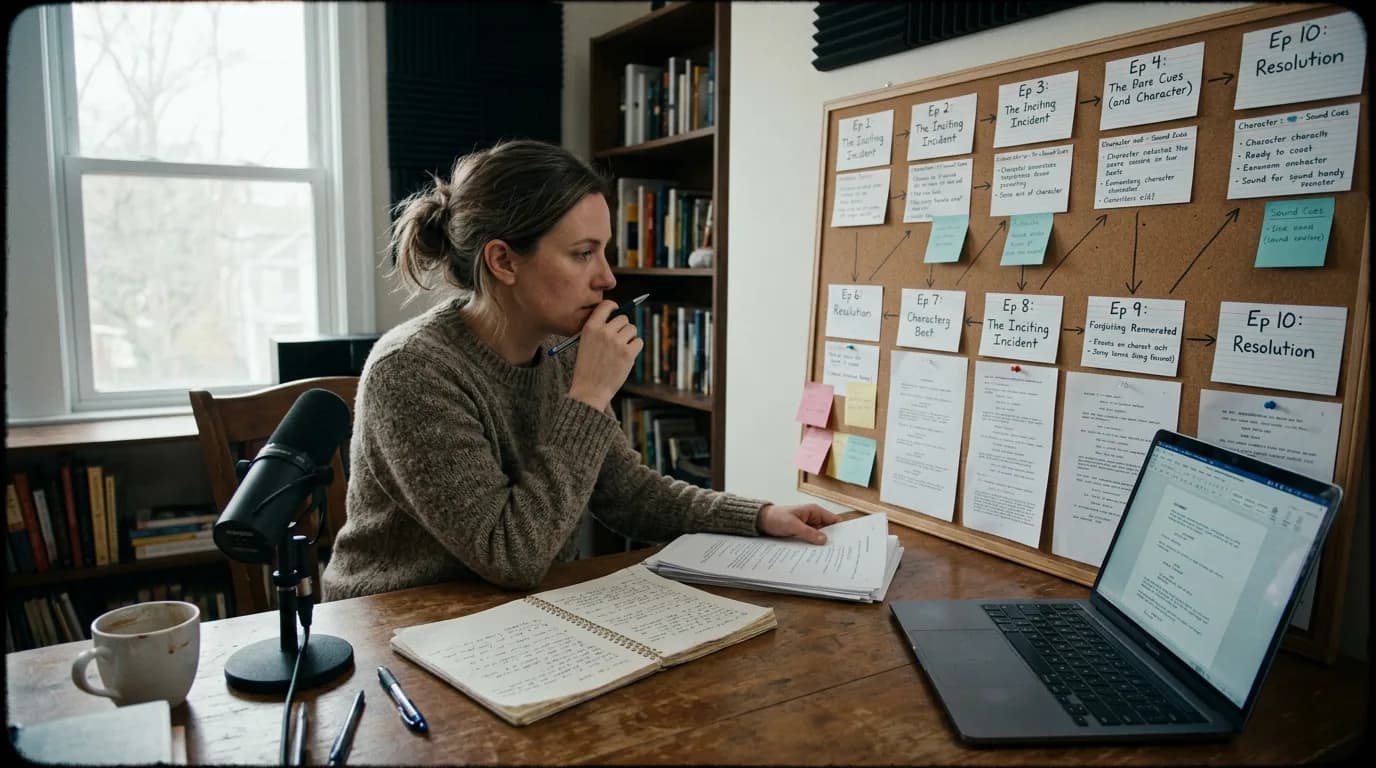
These two visuals work as a pair: the first shows Cinematic workflow still, first angle, 35mm film grain, and the second shifts to Cinematic workflow still, second angle, 35mm film grain - compare them briefly, then move on.
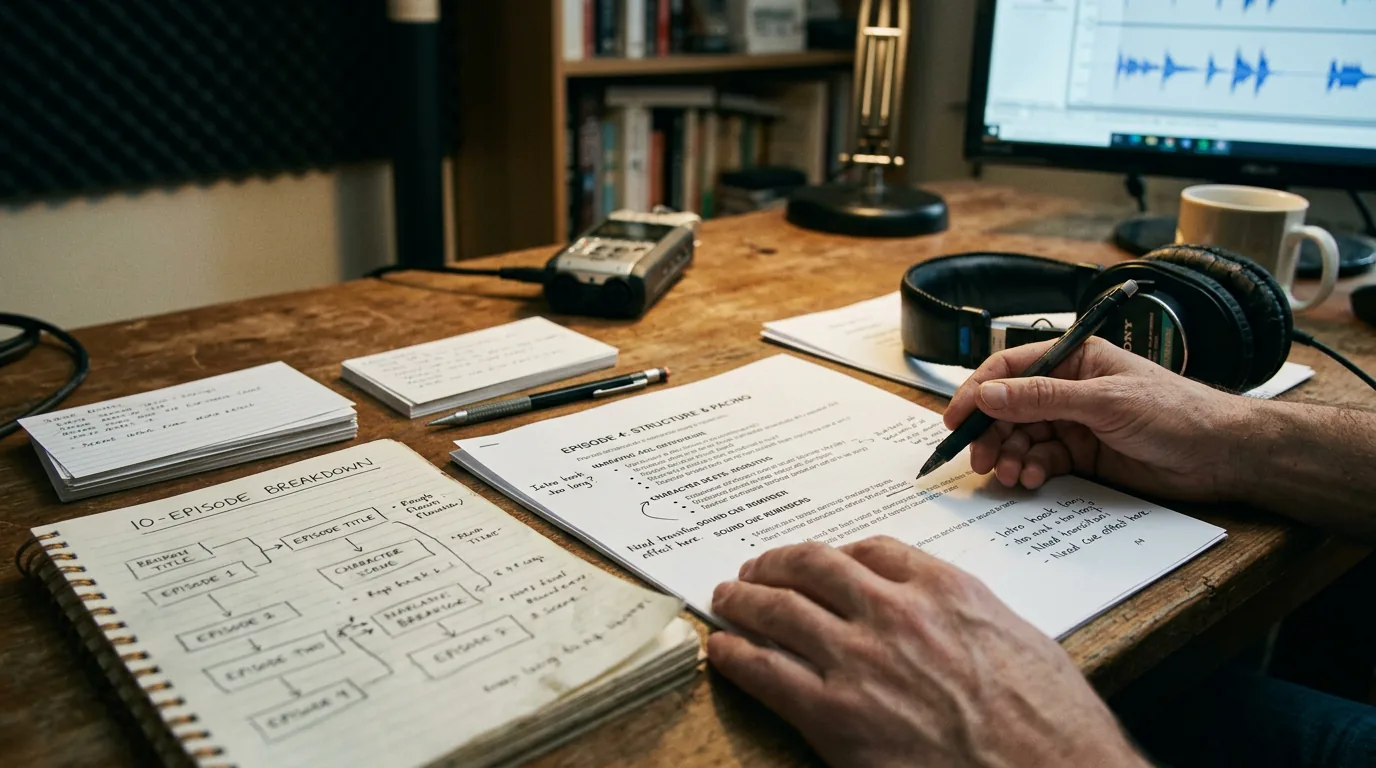
Why Audio Is Different: The Constraints and Freedoms
Audio drama operates under constraints that force creative solutions:
No visual information. Everything must be communicated through dialogue, narration, or sound. You can't show a character's expression; you must write dialogue that conveys the emotion. You can't establish location visually; you need ambient sound or a narrator.
Listener attention is divided. Many podcast listeners multitask, commuting, exercising, cooking. Your story must hold attention without visual anchors. This means clarity, momentum, and regular reorientation.
No pause button for confusion. Listeners can rewind, but in practice they often don't. If a scene is confusing, they're lost. Audio demands clearer storytelling than visual media, where viewers can scan the screen for context clues.
But audio also offers freedoms:
Unlimited locations. A sound effect can place you anywhere, a spaceship, a medieval castle, the bottom of the ocean. Production cost doesn't scale with location ambition.
Intimacy. Audio goes directly into the listener's ears. A whispered line feels close. An internal monologue feels like thought. This intimacy supports emotional storytelling.
Imagination. The monster the listener imagines is scarier than the one you could show them. The romance they picture is more personal. You're collaborating with their mind.
The Ten-Episode Structure: An Overview
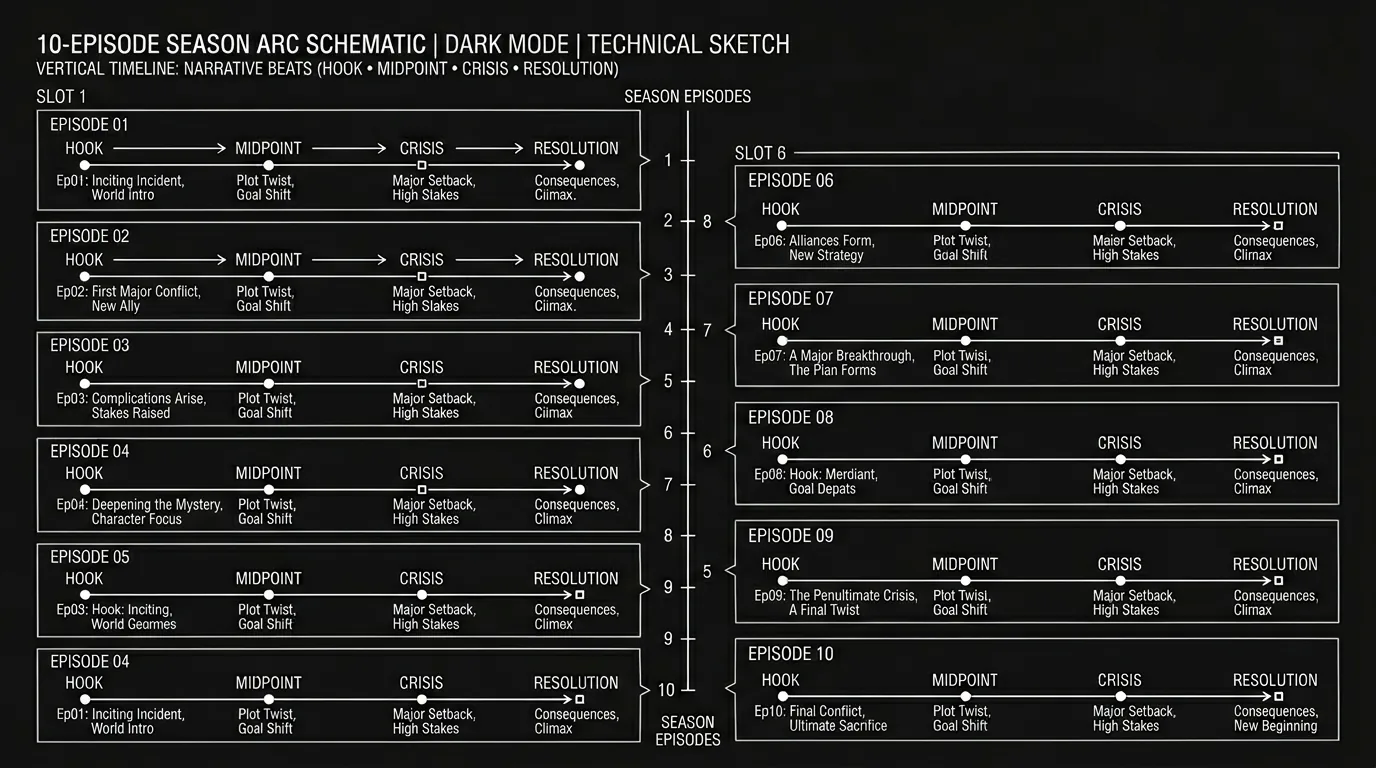
A ten-episode season is a common format for narrative podcasts. It's long enough for substantial storytelling, short enough to feel contained. Here's a structural template:
Episode 1: The Hook and Setup
Establish the world, the protagonist, and the central question. End on an inciting incident that propels the listener into the season.
Episodes 2–4: Building the World and Complications
Deepen the world. Introduce secondary characters. Create complications that raise stakes. Each episode should have its own arc while advancing the larger story.
Episode 5: The Midpoint
A major revelation or reversal. The story shifts direction. What the protagonist thought was true turns out to be wrong, or the stakes escalate dramatically.
Episodes 6–8: Escalation and Pursuit
The protagonist pursues a goal with increasing urgency. Obstacles compound. Allies may be lost. The tension ratchets.
Episode 9: The Crisis
All seems lost. The protagonist faces their greatest challenge. This is the "dark night of the soul" before the finale.
Episode 10: The Resolution
Climax and resolution. The central question is answered (or deliberately left open, if that's the design). The season arc completes; the series arc may continue.
This is a template, not a mandate. Some shows front-load revelation (thriller structure). Some delay the inciting incident (slow-burn horror). But knowing the default helps you choose departures intentionally.
Episode Length: Finding the Right Duration
Podcast episodes vary wildly, from ten minutes to two hours. For serialized fiction, common lengths are:
20–30 minutes: Tight, focused episodes. Good for daily or frequent releases. Requires economical storytelling.
30–45 minutes: The "TV episode" equivalent. Room for development without overstaying. Most common for narrative podcasts.
45–60 minutes: Longer form, more immersive. Requires strong pacing to maintain attention. Works for complex narratives.
60+ minutes: Feature-length. Rare for episodic content, but works for anthology or event episodes.
Choose length based on story needs and audience expectations. A thriller might favor shorter, punchier episodes. A character study might need room to breathe.
A Table: Episode Structure Template
| Episode | Function | Story Beat | Listener Experience |
|---|---|---|---|
| 1 | Hook | Inciting incident | "I need to know more" |
| 2 | Expansion | World deepens, stakes clarify | "I understand the world" |
| 3 | Complication | First major obstacle | "This is harder than expected" |
| 4 | Deepening | Character reveals, subplot seeds | "I care about these people" |
| 5 | Midpoint | Revelation or reversal | "Everything I thought is wrong" |
| 6 | Pursuit | Protagonist acts with urgency | "The clock is ticking" |
| 7 | Escalation | Obstacles compound | "How will they survive this?" |
| 8 | Pre-crisis | Allies tested, losses possible | "It's all falling apart" |
| 9 | Crisis | Lowest point | "Is there any hope?" |
| 10 | Resolution | Climax and wrap-up | "That was worth the journey" |
Formatting the Audio Script
Audio drama scripts look different from film scripts. The key differences:
No visual scene headings. Instead of "INT. KITCHEN – DAY," you might use "SCENE 3: KITCHEN – AFTERNOON" or simply establish location through sound cues and dialogue.
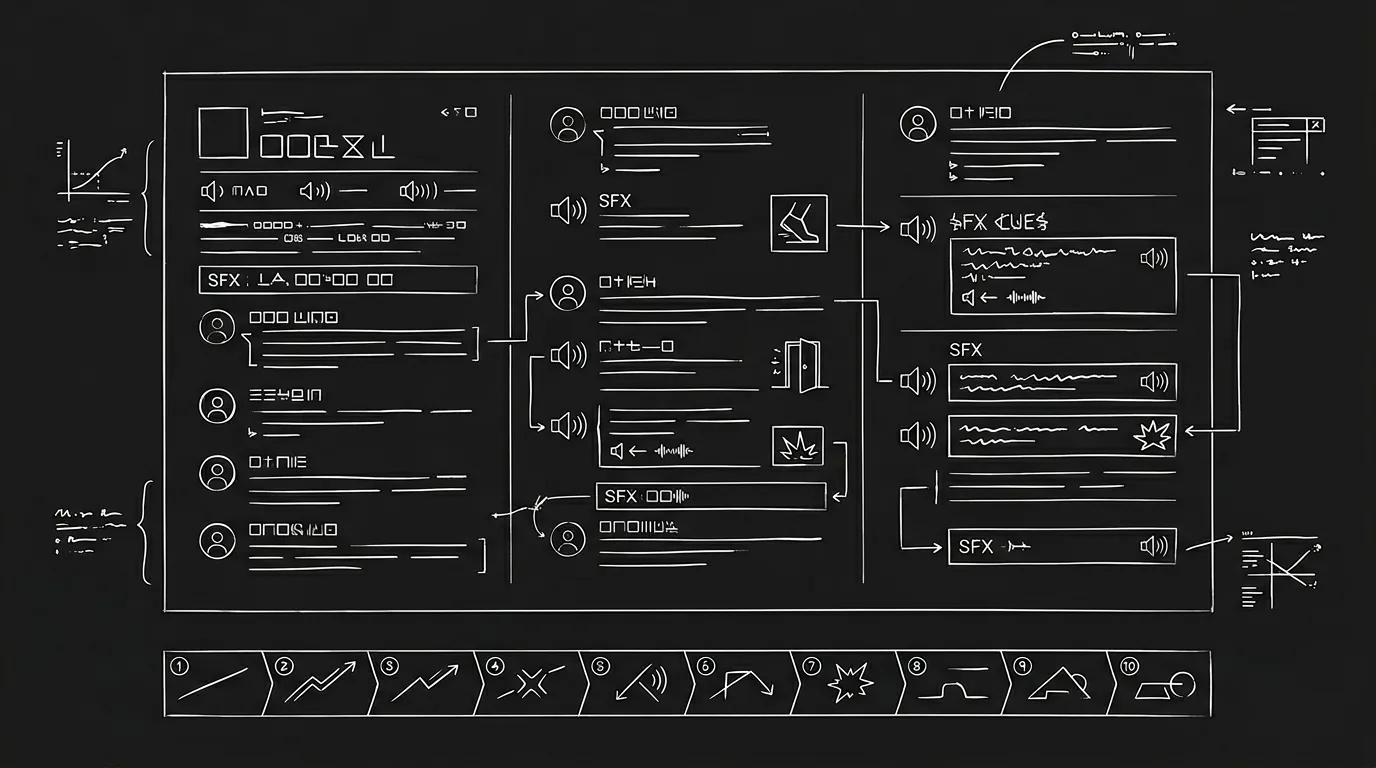
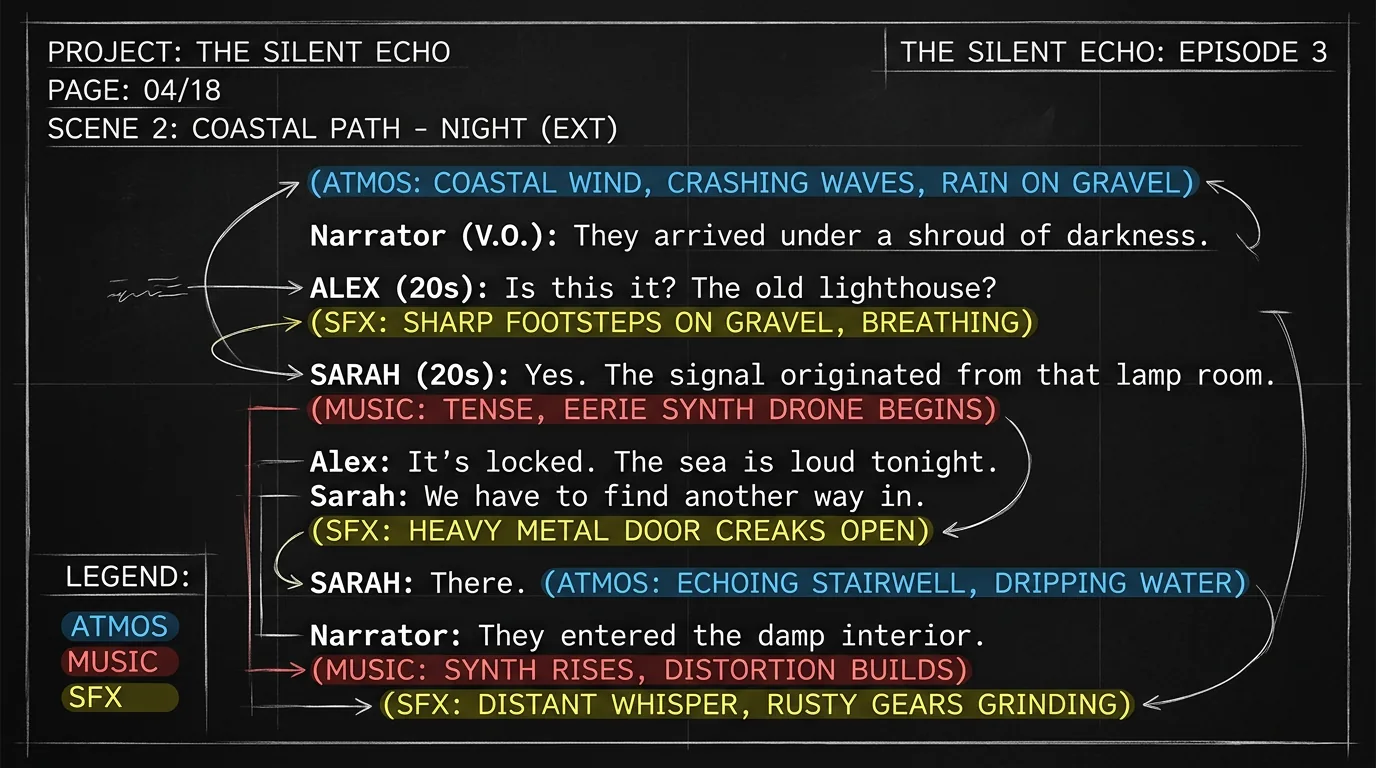
Explicit sound design cues. Sound effects (SFX), music cues (MUSIC), and ambient atmosphere (ATMOS) are written into the script. These are as important as dialogue.
Character identifiers. Especially in scenes with multiple voices, clear character names before each line. Voice actors read from the script directly.
Narrator/host notation. If your show has narration, designate the narrator clearly. NARRATOR: or HOST: depending on the show's framing.
Parentheticals for delivery. Since actors can't see context, parentheticals guide performance: "(whispered)," "(angry but controlled)," "(distracted, reading something)."
A sample audio drama script might look like:
EPISODE 3: "THE CALL"
SCENE 1
ATMOS: Coffee shop. Afternoon. Ambient chatter, espresso machine, soft background music.
MAYA sits at a corner table. Her phone buzzes.
SFX: Phone vibrating on table.
MAYA (hesitant, answering) Hello?
VOICE (ON PHONE, FILTERED) (distorted, cold) You have something that belongs to us.
MAYA (scared, trying to stay calm) Who is this?
VOICE You have seventy-two hours.
SFX: Call ends abruptly.
MAYA (to herself, shaky breath) Oh god.
MUSIC: Tense underscore begins, low and pulsing.
Notice how sound does the work that visuals would do in a film script. The coffee shop is established through ATMOS. The phone is heard, not seen. Maya's emotional state is guided by parentheticals.
Try it free
Try Screenweaver for free on your script
It is free. Import your existing project, get a clearer view of your outline, and regain control of your story structure in minutes.
Start FreeWriting for the Ear: Dialogue and Narration
Audio dialogue has specific requirements:
Clarity over naturalism. In film, actors can mumble and viewers read body language. In audio, every word must be audible and understandable. Write dialogue that's slightly cleaner than natural speech.
Identification through voice. Listeners distinguish characters by voice. Cast diversity helps (different genders, ages, accents). But dialogue itself should also distinguish: vocabulary, rhythm, catchphrases.
Address characters by name. More than in screen dialogue, audio dialogue benefits from characters occasionally using each other's names. It reorients the listener.
Describe action through reaction. You can't show a character punching a wall. But another character can say, "Jesus, calm down!" The action is implied.
Narration is optional but common in audio drama. It can:
- Establish location and time ("The warehouse had been abandoned for years.")
- Describe action that can't be conveyed through sound
- Provide internal monologue ("I didn't trust him. But I had no choice.")
- Create atmosphere and mood
Use narration purposefully. Too much narration makes the show feel like an audiobook. Too little might leave listeners lost.
Three Scenarios: Different Audio Drama Approaches
Scenario A: Found Footage / Documentary Style
The show presents itself as a real podcast investigating a mystery. Episodes include "interviews," "archival recordings," and "host narration." Think The Black Tapes or Serial.
Script considerations: Multiple audio textures (clean studio, phone recordings, old tapes). Heavy narration from the host. Characters are "interview subjects" with their own agendas.
Structure: Often investigative. Each episode uncovers new evidence, ending on a cliffhanger or revelation.
Scenario B: Full-Cast Drama
A traditional drama with multiple voice actors, sound design, and score. Think Homecoming or The Bright Sessions.
Script considerations: Minimal narration. Strong vocal differentiation. Scenes play like radio theater, dialogue and sound do all the work.
Structure: Similar to TV drama. Scene-based, with act breaks suggested by music transitions.
Scenario C: First-Person Horror
A single narrator tells their story, often directly to the listener. Intimate, unsettling, immersive. Think The Magnus Archives statements.
Script considerations: One voice dominates. Atmosphere and music carry emotional weight. The narrator's reliability may be questionable.
Structure: Episodic stories that accumulate into a larger mythology, or a single continuous tale.
The "Trench Warfare" Section: What Goes Wrong
Failure Mode #1: Visual Writing
The script describes what things look like instead of what they sound like. "She wore a red dress" is useless information unless someone comments on it.
How to Fix It: Audit your script for visual-only information. If it can't be heard, cut it or convey it through dialogue/narration.
Failure Mode #2: Indistinguishable Voices
Three characters talk, all with similar cadences and vocabularies. Listeners can't tell who's speaking.
How to Fix It: Give each character distinct vocal patterns. Vary sentence length, formality, and verbal tics. Cast actors with distinct voices.
Failure Mode #3: Wall-of-Dialogue Fatigue
Long scenes of unbroken dialogue exhaust the listener. No sound design breaks. No atmosphere. Just talking heads.
How to Fix It: Punctuate dialogue with SFX, music, and ATMOS shifts. Create variety in texture, not just content.
Failure Mode #4: Confusing Geography
Listeners don't know where characters are or who's present. New characters appear without introduction.
How to Fix It: Establish location and presence clearly. Use ambient sound. Have characters greet arrivals ("Oh, Maya, you're back."). Narration can help.
Failure Mode #5: No Hooks Between Episodes
Episodes end without compelling reasons to continue. Listeners drift away.
How to Fix It: End each episode on a question, revelation, or cliffhanger. The listener should feel urgency to hear the next installment.
Production Considerations
Understanding production helps you write better scripts:
Casting. You'll likely work with a small cast (budget constraints). Write characters that can be played by available actors. Consider doubling (one actor plays multiple roles).
Recording. Voice actors usually record separately, not together. This means you can't rely on live improvisation or reaction. Everything in the script must be playable in isolation.
Sound design. Complex sound design takes time. If every scene requires unique ambiance and dozens of effects, production slows. Balance ambition with feasibility.
Music. Original score or licensed music? Both have costs. Write music cues generically ("tense underscore") unless you have specific music in mind.
Episode runtime. Know your target length and write to it. A thirty-minute episode is roughly thirty script pages (depending on your format).
The Perspective: Trust the Medium
New audio writers often compensate for the lack of visuals by over-writing, too much description, too much narration, too much hand-holding. They don't trust the medium.
But audio has been working for a hundred years. The listener's imagination is a feature, not a limitation. A door creaking open is as evocative as showing a door. A character's breath catches, and we know they're afraid without needing to see their face.
Trust the listener. Trust sound. Write lean, vivid, and suggestive. Let the theater of the mind do its work.
The best audio drama feels like someone whispering a story directly into your ear, intimate, immediate, and impossible to pause.
[YOUTUBE VIDEO: A podcast producer and writer discussing how they structure a ten-episode season, with examples from their show's development process and script excerpts read by actors.]
Further reading:
- For guidance on documentary-style audio, see our guide on scripting true crime: finding the narrative arc in real events.
- If you're formatting dialogue-heavy scenes, see writing dual dialogue: formatting overlapping arguments.
- The BBC Writers Room has extensive resources on audio drama at bbc.co.uk/writersroom{:rel="nofollow"}.
Final Step
Build your next script with Screenweaver
Move from ideas to production-ready pages faster with timeline-native writing and AI-assisted story flow.
Try Screenweaver