
To format voiceover in a screenplay, add (V.O.) after the speaker's name in the character cue, as in JAMES (V.O.), and write the lines in the normal dialogue block. Use NARRATOR (V.O.) for a voice that is not a character, and (O.S.) instead when the speaker is in the scene but out of frame. The action lines carry what we see while the voice speaks.
Voiceover can open worlds or sink scripts. Used well, it adds irony, memory, and interiority film cannot otherwise access. Used poorly, it explains what we already see and tells the reader you did not trust the scene.
Voiceover narration screenplay format is not complicated, but it is easy to get sloppy: inconsistent tags, narrator voice that sounds like marketing copy, V.O. that should be on-screen dialogue, or montage narration that repeats action lines word for word.
Voiceover is a contract with the audience: someone is speaking across the image. The format must show who, when, and why that voice has authority.
How It Works: Types of Voiceover
Character V.O. A person in the story speaks over images, often future-self reflecting, present-self thinking, or letter being read.
Narrator V.O. A voice not treated as a character in the drama, common in satire, fairy tale, or docu-tone pieces.
Institutional V.O. News anchor, training tape, government message. Often introduced with a source line.
Epistolary V.O. Diary entry, email, text read aloud. Tag source early.
Each type has format expectations. Mixing types without signaling creates audio confusion in read and production.
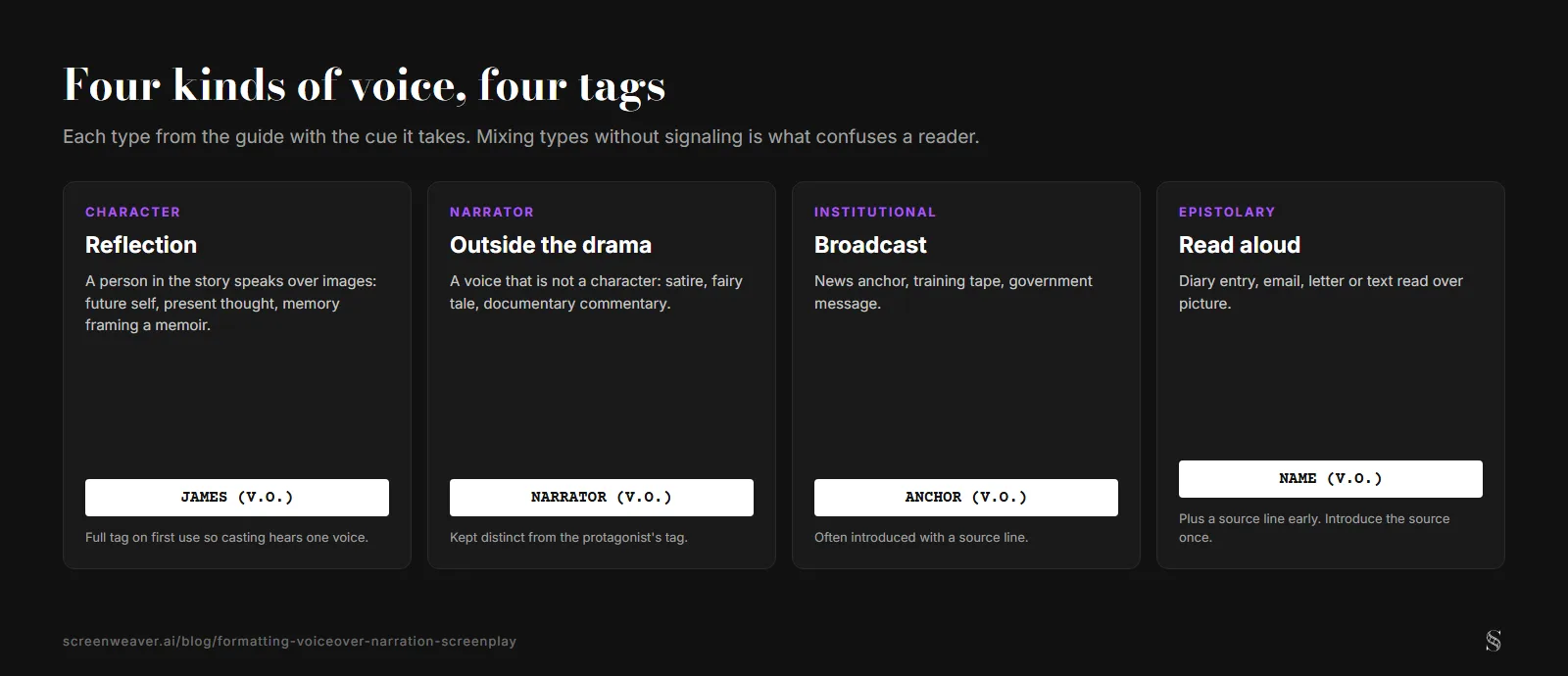
The four voice types with the tag each one takes, from the table further down.
Platform and Use-Case Sections
Feature Drama and Memoir Tone
Memoir-style films use character V.O. to frame memory. Open with a strong narrator identity line so casting imagines one voice. If V.O. stops for long stretches, re-entry needs a clear tag.
Pair V.O. transitions with flashback formatting when narration triggers memory sequences. Label mode shifts: END FLASHBACK before returning to narrating present.
Noir and Crime Thriller
Noir voiceover comments on action with attitude. Keep lines shorter than you want. Irony works when V.O. contradicts image, not when it narrates sneakers tying.
Comedy and Meta Satire
Narrator V.O. may fight with characters or "correct" the story. Format narrator as NARRATOR (V.O.) distinct from protagonist tags.
Television Cold Opens
TV uses V.O. for recap and teaser. Spec pilots should not rely on recap V.O. unless the device is the show's engine. If used, keep it brief and character-specific.
Documentary Narration
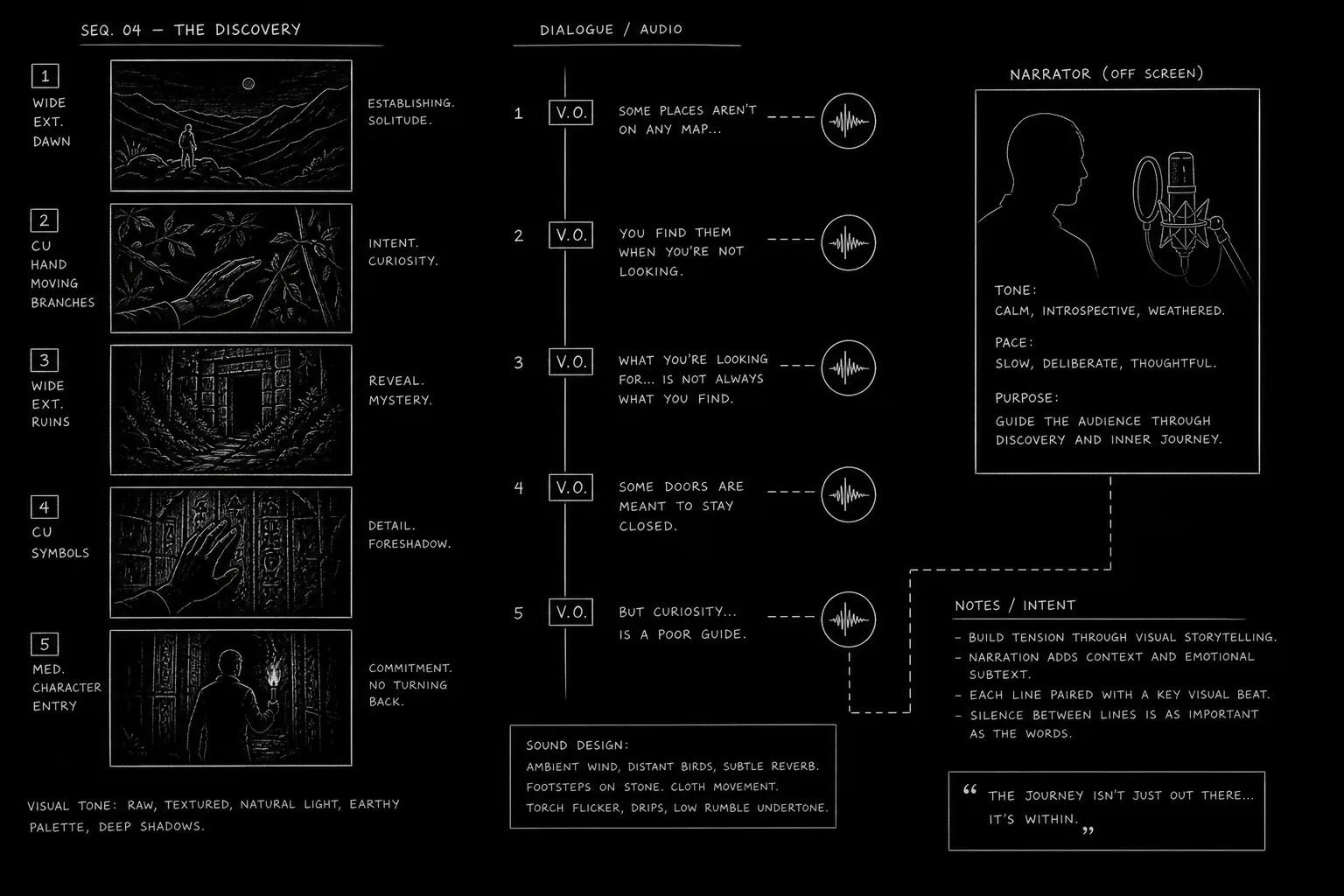
In a documentary, the narrator carries the facts while the images carry the feeling. Write the commentary as NARRATOR (V.O.) next to the shots it covers, and keep each block short enough to read over one or two images. If those images are AI reconstructions, the same script then drives the storyboard: see how to make a documentary with AI, and the AI documentary generator page for a full scene with its narration, storyboard and final shots.
Step-by-Step: Formatting V.O. Correctly
Step 1: Introduce the voice with a full tag. JAMES (V.O.) on first use. If narrator is not a listed character, create NARRATOR (V.O.) consistently.
Step 2: Place V.O. where it plays. Standard practice places dialogue blocks under character names even for V.O., with (V.O.) in the character cue.
Step 3: Write image relationship. Action lines show what we see while voice speaks. V.O. should add layer, not duplicate.
Step 4: Use montage grammar when needed. If V.O. spans a montage, open montage container, stack beats, keep narration lines spaced for rhythm.
Step 5: Mark hard stops. When V.O. ends and we are fully in scene audio, a short action line helps: James stops talking. Only street noise now.
Step 6: Read for redundancy. Read V.O. aloud over action lines. Cut overlap.
Reading aloud also tells you whether the narration will survive a microphone. Lines that look fine on the page often trip a narrator on a date, a place name or a sentence that runs out of breath; writing documentary narration that sounds like a real narrator covers how to write for the ear and time each block before anything is recorded or synthesized.
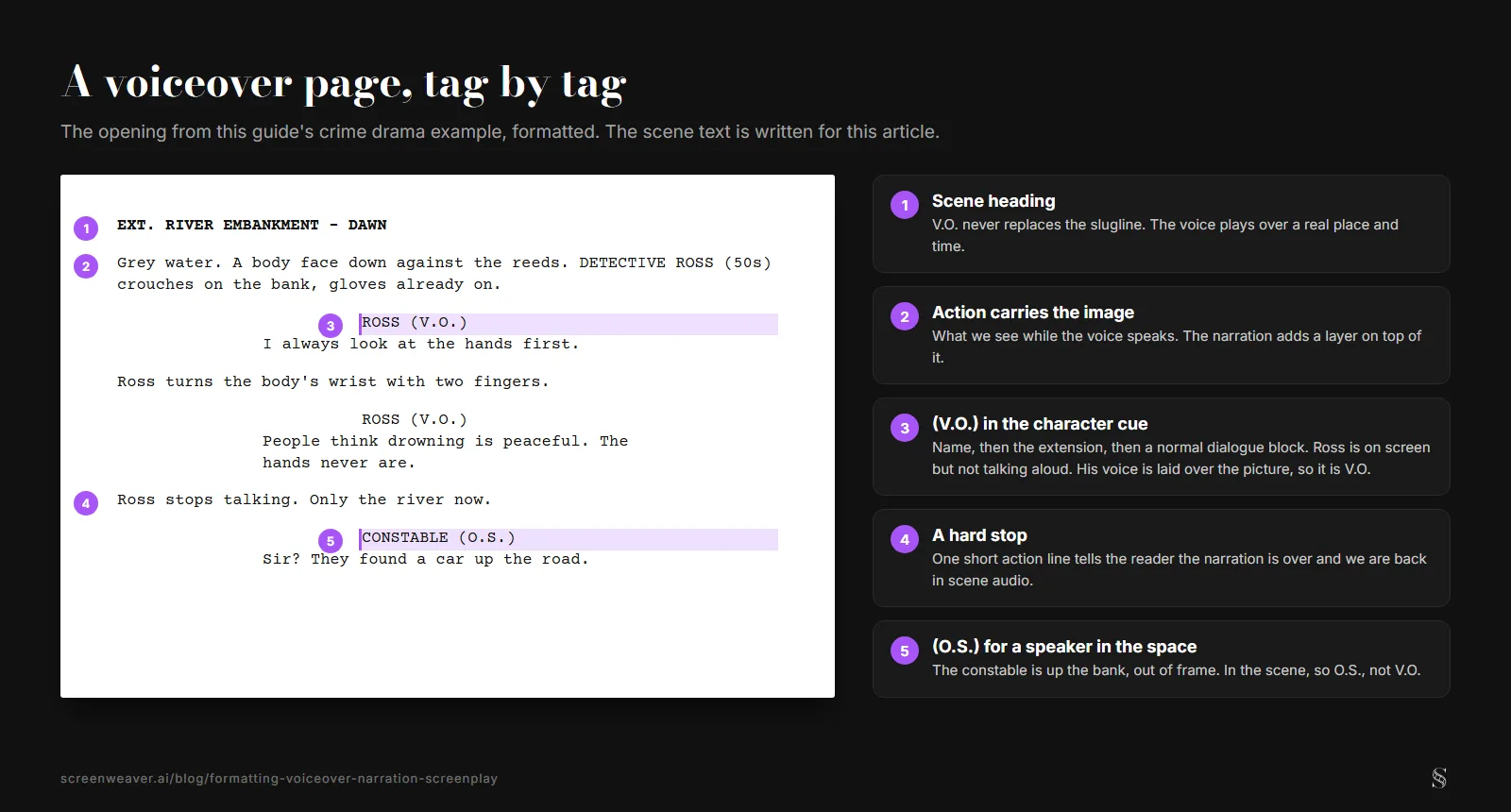
The steps above on one formatted page. The scene text is an original example built from the crime drama opening later in this guide.
Operational Section: Tags, Legal Tone, and Production Notes
V.O. vs O.S. Off-screen (O.S.) usually means the speaker exists in the scene space but is not visible. V.O. typically means voice laid over picture without present speaker in frame. Phone calls blurs the line; pick a convention and stay consistent, as in phone call formatting.
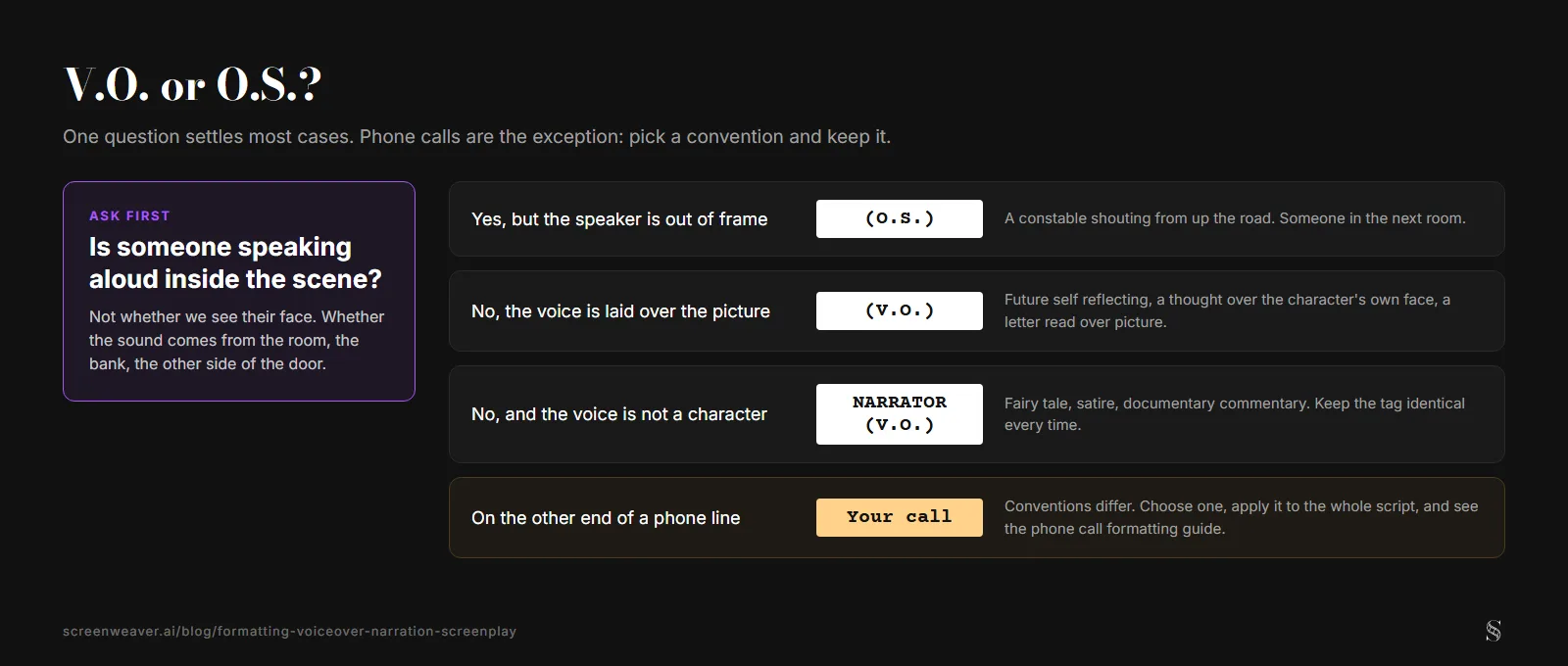
V.O. or O.S. in one question, with the phone call left as a house convention.
Italicized narration in action. Some writers italicize unspoken thoughts in action instead of V.O. That is a different device. Choose V.O. when the film will literally hear a voice.
Children and unreliable narrators. Unreliable V.O. still needs clarity on page. Reader must know the voice may lie. Irony lives in juxtaposition, not confusion.
Language and translation. If V.O. is translated from another language, note once. Do not repeat note each block.
Length discipline. V.O.-heavy scripts fatigue readers. Aim for lines that punch, not paragraphs that drift.
Spec restraint. Do not specify celebrity narrator tone. Write voice that implies casting type.
| Device | Tag | When to use |
|---|---|---|
| Character reflection | NAME (V.O.) | Framing, memory, commentary |
| Narrator | NARRATOR (V.O.) | Meta, fairy tale, doc tone |
| Institutional | ANCHOR (V.O.) | News, training, PSA |
| Letter/diary | NAME (V.O.) + source line | Epistolary framing |
For a documentary, the screenplay page is not the only option: most documentaries are still written in the two-column A/V layout inherited from television, picture on the left, narration and sound on the right, one row per beat. Our free two-column documentary script template builds that layout with a running time and exports to PDF, Word or Final Draft.
Try it free
Try Screenweaver for free on your script
It is free. Import your existing project, get a clearer view of your outline, and regain control of your story structure in minutes.
Start FreeOutcome and Results: What Good V.O. Formatting Achieves
Proper formatting leads to:
- Clear read rhythm. Readers hear voice and see image in sync mentally.
- Casting clarity. Teams know whether narrator is a role or device.
- Editing foresight. V.O. blocks map to audio lanes in post.
- Stronger storytelling. Redundant narration becomes obvious on the page and gets cut early.
Validate in a table read. Assign one reader as V.O. only. If the room tires, trim.
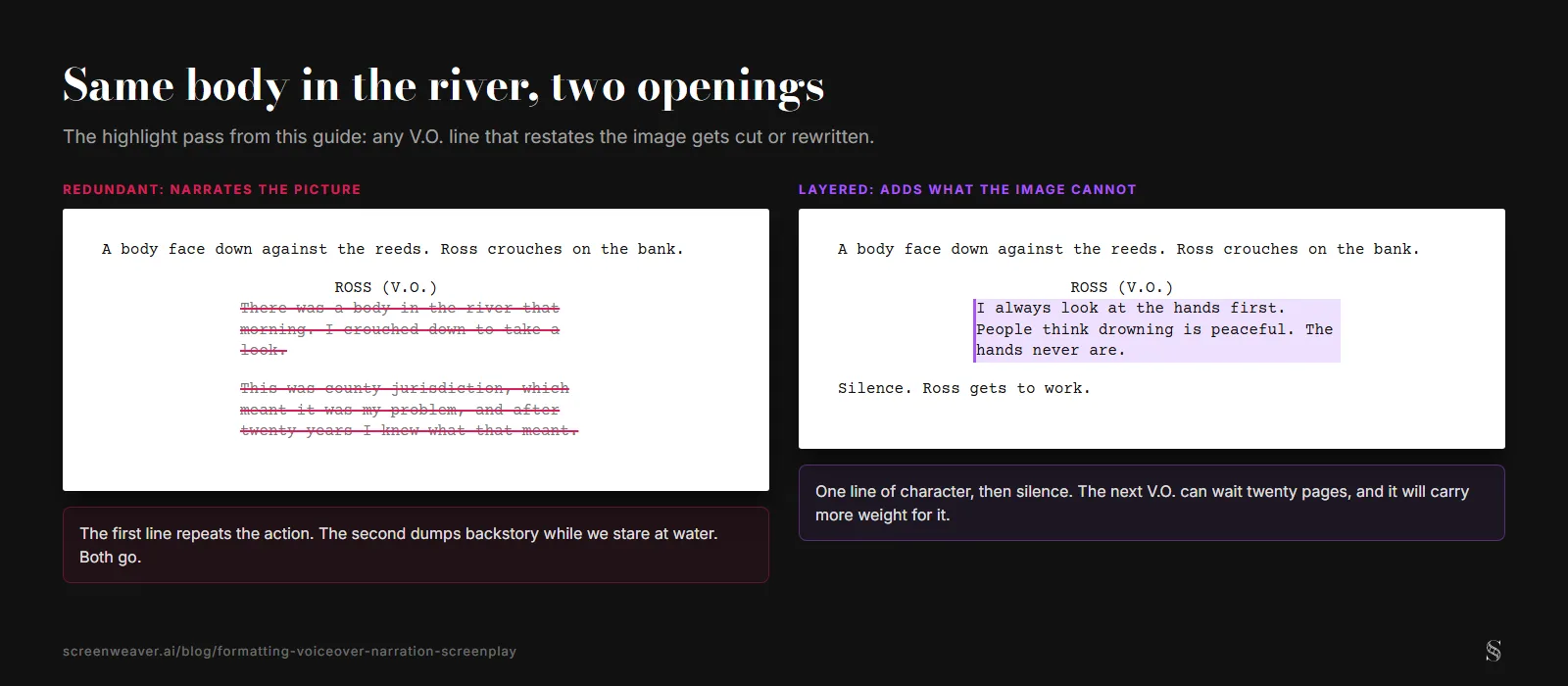
The highlight pass applied to the river opening. The struck lines are written for this example to show what gets cut.
Relatable Scenario: Opening V.O. That Frames the Movie
A crime drama opens on a body in a river. The old way uses V.O. to explain jurisdiction, backstory, and theme in one paragraph while we stare at water. The new way gives the detective one line that reveals character: "I always look at the hands first. People think drowning is peaceful. The hands never are." Then silence and investigation begin.
Format the V.O. as two or three short blocks maximum in the opening, then earn the next V.O. twenty pages later. Spacing creates authority.
When to Cut V.O. Entirely
If action lines already show the realization, cut the narration. If dialogue between characters can carry subtext, cut the narration. If V.O. only translates foreign dialogue the audience could read in subtitle, cut unless tone demands a narrator.
Run a highlight pass: every V.O. line that restates visible action gets deleted or rewritten to contradict, deepen, or joke with the image.
V.O. in Montage and Epilogue
Montage V.O. should track one emotional argument across images, not describe each image. Epilogue V.O. risks wrapping theme too neatly. If you use epilogue narration, tie it to a choice the character made in the final scene, not a lesson for the audience.
For montage containers, see montage format and keep narration lines spaced so readers hear rhythm between visual beats.
Table Read Note for V.O.-Heavy Scripts
Assign one reader to all V.O. in a table read. If that reader never leaves the packet while others play scenes, your script may be over-narrated. Balance V.O. pages with fully dramatized scenes so the room experiences both modes.
Documentary-style narration still needs character specificity. Even if the voice is neutral, word choice should match the film's tone: comic, cold, lyrical, or forensic. Format stays the same; diction carries genre.
When V.O. quotes letters or case files, introduce the source once, then let short excerpts carry. Long block quotes in narration slow thriller pace and read like pasted research.
Why It Matters: Old Way vs New Way
The old way: Writers used V.O. as exposition dump after visual storytelling failed. Tags drifted between V.O., O.S., and plain action. Ending monologues explained theme.
The new way: Writers treat V.O. as selective spice. Format tags stay consistent. Lines comment or contradict image with purpose.
This aligns with spec script discipline: the page should imply sound design, not replace it with paragraph after paragraph of narration.
Final CTA and Conclusion
Highlight every V.O. block in your script. Ask: could I delete this and add one action line instead? If yes, try the cut. Keep V.O. where it adds voice no image can provide.
Standardize your tags today; a free screenwriting app places the character cue, the extension and the dialogue block in industry-standard format for you. Then rewrite the opening narration until it sounds like a person, not a press release.
Voiceover is powerful when the format is invisible and the lines are not. Make both true in your next draft.
Final Step
Build your next script with Screenweaver
Move from ideas to production-ready pages faster with timeline-native writing and AI-assisted story flow.
Try Screenweaver