
The Save the Cat beat sheet is Blake Snyder's 15-beat map of a screenplay, and each beat lands on a specific page in a 110-page feature: Opening Image on page 1, Catalyst around page 12, Break into Two on 25, Midpoint on 55, All Is Lost on 75, Break into Three on 85, Final Image on 110. The page numbers are the whole point. They turn structure from a vague feeling into a checklist you can hold your draft against.
Below is every beat, where it sits, what it does, and how the numbers stretch or compress when your script is not exactly 110 pages. If you want the framework applied to your own act breaks, the beat sheet calculator does the arithmetic for you. This page explains what the arithmetic means.
The 15 beats at a glance
These are the page targets Snyder published for a standard 110-page screenplay. Treat them as anchors, not fences. A beat that lands two or three pages off is fine. A beat that lands fifteen pages off is telling you something.
| # | Beat | Page(s) | One-line job |
|---|---|---|---|
| 1 | Opening Image | 1 | Set the tone and the "before" version of the hero |
| 2 | Theme Stated | 5 | Someone says what the movie is secretly about |
| 3 | Set-Up | 1-10 | Show the hero's world and what is missing from it |
| 4 | Catalyst | 12 | The event that knocks the old life over |
| 5 | Debate | 12-25 | The hero resists the change and asks "should I?" |
| 6 | Break into Two | 25 | The hero commits and enters the new world |
| 7 | B Story | 30 | A second thread, usually a relationship, carries the theme |
| 8 | Fun and Games | 30-55 | The "promise of the premise," the trailer moments |
| 9 | Midpoint | 55 | A false victory or false defeat raises the stakes |
| 10 | Bad Guys Close In | 55-75 | Pressure mounts from outside and inside |
| 11 | All Is Lost | 75 | The lowest point, often with a "whiff of death" |
| 12 | Dark Night of the Soul | 75-85 | The hero sits in the loss before finding the answer |
| 13 | Break into Three | 85 | The A story and B story fuse into a solution |
| 14 | Finale | 85-110 | The hero acts on what they learned and wins |
| 15 | Final Image | 110 | The mirror of the opening, proof of change |
Print that. Put your current page count next to each beat. The gaps are your rewrite notes.
Act One: pages 1 to 25
The first act's whole job is to make the second act inevitable. Seven beats live here, and they move fast.
Opening Image (page 1) is your one shot at a first impression, and it should show the hero as they are before the story fixes them. It rhymes with the Final Image, so the two are best written together, or at least rewritten together once you know how the story ends.
Theme Stated (page 5) is a line of dialogue, usually thrown away, that names what the hero needs to learn. A friend says "you can't keep running from people" and the hero shrugs it off. Two hours later they stop running. The trick is that the hero cannot hear it yet, which is why it works as a plant.
Set-Up (pages 1 to 10) establishes the ordinary world and, more importantly, everything about it that is broken. Snyder's rule of thumb was to show the hero's flaws, the stasis, and the things you will pay off later, all inside the first ten pages. If a habit or a relationship matters in the finale, plant it here.
Catalyst (page 12) is the phone call, the letter, the body in the trunk. It is the moment the old life stops being an option. It should be external and undeniable, not a decision the hero makes.
Debate (pages 12 to 25) is the hero pushing back. This is the "can I really do this?" stretch, and it exists so the Break into Two feels like a choice rather than a shove. Skip the debate and your hero looks like they had no life worth leaving.
Break into Two (page 25) is the door closing behind them. The hero chooses to enter the new world, ideally through an act of will rather than an accident. Everything before this was setup. Everything after is the story you promised.
B Story (page 30) introduces the relationship that will carry the theme while the A story handles the plot. It is often a love interest, sometimes a mentor, sometimes a rival. The B story is where the hero actually changes, even though the A story is where the noise happens.
For the craft fundamentals underneath all of this, the screenplay formatting hub covers the page mechanics that make these numbers land the way Snyder intended.
Act Two: pages 30 to 85
The middle is where scripts sag, and the beat sheet is at its most useful here precisely because it breaks the hardest fifty-five pages into manageable chunks.
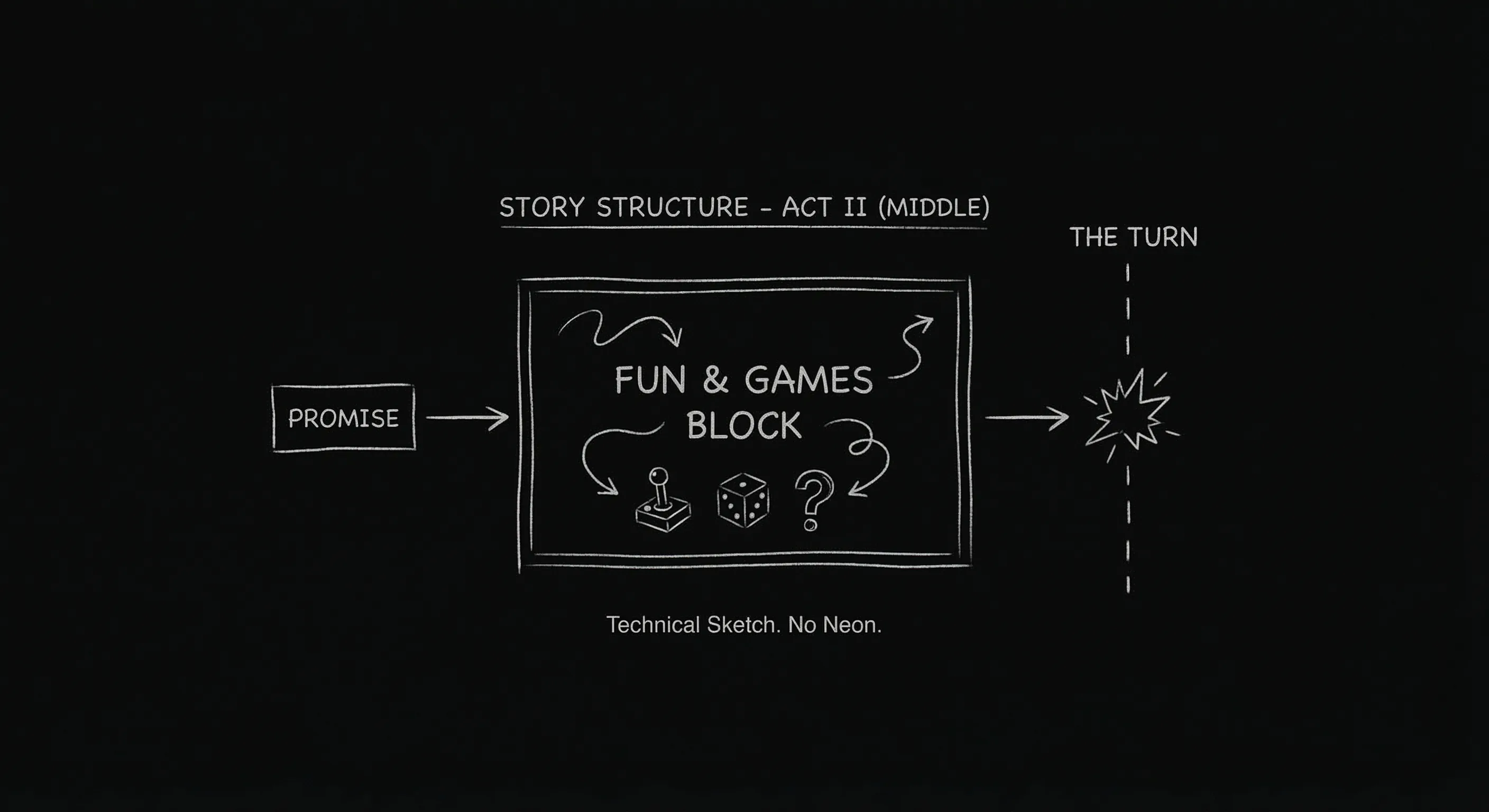
Fun and Games (pages 30 to 55) is the section you put on the poster. If the premise is "cop goes undercover as a kindergarten teacher," this is the kindergarten. Snyder called it the "promise of the premise," and it is the least plot-driven stretch of the movie, which is exactly why writers either coast through it or panic. If you want the full breakdown of this beat, the Fun and Games beat and the second-act sag goes deeper than I can here.
Midpoint (page 55) is a hinge. It is either a false victory, where the hero seems to get what they want and it turns hollow, or a false defeat, where things look lost but the hero is closer than they know. Either way the stakes ratchet up and the "fun" stops being fun. A strong midpoint is the single best cure for a saggy second act, because it splits fifty-five pages into two halves that pull in opposite directions.
Bad Guys Close In (pages 55 to 75) is the pressure phase. External antagonists tighten the screws while the hero's own flaws, the ones you planted in the Set-Up, start to sabotage them from inside. The team fractures. The plan stops working. This is where you cash the checks the first act wrote.
All Is Lost (page 75) is rock bottom. Snyder liked a "whiff of death" here, something literal or symbolic that ends: a mentor dies, a relationship breaks, the dream job evaporates. The lower this beat goes, the higher the finale can climb.
Dark Night of the Soul (pages 75 to 85) is the hero alone with the loss. No solving yet, just the sit. This beat earns the turn that follows it. Rush it and the recovery feels unearned; every "I've got it" moment needs a stretch of "I've got nothing" in front of it.
Try it free
Try Screenweaver for free on your script
It is free. Import your existing project, get a clearer view of your outline, and regain control of your story structure in minutes.
Start FreeAct Three: pages 85 to 110
Three beats, and they close the loops.
Break into Three (page 85) is the click. The A story problem and the B story lesson fuse, and the answer the hero could not see on page 75 becomes obvious. The thing they learned from the relationship is exactly what solves the plot. When this fusion works, the audience feels the script tighten like a knot pulling closed.
Finale (pages 85 to 110) is the hero acting on the change. Snyder later broke the finale into five sub-steps of its own, but the core is simple: the hero storms the castle, and they win because they are now a different person than the one who started. The old flaw, if it shows up here, gets beaten rather than indulged.
Final Image (page 110) answers the Opening Image. Same character, same frame, measurably changed. If the opener showed a cluttered apartment and a lonely person, the closer shows the apartment different or the person not alone. It is the proof that the two hours meant something.
How the page numbers scale to your script
The 110-page model is a reference, not a law, and most working screenplays are not exactly 110 pages. A tight thriller might run 95. A sprawling drama might hit 120. The beats keep their proportions even when the total moves, which is the part writers get wrong when they copy the numbers literally.
| Your script | Break into Two (~23%) | Midpoint (50%) | All Is Lost (~68%) | Break into Three (~77%) |
|---|---|---|---|---|
| 90 pages | ~20 | 45 | ~61 | ~70 |
| 100 pages | ~23 | 50 | ~68 | ~77 |
| 110 pages | 25 | 55 | 75 | 85 |
| 120 pages | ~27 | 60 | ~82 | ~92 |
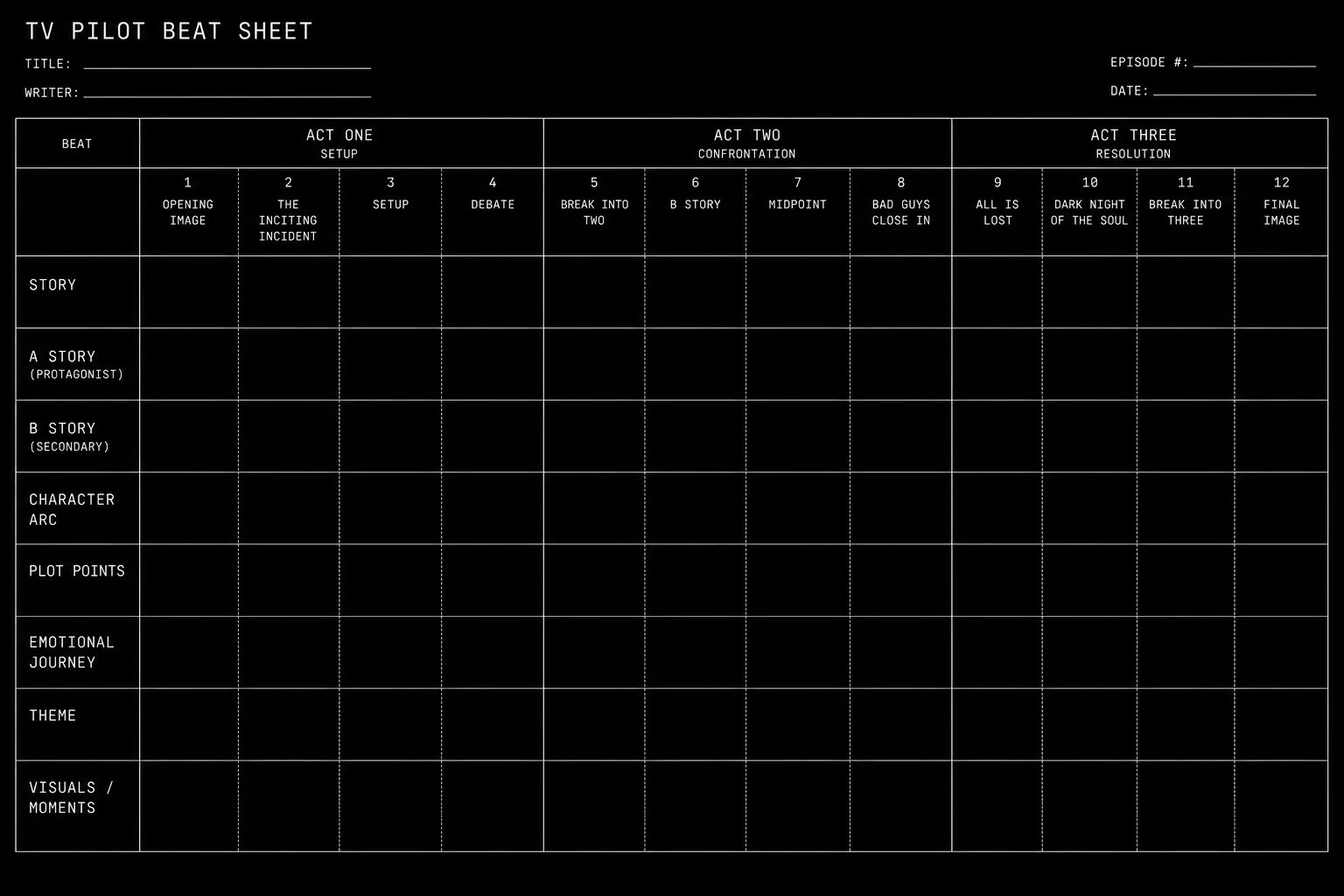
The Midpoint is the reliable one: it sits at the halfway mark of whatever your total is. Break into Two lands a hair under a quarter of the way in, All Is Lost around two thirds, Break into Three around three quarters. Rather than doing this by hand for every draft, the beat sheet calculator takes your target page count and returns the beats already positioned. The format that matters at these page counts differs across mediums too, and a TV pilot beat sheet works on different act breaks than a feature, so do not copy feature numbers onto a 30-page pilot. The percentages also stop working below feature length entirely: a short film compresses the fifteen beats down to five rather than shrinking each one proportionally.
Where the beat sheet helps and where it hurts
I will be honest about the tool rather than sell it. The Save the Cat beat sheet is the best diagnostic instrument in screenwriting and a mediocre generative one. As a way to read a finished draft, it is unbeatable: lay your pages against the fifteen beats, and the places where your story goes quiet light up immediately. A missing Midpoint, a Debate that never happens, an All Is Lost that is not lost enough. The numbers make vague problems specific.
As a way to write from scratch, it is more dangerous, because filling in fifteen boxes produces something structurally sound and often completely lifeless. Every movie that hits every beat on the exact page starts to feel like every other movie, which is the fair criticism people level at Snyder. The beats describe how a certain kind of satisfying commercial story tends to work. They do not describe every story worth telling, and treating them as a formula rather than a pattern is how you end up with the beige, interchangeable scripts the method gets blamed for.
Use it late, in other words. Draft loose, then check the draft against the sheet. If your instincts already put the Catalyst on page 11 and the Midpoint on 54, wonderful, the beats are confirming your instincts rather than replacing them. Snyder built this from patterns he noticed in films that already worked, and it is worth reading his original in Save the Cat's own words rather than only the summaries. If you want the reasoning underneath the numbers, the Blake Snyder Beat Sheet explained beat by beat covers the job each beat does and the ten story types that decide its content. For how this framework sits next to the other big one, Save the Cat versus the Hero's Journey lays out when each is the better lens.
Map your beats without the math
If you want your fifteen beats placed against your actual page count in one step, the beat sheet calculator does it free and without an account. Enter your target length, get the beats positioned, then write into the frame instead of against it. It is the fastest way to turn this page from a reference you read into a plan you use. Once the beats hold, the next document is the scene list, and the order to build a beat sheet, outline and treatment explains why that sequence saves you a rewrite.
FAQ
What are the 15 beats of Save the Cat in order?
Opening Image, Theme Stated, Set-Up, Catalyst, Debate, Break into Two, B Story, Fun and Games, Midpoint, Bad Guys Close In, All Is Lost, Dark Night of the Soul, Break into Three, Finale, and Final Image. They run in that order from page 1 to the end, and each one has a target page in a 110-page script.
What page is the Midpoint on in Save the Cat?
Page 55 in the standard 110-page model, which is exactly halfway. The Midpoint is the most portable beat because it always sits at the 50 percent mark of your script, whatever your total page count is. If your feature runs 100 pages, the Midpoint belongs around page 50.
Do I have to hit the exact page numbers?
No. The numbers are anchors that describe proportions, not hard rules. Landing a beat two or three pages off the target is normal and usually invisible to an audience. Landing it ten or fifteen pages off is a signal worth investigating, because it often means a beat is weak, missing, or buried.
Is the Save the Cat beat sheet only for 110-page scripts?
No, though 110 pages is the reference model Snyder used. The beats scale by percentage, so a 90-page script or a 120-page script keeps the same shape with the page targets shifted. The beat sheet calculator handles the scaling if you would rather not do the percentages yourself.
Does using the beat sheet make my script formulaic?
It can, if you use it to generate a story by filling boxes. It does the opposite when you use it to check a draft you already wrote from instinct. The method is a diagnostic that shows where a story loses momentum. Treat it as a checkup rather than a recipe and it sharpens your work instead of flattening it.
What is the difference between the beat sheet and the calculator?
The beat sheet is the framework, the fifteen named story beats and what each one does. The beat sheet calculator is the tool that places those beats on specific pages for your chosen script length. You use the sheet to understand the structure and the calculator to apply it to your own page count.
Final Step
Build your next script with Screenweaver
Move from ideas to production-ready pages faster with timeline-native writing and AI-assisted story flow.
Try Screenweaver