
A beat sheet template is a fifteen-row grid: beat name, target page, and one sentence describing what happens in your story at that page. Copy the blank table below, fill the right column, and you have a structural map of a 110-page feature before you write a single slugline. There is a filled example underneath it.
If you want the page targets recalculated for a script that is not 110 pages, the beat sheet calculator does that instantly. For what each beat actually means and why it sits where it sits, the 15 beats with page numbers guide is the companion piece to this template.
The blank template
Copy this into a document, a spreadsheet, or the back of an envelope. The only column you write is the last one, and each cell is one sentence. Not a paragraph. One sentence.
| # | Beat | Page | Your one sentence |
|---|---|---|---|
| 1 | Opening Image | 1 | |
| 2 | Theme Stated | 5 | |
| 3 | Set-Up | 1 to 10 | |
| 4 | Catalyst | 12 | |
| 5 | Debate | 12 to 25 | |
| 6 | Break into Two | 25 | |
| 7 | B Story | 30 | |
| 8 | Fun and Games | 30 to 55 | |
| 9 | Midpoint | 55 | |
| 10 | Bad Guys Close In | 55 to 75 | |
| 11 | All Is Lost | 75 | |
| 12 | Dark Night of the Soul | 75 to 85 | |
| 13 | Break into Three | 85 | |
| 14 | Finale | 85 to 110 | |
| 15 | Final Image | 110 |
The one-sentence constraint is doing most of the work here. A beat that needs three sentences to describe is usually a beat you have not solved, and the extra words are covering for it. Compress it, or leave the row blank and be honest about the gap.
The same template, filled in
Here is the grid completed for an invented feature so you can see the density a working row needs. The film is called The Quiet Ledger: a bookkeeper at a family haulage firm finds a second set of accounts and has to decide what her loyalty is worth. It is a made-up example built for this article, not a real script, which means you can steal the shape without stealing anyone's story.
| # | Beat | Page | Filled row |
|---|---|---|---|
| 1 | Opening Image | 1 | Mara balances a petty cash tin to the penny at 6am in an empty depot office, alone and satisfied. |
| 2 | Theme Stated | 5 | Her brother-in-law jokes that "loyal and honest are not the same job," and she laughs it off. |
| 3 | Set-Up | 1 to 10 | Twenty years at the firm, a dying founder, a mortgage two payments behind, a niece she half raises. |
| 4 | Catalyst | 12 | A misfiled invoice leads her to a second ledger with nine months of freight that never moved. |
| 5 | Debate | 12 to 25 | She tries to make the numbers innocent: bad data entry, a rounding error, anything but fraud. |
| 6 | Break into Two | 25 | She photographs every page of the second ledger instead of putting it back. |
| 7 | B Story | 30 | A freight inspector, cautious and unimpressed by her, becomes the only person she can ask questions. |
| 8 | Fun and Games | 30 to 55 | Mara audits the firm from inside it, running two jobs at once and getting good at lying. |
| 9 | Midpoint | 55 | She proves the money is real and finds her late sister's signature on the first forged page. |
| 10 | Bad Guys Close In | 55 to 75 | Her access is quietly reduced, the inspector is warned off, and her niece is offered a job in the office. |
| 11 | All Is Lost | 75 | The founder dies, the brother-in-law inherits, and the original ledger is destroyed in a "flood." |
| 12 | Dark Night of the Soul | 75 to 85 | Mara sits with the fact that exposing the firm ends the only family her niece has. |
| 13 | Break into Three | 85 | The inspector's throwaway remark about chain of custody reminds her she photographed everything. |
| 14 | Finale | 85 to 110 | She hands the images to the inspector, testifies, and watches the firm and her family come apart. |
| 15 | Final Image | 110 | Mara balances a petty cash tin to the penny at 6am in a new depot, alone, and not satisfied. |
Read rows 1 and 15 back to back. Same action, same light, opposite meaning, which is the job of a Final Image. Then read row 2 against row 14: the theme gets answered by what she does, not restated in dialogue. When a filled sheet has no echoes like that, the story is usually a sequence of events rather than an arc, and you have found that out in fifteen minutes instead of eighty pages.
How to fill each column
The page column
Leave it alone on your first pass. The numbers in the template are the standard targets for a 110-page script, and their job on day one is to tell you how much room each stretch gets, not to be met exactly. Fun and Games gets twenty-five pages. Dark Night of the Soul gets ten. That ratio is the useful information.
Adjust the numbers only after you know your real length. A 95-page thriller does not put its Midpoint on page 55, it puts it near 48. Multiply each target by your page count divided by 110 and round to the nearest page. The calculator linked above does this, but the arithmetic is not hard enough to need a tool if you would rather do it in your head.
The one-sentence column
Name a character and an action. "The stakes get higher" is not a beat. "She photographs every page instead of putting it back" is a beat, because someone does something irreversible.
Describe the beat itself and skip the scene you imagine around it. A Catalyst row is the event that lands, not the four pages of buildup leading to it.
Stay concrete, present tense. Abstractions hide holes, and the words "somehow" and "realizes that" are where they usually hide. If you cannot write the row without one of them, the beat is still unsolved, and finding that out after fifteen minutes rather than eighty pages is the point of the exercise.
The beats nobody fills properly
Three rows get faked more than the rest.
B Story (page 30) gets written as "she meets the love interest" and then never touches the theme. The B Story exists to carry the lesson the A story cannot state. In the filled example, the inspector is not a romance, he is the person who models the difference between loyalty and honesty. That is why his throwaway line can trigger Break into Three fifty-five pages later.
Midpoint (page 55) gets written as "things escalate." A real midpoint is a false victory or a false defeat that changes what the hero is chasing. Our example uses a false victory: she proves the fraud and the proof implicates her own family. If your midpoint could be moved twenty pages in either direction without breaking anything, it is not a midpoint. The midpoint shift that turns a passive protagonist active covers the diagnosis in more detail.
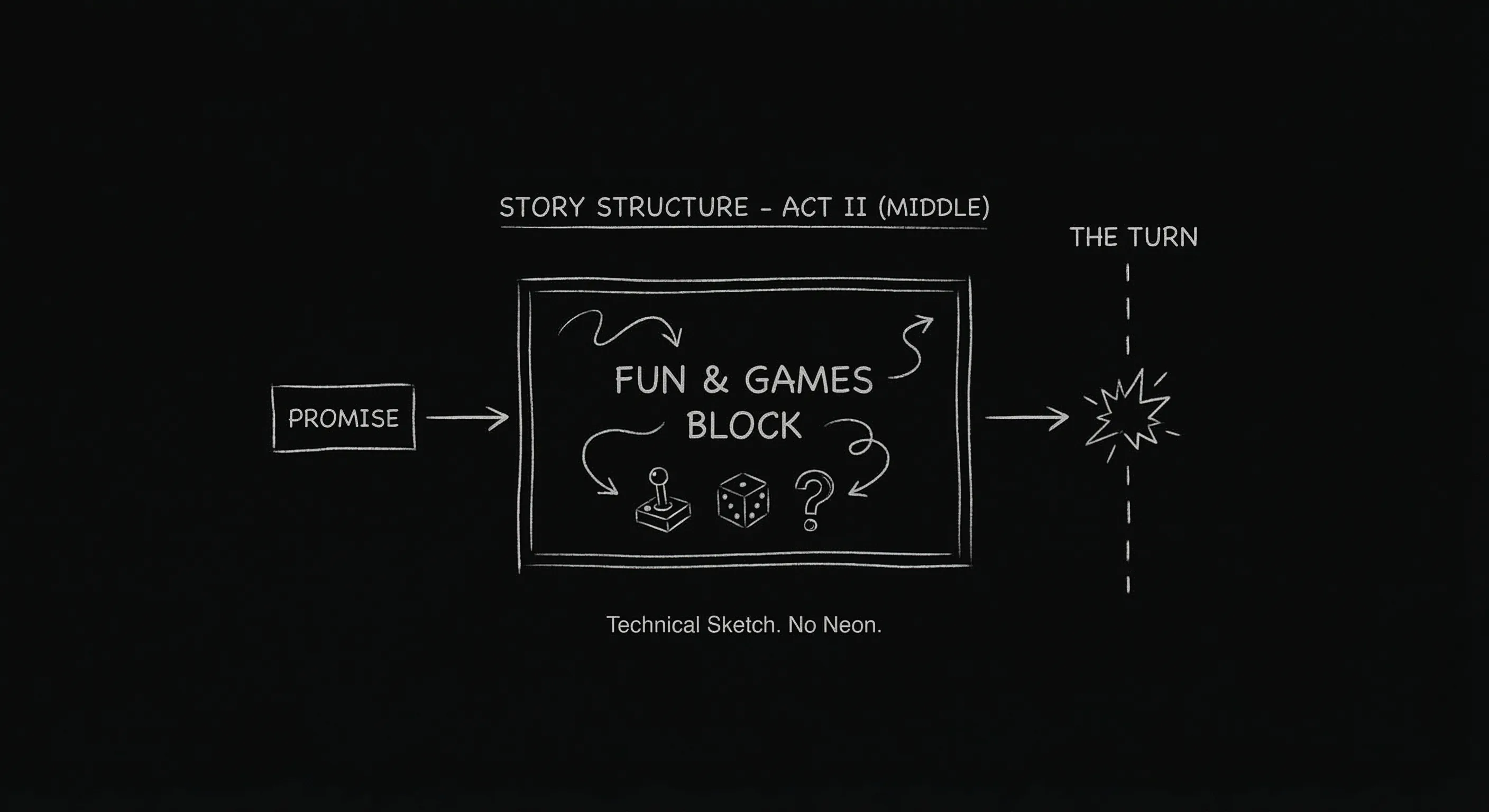
Fun and Games (pages 30 to 55) gets written as one sentence for twenty-five pages, which is how second acts sag. Break this row into four or five sub-beats on a second pass. If you only expand one row of the template, expand this one, and the Fun and Games beat and the second-act sag explains what belongs in each sub-beat.
Try it free
Try Screenweaver for free on your script
It is free. Import your existing project, get a clearer view of your outline, and regain control of your story structure in minutes.
Start FreeVariants for other lengths and formats
The fifteen rows stay. Only the page column moves.
| Format | Total pages | Catalyst | Break into Two | Midpoint | All Is Lost | Break into Three |
|---|---|---|---|---|---|---|
| Tight thriller | 90 | 10 | 20 | 45 | 61 | 70 |
| Standard spec | 100 | 11 | 23 | 50 | 68 | 77 |
| Snyder baseline | 110 | 12 | 25 | 55 | 75 | 85 |
| Epic or period | 120 | 13 | 27 | 60 | 82 | 93 |
Two format notes that matter more than the arithmetic.
A television pilot does not scale this way. Act breaks, not page proportions, drive the structure, and a pilot has to seed a series as well as close an episode. Use the TV pilot beat sheet and act breaks guide instead of squeezing this grid into 55 pages.
A short film compresses rather than scales. Below about 25 pages, several beats merge: Set-Up and Catalyst often share a scene, and Dark Night of the Soul can be a single shot. The full compression map, beat by beat, is in the beat sheet for a short film guide, which keeps five of the fifteen rows and shows what happens to the other ten.
The five-minute audit
Once the sheet is filled, run it. This is faster than reading your draft and catches most structural problems.
- Do rows 1 and 15 show the same thing with opposite meaning?
- Does row 2 state the lesson, and does row 14 prove the hero learned it?
- Is the Catalyst something that happens to the hero, not a choice they make?
- Is Break into Two an active decision with a cost?
- Does the B Story character say or do something that becomes the answer at Break into Three?
- Is the Midpoint a reversal, not an escalation?
- Does All Is Lost take away something established before page 10?
- Can you name what the hero can do on page 100 that they could not do on page 10?
Any unticked box is a rewrite note with a page number attached, which is more than most notes give you. If you want to turn the filled sheet into scenes, the screenplay outline builder expands each row into a scene list you can write against.
FAQ
Is a beat sheet the same as an outline?
No. A beat sheet is fifteen structural checkpoints with page targets. An outline is every scene in order, usually forty to sixty entries for a feature. Most writers do the beat sheet first because it fits on one page and can be thrown away cheaply, then expand it into an outline once the shape holds. The beat sheet versus outline versus treatment breakdown covers where the treatment fits into that sequence.
Do I have to hit the page numbers exactly?
No, and trying to is how scripts get mechanical. Two or three pages either side of a target is normal. Fifteen pages off is a signal worth investigating: an All Is Lost on page 92 usually means the second act is carrying material that belongs in act one.
Can I use this template for a script that is already written?
That is arguably its best use. Open your draft, note the actual page where each beat lands, and put those numbers next to the targets. The gaps map your rewrite in about twenty minutes. Writers often find their Break into Two sitting on page 38, which explains a first act everyone said was slow.
What if my story genuinely has no Dark Night of the Soul?
Then write "none" and move on. Comedies, heists, and ensemble films frequently compress or skip beats 11 and 12. The template is a diagnostic, not a contract. What you should not do is skip a beat because you have not figured it out and hope the draft solves it.
Where does the 110-page model come from?
It is the length Blake Snyder used as his reference in Save the Cat!, which is where every page target in this template comes from, and the beat sheet explained beat by beat unpacks what each row is asking you to solve. His publisher still maintains the framework at savethecat.com. Modern specs skew shorter, closer to 100 pages, which is why the scaling table above exists.
Should I fill this in before or after the logline?
After. The logline names the hero, the flaw, the antagonist, and the stakes, and every one of those shows up in the beat sheet. Filling fifteen rows without a logline usually produces fifteen rows about a situation rather than a story.
Final Step
Build your next script with Screenweaver
Move from ideas to production-ready pages faster with timeline-native writing and AI-assisted story flow.
Try Screenweaver