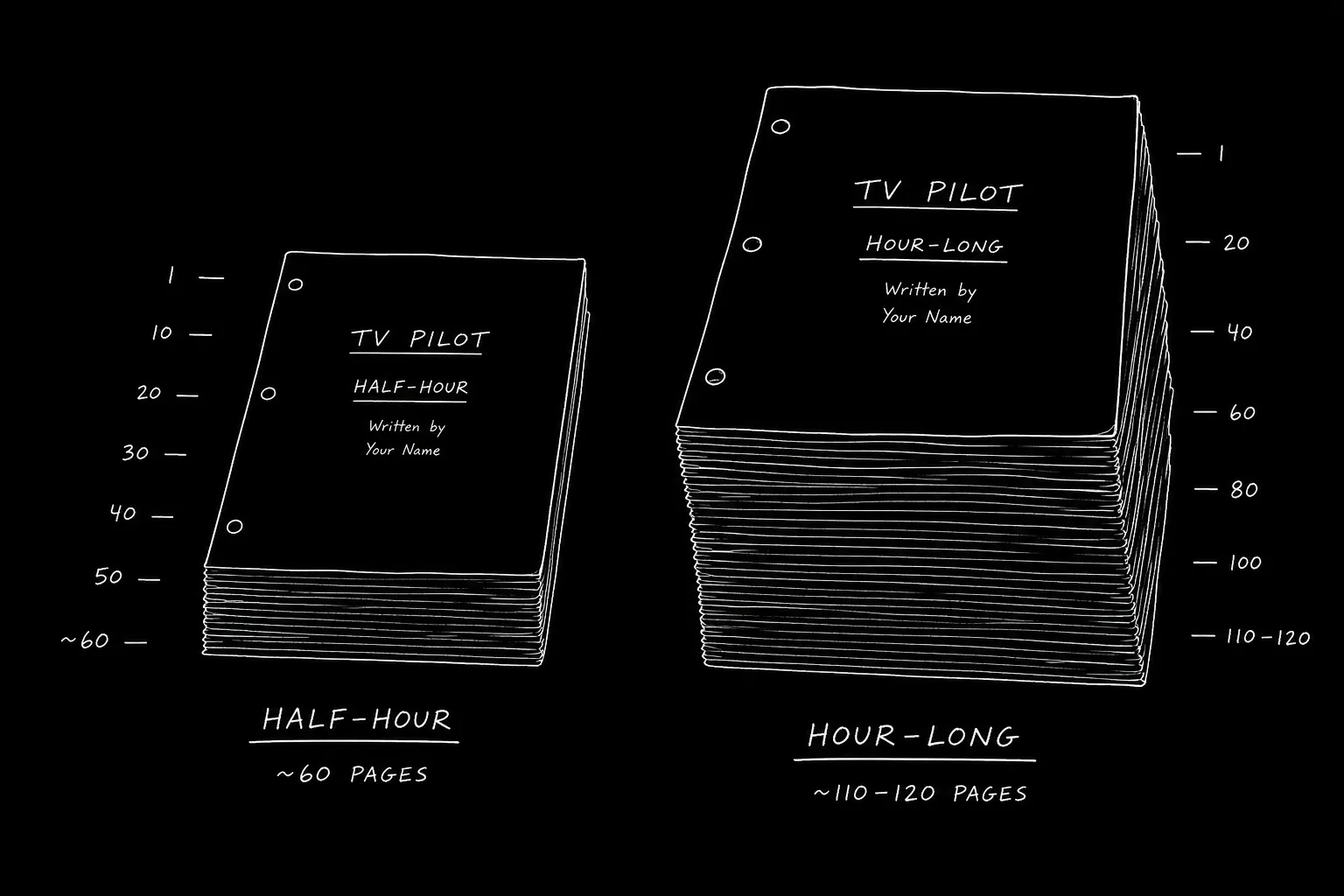

Short answer: a 30-minute script runs 22 to 26 pages for a multi-camera sitcom, 28 to 34 pages for a single-camera comedy or dramedy, and up to 38 pages for a premium or streaming half-hour with no ad breaks to shrink the runtime. The one-page-per-minute rule still applies in spirit, but format changes how much of the page is dialogue versus description, which is what actually moves the count.
The precise answer, by format
Half-hour is not one format wearing different hats. Camera setup and platform both shift how many pages it takes to fill the same slot.
| Format | Typical page count | Produced screen time | What drives the count |
|---|---|---|---|
| Multi-cam sitcom (3-camera, studio audience) | 22-26 pages | ~22 min (broadcast) | Mostly dialogue in one or two sets, minimal scene description |
| Single-camera sitcom | 28-34 pages | ~22-26 min | More locations, more action lines, less pure dialogue |
| Animated half-hour | 28-33 pages | ~21-22 min (broadcast) | Similar density to single-cam live-action |
| Dramedy / premium half-hour | 30-38 pages | ~26-32 min | Longer scenes, hybrid comedy-drama pacing |
| Streaming half-hour (no ad breaks) | 30-38 pages | up to 34 min | No commercial ceiling, platform notes outrank convention |
For the full feature, hour-long, and short-film ranges this table does not cover, see How Long Should a Script Be?. For the pilot-specific selling bands and act-break economics, TV Pilot Page Count: Half-Hour vs Hour-Long goes deeper on the format-by-format contract buyers expect.
The nuance that changes the answer
A 30-minute script is not automatically 30 pages, and the gap is not sloppiness. Two things explain it.
Camera format changes what is on the page. A multi-cam sitcom lives in one or two sets and is almost pure dialogue, so a page carries mostly lines with very little scene description. Live-audience pause and laugh time is not written on the page at all, it is performed, which is why a script can run fewer pages than a single-cam script covering the same runtime. Single-camera format adds scene headers, locations, and action description every time the story moves, and that description is what pushes the page count up even when the story is not longer.
Slot minutes are not content minutes. A network "30-minute" broadcast slot delivers roughly 21 to 22 minutes of actual episode after ad breaks, while a streaming "half-hour" with no ads can run the same page count into 28 to 34 minutes of screen time. Checking a script's runtime against the wrong assumption, ad-supported versus ad-free, is the most common reason a page count that looks correct still reads long or short.
Try it free
Try Screenweaver for free on your script
It is free. Import your existing project, get a clearer view of your outline, and regain control of your story structure in minutes.
Start FreeHow to check yours in seconds
Do not guess your episode's runtime from genre or format alone. Enter your exact page count into the free Script Time Calculator and get an estimate built on the same page-to-minute logic, adjusted for how dialogue-heavy or description-heavy your script actually is.
Free tool: the Script Time Calculator estimates runtime from page count or pasted script text in seconds, no signup.
FAQ
How many pages is a 22-minute sitcom script?
A multi-cam sitcom script for a 22-minute episode typically runs 22 to 26 pages, since the format is almost entirely dialogue in one or two sets. A single-camera sitcom covering the same 22 minutes usually runs a few pages longer, 28 to 32, because it carries more scene description.
Is a half-hour script always around 30 pages?
Not always. Multi-cam comedies often land under 30 pages, while single-camera comedies, dramedies, and streaming half-hours without ad breaks commonly run 30 to 38 pages for the same nominal half-hour slot.
Why do multi-cam scripts have fewer pages than single-cam for the same runtime?
Multi-cam scripts are built almost entirely from dialogue in a small number of sets, with live-audience pause and laugh time performed rather than written on the page. Single-camera scripts add scene headers, new locations, and action description every time the story moves, which adds pages without adding runtime.
How long is a 30-minute script in minutes once it airs?
On broadcast, a "30-minute" slot delivers about 21 to 22 minutes of episode after ads. On streaming, with no ad breaks, the same page count can run 26 to 34 minutes, so always check whether a target runtime assumes ads before comparing it to your page count.
Final Step
Build your next script with Screenweaver
Move from ideas to production-ready pages faster with timeline-native writing and AI-assisted story flow.
Try Screenweaver