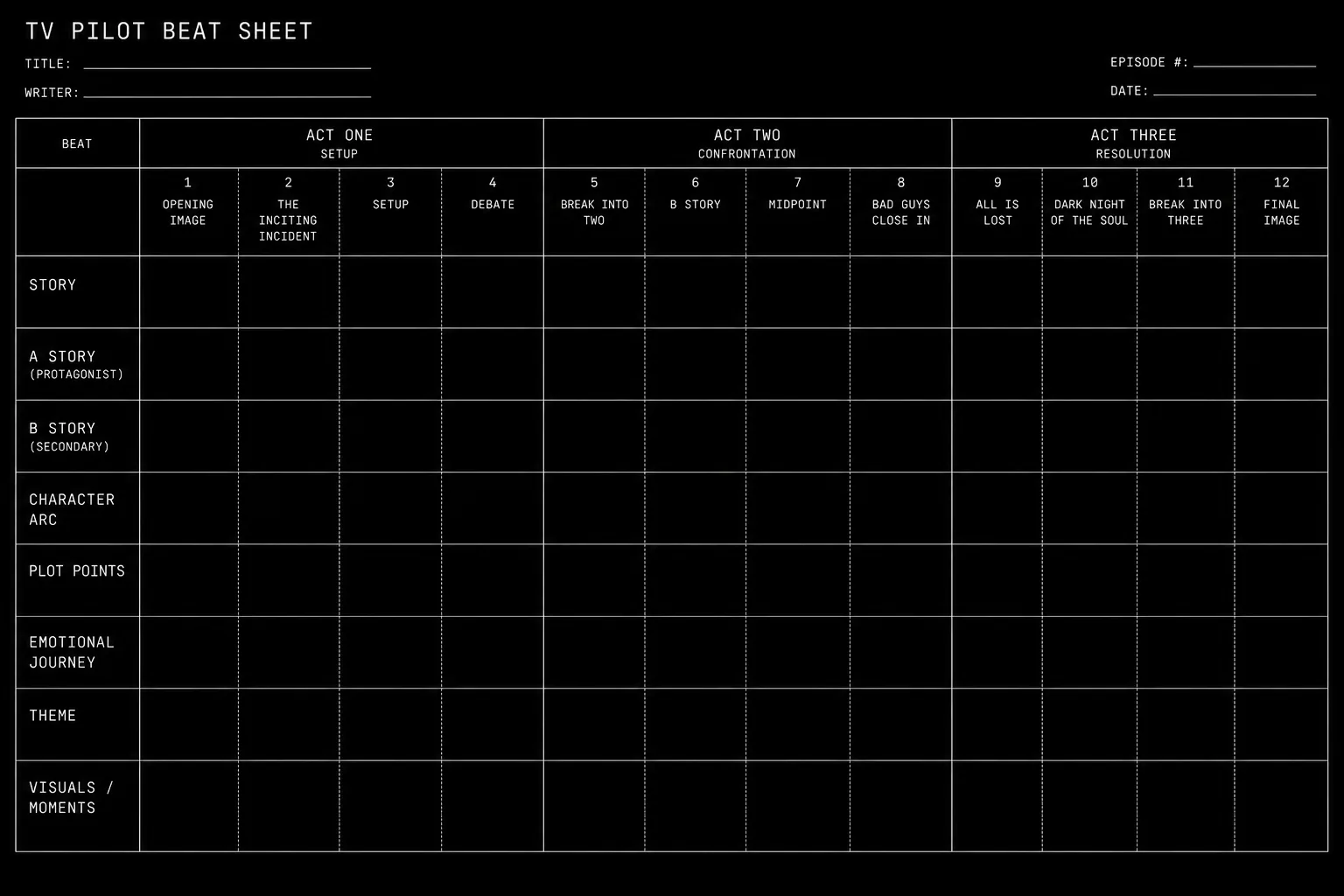

A feature beat sheet plots fifteen fixed beats across roughly 100 to 120 pages toward one ending. A pilot beat sheet plots three to seven acts, each closing on a turn that keeps the audience for the next episode, and it has to seed a series instead of resolving one. Same word, different job, different failure modes.
Writers who learn structure on features often carry the wrong instincts into a pilot, and the reverse happens just as often to television writers drafting their first spec feature. If you already know the Save the Cat beat sheet's 15 beats, this is the article that tells you which parts survive the jump to television and which parts actively hurt you there.
The two beat sheets, side by side
| Feature beat sheet | TV pilot beat sheet | |
|---|---|---|
| Structural unit | 15 fixed beats (Opening Image through Final Image) | 3 to 7 acts, each ending on a turn |
| Page range | Roughly 100 to 120 pages | 28 to 65 pages, depending on format |
| What each unit does | Names a specific story function at a specific page | Ends on an act-out that earns commercial or streaming white space |
| Where it points | Toward a resolution | Toward episode two, and toward a series |
| Midpoint function | A single false victory or false defeat, one instance | May repeat across acts two and three depending on act count |
| Ending job | Close the hero's arc | Answer the pilot's chapter, deepen the series question, never solve it |
| Reusable across drafts | Same 15 beats every time | Act count shifts by network, streamer, half-hour vs hour |
| Companion tool | Beat sheet calculator scales page targets | Same calculator checks percentage placement, not act count |
The table looks tidy. The two documents are not interchangeable, and the rest of this article is about the four places writers get burned assuming they are.
Where feature instincts survive the jump
Not everything you learned plotting a feature is wrong for television. Three habits carry over cleanly.
The one-sentence beat rule still applies. Whether you are naming a Catalyst on page 12 of a feature or an act-two out in a pilot, a beat that needs three sentences to describe is a beat you have not solved. Compression forces you to find the actual turn instead of describing the mood around it.
Setups still need payoffs. A feature plants a Theme Stated line on page 5 and answers it by the Final Image. A pilot plants the same kind of thematic seed in the teaser and should be answering a version of it by the tag, even though the series question itself stays open. The mechanism is identical. Only the ending changes from closed to open.
The midpoint is still a reversal, not an escalation. In a feature, the false victory or false defeat on or near page 55 changes what the hero is chasing. In an hour pilot, whichever act sits at the midpoint of the runtime needs the same kind of turn, not just louder stakes. "Things get worse" is not a midpoint in either format.
Where feature instincts actively hurt a pilot
Four habits that work fine on a feature will read as amateur on a pilot, and they are the most common notes new TV writers get.
Trying to resolve the story
A feature beat sheet builds to a Final Image that answers the Opening Image and closes the hero's arc. A pilot that does the same thing has just told the room there is no series. If your pilot's last beat solves the central conflict, an executive reading it will assume you do not know what a pilot is for, even if every scene before it is strong. The act breaks that earn their white space piece covers this in detail: the fifth or sixth act should deepen the series question, not close it.
Using fifteen fixed beats instead of act functions
Save the Cat's fifteen beats assume a single continuous document with one shape. A pilot is built from acts, and each act has its own local job (raise a question, complicate, reverse, escalate, resolve the chapter) independent of where it sits in a fifteen-beat map. Forcing a pilot into Opening Image, Theme Stated, Catalyst and so on produces a document that looks like a checklist and reads like one. Act function, not beat count, is the organizing idea in television.
Ignoring page count as a structural signal
On a feature, page targets scale linearly with your total length: multiply each beat's target page by your page count divided by 110. A pilot does not scale that way. A half-hour compresses the middle instead of shrinking every act proportionally, and an hour network drama carries different act-out expectations than a premium streaming hour that runs "continuous" on the page but still needs the same pressure internally. Treating a 45-minute streaming drama's structure like a shrunk-down 110-page feature beat sheet is how second acts sag in television for a completely different reason than they sag in film.
Writing one act out per act instead of one per character line
Ensemble features can survive a single hero-focused Midpoint because the beat sheet exists to serve one throughline. Ensemble pilots fail when every character gets an identical act out doing the same emotional work. If three act outs in a row are three characters learning the same lesson, that is a television-specific failure mode a feature beat sheet never surfaces, because a feature beat sheet was never asked to track five people at once across a limited number of pages.
Act count by format
Pilots do not share one universal act structure. Pick the count that matches your lane before you start filling boxes.
| Format | Typical act count | Approx. page range | Notes |
|---|---|---|---|
| Half-hour, single-cam | 2 to 3 acts | 28 to 35 pages | Compresses the middle; B-story turn shares the act with the A-story turn |
| Half-hour, multi-cam | 2 to 3 acts | 28 to 38 pages | Act out often lands on a button line, not a visual reveal |
| Hour, broadcast network | 5 to 7 acts (including teaser and tag) | 45 to 65 pages | Commercial breaks drive the count; each break needs a turn |
| Hour, premium or streaming | Often written "continuous," act-shaped internally | 50 to 65 pages | No printed act labels, but the pressure map still needs the same functions |
The TV pilot page count guide covers page targets in more depth if act count is not your immediate problem and length is.
Try it free
Try Screenweaver for free on your script
It is free. Import your existing project, get a clearer view of your outline, and regain control of your story structure in minutes.
Start FreeWhich beat sheet to build, by situation
You are drafting a spec feature. Use the fifteen-beat model. It is the right tool, and the beat sheet template for a 110-page feature gives you a filled example to copy against.
You are drafting an original pilot for a broadcast network. Build an act-function beat sheet with five to seven acts, teaser and tag included, and treat commercial act breaks as real story pressure points, not formatting.
You are drafting a streaming or premium hour. Keep the prose continuous if that fits your voice, but build the same act-shaped pressure map privately. Development readers can tell the difference between a fluid hour with a broken spine and a fluid hour with a hidden one.
You are adapting a feature idea into a pilot. Do not just chop your fifteen beats into five buckets. Ask what the pilot's chapter is and what stays open for episode two. The story engine that would resolve a feature needs to survive past the pilot's last page instead.
You already have a feature beat sheet and need a pilot fast. Keep the theme, the protagonist's flaw and the tone. Discard the ending. Rebuild the back half around a series question instead of a resolution, and check your draft against the outline for a 60-minute drama pilot once the act shape holds.
A five-minute check for either document
- Does the last beat or act resolve something, or does a feature's last beat leave something open that should be closed?
- Is there exactly one reversal-style midpoint, correctly placed for the format (page 55 of 110 for a feature, the runtime's actual midpoint for a pilot)?
- For a pilot: does the final act deepen the series question instead of answering it?
- For a feature: does the Final Image answer the Opening Image with the same image, opposite meaning?
- For an ensemble pilot: do any two act outs do the same emotional work for different characters?
- Does every act or beat name an event, not a mood? "Tension rises" fails this check in both formats.
Any unticked box points at a specific rewrite, which is more useful than a note that says the middle "feels slow."
FAQ
Can I use the same beat sheet document for a feature and a pilot version of the same idea?
Not as one document, though they can share an origin. Draft the feature's fifteen beats first if that is the version you understand best, then rebuild the ending and the act boundaries separately for the pilot rather than relabeling the same fifteen rows. The protagonist, the flaw and the theme transfer; the shape does not.
Does a pilot beat sheet need exactly five acts?
No. Five to seven is typical for an hour network drama including teaser and tag, but streaming hours are often written without printed act breaks at all, and half-hours usually run two or three. Match the count to where you are actually submitting, not to a rule you read once.
Why does my pilot feel like a feature's first act instead of a complete episode?
Usually because the beat sheet borrowed a feature's pacing without borrowing a pilot's obligation to close a chapter. Features spend their first quarter setting up; pilots need a complete turn, not just an introduction, by the time the tag hits. Check whether your final act genuinely resolves the pilot's immediate question even while the series question stays open.
Is the midpoint the same concept in both formats?
The function is the same, a reversal that changes what the protagonist is chasing, but its placement is not fixed by beat number in a pilot the way it is on page 55 of a 110-page feature. Find your pilot's actual runtime midpoint and check whether that act carries the turn, rather than assuming it lands in a specific labeled act.
Should I run a pilot through the beat sheet calculator the way I would a feature?
You can use it as a percentage check once your act outs already work in prose, the same way the act breaks guide recommends. It is useful for catching a midpoint sitting too early or too late in your gut. It will not tell you how many acts your format needs or whether your tag actually launches episode two.
What is the single biggest structural mistake writers make moving from features to television?
Solving the story. A feature beat sheet is built to close; a pilot beat sheet is built to keep the door open while still answering the immediate chapter. Writers who ignore that distinction turn in pilots that read like series finales, and it is usually the first note they get back.
Final Step
Build your next script with Screenweaver
Move from ideas to production-ready pages faster with timeline-native writing and AI-assisted story flow.
Try Screenweaver