
A scene heading is not decoration. It is the GPS chip embedded in every page of your script. Readers use it to orient, assistants use it to break down locations, and you use it to remember what world you are in before the dialogue starts. When scene heading mistakes pile up, the script still reads, but everyone works harder. Sluglines that lie about time, location, or interior versus exterior force the production brain to guess. Guessing costs trust.
This piece is a working slugline format guide disguised as a checklist you can run before you send pages. If you need the fundamentals first (what the three parts of a heading are and how they are punctuated), start with what a slugline is, then come back here for the failure modes. You will get three realistic failure stories, a granular workflow you can repeat on every draft, and a long trench section on what beginners break first. No theory for its own sake. You should be able to open your script tonight, scan sluglines for ten minutes, and fix problems that would have embarrassed you in a coordinator's inbox.
A slugline is a contract. It promises where we are, when we are, and what kind of space surrounds the characters. Break the contract and the reader stops believing your eye.
How Sluglines Work in Production (Not Just in Screenwriting Class)
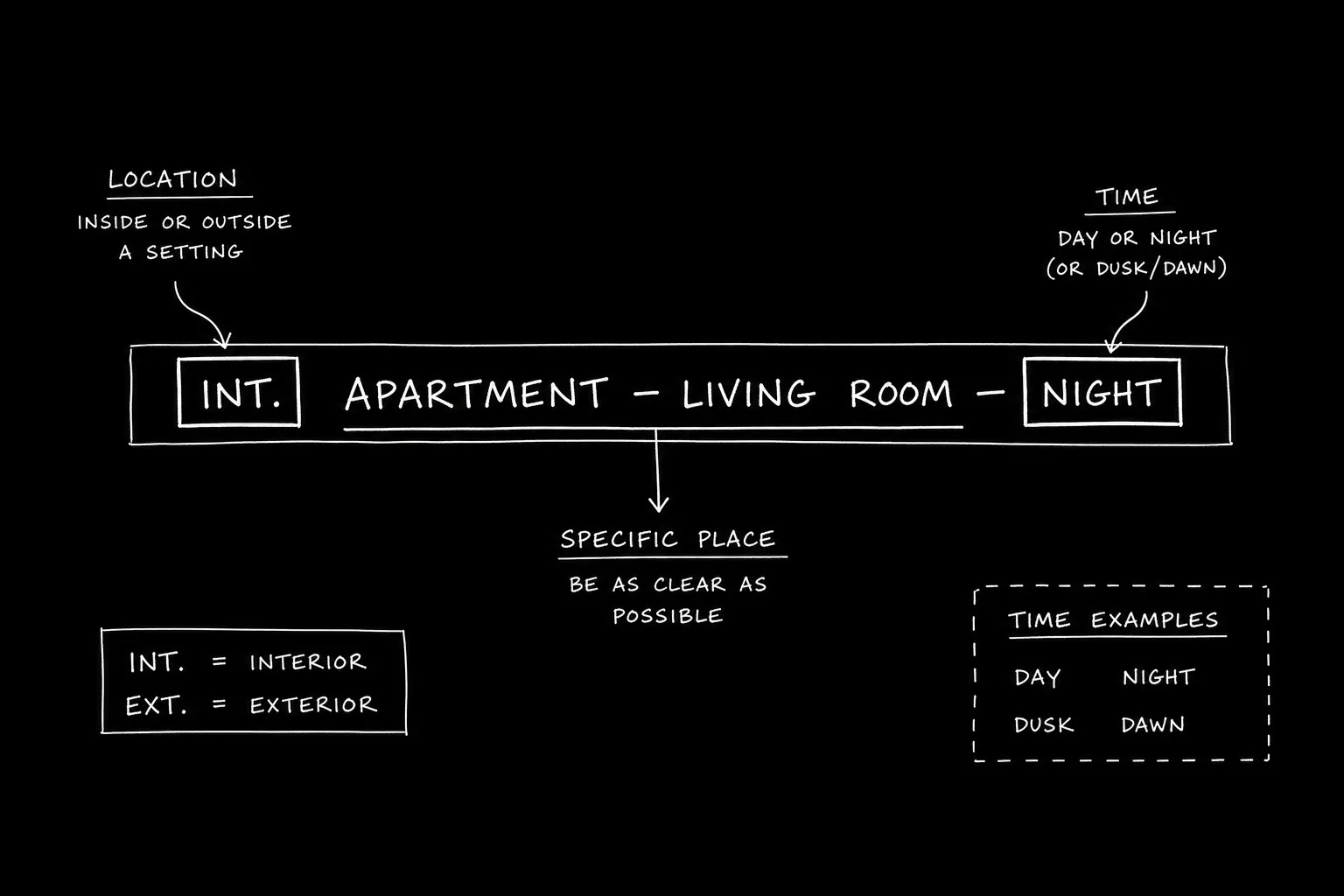
A standard scene heading has three jobs in one line. It tells the reader whether the scene is interior or exterior, names the specific place, and states the time of day (or a clear substitute like LATER or CONTINUOUS). Software may display this as INT. COFFEE SHOP - DAY or INT COFFEE SHOP - DAY depending on template. The punctuation varies by habit. The information does not.
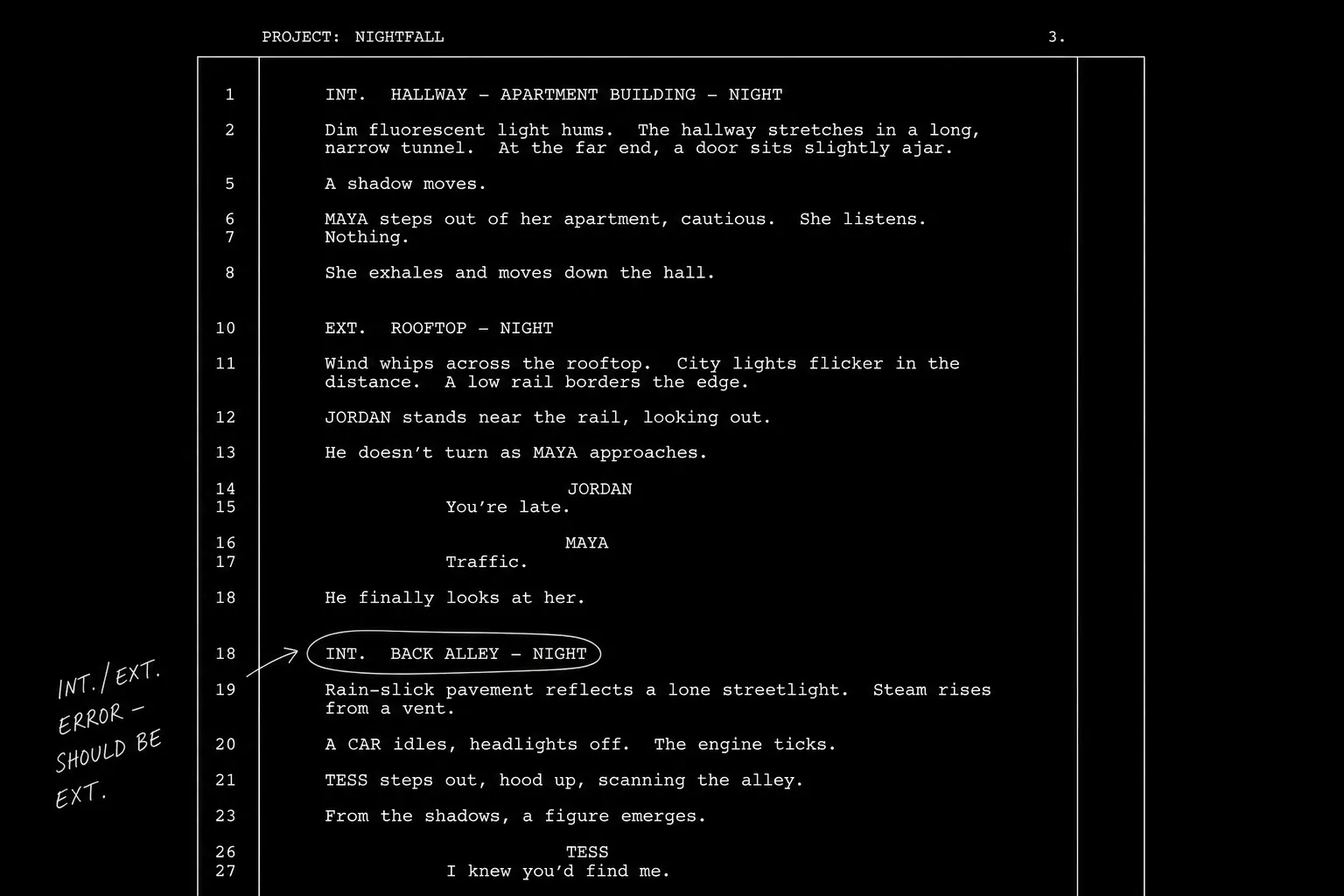
Line producers group scenes by slugline location to build a stripboard. Script supervisors compare slugline time against continuity notes. Casting may never see your sluglines, but the first AD will live inside them. When your slugline says EXT. ALLEY - NIGHT and the previous scene ended in the same alley at magic hour without a time jump, someone will ask whether you meant a new night or a mistake. That question is never free. It steals five minutes from a room that needed five minutes to fix a beat.
Sluglines also pace the read. Readers skim them between dialogue blocks. A vague heading like INT. SOMEWHERE - LATER tells them you were tired. A precise heading like INT. HOSPITAL MRI ROOM - NIGHT tells them you know the geography of your own story. Precision is not fussiness. It is respect for the people who turn letters into a location permit.
If you are still calibrating the rest of your layout, pair this pass with the screenplay formatting guide so margins, font, and element types stay stable while you fix headings.
Slugline Format: The Parts You Cannot Skip
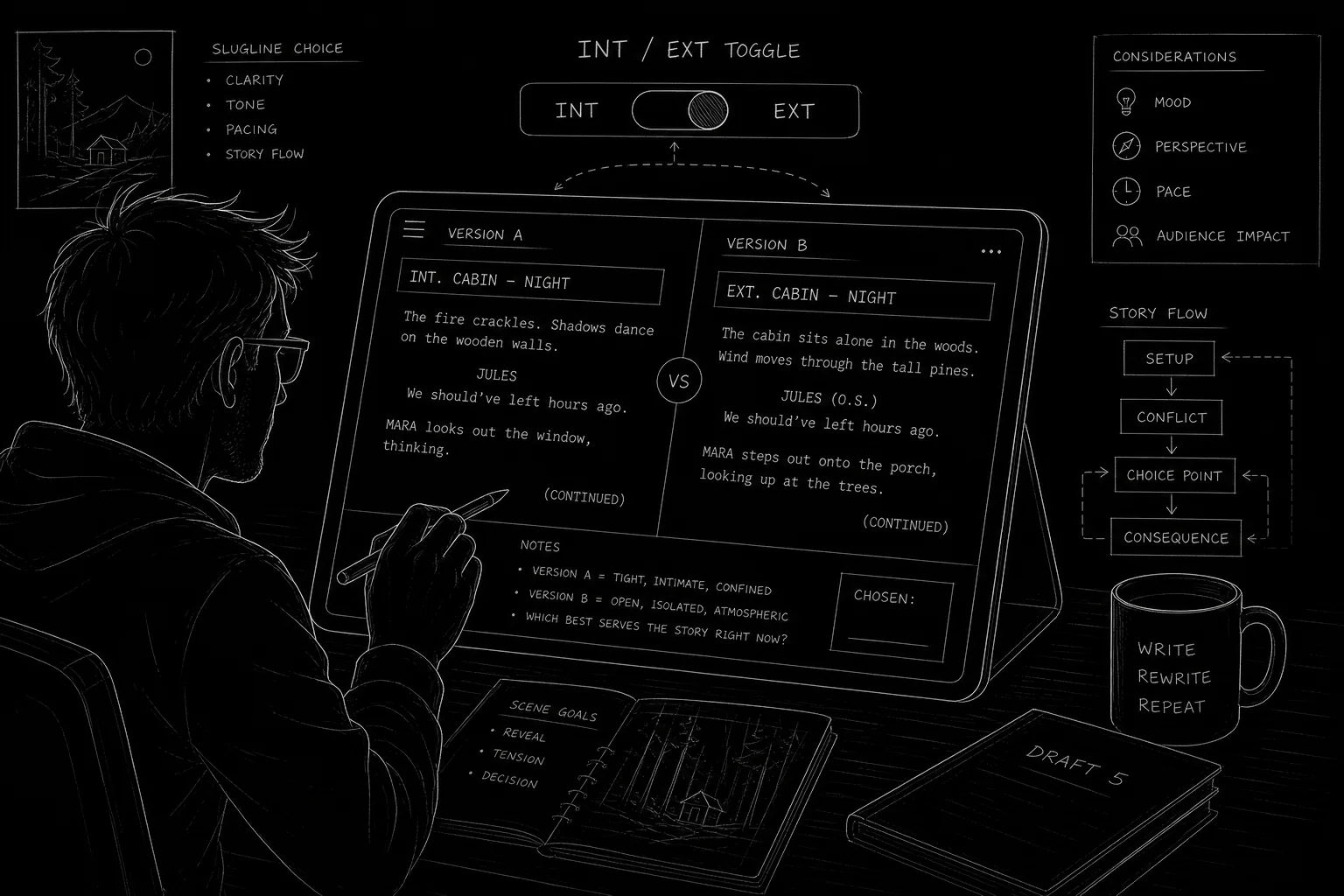
INT. and EXT. are not suggestions. INT means interior. EXT means exterior. Some writers add INT/EXT. for vehicles or doorways that straddle both; use it sparingly and only when the scene truly plays in both worlds at once. A character standing in a doorway looking out might be INT/EXT. HOUSE - PORCH - DAY. A character fully inside a car is usually INT. CAR - MOVING - DAY unless the drama plays through open windows against the street.
Location should be specific enough to schedule. KITCHEN is weak if the house has three kitchens. MARA'S APARTMENT - KITCHEN is better. Avoid cute names in sluglines unless the cute name is what production will call the set. CODE NAMES belong in character dialogue, not in headings that a location manager must search.
Time is usually DAY, NIGHT, DAWN, DUSK, or a continuity note like CONTINUOUS, LATER, SAME, MOMENTS LATER. CONTINUOUS means we pick up immediately where we left off. LATER means same place, new time. SAME means same place and same time as the prior scene, often used when you cut to another angle or character in parallel action.
| Slugline element | What readers expect | Common failure |
|---|---|---|
| INT / EXT | Clear inside/outside | EXT for a room because "the mood feels open" |
| Place | Schedulable location | GENERIC ROOM, APARTMENT with no qualifier |
| Time | DAY/NIGHT or honest continuity tag | Missing time, or DAY after NIGHT with no bridge |
| Special tags | CONTINUOUS, LATER used correctly | CONTINUOUS when hours clearly passed |
The table is not a style scorecard. It is a triage sheet. If you fail one column, fix that column before you argue about font.
Use Cases: Where Sluglines Do Different Work
Features want clean geography. If you hop countries, the slugline must say it. INT. HOTEL ROOM - TOKYO - NIGHT does more work than INT. HOTEL ROOM - NIGHT when your story already established Paris two scenes ago.
Television multiplies sluglines because act breaks multiply scenes. A pilot slugline pass is how you catch whether the cold open and tag match the bible. When you are comparing page norms for pilots, the TV pilot page count guide helps you see how many scenes fit in a module without breaking time logic.
Rewrite passes often introduce duplicate sluglines with tiny variations. INT. KITCHEN - DAY becomes INT. KITCHEN - MORNING becomes INT. MARIA'S KITCHEN - DAY for the same room. Pick one canonical label per location and stay with it unless the story moves to a new unit.
Set pieces sometimes need sublocations. INT. STADIUM - TUNNEL - NIGHT is fair when the scene plays in the tunnel, not the field. Do not split into five micro-sluglines inside one continuous chase unless production truly needs separate setups.
Granular Workflow: Ten-Minute Slugline Pass Before Handoff
Step 1: Freeze your location bible on paper. List every recurring place. Write the exact slugline label you will use for each. MARINA'S OFFICE beats OFFICE if Marina is the only office that matters in the script.
Step 2: Run software scene navigation. Jump scene to scene using your app's outline view. Read only the sluglines aloud. Hearing them exposes repetition and drift.
Step 3: Check INT/EXT against the first action line. If the first action line mentions rain on a face under open sky, EXT should be in the heading. If the first action line mentions fluorescent tubes, INT belongs there.
Step 4: Audit time logic. Mark every NIGHT that follows DAY in the same location. Ask whether you need LATER, SAME, or a new DAY. Magic hour is not an excuse to write DUSK on one page and NIGHT on the next without intent.
Step 5: Collapse duplicates. Merge INT. LIVING ROOM and INT. APARTMENT - LIVING ROOM if they are the same set. Production does not want two names for one kitchen.
Step 6: Run a mechanical formatter on stubborn lines. When you paste sluglines from notes or older drafts, a dedicated slugline formatter can normalize spacing, case, and punctuation so your headings match reader expectations before PDF export.
Step 7: Export PDF and re-read sluglines only. Pagination shifts can orphan headings at page bottoms. A heading alone at the foot of a page is not wrong, but a heading separated from its scene by a page break from a bad export is worth fixing in the source file.
Relatable Scenario: The Heist Script That Scheduled Three Cities in One Kitchen
Jonah writes a contained heist. On page twelve the slugline reads INT. WAREHOUSE - NIGHT. On page forty-seven the same action plays but the slugline reads INT. DISTRIBUTION HUB - NIGHT. The scenes are the same build. The script coordinator builds a stripboard with two locations, orders scouts for both, and Jonah spends a meeting explaining they are one set. The mistake was not creativity. It was label drift during a rewrite week when Jonah renamed the place in dialogue but only sometimes updated headings.
Jonah's fix was boring and effective. He picked WAREHOUSE as the canonical slugline, replaced every variant, and added a parenthetical in the first warehouse scene if he wanted the dialogue to say distribution hub. The stripboard shrank. Trust went up.
Relatable Scenario: The Romance That Forgot Night Exists
Priya's first draft uses INT. APARTMENT - DAY for twenty scenes in a row because she wrote mornings only in her head. Two scenes are clearly candlelit breakups. Readers flag continuity errors. Priya insisted "everyone knows it's night." Everyone did not. A reader on a tablet at midnight does not owe Priya context.
Priya ran a night pass. She changed only sluglines and the first action line of each affected scene. No dialogue rewrite. The script suddenly felt like it breathed across twenty-four hours. Runtime estimates improved too because night scenes read slower; she caught that when she paired slugline time with the one page per minute runtime guide.
Try it free
Try Screenweaver for free on your script
It is free. Import your existing project, get a clearer view of your outline, and regain control of your story structure in minutes.
Start FreeRelatable Scenario: The Pilot With CONTINUOUS Overuse
Malik's hour-long pilot marks six scenes CONTINUOUS across an act break that clearly spans hours. The showrunner assumes the middle block is real-time. The edit plan breaks. Malik thought CONTINUOUS was a vibe word for tension.
Malik replaced CONTINUOUS with LATER where the clock moved, and kept CONTINUOUS only for genuine pick-ups. He added one line of action when needed: "Hours later, the same lobby, now empty." Sluglines carried time. Action carried texture.
Operational Section: Submission and Verification Expectations
Contests and labs rarely publish slugline police manuals, but readers notice. All-caps sluglines are standard. Bold sluglines in custom templates sometimes survive export and sometimes do not. Test your PDF.
Revision colors do not change slugline rules, but they change how you track slugline fixes. If you are on blue pages, mark slugline-only changes in your revision log so the coordinator does not hunt story changes that were typography.
When you send to a manager, inconsistent sluglines read as inconsistent vision. When you send to a production-bound project, they read as schedule risk. Before any send, run the ten-minute pass above.
For external reference on industry script format expectations, the <a href="https://www.wgawritersacademy.org/screenwriting-resources" rel="nofollow">WGA Writers Academy screenwriting resources</a> hub collects foundational guidance worth skimming once, then you return to your own script with a highlighter on the left margin.
Outcomes: What Changes When Sluglines Tell the Truth
Scripts with clean sluglines get faster breakdowns. Assistants spend less time in email asking "is this the same house?" Directors read with more confidence because geography feels authored. You also edit faster. When you need to move a scene, you search one label and find every instance.
Clean sluglines do not fix weak story. They remove a friction layer that makes weak story harder to see. Think of this as clearing fog from the windshield, not installing a new engine.
Slugline discipline is cheap. Reshoot discipline is not.
Why It Matters: Old Habit vs Improved Habit
The old habit treats sluglines as typing chores after the real art is done. You slam INT. ROOM - DAY on every scene because the software auto-completes it. The improved habit treats sluglines as pre-production writing. You choose labels production can schedule. You encode time so pacing reads honestly. You earn trust without a single flashy line of dialogue.
The old habit fixes sluglines only when someone complains. The improved habit runs a pass before every handoff, the same way you spell-check. The old habit lets emotion rename locations scene by scene. The improved habit keeps canonical names and lets dialogue flirt with nicknames.
The Trench Warfare Section: Scene Heading Mistakes Beginners Make (And Fixes That Stick)
Mistake: using EXT for interiors because the scene "feels cinematic." Rain against a window from inside is still INT. Fix: read the first action line literally. Where is the camera's body standing?
Mistake: LOCATION - PLACE redundancy. INT. APARTMENT - LIVING ROOM - APARTMENT is noise. Fix: pick one chain: INT. MARCO'S APARTMENT - LIVING ROOM - DAY.
Mistake: forgetting time entirely. INT. ROOFTOP with no DAY or NIGHT forces everyone to guess. Fix: add time unless CONTINUOUS is true and obvious.
Mistake: SAME and CONTINUOUS as synonyms. They are not. CONTINUOUS is immediate flow. SAME is same time slot, often parallel story. Fix: learn the difference once, apply it forever.
Mistake: renaming the same set after act breaks. Act breaks do not reset geography. Fix: canonical location bible on paper.
Mistake: sluglines that describe shot type. INT. CLOSE ON JENNA - DAY is a shot, not a place. Fix: put camera direction in action lines, keep sluglines schedulable.
Mistake: stacking time jumps in the heading. INT. HOUSE - NIGHT - LATER - DAWN is a novel. Fix: pick the time the scene starts. Use action to carry jumps, or split scenes.
Mistake: copying sluglines from outline notes. Notes say "maybe pier" and the slugline becomes INT. MAYBE PIER - DAY. Fix: decide before the slugline exists.
Mistake: inconsistent hyphen spacing. INT.HOUSE-DAY vs INT. HOUSE - DAY vs INT HOUSE - DAY. Readers forgive one style. They notice three. Fix: run a formatter pass and lock template defaults.
Mistake: hiding new locations inside action instead of the heading. We are now in the basement plays as a surprise. Production wanted the basement in the slugline two pages ago. Fix: new place, new slugline.
Mistake: treating flashbacks as genre exceptions to clarity. INT. HOUSE - DAY (1987) is fine when brief. INT. HOUSE - DAY with no tag for twenty pages of past is not fine. Fix: mark time period in slugline or first action line once, then stay consistent.
Mistake: overusing INT/EXT for normal rooms. A porch scene viewed from the yard might be EXT. PORCH. A porch scene with characters seated inside the rails might still be INT. Fix: choose where the scene plays, not where the breeze comes from.
Mistake: slugline typos that autocorrect into new places. INT. DINER becomes INT. DINNER. Fix: read sluglines aloud in the ten-minute pass.
Mistake: ignoring sluglines when estimating runtime. Night interiors with long dialogue read longer than day exteriors with chase action. Fix: pair slugline audit with a timed read from the runtime guide mindset.
Mistake: waiting until PDF export to discover broken headings. Some imports strip periods or merge lines. Fix: export test early, spot-check first ten sluglines in the PDF.
Beginners think sluglines are formatting. Veterans know sluglines are scheduling in disguise.
Closing: Run the Checklist, Then Forget the Anxiety
Scene heading mistakes are silent until they are expensive. You do not need a perfect slugline on draft one. You need a repeatable pass before the script travels. Freeze names. Match INT/EXT to action. Tell the truth about time. Collapse duplicates. Format mechanically when your fingers are tired.
Open your script tonight. Read only the left margin. Fix what embarrasses you out loud. Tomorrow, someone in production will move faster because you did ten minutes of boring work tonight.
When sluglines are stable, go write the scene that makes people forget they are reading at all. The heading's job is to get them into the room without noticing the door.
Final Step
Build your next script with Screenweaver
Move from ideas to production-ready pages faster with timeline-native writing and AI-assisted story flow.
Try Screenweaver