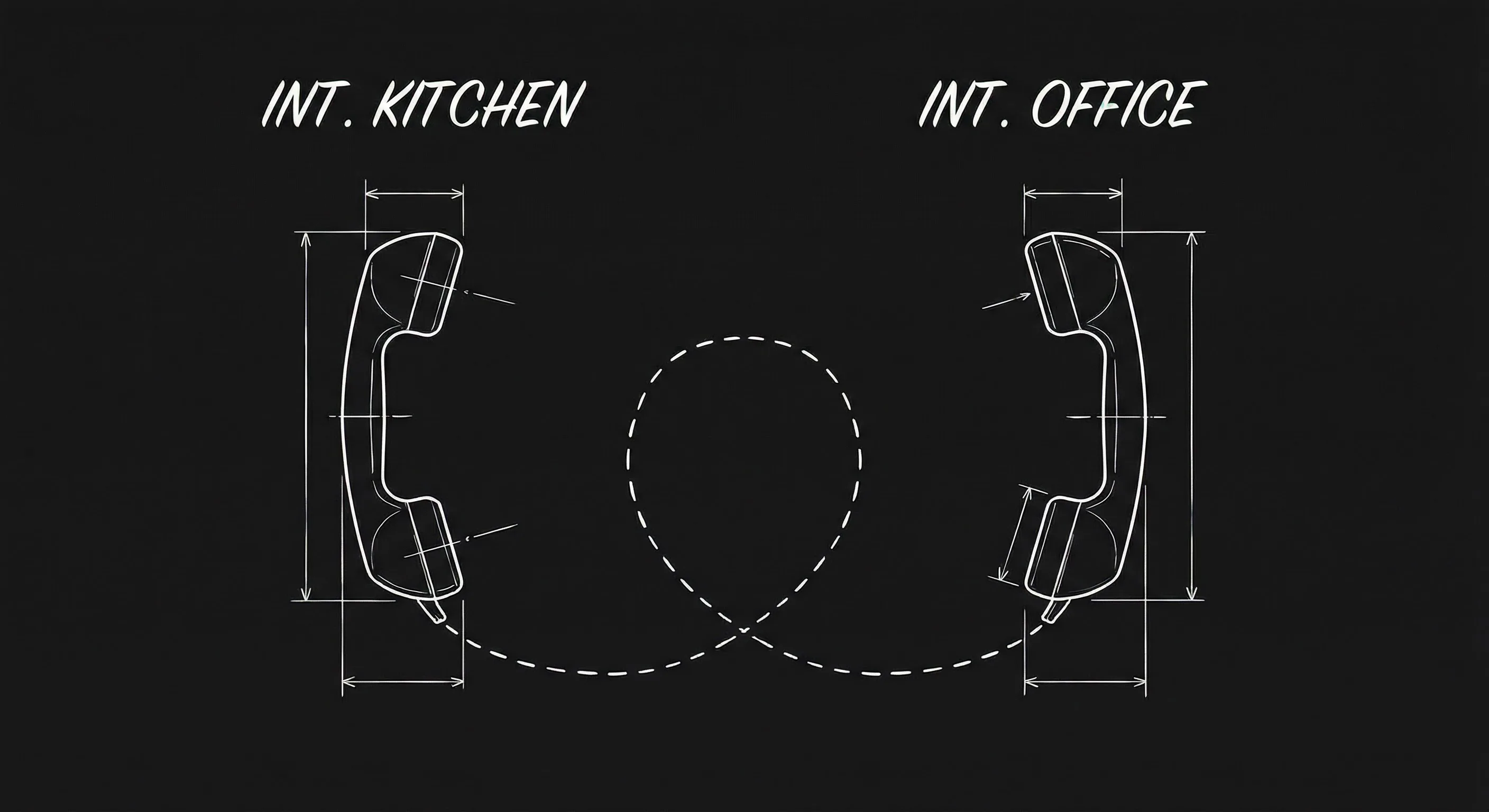

Your character picks up the phone. Someone on the other end is talking. The reader is already confused. Are we in the kitchen or the car? Who is speaking? Half the scripts that land on desks botch this. Not because the writer doesn't understand the scene,they do,but because they never learned that phone calls have a grammar. Two people in two places having one conversation. The page has to make that clear in a glance. When it doesn't, the reader stumbles. And stumbling readers put scripts down.
Format tells the reader where to look. In a phone call, that's half the drama.
The choice isn't cosmetic. Intercut and one-side are different tools. Each shapes pacing, information flow, and where the audience's loyalty sits. Pick wrong and you're either overcutting a quiet moment or burying tension that needed to breathe.
Free tool: use the Slugline Formatter to clean up and standardize your scene headings.
What You're Really Deciding
A phone call in life is one continuous event. On the page it's two locations, two blocks of action, and dialogue that has to be assigned. The format you choose tells the production team how to shoot it and the reader how to experience it. One-side means we stay with one character for the whole conversation. We hear their half. We see their face. The other voice is offscreen, or we never cut to them at all. Intercut means we move back and forth between both sides,kitchen, then car, then kitchen again. We see both faces. We watch both reactions.
Think about the last phone call that mattered in a film you loved. Heat. Pacino and De Niro. That diner scene could have been a phone call; the tension was the same. Two people. One conversation. The decision to show one face or both wasn't arbitrary. It was storytelling.
The One-Side Call: When to Use It
Use one-side when the reaction is the story. We don't need to see the person on the other end. We need to see the character we're with,their face falling, their hand tightening on the receiver, the way they go very still. The information is in the dialogue we hear, but the drama is in the face we watch.
Picture a detective in a cramped office. The phone rings. It's the lab. We stay on the detective. We hear the technician's voice (V.O. or O.S., depending on how you handle it). We never cut to the lab. We don't need to. The detective's slow exhale, the pen dropping,that's the scene. Cutting away would dilute it. One-side keeps the emotional focus tight. It also saves pages. You're not writing two scene headings, two action blocks, two reaction beats. You're writing one. For a script that's already long, or a moment that's intimate, one-side is the lean option.
There's a catch. If the person on the other end has equal dramatic weight,if their reaction matters as much, or if the power dynamic of the call is the point,one-side can feel like you're hiding. The audience will wonder what the other character looked like when they said that. If that wondering is productive (mystery, offscreen threat), lean in. If it's just you avoiding the work of writing both sides, fix it.
The Intercut: When You Need Both Faces
Intercut when the exchange is the story. When every line lands on someone's face. When the cut itself has rhythm,silence on one side, then the other character's reply, then a cut that underlines the beat. Intercuts are standard for confrontations, negotiations, breakups, and revelations. Both people have stakes. Both reactions pay off.
Format is straightforward. You establish both locations with standard scene headings. Then you use INTERCUT or INTERCUT BETWEEN [LOCATION A] AND [LOCATION B] so the reader (and the editor, later) knows we're in a back-and-forth. After that, you use minimal scene headings or just character names and dialogue. You don't repeat full slug lines every time you switch. You write "JANE" or ",JANE (ON PHONE)" and the dialogue, then "MIKE (ON PHONE)" and his. The INTERCUT heading does the heavy lifting. As discussed in our guide on screenplay format and scene structure, clarity for the reader and the production draft matters more than decorative headings.
Intercuts eat more space. You're tracking two physical spaces, two action lines, two emotional arcs. They also give you the ability to use the cut as punctuation. Hang on one character's silence a beat too long, then cut to the other. The rhythm of the scene lives in those transitions.
A Side-by-Side Look at the Mechanics
| Approach | Best for | Page impact | Emotional focus |
|---|---|---|---|
| One-side | Reaction-driven; one character's POV; tight scripts | Fewer lines, one location | Single character |
| Intercut | Confrontation; negotiation; both reactions matter | More lines, two locations | Both characters |
| Hybrid (one-side then cut) | Twist or reveal,we think we know, then we see the other side | Variable | Shifts mid-call |
Hybrid is the third option. Start one-side. We're with the detective. We hear the bad news. Then,one cut to the other location. The caller, hanging up, calm. We realize they were lying, or relieved, or already moving. The single cut lands because we've been denied that face until now. Use it sparingly. Once per script, maybe. The trick loses power if you repeat it.
Relatable Scenario: The Bad News Call
Maya is at home. Her brother calls from the hospital. If you write this one-side, we stay with Maya. We hear her brother's voice (O.S. or V.O.,more on that below). We watch her sit down, we watch her cry, we watch her hang up and sit in silence. We never see the brother. The scene is about her receiving the news. One location. One emotional throughline.
If you write it intercut, we see the brother in a corridor, phone to his ear, struggling to keep his voice steady. We see Maya's face when he says the words. We cut back to him after he hangs up,maybe he slides down the wall, maybe he just walks away. Now the scene is about both of them. The choice changes what the scene is. Not just how it's formatted.
Relatable Scenario: The Negotiation
Two executives. One in LA, one in Tokyo. They're closing a deal. Every line is a probe or a parry. If we only stay with one, we're guessing at the other's tells. The scene works better as an intercut. We see the LA exec's smirk when he lowballs. We see the Tokyo exec's pause, the slight nod. The negotiation is a duel. We need both duelists on screen.
Try it free
Try Screenweaver for free on your script
It is free. Import your existing project, get a clearer view of your outline, and regain control of your story structure in minutes.
Start FreeThe V.O. vs. O.S. Question
Voice-over (V.O.) typically means the speaker is not in the physical space,they're on the phone, or we're hearing their thoughts, or a narrator. Off-screen (O.S.) means the speaker is in the scene but not visible,in the next room, or on the other end of the line. Many pros use V.O. for the distant party in a phone call: they're not in the room, so their voice is "over" the scene. Others reserve O.S. for any voice we hear but don't see. Both are accepted. The important thing is consistency. Pick one convention and stick with it for the whole script. As with how to describe sound effects in a screenplay, small formatting choices add up to a professional read.
What Beginners Get Wrong (The Trench Warfare Section)
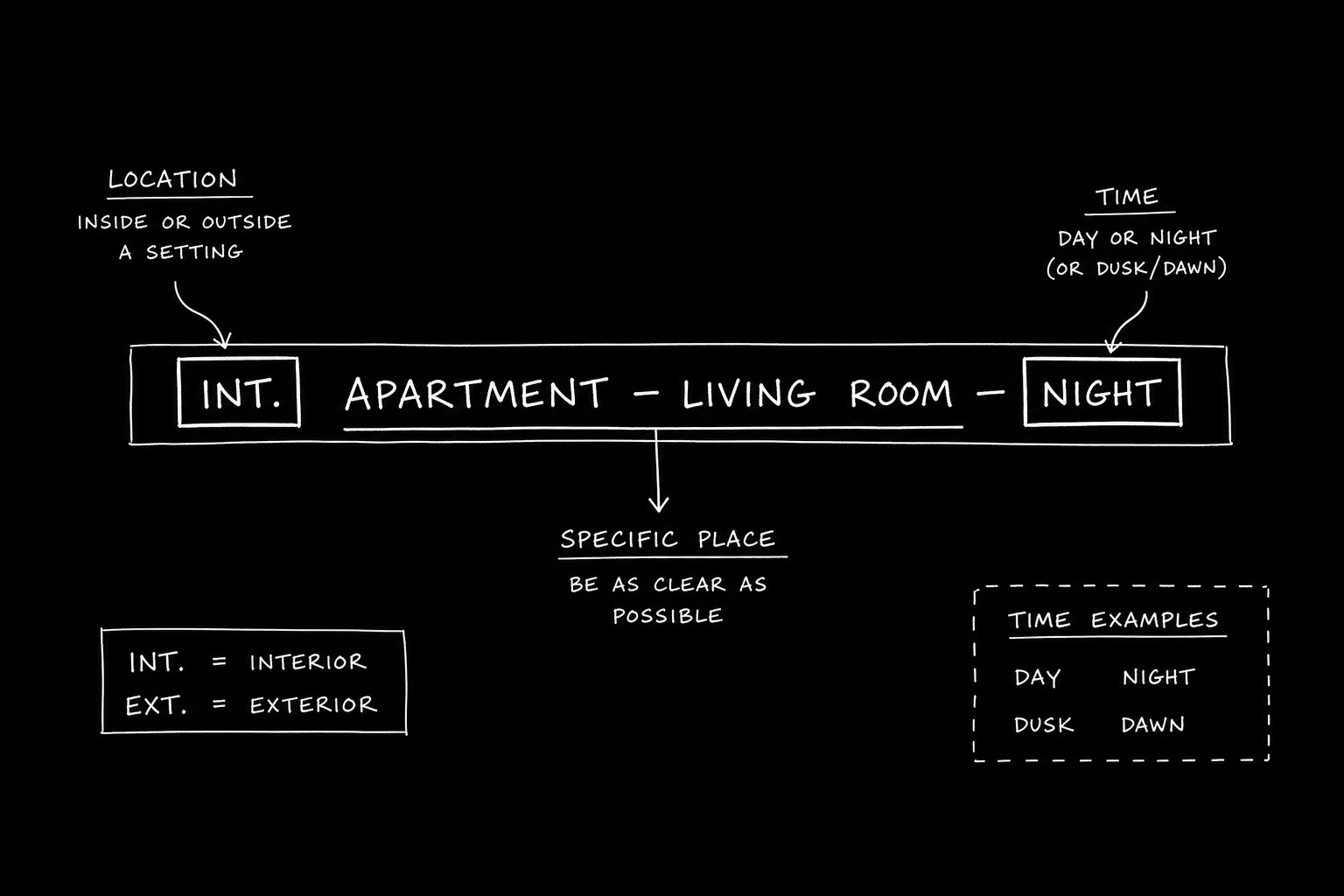
Writing both sides as full scenes. They write INT. MAYA'S APARTMENT , NIGHT, then later INT. HOSPITAL CORRIDOR , NIGHT, and repeat full slug lines every time they switch. The script bloats. The reader gets whiplash. Fix: One INTERCUT heading, then character names and dialogue. Only reslant to a full scene heading if we leave the call (e.g., someone hangs up and the scene continues in one location).
Using intercut when one-side would do. A quick check-in call,"I'm on my way",doesn't need two locations. Stay with the character we care about. Use intercut when the other character's presence on screen earns its keep.
Forgetting that we can't see the other person. In one-side calls, the dialogue from the other end has to stand alone. They can't rely on a meaningful look or a pause that we'd see. Everything the audience gets from that side is in the line. So those lines need to be clear, loaded, or deliberately cryptic,by design, not by accident.
Overdirecting the intercut. "We cut to Sarah. We cut back to James." You don't need to say "we cut" every time. INTERCUT implies it. Write the dialogue and the action; the editor will cut. Specify a cut only when the timing is critical,e.g., "Hold on Sarah's face for a beat after James hangs up."
Making the offscreen voice a non-entity. In one-side calls, the other character still has to sound like a person. Give them a rhythm, a vocabulary, a mood. "Hello. Yes. Okay. Goodbye." reads like placeholder. Who are they? Nervous? Cold? In a rush? The lines we hear are all we have. Make them count.
Ignoring the hang-up. How the call ends is a beat. Someone hangs up first. Someone is left listening to dead air. Someone says "I have to go" and we feel the lie. Don't race to the next scene. The moment after the call,the character alone with what they just heard,often carries more weight than the call itself.
Step-by-Step: Formatting an Intercut Call
Establish both locations. Write the first scene heading (e.g., INT. KITCHEN , NIGHT) and a short action line. Then the second (INT. CAR , NIGHT) and its action. One of them picks up, or we're already in the call. Next line: INTERCUT , KITCHEN / CAR. From here on, you don't need to repeat INT. KITCHEN or INT. CAR unless the scene stops being a phone call (e.g., someone exits the car). Write character name, (ON PHONE) if it helps, then dialogue. Action lines go under the character they apply to. When the call ends, you can write "END INTERCUT" and continue in one location, or just continue with a single scene heading. Done.
Step-by-Step: Formatting a One-Side Call
Single scene heading. INT. MAYA'S APARTMENT , NIGHT. Action: Maya's phone rings. She answers. Then dialogue. For her lines, it's just MAYA. For the caller, use JAKE (V.O.) or JAKE (O.S.) and the line. We never leave the apartment. When Jake hangs up, the scene continues with Maya,her reaction, her next move. No second location, no INTERCUT.
Relatable Scenario: The Threat
A woman at home. Unknown caller. If we stay one-side, we're in the room with her. We hear the voice,distorted, cold,and we watch her fear. We don't need to see the caller. The menace is in the unknown. Cutting to the caller would demystify. One-side preserves the dread. If the story later reveals who was on the line, that revelation can land in a different scene. Here, the phone call is about her isolation. One location. One face.
When the Script Reader Stumbles
Readers see hundreds of scripts. When they hit a phone call that's formatted wrong, they don't re-read to decode it. They skim. They guess. Or they mentally check out. Sloppy formatting reads as inexperience. It doesn't matter if your story is strong; the first impression is "this writer doesn't know the craft." Clean formatting is invisible. It gets out of the way. The reader stays in the scene instead of puzzling over who's talking. That's the real reason to care. Not rules for rules' sake,because you want the person holding your script to stay in the story.
The One List You Need
- Use INTERCUT only after establishing both locations once.
- In one-side calls, tag the offscreen voice consistently (V.O. or O.S.) and don't switch mid-script.
- Never repeat full slug lines for every beat of an intercut; use character names and (ON PHONE) after the initial INTERCUT.
Everything else is judgment. Who drives the scene? Who needs to be seen? Answer that, then format accordingly.
When the Call Is the Whole Scene
Sometimes the phone call isn't a beat inside a larger scene,it's the scene. One location or two. One conversation. The entire dramatic weight is in the exchange. In that case, the format choice (one-side vs. intercut) is even more important. You're not cutting away to action. The dialogue and the reactions are the action. So the rhythm of the cuts (in an intercut) or the sustained focus (in one-side) has to carry the scene. Read the scene aloud. If it's one-side, does the offscreen voice have enough presence? If it's intercut, does each cut earn its place? When the call is the whole scene, there's nowhere to hide. The formatting has to be clean and the beats have to land.
The Perspective
Phone calls are not filler. They're two people in two places, sharing one moment. The format you choose,one-side or intercut,is a narrative choice. It decides who we look at, who we feel with, and how much we know. Get the grammar right so the reader never has to guess. Then use that grammar to make the call do real dramatic work.
Final Step
Build your next script with Screenweaver
Move from ideas to production-ready pages faster with timeline-native writing and AI-assisted story flow.
Try Screenweaver