
You download a "sitcom template" and your first scene looks wrong before anyone reads a joke. The slugline sits where a stage direction should be. Action is lowercase when the sample you love is shouting in caps. Your half-hour footer says thirty-four pages and a coverage reader writes back that you wrote an hour pilot in comedy clothes. None of that means you cannot write comedy. It means you picked a dialect without knowing the grammar.
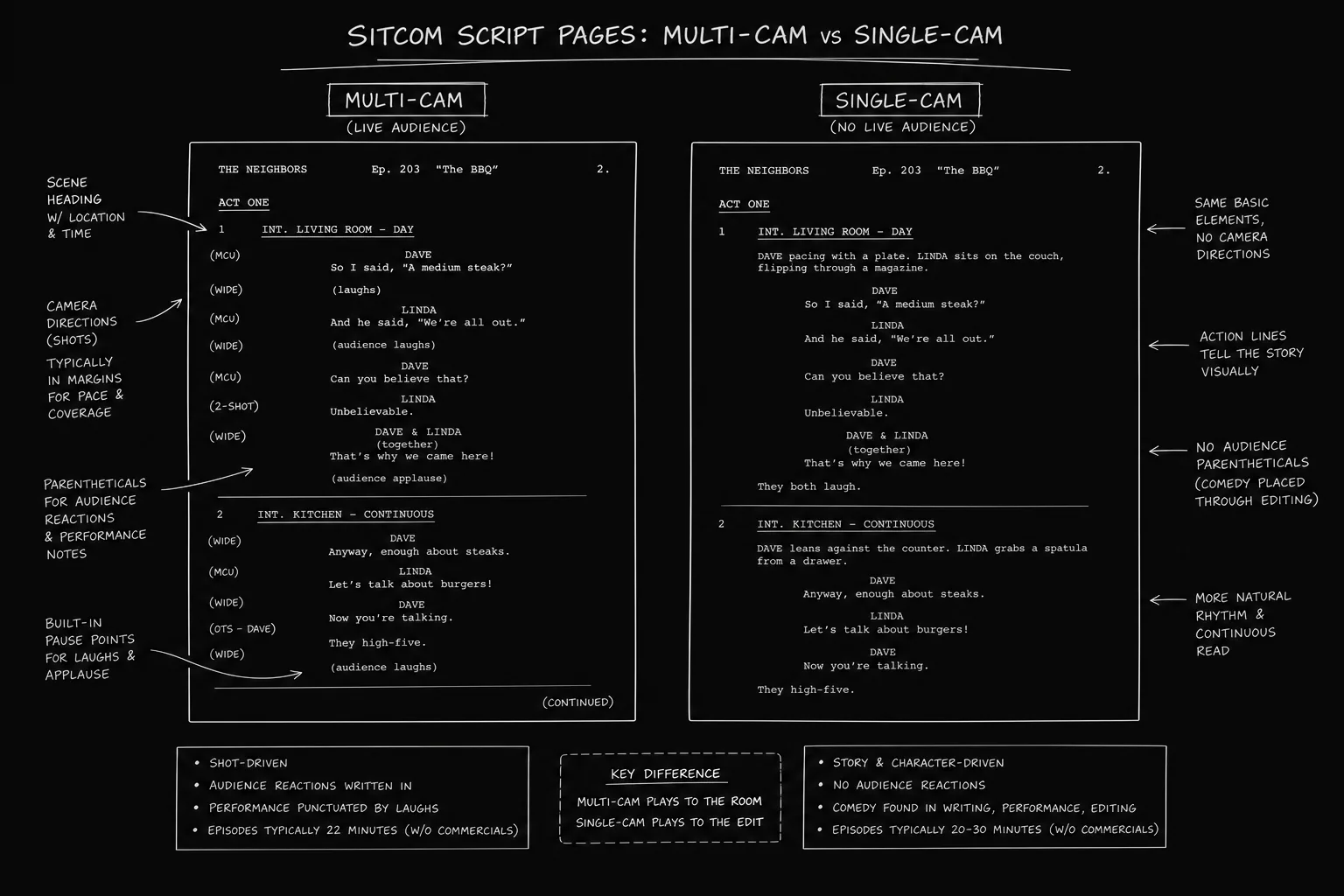
Multi-cam and single-camera sitcoms share the same job on television: turn a cast into a weekly machine audiences trust. On the page they are not the same animal. Multi-cam scripts are performance documents built for a stage, a live audience or laugh track, and camera geography that resets in blocks. Single-cam scripts are closer to short films with joke density baked into scene shape. If you confuse the two, you will fight your template, your page count, and the room that has to shoot five days before a holiday hiatus kills everyone's sleep.
This guide is what changes on the page when you move between multi-cam and single-camera sitcom format: element rules, scene headers, action line voice, act break habits, and the page bands buyers still use in 2026. Pair it with our TV pilot page count targets for half-hours once you know which species you are writing, and with the screenplay formatting guide when your software defaults are lying to you.
A sitcom format is not a vibe. It is a production contract written in Courier 12.
Free tool: use the Script Time Calculator to estimate your runtime from your script text or word count.
Why the Page Looks Different (Economics, Not Snobbery)
Multi-cam comedy survived because it is efficient under the right conditions. Sets cluster on a stage. Crews learn swing patterns. Actors hit marks while a fourth wall pretends not to exist. Writers leave room for performance rhythm because the shoot will add breath, reaction shots, and sometimes a second take because the audience laughed through the next line.
Single-camera comedy buys flexibility with cost. You can shoot a kitchen scene at a location that does not match the living room set. You can do a walk-and-talk down a hallway that multi-cam would treat like a logistics nightmare. The script carries more geography in sluglines and action because the production will not be blocked in a cube all week.
Readers use format as a proxy for experience. Send a multi-cam spec with film-style sluglines and they wonder if you have ever held a produced script from a three-camera show. Send a single-cam spec with all-caps action paragraphs and they wonder if you think The Office was shot on a proscenium. The jokes might be great. The handshake fails anyway.
The Comparison Table: What Changes on the Page
| Element | Multi-cam sitcom (typical spec) | Single-camera sitcom (typical spec) |
|---|---|---|
| Scene headers | Often ALL CAPS; may use "ACT ONE" / stage-style breaks | Standard INT./EXT. sluglines; more locations per episode |
| Action lines | Frequently ALL CAPS; short, performance-facing | Sentence case; more visual description allowed |
| Character intros | CAPS on first introduction; punchy traits | Standard first-appearance caps; may mirror drama |
| Dialogue | Fast exchanges; fewer parentheticals | Parentheticals when tone is not obvious on screen |
| Act breaks | Marked for broadcast rhythm; act outs are jokes or turns | Still useful for shape; may be softer on streamers |
| Dialogue spacing | Double-spaced | Single-spaced, standard screenplay format |
| Page band (half-hour pilot) | Often 45-55 pages | Often 25-35 pages |
| Joke density | High; air left for performance | High; air bought with shorter action |
| Transitions | "CUT TO:" common; act resets explicit | Standard cuts; more continuous geography |
The table is a map, not a religion. A streamer half-hour might want single-cam pages with broadcast act labels because the showrunner came up on network. Read comps in the lane you are pitching, then write the lane.
Multi-Cam Format: Writing for the Stage That Pretends It Is Not One
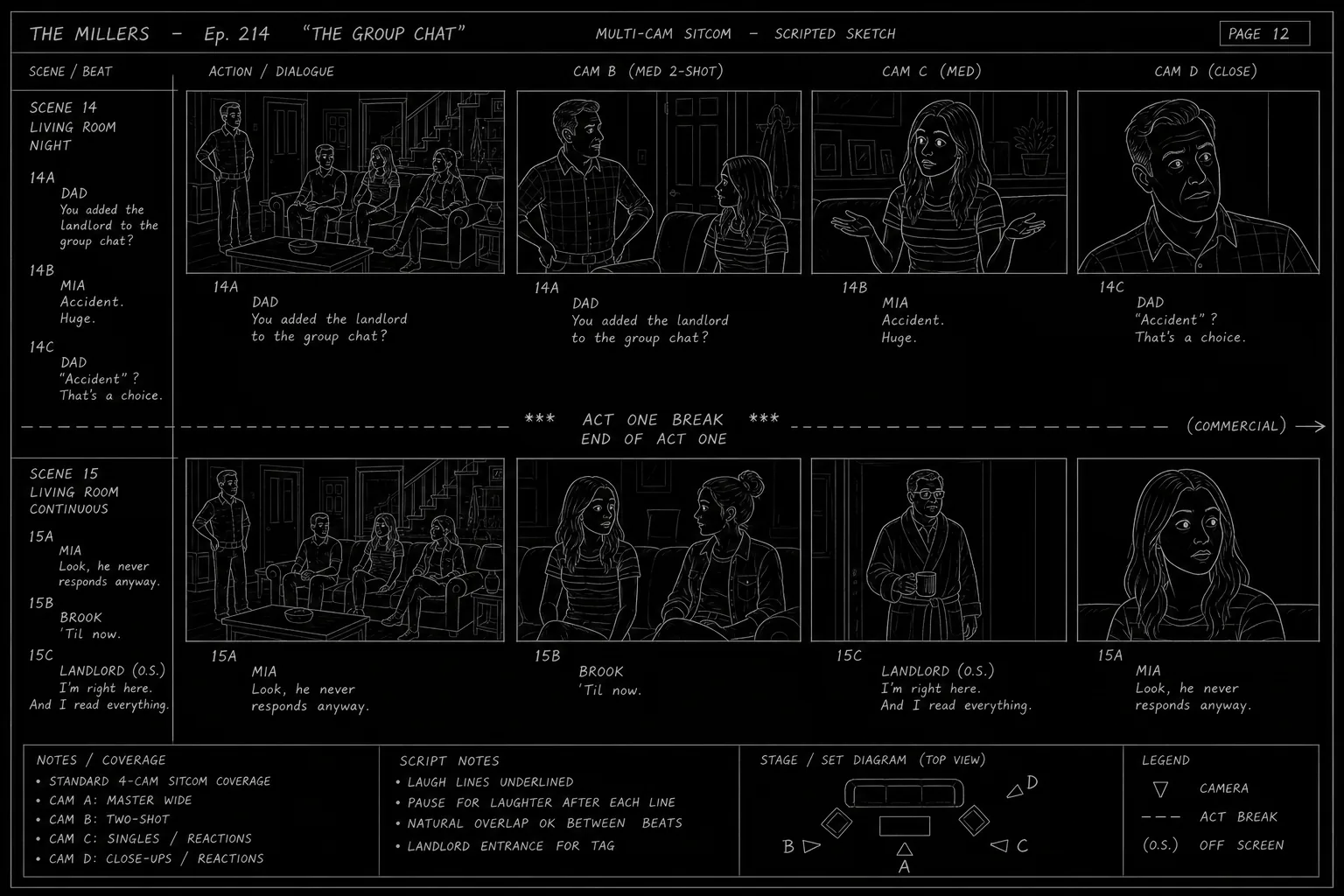
Multi-cam scripts read loud. Action is often in capital letters because the director, stage manager, and cast are scanning for blocking and business without treating the page like a novel. You are not painting sunsets. You are telling Dana to cross to the fridge while Greg delivers the button.
Scene geography stays tight. Think in sets you can see from the audience side. Living room, kitchen, hallway, maybe a bedroom if the budget smiles. When you invent a new location every scene, you are writing single-cam with the wrong footer. The production will compress you back to four walls anyway, but the read already marked you as unfamiliar.
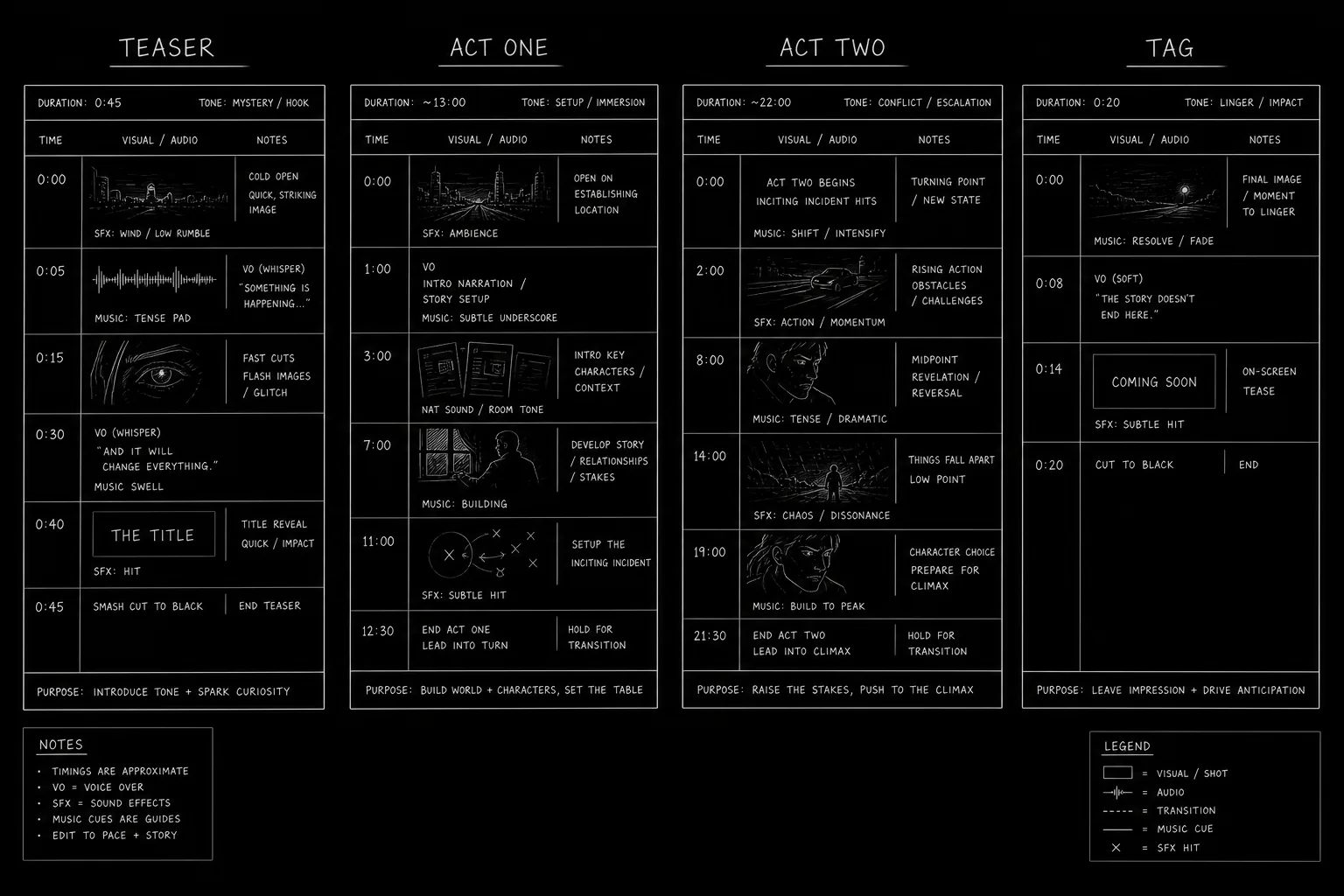
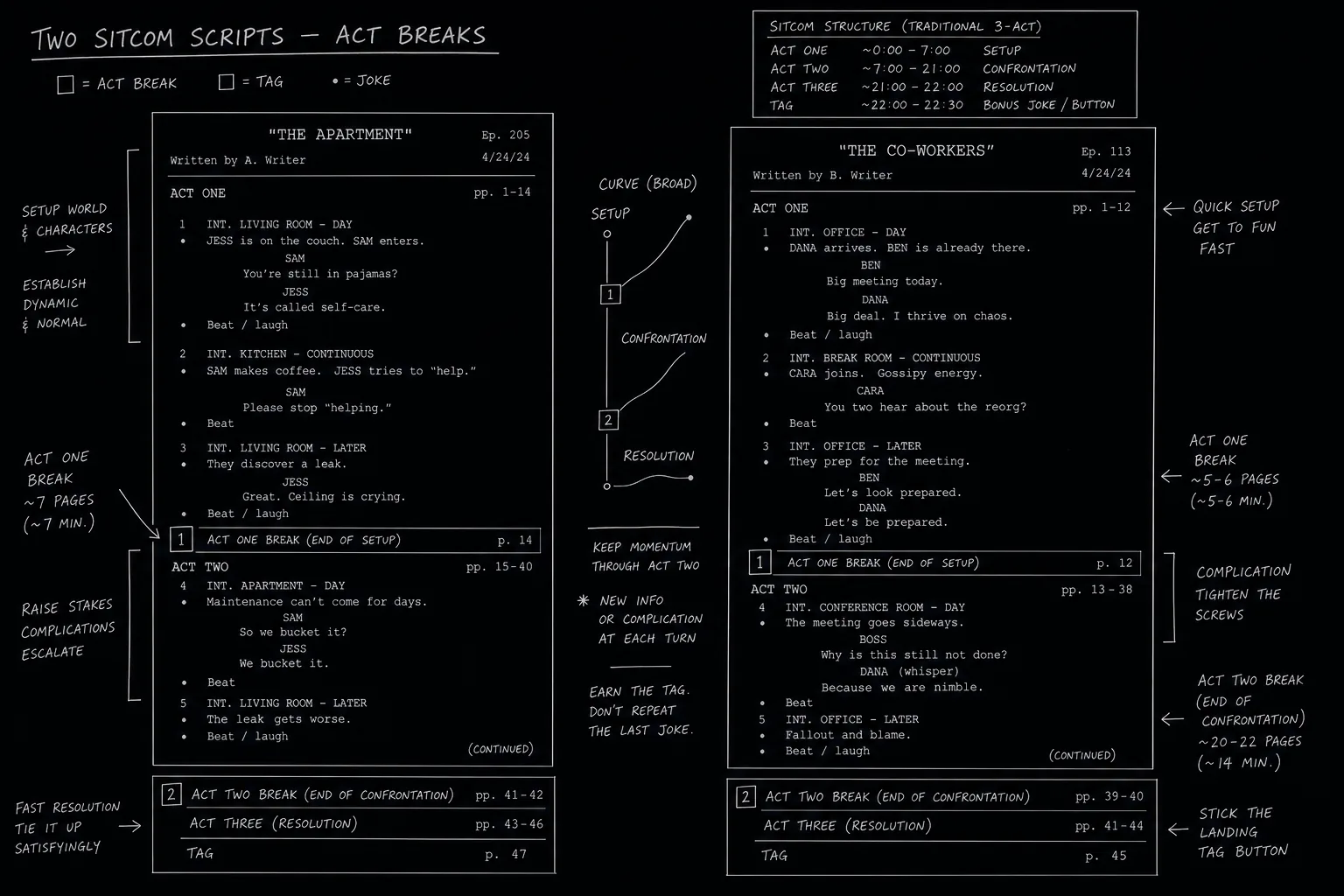
Act structure is visible. Teaser, acts, tag. Multi-cam pilots still demonstrate you understand episode machinery. The act out is often a joke that lands, a reveal, or a sharp emotional turn played for comedy. Soft act outs feel like the energy leaked out of the room.
Dialogue rhythm is the engine. Long speeches die in multi-cam unless the room is writing a monologue episode on purpose. Exchange length matters. If three characters each take forty-word turns, the read drags before the camera rolls. Break lines. Tag jokes. Let interruptions exist on the page.
Audience awareness is a choice, not an accident. Some specs still label audience reactions in revision drafts; others never do on the page. Know the show you are cloning. If you are writing for a streamer multi-cam without audience, you still write pacing that leaves performance air. The absence of a live crowd does not mean you write a feature scene count.
When you set up your template, lock Courier 12, standard television margins, and element spacing before you argue about twenty-two versus thirty pages. Wrong defaults create wrong habits. Our formatting baseline catches the element rules that sitcom templates sometimes hide in a "comedy" preset that is actually hybrid garbage.
Single-Camera Format: Mini-Movies With Joke Obligations
Single-cam sitcom scripts look closer to hour-long drama formatting at a glance, then the joke density betrays the genre. Sluglines multiply. You might be outside. You might do a short montage. You might write a silent beat that multi-cam would solve with a reaction in the same set.
Action can carry story. You are allowed to describe what we see in sentence case. Do not become a novelist. Single-cam action still needs to be shootable on a schedule. If your action paragraph is longer than the scene's dialogue, ask whether you are directing on the page because you do not trust the joke.
Locations are part of the comedy. A bad parking lot beat can be funnier than the same argument in the apartment again. Single-cam buys variety. It also buys company moves and lighting resets. The writer who adds six new locations to a network half-hour without knowing budget is writing a pilot that production will hate politely.
Act breaks still matter for many buyers. Streaming freedom is real. Development executives still often want to see you can shape an episode. Write act outs even if you believe they will vanish in post. Act shape is how you prove middle-act pressure in a half-hour.
The page band runs on a different scale. Thirty-two pages is a normal half-hour single-cam draft; the same episode laid out in multi-cam format, with double-spaced dialogue and caps action, would run closer to fifty. Compare to comps. Compare to the pilot page count guide before you panic-cut jokes that were doing real work.
Relatable Scenario: The Template That Defaulted Wrong
Jordan downloads a generic "TV comedy" template and writes a heartfelt single-cam half-hour about adult roommates. The software puts action in caps because the template was built for an old multi-cam sample. Jordan's dialogue is dry and observational. The action screams like a nineties three-camera show. A reader at a contest stops after eight pages with a note that says "pick a format."
Jordan's fix took one afternoon, not a rewrite of the series. They pulled two produced scripts in their actual lane: one single-cam pilot they admired, one multi-cam classic for contrast. They rebuilt their template elements: sentence case action, standard sluglines, correct margin. They did not change a single plot beat. They re-labeled scenes and trimmed action lines that were performing blocking the production would invent anyway. The next read got "voice is clear" instead of "format confusion."
Try it free
Try Screenweaver for free on your script
It is free. Import your existing project, get a clearer view of your outline, and regain control of your story structure in minutes.
Start FreeRelatable Scenario: Forty-Six Pages That Feel Like a Sketch Show
Aisha writes a multi-cam pilot with rapid-fire jokes. Her footer says forty-six pages. She thinks she nailed the band. The read says the story never arrives. She confused page economy with story economy.
Her pages were tight. Her act one had no clear protagonist want. She had ten funny bits and one half-formed emotional stake. Multi-cam pilots still need a pilot story, not only a string of bits. Aisha mapped act one as "establish friends" without a disruption that forces a choice. She added a late act-one turn: the main character must host the parents who hate each other, and the apartment lease forbids overnight guests. Same joke density. Clearer pressure. Page count rose to fifty. The read finally felt like television instead of a writers' night showcase.
Relatable Scenario: The Single-Cam Spec With Sitcom Jokes and Drama Pacing
Leo writes a single-cam pilot with strong voice but long act-two scenes that play like a premium drama. Coverage says "funny but reads slow." Leo almost added cutaway jokes. The real issue was scene shape: two-person arguments that reset instead of escalate.
Leo broke each act-two scene into a enter-late, exit-early pass. He marked the first line that must land and the last line before the turn. He combined two kitchen scenes into one with a mid-scene reversal: the friend who was supportive takes the wrong side. Pacing fixed the read without sanding down the voice. Single-cam rewards scene craft. Multi-cam rewards rhythm. Leo was writing rhythm in a format that bills by geography.
Granular Workflow: Choose Your Lane Before Page One
Name the show's production grammar in one sentence at the top of your outline. Example: "Half-hour single-cam, streamer, act shape for room, low-thirties pages." Example: "Multi-cam network half-hour, stage geography, act outs are jokes."
Collect two comps in that exact lane. Not "comedies I like." Pilots or produced episodes that match camera grammar. Mark how many locations appear in act one. Mark case on action. Mark how act breaks read on the page.
Set template elements before dialogue. Slugline style, action case, character intro style, transition habits. If your software fights you, fix elements once instead of fighting every scene.
Outline act outs as lines, not vibes. Write the last beat of each act in plain language. If it is not funny, revealing, or painful in a comic way, the act out is not ready.
Draft act one without looking at total pages. Get the story engine on the page. Then audit footer against comp band.
Read aloud with a stopwatch for rhythm. Multi-cam: hear the room. Single-cam: hear scene turns. Silence on the page is not free in either format.
Export PDF and compare pagination to a comp. Shifted page breaks break trust in coverage. Stable export matters when you send alongside other samples.
Hybrid Rooms and Format Drift in 2026
Rooms love to mix references. A show might be single-camera with multi-cam pacing in the writers' room. A multi-cam might shoot without audience but keep CAPS action because the cast trained on three-camera rhythms. Your spec cannot be every show at once. Pick the clearest comp and write that dialect.
"Single-camera" on a pitch deck does not always mean film grammar on the page. Some shows use single-camera locations but still want half-hour act labels and broadcast-shaped pilots because the buyer is a network sibling. Ask when you can. When you cannot ask, comp the buyer's last three pickups.
Writers' assistants and script coordinators will fix minor element sins if the voice sells. They will not fix a fundamental format mismatch. Learn the difference between a taste note and a format note. Taste is debatable. Format is the job interview.
The Trench Warfare Section: Sitcom Format Failure Modes
Wrong: treating CAPS action as "more professional." In single-cam, it reads like you never updated your template. Fix: match action case to lane.
Wrong: writing multi-cam location sprawl. New set every scene kills the budget read. Fix: cluster geography; justify swings.
Wrong: writing single-cam as if pages are free. Thirty-eight pages of loose scenes still reads undisciplined. Fix: scene combination, enter late, act pressure.
Wrong: no act breaks because "streaming." Many readers still want shape. Fix: mark act outs; earn breaks.
Wrong: confusing joke density with story. Bits without stakes get old by act two. Fix: pilot want, disruption, consequence.
Wrong: parenthetical abuse in single-cam. If every line needs a wry direction, the dialogue is not doing work. Fix: rewrite lines; cut parentheticals.
Wrong: film slugline poetry in multi-cam. "Golden hour" in a living room sitcom read is a tone error. Fix: short, playable action.
Wrong: copying a 2004 comp's page band without checking lane. Rooms moved. Fix: recent comps, same camera grammar.
Wrong: ignoring the tag. The tag trains series promise. Fix: write it as part of the pilot proof.
Wrong: margin cheating to hit twenty-two pages. Readers notice thin margins faster than they notice a weak act out. Fix: cut scenes, not typography.
Multi-cam vs single-cam is not about which is smarter. It is about which machine you are asking to hire you.
Handoff: What to Put in Your Cover Line
When you send the spec, say the grammar out loud in one sentence. "Multi-cam half-hour pilot, fifty pages, three-camera geography, broadcast act structure." Or "Single-cam half-hour pilot, thirty-two pages, act-shaped, streamer tone." That line saves everyone a guess.
External references still help when you calibrate against working craft norms. The <a href="https://www.wga.org/writers-room/101/writing-for-television" rel="nofollow">WGA writing for television overview</a> reminds you that sitcom paths are still professional television, even when your sample is for a short-order streamer.
Sitcom script format is where production meets voice before the room hears you read. Multi-cam and single-camera are two dialects. Learn the page signals, match your template, earn your act outs, and let the jokes land in the grammar the show actually shoots.
Final Step
Build your next script with Screenweaver
Move from ideas to production-ready pages faster with timeline-native writing and AI-assisted story flow.
Try Screenweaver