
AI voices sound fake because of prosody, not audio quality: flat emphasis, missing breaths, no room tone, and dialogue mixed on top of the scene instead of inside it. The fix is workflow, not a better model. Write shorter lines, generate multiple takes and edit like ADR, place the voice in the room, and treat lip sync as its own pass.
Viewers will forgive a lot of image. A slightly melted background, a hand with a suspicious number of fingers, a physics-defying coat. They'll shrug and keep watching. Then a character opens their mouth, and if the voice is off by even a little, the film dies in about four seconds.
I've watched it happen in screening after screening of AI shorts. The image gets a pass. The voice gets a verdict.
The ear catches what the eye forgives
There's a practical reason for this asymmetry. You've spent your entire life decoding human speech in high resolution: emphasis, hesitation, breath, the tiny pitch drop that signals a sentence is ending. That decoder runs constantly and involuntarily. Your visual system, by contrast, tolerates stylization happily. Nobody rejects animation because faces aren't photoreal. But a voice is never stylized in the viewer's head. It's either a person or it isn't.
So the tells that sink synthetic dialogue are rarely about fidelity. Modern synthetic voices are clean. Too clean. The problems are these:
Flat prosody. The line reads with even, reasonable emphasis on every phrase, which is exactly what no human under emotional pressure does. Real speech spikes and collapses.
Missing breaths. People breathe before they speak, mid-sentence when a thought turns, and audibly when they're upset. Synthetic lines often arrive breathless, each one launched from silence.
No room. A human recorded in a space carries that space with them: reflections, tone, air. A generated voice arrives dry and placeless, and your ear notices the character is nowhere.
Dialogue on top of the mix. Related but distinct: the voice sits at a constant level above everything, never ducking under a passing truck, never half-buried by the scene. It sounds like narration wearing a costume.
Lip sync that's close but not locked. Ninety percent sync reads as dubbed. The last ten percent, plosives and mouth closures landing on frame, is where believability lives.
Every one of these has a workflow answer. None of them has a "wait for a better model" answer, because prosody, breath, and room placement are directing and mixing decisions, and a generator can't make those for you.
Write dialogue a synthetic voice can survive
This starts at the script, which is why voice problems are cheaper to fix in your writing software than in your DAW.
Synthetic voices handle short, purposeful lines well. They fall apart on long emotional monologues, because a monologue is a sustained performance arc, thirty seconds of shifting intention, and current voices hold one intention at a time. So write for the instrument you have. Break the big speech into an exchange. Let another character interrupt. Move the emotional weight into what the scene shows rather than what the voice must carry.
A few rules I now apply to any script headed for synthetic voices:
Keep most lines under fifteen words. A short line gives the generator one intention to execute, and one is what it can do.
Cut the stage-direction adverbs and write the intention into the words. "I said leave" survives synthesis better than a long line you've mentally tagged as (furious, breaking).
Give hard consonants a job. Lines with clear plosives give you sync anchors later. Mumbled, breathy writing gives you nothing to lock to.
Read every line aloud once. If you can't say it naturally in one breath, split it.
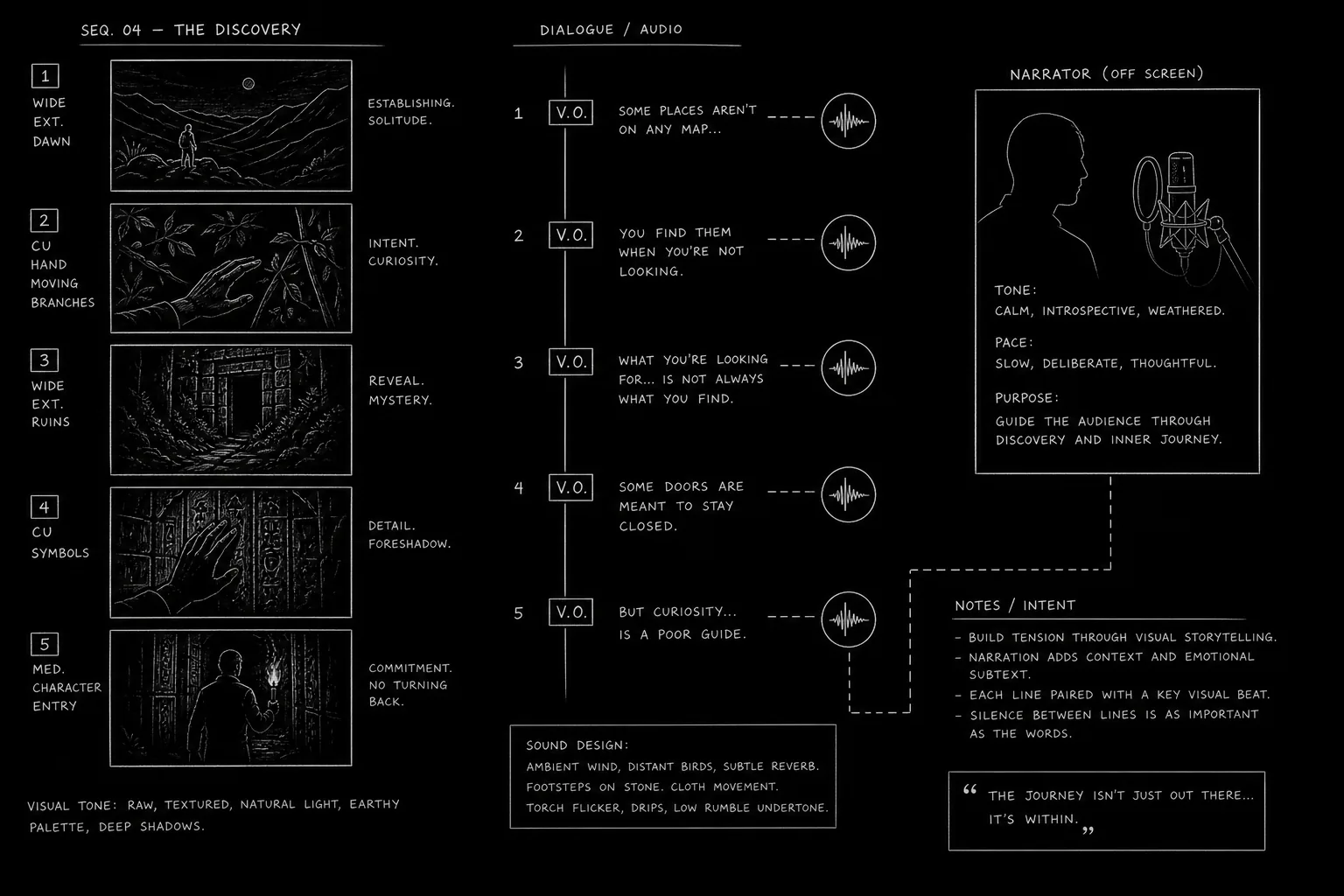
If your project leans on narration, the standards for formatting voice-over and narration in a screenplay still apply, and a properly formatted V.O. script doubles as your generation manifest: every line numbered, every speaker tagged, nothing improvised at the keyboard.
Direct the read like an ADR session
Here's the mental shift that improves synthetic dialogue more than any tool choice: stop treating generation as recording and start treating it as casting takes.
Film has done this for a century. In traditional dubbing and ADR, actors re-record dialogue in a studio, line by line, take after take, and an editor chooses performances and fits them to picture. Nobody accepts take one. The craft is in the selection.
Apply that directly. For every line that matters, generate four to eight takes. Vary the phrasing input slightly, punctuation changes alone will shift a read. Then listen like a dialogue editor, not like a customer: you're not asking "is this good enough," you're asking "which of these is the performance." Often the best result is a splice, the first half of take three cut to the last two words of take six.
Log your choices. A simple sheet per scene, line number, chosen take, and why, keeps a long project consistent and gives you something to hand off if anyone else touches the edit. It's the same discipline that keeps faces stable across shots, which we cover in fixing character drift in AI video; voices drift too, and take selection is how you hold a character's sound steady across scenes generated weeks apart.
One more directing note. If a line refuses to work after eight takes, the line is the problem. Go back to the script and rewrite it shorter. That loop, script to takes to script, is normal, and it's the loop described in our full AI filmmaking workflow from script to screen.
Put the voice in the room
A chosen take is still a dry take. The single biggest upgrade available to most AI films costs nothing and takes an afternoon: make the voice exist in the same space as the image.
Room tone first. Every real location has a noise floor. Lay a bed of subtle ambience under the entire scene, and let it continue under and between the dialogue lines, including across the cuts: that continuous bed is the first pass in the full AI film sound workflow for exactly this reason. Silence between lines is the loudest tell there is.
Match the reverb to the shot. A voice in a tiled bathroom, a car, and a field are three different acoustic events. Small amounts of the right reverb read as "this person is here." A generic polish reverb reads as a podcast.
Mix under and behind, not on top. Let the score push dialogue down slightly in wide shots. Let a door slam eat the front of a word. Perfect audibility of every syllable is a tell; real film sound is a negotiated space where dialogue wins most battles but visibly fights them.
Add the human debris. A breath before the first line of a scene. A small exhale after a hard line. These can come from a library or from you leaning into a microphone; the ear accepts them instantly and credits the whole performance.
Try it free
Try Screenweaver for free on your script
It is free. Import your existing project, get a clearer view of your outline, and regain control of your story structure in minutes.
Start FreeLip sync is its own pass
If you take one thing from this section: never trust the sync a generator hands you. Treat it the way an editor treats ADR, as a dedicated pass with its own quality bar.
The best way to sync AI voice to video is to lock picture first, conform audio to picture second, and verify on consonants third. Working in the other direction, regenerating video until the mouth happens to match, burns credits and never fully locks.
Check sync at the plosives. B, P, and M require closed lips, so scrub frame by frame on those consonants; if lips are closed when the sound fires, the shot passes. Vowels are forgiving, closures aren't.
Nudge in frames, not feelings. Dialogue that's one to two frames early usually reads fine; late sync reads dubbed almost immediately. Slide the clip, don't stretch it, and recheck.
Use cutaways honestly. If a line will not lock, put it over the listener's reaction. Films have hidden imperfect sync this way forever, and it also buys you freedom to use a better vocal take that doesn't quite fit the mouth.
Budget for this pass. Sync work is slow, a few seconds of screen time per pass. Tools that generate speech and mouth movement together help, and the current options are surveyed in script-to-video AI tools compared for 2026, but every pipeline I've tested still needs a human verification pass on the plosives.
The pre-mix checklist
Run this before you call any dialogue scene finished. It's ten minutes per scene and it catches nearly everything above.
- Every line chosen from multiple takes, not the first render
- Breath before scene-opening lines and after emotionally heavy ones
- Room tone bed continuous under the full scene, including gaps between lines
- Reverb matched to the visible space, and changed when the location changes
- Dialogue level varies with shot size instead of sitting at one constant loudness
- Levels matched line to line, so spliced takes don't jump
- Sync verified frame by frame on every B, P, and M closure
- No late sync anywhere; early by a frame is acceptable, late is not
- Unfixable sync lines moved to reactions or off-screen
- Full scene reviewed once with eyes closed, listening only
That last item sounds odd and finds the most problems. With the picture gone, flat reads and missing air become impossible to ignore.
Know when to record a human instead
Some lines shouldn't be synthesized, and the honest workflow plans for that from day one.
The dividing line is emotional load. Functional dialogue, exposition, banter, orders shouted in action scenes, passes synthesis fine with the treatment above. A protagonist carrying the emotional climax of your film mostly doesn't, because that scene lives on micro-choices, a crack on one word, a breath held too long, that generation can't yet make on purpose.
So split your cast on paper before production. Supporting and functional roles: synthetic, directed through takes. The one or two performances the film actually rests on: a human actor and a decent microphone, even if it's you in a blanket fort. A hybrid dialogue track, human leads over synthetic support, is standard practice among the AI films that hold up, and it's how the budget stays sane. Where that decision sits in the larger production plan is mapped in the complete guide to making an AI film.
Close your eyes and play your rough cut. Wherever you stop believing someone is in the room, that's your work list.
FAQ
Why do AI voices sound fake in films?
The tells are prosodic and spatial, not technical. Synthetic voices deliver flat, evenly weighted emphasis, skip the breaths humans take before and during speech, and arrive with no room acoustics, so the character sounds like they're nowhere. Mixing the voice at a constant level on top of the scene, instead of inside it, completes the effect.
What is the best way to sync AI voice to video?
Lock picture first, then conform the audio to it, then verify frame by frame on plosives: B, P, and M require closed lips, so those are your checkpoints. Slide clips by frames rather than stretching them, accept sync that's a frame early but never late, and move genuinely unfixable lines onto a listener's reaction shot.
Should I generate multiple takes of each AI voice line?
Yes, four to eight takes for any line that matters, then choose and splice like a dialogue editor working an ADR session. Vary punctuation and phrasing between takes to push different reads. Accepting the first render is the single most common mistake in AI film dialogue, and take selection is the cheapest fix available.
How do I make an AI voice sit in the mix?
Lay continuous room tone under the whole scene, match reverb to the visible space, and let the dialogue level move with shot size instead of holding one loudness. Add breaths at scene openings and after heavy lines. Then review the scene once with your eyes closed; dry, placeless audio is obvious the moment the picture stops helping it.
When should I use a real actor instead of an AI voice?
When the line carries the film's emotional weight. Functional dialogue and supporting roles survive synthesis with good direction, but a protagonist's climactic scene depends on deliberate micro-choices that generators can't make on purpose yet. Most solid AI films run a hybrid track: human leads, synthetic support, planned that way from the script stage.
Does better writing actually improve AI voice performance?
More than any other single factor. Lines under fifteen words give the generator one clear intention, which is what it can execute. Long emotional monologues fail because they require a shifting performance arc. Breaking speeches into exchanges, writing intention into the words themselves, and keeping hard consonants for sync anchors all pay off downstream.
Final Step
Build your next script with Screenweaver
Move from ideas to production-ready pages faster with timeline-native writing and AI-assisted story flow.
Try Screenweaver