
Yes, you have to declare it, and in 2026 the declaration mostly happens without you. YouTube requires a disclosure toggle for realistic generated content. TikTok and Meta read provenance metadata and label your upload automatically. The label itself does not cost you reach. What costs you is failing to disclose, or publishing at a volume the platforms read as mass production.
This is the compliance half of where to publish your AI film. Get it right once and it stops being a consideration.
The shift that caught people out
Until recently, disclosure was an honour system. You ticked a box or you did not. Through 2025 and 2026 the major platforms moved to detection: they read the Content Credentials embedded by the generation tools and apply the label whether or not you declared anything.
That flips the calculation. Not disclosing no longer means going unlabelled. It means being labelled anyway, by a system that also logs that you did not say so.
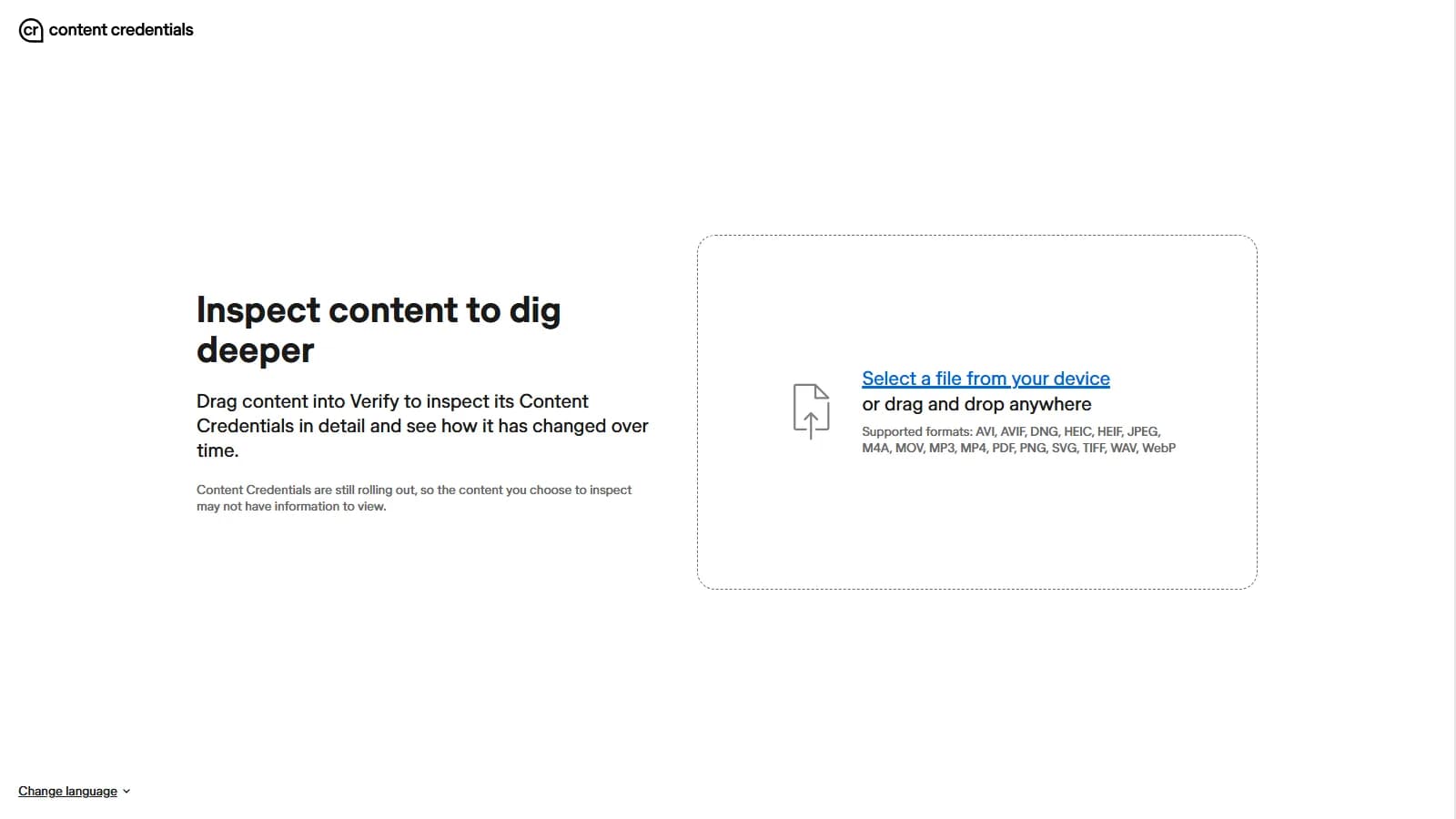
The Content Credentials Verify tool, captured 8 September 2026. The metadata travels inside the file, which is how platforms label uploads without asking you.
Content Credentials, the C2PA standard, is what most major generation tools now write into their output. Adobe, Google, OpenAI, Microsoft and others attach it. TikTok has been reading it and applying automatic labels at a scale it counts in billions of videos. Meta uses the same industry signals across Facebook, Instagram and Threads.
YouTube: the toggle and the policy
YouTube's rule is narrower than most people assume. It applies to realism, not to AI use in general.
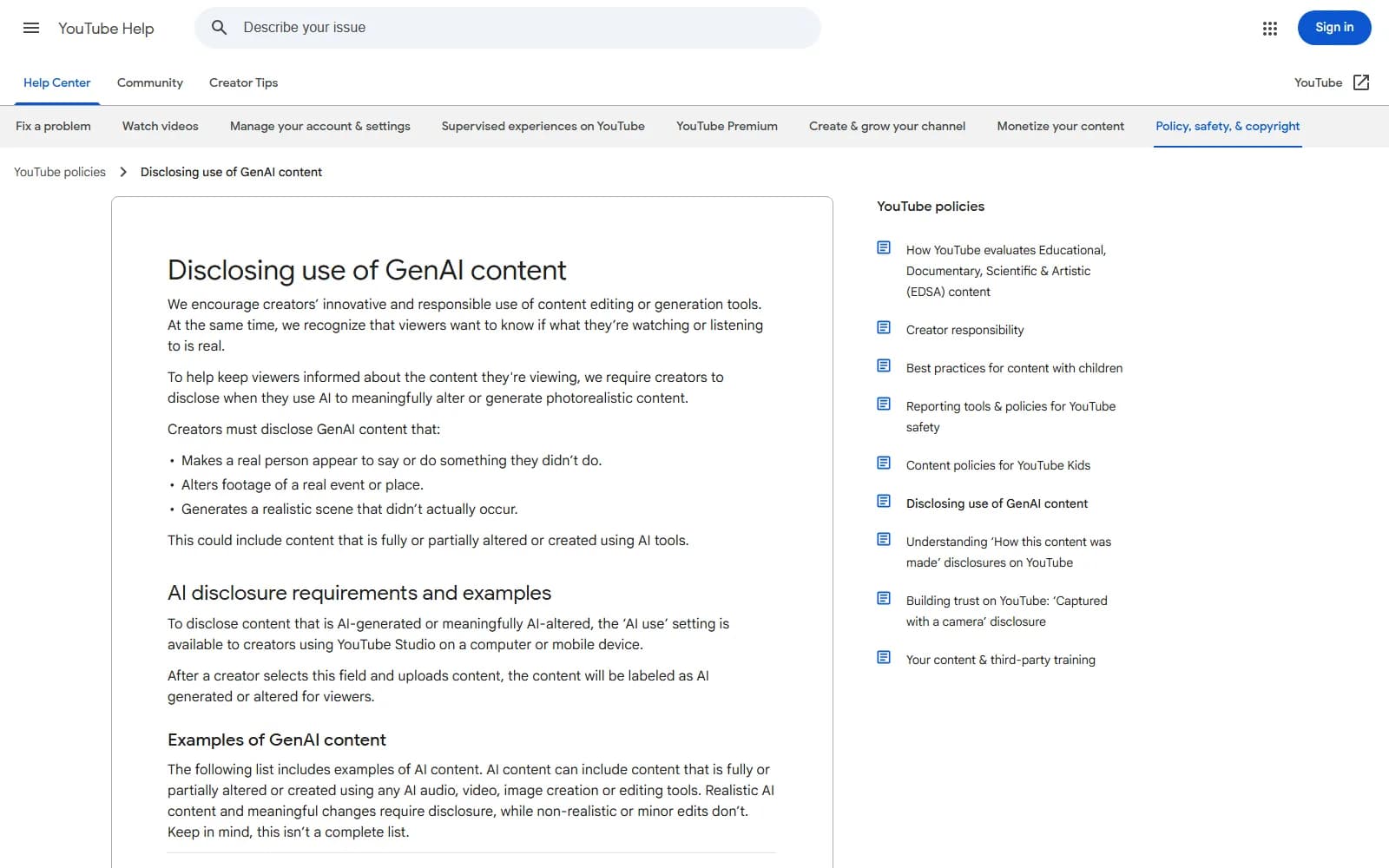
YouTube's official GenAI disclosure page, captured 8 September 2026.
You must disclose when your content makes a real person appear to say or do something they did not do, alters footage of a real event or place, or generates a realistic scene that did not actually occur. The setting is the "AI use" field in YouTube Studio at upload, on desktop or mobile. Select it, and viewers see an altered or synthetic content label.
Two things that are not required: disclosure for obviously unreal or stylised work, and disclosure for AI in the writing or editing process. A generated animated fantasy short does not trigger it. A photoreal drama set in a real city does.
Documentary is where this rule bites hardest, because a reconstruction is by definition a realistic scene that did not occur, set in a real place. The platform label is only the floor there: AI in documentaries and how to use reconstructions without losing trust ranks the five uses of AI by risk and turns the Archival Producers Alliance guidance into a disclosure checklist you can run before release.
The second YouTube rule is the one that actually removes people from the Partner Programme. In July 2025 the platform renamed its repetitious content policy to inauthentic content. It targets mass-produced, templated, repetitive uploads. Enforcement runs as strikes: a warning, then a suspension, then removal from monetisation. The tools are not the problem. Forty near-identical uploads a week is.
TikTok, Instagram and Facebook
| Platform | Who applies the label | What triggers it |
|---|---|---|
| YouTube | You, in Studio | Realistic generated or altered content |
| TikTok | Automatic, plus your toggle | Provenance metadata, watermarks, detection models |
| Instagram, Facebook | Automatic, plus your toggle | Shared industry signals in C2PA and IPTC |
TikTok requires visible labelling on AI visuals and audio depicting realistic people or scenes, and applies labels itself when it detects them. Text workflows such as script writing and hashtag generation are exempt, which is worth knowing if you used a model to draft the screenplay but shot or generated the images another way.
Meta's organic posts use a creator toggle, and Meta applies its own label automatically when shared industry signals flag photorealistic AI video, audio or images. Instagram has since gone further at the account level, adding a label for AI-generated profiles and reducing the reach of accounts that do not declare themselves. That penalty attaches to undeclared AI personas, not to a filmmaker posting a generated short from their own account.
Try it free
Try Screenweaver for free on your script
It is free. Import your existing project, get a clearer view of your outline, and regain control of your story structure in minutes.
Start FreeFestivals want more than a label
Platform disclosure is a toggle. Festival disclosure is a document.
The Astana AI Film Festival required entrants to credit every contributor and disclose their AI models and pipeline, and it required generative AI to be integral to the film rather than used only for VFX or upscaling. Curated venues ask for the primary tool on the submission form. Both directions are converging on the same demand: an account of how the film was made.
So keep the record while you produce it. A short pipeline note takes ten minutes during production and an afternoon to reconstruct later.
- Which model generated the images, and which version.
- What handled voice, music and sound.
- Which shots came from live-action plates or stock, if any.
- Who the human contributors were, and what each did.
- Whether any real person, place or event is depicted realistically.
That last line is the one that decides your YouTube toggle, so answering it during production saves you guessing at upload.
The disclosure does not hurt you
The persistent worry is that the label suppresses reach. On YouTube, properly disclosed content faces no distribution or monetisation penalty; the label is a transparency signal, not a ranking input. Reach problems on AI work almost always trace to something else: no story, a weak first ten seconds, or an upload pattern that looks templated.
Which is the honest summary of the whole compliance question. Tick the box, keep your pipeline notes, publish less and better. The rules punish volume without authorship, and they leave a single well-made film alone. Labelling is also a separate track from ownership, which copyright of AI films untangles. The real cost of an AI film makes the same case from the budget side, and the Netflix of AI films shows why the platforms that pay reward one strong entry over twelve weak ones.
FAQ
Do I have to disclose AI on YouTube?
Only for realistic content: a real person appearing to say or do something they did not, altered footage of a real event or place, or a realistic scene that never happened. Stylised or obviously unreal work does not require the toggle, and AI used in writing or editing does not either.
Does the AI label reduce my views or block monetisation?
No. YouTube treats a proper disclosure as a transparency signal with no effect on distribution or monetisation. Removal from the Partner Programme comes from the inauthentic content policy, which targets mass-produced repetitive uploads.
What happens if I do not disclose?
The platform is likely to label the upload anyway from the provenance metadata, and repeat non-disclosure can lead to content removal or loss of Partner Programme access.
What are Content Credentials?
The C2PA provenance standard. Major generation tools embed it in the exported file, and TikTok, Meta and others read it to apply AI labels automatically. You can inspect any file yourself with the Content Credentials Verify tool.
Do film festivals require AI disclosure?
Increasingly yes, and in more detail than platforms. Astana required models, pipeline and full contributor credits. Keep that list from the first day of production.
Final Step
Build your next script with Screenweaver
Move from ideas to production-ready pages faster with timeline-native writing and AI-assisted story flow.
Try Screenweaver