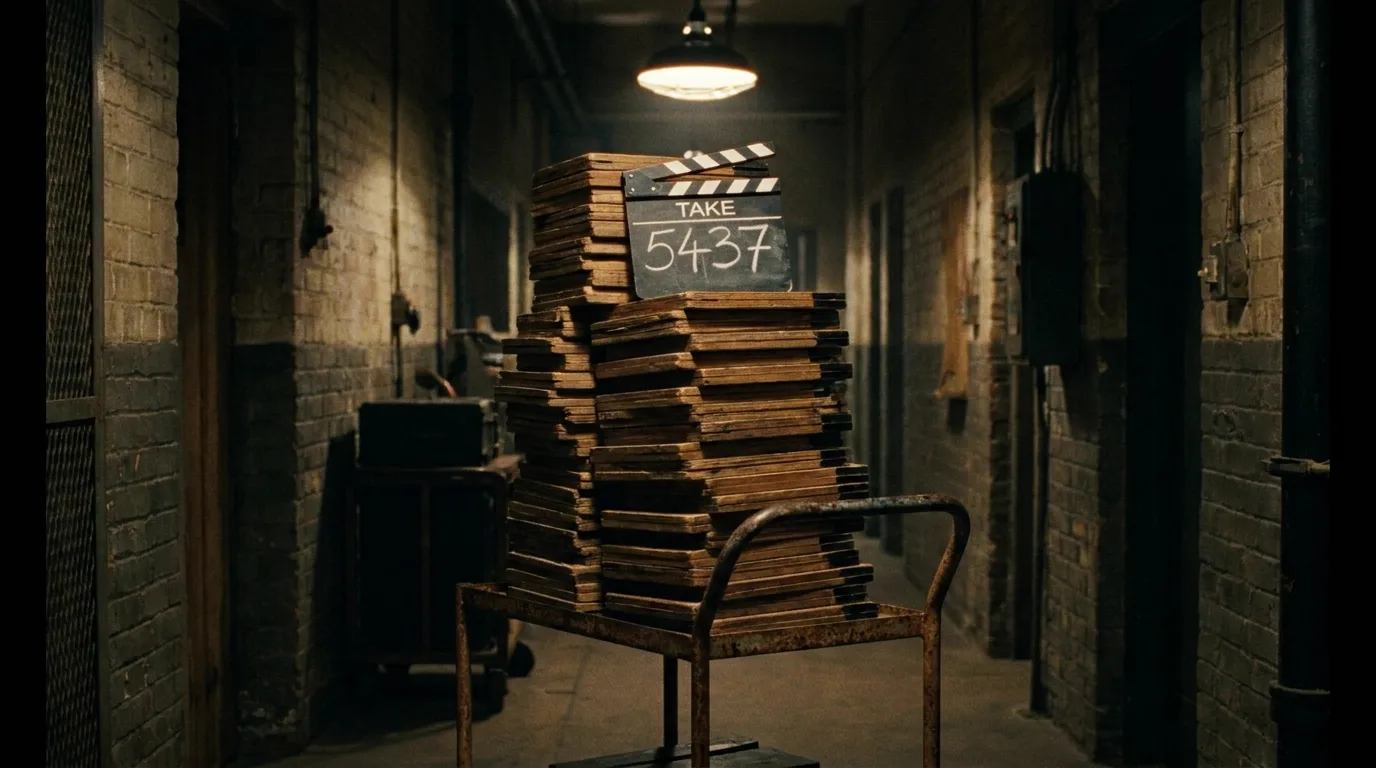

An AI film costs whatever your subscription costs, multiplied by how many takes you burn per usable shot. The subscription is the floor. Rerolls are the real bill. A 30-shot short at eight takes per shot needs 240 generations; at two takes it needs 60. That multiplier, not the tool, decides your budget.
The subscription is not the number that matters
Ask what an AI film costs and most answers point you at a pricing page. Wrong page. The pricing page tells you the floor, meaning what you pay to walk in the door each month. It says nothing about the variable that actually sets your budget, which is how many times you press generate before a shot is usable.
Every serious video platform prices the same basic shape, whatever the labels say. A subscription buys a monthly allowance of credits or seconds. Top-up packs sit above that. Some tools meter per second of output, some throttle you into a slower queue once you've generated a lot, some cap resolution until you pay more. I went through the structures one by one in my script-to-video tools comparison, and the pattern holds everywhere: the floor is fixed, the consumption is not.
Consumption is where films die. No single take feels expensive. The multiplication is what gets you. You reroll a shot four times before lunch and think nothing of it, then you do that across thirty shots, and the film quietly costs five times what you planned. I've watched my own credit balance do this. It never happens in one dramatic burn. It happens eleven takes at a time.
A cost model you can apply to any tool
The model fits on an index card:
Total cost = subscription floor + (shots x takes per usable shot x cost per take)
Three of those four numbers are easy. Shots you count from your shot list. The floor is on the pricing page, and the full AI film production cost breakdown prices that floor line by line, board to festival fees, from the pages themselves. Cost per take you can work out from whatever structure your tool uses, credits per generation, seconds per clip, whatever; if your tool sells credits rather than seconds, what one AI video credit actually buys shows the conversion tier by tier. A calculator for AI video generation costs runs the same formula against current model pricing so you can compare platforms on your own shot count.
The middle term, takes per usable shot, is the one nobody publishes. It's also the entire game. If any of the units in that formula are unfamiliar, the AI filmmaking glossary defines burn rate, allowance and metered rate alongside the rest of the billing vocabulary.
Why does the multiplier exist at all? Because a text-to-video model samples from noise on every run. Two generations from the same prompt come back different. That variance is the product, and it's also the bill. You aren't paying for a render. You're paying for a lottery ticket, and preparation is how you shorten the odds.
From the shape of the workflow, the spread looks like this: an unprepared session, where you improvise prompts and judge results on vibes, tends to burn somewhere in the range of 5 to 10 takes per usable shot. A prepared session, with locked character references, a storyboard, and a shot list, lands far lower. Treat those as illustrative brackets, not measured statistics. Your numbers will differ. The gap between the two modes will not. If you want to see the prepared mode laid out as a week, the seven-day production log caps every shot at three takes and logs the count daily.
Where rerolls actually come from
Rerolls feel random. They aren't. Almost every wasted take traces back to one of three decisions you skipped.
Re-described characters. If your protagonist exists only as a sentence in each prompt, the model reinvents her face every generation, and you reroll until the reinvention happens to match your memory of take one. This is the single biggest credit leak I know, and it's why I wrote a whole piece on character drift and how to stop it. A locked reference image turns an open-ended lottery into a much smaller one.
No framing decisions. Prompt a scene without specifying shot size, angle, or lens feel, and you've asked the model to direct your film. It will, differently every time. You then spend takes discovering what you wanted instead of fixing errors. That discovery is legitimate creative work. Doing it at the most expensive stage of the pipeline is the mistake.
Fixing story problems at the generation stage. This one hurts the most. You generate a scene, feel that it's flat, and start rerolling variations hoping one lands. The scene isn't flat because of the render. It's flat because of the writing, and no number of takes fixes a script problem. Rewriting a beat in your screenplay costs nothing. Rewriting it through the generate button costs a credit pack. The cheapest guard against this is a proper dailies review of the takes you already have, where every reroll has to be justified by a named defect.
A worked example: one short, two sessions
Let's put numbers on it. Everything below is an invented, illustrative scenario, a made-up but typical shape, not pricing from any real tool. Assume a 3-minute short, 30 shots, and call the cost of one take 1 unit, whatever a unit means on your platform.
Scenario A, prompt-only improvisation. No references, no boards, prompts written at the keyboard. Assume 8 takes per usable shot, mid-range for an unprepared session.
Scenario B, prepared. Locked character references, a storyboard frame per shot, a shot list with framing and motion noted. Assume 2.5 takes per usable shot.
| Line item | Scenario A: improvised | Scenario B: prepared |
|---|---|---|
| Shots | 30 | 30 |
| Takes per usable shot (assumed) | 8 | 2.5 |
| Total takes | 240 | 75 |
| Generation cost at 1 unit per take | 240 units | 75 units |
| Subscription floor (assumed) | 1 month | 1 month |
| Prep time | ~0 hours | assume 6 to 8 hours |
Same film. Same tool. One version costs more than three times the other in generation spend, and the only difference is where the decisions got made. Scenario B also finishes sooner in calendar time, because 75 takes clear the queue faster than 240, and because you're not staring at outputs wondering what you meant.
Notice what the prep actually bought. Those 6 to 8 hours produced the boards and references, and boards are cheap or free to make. If your generation budget is zero rather than small, this math stops being about savings and becomes survival; on free tiers the multiplier is a wall, which is the core argument of my guide to free AI filmmaking without a GPU.
Try it free
Try Screenweaver for free on your script
It is free. Import your existing project, get a clearer view of your outline, and regain control of your story structure in minutes.
Start FreeEvery decision upstream of the generate button is nearly free
That's the whole principle, and it deserves to be said plainly: every decision you move upstream of generation costs almost nothing, and every decision you make by rerolling costs credits.
Deciding a shot is a close-up costs one line in a shot list. Discovering it should have been a close-up costs three takes. Fixing a limp scene costs twenty minutes in your screenplay. Fixing it through variations costs a night of generations, and it usually doesn't work. The economics are lopsided enough that prep stops being a virtue and becomes the cheap option.
This is why I keep banging on the storyboard-first workflow. A board is a cheap rehearsal of an expensive decision. You get to be wrong about framing, blocking, and continuity at the still-image stage, where being wrong costs pennies or nothing, instead of at the video stage, where being wrong costs the most expensive takes in your pipeline.
Model choice belongs upstream too. Different models fail differently, and sending a dialogue close-up to a model that's strong on scenery but weak on faces is a reroll factory. Match the shot type to the model before you spend, using something like my Seedance 2 vs Veo 3 vs Sora 2 breakdown as a starting map. And if you want the full pipeline from blank page to finished film, the complete walkthrough lives at how to make an AI film.
The pre-generation lockdown checklist
Run this before your first paid take. Every unchecked box is a reroll you've pre-ordered.
- The screenplay is finished and read aloud once. No known story problems remain.
- Every recurring character has a locked reference image, reused in every prompt, never re-described from scratch.
- Every recurring location has a reference image too. Locations drift like faces do.
- A storyboard frame exists for every shot, even a rough one.
- A shot list specifies shot size, angle, and camera motion for each shot.
- Each shot is matched to a model based on what that model is good at.
- You've set a take cap per shot (say, 4) and a rule for what happens when you hit it: move on, fix upstream, come back.
- You know your total take budget for the session before you start, not after.
The take cap matters more than it looks. Without one, a stubborn shot becomes a sunk-cost spiral, and one bad shot can eat the budget of ten good ones. With a cap, a shot that won't land after four takes gets flagged as an upstream problem, which is almost always what it was.
Everything above happens before you generate. The leaks on the other side of the button, resolution tiers, generated audio you later mute, per-generation minimums and speculative upscales, are a separate list, and I ranked them in the ten mistakes that burn credits fastest.
One line in that budget is worth planning for early: the festivals with real prize funds are free to enter, and where to publish your AI film covers which routes pay back and in what currency.
FAQ
How much does it cost to make an AI film?
There's no single number, because the dominant cost isn't the subscription, it's your reroll multiplier. The model is: subscription floor + (shots x takes per usable shot x cost per take). A prepared 30-shot short might need 60 to 90 generations, while an improvised one can need several hundred. Work out your tool's cost per take, then your preparation level sets everything else.
Why do AI films cost more than the subscription price suggests?
Because video models are probabilistic, so every generation is a sample, not a render. You pay per attempt, and unusable attempts cost exactly the same as keepers. Pricing pages show the floor, while your take multiplier, which nobody publishes, determines the real total.
How many takes per usable shot is normal?
Preparation sets that number almost single-handedly, and any precise figure you read is someone's anecdote, including mine. As an illustrative bracket drawn from the workflow itself: improvised prompting tends toward 5 to 10 takes per usable shot, while locked references plus a storyboard and shot list pull that down sharply. Track your own ratio for one session. It's the most useful production number you'll own.
Do storyboards really lower the cost of an AI film?
Yes, because they move framing and continuity decisions to a stage where mistakes are nearly free. A board lets you be wrong at the still-image stage instead of the video stage. You'll still reroll, but you'll reroll to polish a decision, not to discover one, and those are very different multipliers.
Is a more expensive model actually cheaper overall?
Sometimes. A model with a higher cost per take but a stronger hit rate on your specific shot type can beat a cheap model you have to reroll constantly. Compare cost per usable shot, not cost per take. That means knowing each model's strengths before you spend, not after.
Can I make an AI film without spending anything?
You can get surprisingly far on free browser tools, but the tolls come as watermarks, queues, caps, and very scarce generations instead of invoices. Scarcity makes the reroll math brutal, since you can't afford wasted takes at all. Planning stops being good practice and becomes the whole method.
Final Step
Build your next script with Screenweaver
Move from ideas to production-ready pages faster with timeline-native writing and AI-assisted story flow.
Try Screenweaver