
A credit is not a fixed amount of video. It is a platform currency, and its price moves with your plan tier. Runway charges $0.0192 per credit on annual Standard and $0.0080 on annual Max. Same model, same credits burned per second, 2.4 times the cash. Convert to dollars per second before you plan.
Every platform mints its own currency
Credits do not convert between tools, and they rarely hold the same value between tiers of one tool. So the number printed on the pricing card tells you almost nothing by itself. Two thousand credits is a meaningless quantity until you know what a credit costs you and how many of them a second of output consumes.
This matters more than model choice for most people making their first film. I covered the dollar side of a full production in the AI film production cost breakdown, and the reroll multiplier that moves it in the reroll math piece. Both of those articles work in dollars, because dollars compare. This one works backwards from the credit, because that is the unit you actually see when you subscribe, and it is the unit that hides the price. For the wider production picture, the AI filmmaking guide hub is the place to start.
Three numbers turn any credit bundle into something comparable. Your cost per credit, which is the plan price divided by the credits included at the billing period you will actually pay. The credits per second of the model you will actually use, which platforms publish and which moves with resolution. And the product of the two, your cost per second, which is the only figure worth writing down.
Everything below is that arithmetic, run on two platforms that publish enough to check it.
Runway sells the same credit at four prices
Runway is the clearest case because it publishes both halves of the equation. Gen-4.5 costs 60 credits per five-second clip, which is 12 credits per second. That rate is identical across every plan and identical on the developer API. The credits burn the same. What changes is what you paid for them.
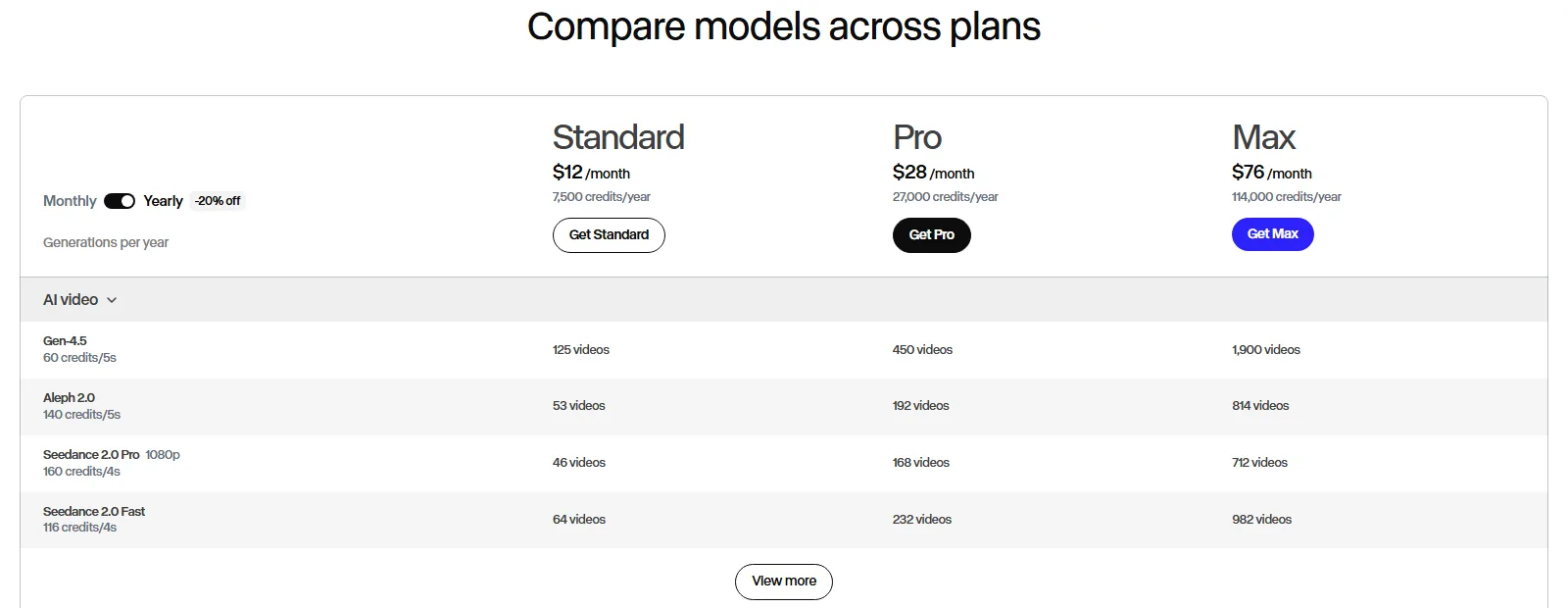
Runway's per-model credit rates and annual credit allowances, captured 25 September 2026.
Annual billing, converted:
| Plan | Cash per year | Credits per year | Cost per credit | Gen-4.5 per second | Monthly allowance, in Gen-4.5 seconds |
|---|---|---|---|---|---|
| Standard, $12/mo | $144 | 7,500 | $0.0192 | $0.230 | 52s |
| Pro, $28/mo | $336 | 27,000 | $0.0124 | $0.149 | 187s |
| Max, $76/mo | $912 | 114,000 | $0.0080 | $0.096 | 792s |
| Developer API | pay as you go | $0.01 flat | $0.0100 | $0.120 | uncapped |
Read the fourth column first. The same credit, buying the same model at the same burn rate, costs between eight tenths of a cent and nearly two cents depending on which box you ticked at checkout. Runway's own developer pricing page sells API credits at a flat cent, which means the entry subscription is nearly double the API rate while the top subscription undercuts it by a fifth.
Then read the last column, which is the one that ruins schedules. Standard's 625 monthly credits buy 52 seconds of Gen-4.5. Not 52 seconds of finished film. Fifty-two seconds of generation, takes included. That plan cannot produce a one-minute video in a month, and nothing on the pricing card says so.
Monthly billing is worse again. Standard lists at $15 without the annual discount, which pushes the credit to $0.024 and Gen-4.5 to $0.288 per second, or 2.4 times what the API charges for the identical output.
The conversion that makes any plan comparable
The formula is short enough to keep in your head:
Cost per second = (plan price / credits included) x (credits per second)
Then size the job:
Seconds of generation = shots x clip length x takes per kept shot
The second number is where people underestimate. It is not your finished runtime. A 90-second ad cut from 18 shots of five seconds needs 90 seconds of keepers, and at three takes per kept shot it needs 270 seconds of generation. Three times the film, before anyone asks for a change.
Our AI video cost calculator runs both formulas against a dataset of September 2026 API rates, so you can sanity-check a credit bundle against the metered price of the same model. If the bundle loses badly, that is a real signal and not a rounding error.
Higgsfield runs the same mechanic in euros
Two platforms is not a survey, but when the second one behaves like the first, the pattern is structural rather than a quirk of one pricing team.
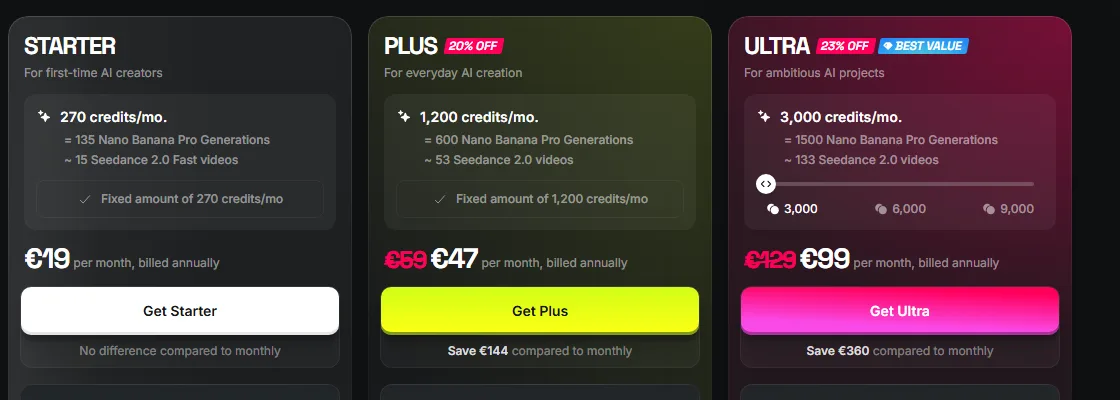
Higgsfield's individual plans, captured 25 September 2026 from a French IP, so prices display in euros.
| Plan, billed annually | Credits per month | Cost per credit | Seedance 2.0 720p per second | Monthly allowance, in seconds |
|---|---|---|---|---|
| Starter, €19 | 270 | €0.0704 | locked | locked |
| Plus, €47 | 1,200 | €0.0392 | €0.172 | 273s |
| Ultra, €99 | 3,000 | €0.0330 | €0.145 | 682s |
Starter costs 2.1 times more per credit than Ultra, which is the same shape as Runway's 2.4. But look at the "locked" row, because it is the part the arithmetic misses. Higgsfield's comparison table marks Seedance 2.0 at 720p and 1080p as unavailable on Starter and on Free. The cheapest tier carries the worst exchange rate and the shortest model list at once. It is restricted to the Fast and Mini variants, which are cheaper per clip but are not the models you saw in the marketing.
That combination is common enough to plan around. Entry tiers exist to be upgraded from.
One 90-second ad, priced on five plans
Same brief on both platforms. Eighteen shots, five seconds each, three takes per kept shot. That is 54 clips and 270 seconds of generation.
On Runway with Gen-4.5, at 12 credits per second, the job needs 3,240 credits.
| Plan | Credits needed | Cash value of those credits | Months of allowance consumed |
|---|---|---|---|
| Standard | 3,240 | $62.21 | 5.2 |
| Pro | 3,240 | $40.32 | 1.4 |
| Max | 3,240 | $25.92 | 0.3 |
On Higgsfield with Seedance 2.0 at 720p, at 22 credits per five-second clip, the job needs 1,188 credits.
| Plan | Credits needed | Cash value of those credits | Months of allowance consumed |
|---|---|---|---|
| Plus | 1,188 | €46.53 | 0.99 |
| Ultra | 1,188 | €39.20 | 0.40 |
Two things fall out. The cash spread between the cheapest and dearest way to buy the same Runway output is $36 on a single ad, which is more than two months of the Standard subscription. And Runway's Standard plan needs five months of allowance to deliver one 90-second commercial, which means the decision was never really about price. It was about whether the plan can do the job at all.
Higgsfield's Plus lands at 99% of a monthly allowance, which looks like a fit and is in fact a trap. One round of client notes and you are buying top-ups at the retail rate.
Try it free
Try Screenweaver for free on your script
It is free. Import your existing project, get a clearer view of your outline, and regain control of your story structure in minutes.
Start FreeWhat the headline credit number leaves out
Five multipliers sit behind the number on the card, and none of them appear in it.
Resolution is the big one. Seedance 2.0 costs 22 credits per five seconds at 720p and about 45 at 1080p, so delivering HD roughly doubles the bill. You will usually work that out after you have already picked the plan. Audio behaves the same way: several models charge separately for native sound, or double the rate when it is on, so a film priced silent gets a surprise line at the mix.
Then there is the model tier inside your own subscription. Premium options burn several times the credits of the house model on the same plan. Runway's Aleph 2.0 runs 140 credits per five seconds against Gen-4.5's 60, and nothing stops you from reaching for it on a Tuesday afternoon.
The last two are about time rather than output. Runway rolls unused credits over for one month, but only on Max; most allowances vanish at the period boundary, which punishes exactly the stop-start schedule that solo production actually has. And the credits you buy mid-month to cover the gap almost never carry your plan's exchange rate. That top-up spread is the entire business model of the entry tier.
None of this is hidden, exactly. It is spread across four pages while the number you remember sits on one.
Five checks before you subscribe
Run these in order. It takes about ten minutes and it is the cheapest ten minutes in the production.
- Divide, don't compare. Plan price / credits included = your cost per credit. Do it for every tier, including annual and monthly. Write the four numbers down.
- Find the credits-per-second for the model you will actually use, at the resolution you will actually deliver, with audio in the state you will actually ship.
- Multiply out your job. Shots x clip length x takes. Use three takes unless you have a reason to believe otherwise, and check that figure against your own history rather than the platform's example.
- Divide the job by the monthly allowance. If the answer is above 1, the plan cannot deliver your film in a month regardless of what it costs. Move up a tier or extend the schedule on purpose.
- Compare the winning tier against the metered API rate for the same model. If the subscription loses by more than about 30%, you are paying for the interface, and you should at least know that you chose to.
There is a sixth check I keep wanting to add to that list, and it does not belong there because it happens earlier. Most credits get spent deciding things that could have been decided on paper. The storyboard-first workflow is the cheapest budget tool in this whole article, and it costs nothing.
If you are still picking a platform rather than a plan, start from our guide to making an AI film instead. Plan arithmetic only pays off once you know which model you are committing to.
FAQ
How many credits does a one-minute AI video cost?
On Runway with Gen-4.5 at 12 credits per second, one finished minute at three takes per kept shot needs 180 seconds of generation, so 2,160 credits. On Higgsfield with Seedance 2.0 at 720p, the same job needs 792 credits. The two numbers are not comparable to each other. Convert both to your cost per second first.
Why do credits cost different amounts on different plans of the same platform?
Because the plan sets the exchange rate, and a credit only ever measures billing. Runway's credit is worth $0.0192 on annual Standard and $0.0080 on annual Max, a 2.4x spread for identical output. Higgsfield's runs €0.0704 on Starter against €0.0330 on Ultra. Volume discounting is normal; the unusual part is that the discount is invisible unless you divide.
Is the API cheaper than a subscription?
Sometimes, which is why you check rather than assume. Runway sells API credits at a flat $0.01, which beats annual Standard by nearly half and loses to annual Max by a fifth. The API also has no allowance to run out of, which for a schedule that moves is often worth more than the rate itself.
Do unused credits roll over?
Usually not. Runway rolls unused credits over for one month on the Max plan and states so on the plan card; the lower tiers do not. Treat any allowance as use-it-or-lose-it unless the plan explicitly says otherwise, and plan your generation weeks accordingly.
What is a realistic takes-per-shot number for budgeting?
Three is the honest planning figure for most people, which is what our calculator calls the typical profile. Disciplined work with locked references and a finished storyboard gets to about 1.5. Development work with no reference lock runs to five and beyond. The multiplier moves your budget more than the model does.
Should I buy the annual plan?
Only once you have run the fourth check above. Annual billing cuts the cost per credit meaningfully, Runway by 20% and Higgsfield by more on the upper tiers, but it locks you to one platform's credit for a year in a market where model rates changed several times in 2026. If you are not sure which tool you will still be using in six months, pay monthly and accept the worse rate as the price of the option.
Final Step
Build your next script with Screenweaver
Move from ideas to production-ready pages faster with timeline-native writing and AI-assisted story flow.
Try Screenweaver