
Four routes exist, and they pay in different currencies. YouTube gives you reach and, if you disclose properly, ad revenue. Curated AI showcases give you credibility. Vertical streaming apps give you a revenue split. Festivals give you cash and a jury. Pick by what you actually want back, because posting to all four at once can disqualify you from the one that mattered.
This is the distribution end of the AI filmmaking guide. If you are still in production, how to make an AI film covers the part before this one.
Decide what you want back first
Most people publish on instinct, upload to YouTube the day the render finishes, and then discover the festival they wanted required a premiere. Work backwards from the outcome instead.
| What you want | Where it comes from | What it costs you |
|---|---|---|
| Views and ad revenue | YouTube, TikTok, Reels | Nothing, but you burn premiere eligibility |
| A line on your credits | Curated AI showcases | A submission form, usually free |
| Prize money | AI film festivals | A deadline, sometimes an entry fee |
| A revenue split | Vertical AVOD apps | Non-exclusive licence, delivery specs |
| A meeting | Industry showcases and conferences | Travel, and a film good enough to screen |
The order matters more than the list. Festivals and showcases first, open platforms last, because the sequence only runs one way.
Route 1: the open platforms
YouTube is still the default, and in 2026 it comes with two rules worth knowing before you upload.
The first is disclosure. YouTube requires creators to flag content that makes a real person appear to say or do something they did not, alters footage of a real event or place, or generates a realistic scene that never happened. The setting sits in YouTube Studio at upload. Properly labelled work is not demoted, so the label is not the thing that hurts you.
The second is the inauthentic content policy, which YouTube renamed from "repetitious content" in July 2025. It does not ban AI tools. It bans mass-produced, templated uploads. A channel pumping out forty near-identical generated clips a week is the target. One crafted short is not.
TikTok and Reels are a different proposition. They will not host your seven-minute film, they will host the ninety seconds of it that works vertically. Cut a separate vertical piece rather than cropping the horizontal master, and expect an automatic AI label whether or not you add one. TikTok reads provenance metadata and applies labels at a scale it counts in billions of videos. The rules and the consequences are in AI film disclosure rules.
Vimeo remains the sensible portfolio link. No algorithm, no comments to moderate, a clean player, and a URL you can put in a submission form without a pre-roll ad in front of your first shot.
Route 2: curated showcases
These pay in credibility rather than money, and the bar is a human curator instead of a recommendation engine.
Watch AI Films runs the closest thing to an open door. Submissions are free and reviewed weekly, and you submit a link rather than a file: a YouTube, Vimeo, or X URL, plus the primary AI tool and the genre.
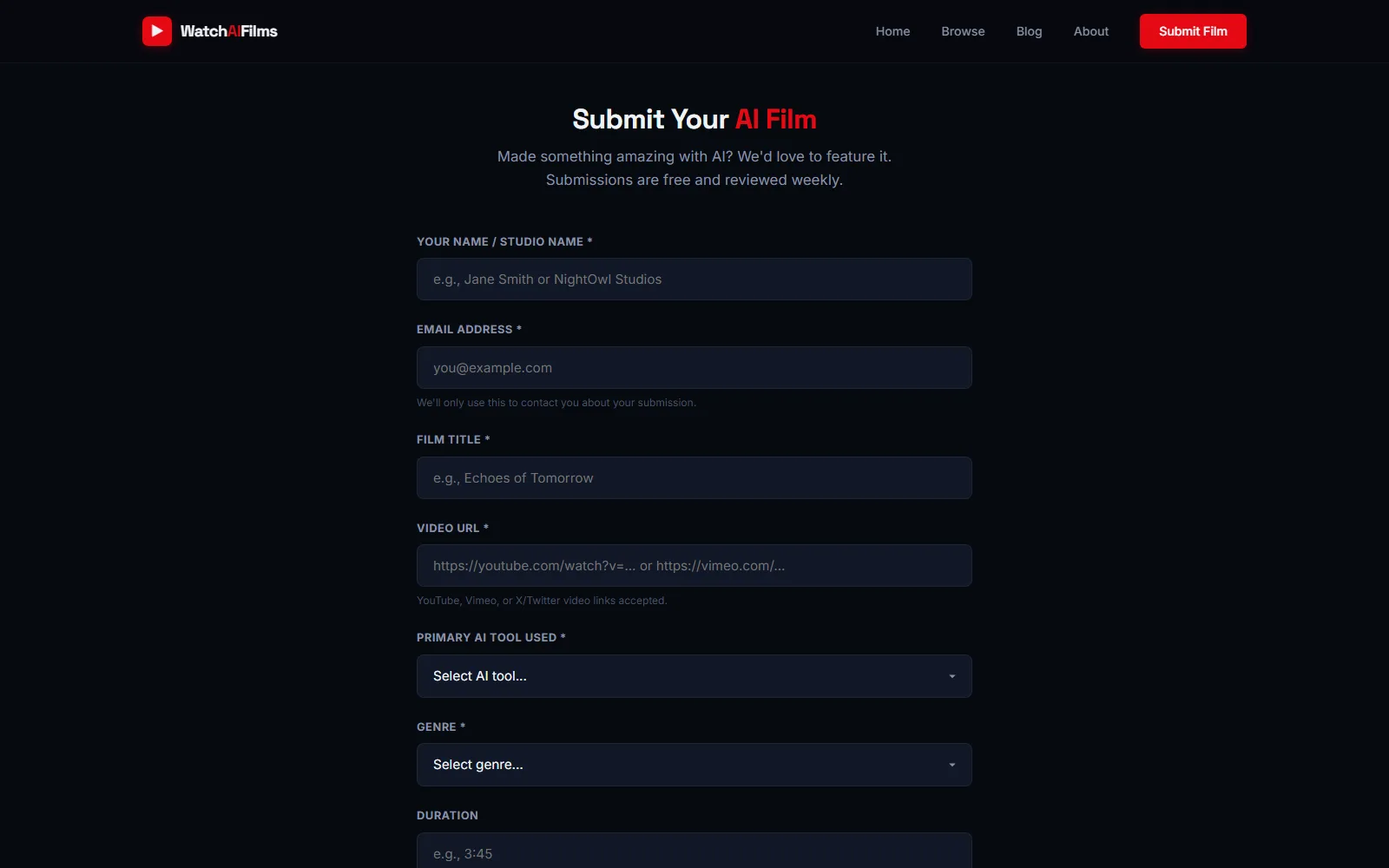
The Watch AI Films submission form, captured 8 September 2026. Note the field asking which model you used, which is becoming standard.
That field is the tell. Curated AI venues increasingly want your pipeline on the record, so keep a list of every model you touched while you are still in production. Reconstructing it four months later is miserable.
The AI Short Film Showcase at AI on the Lot is the step up. It is a curated screening programme that runs continuously through the conference at Culver Studios, in front of an audience of studio people and tool companies rather than a comment section.
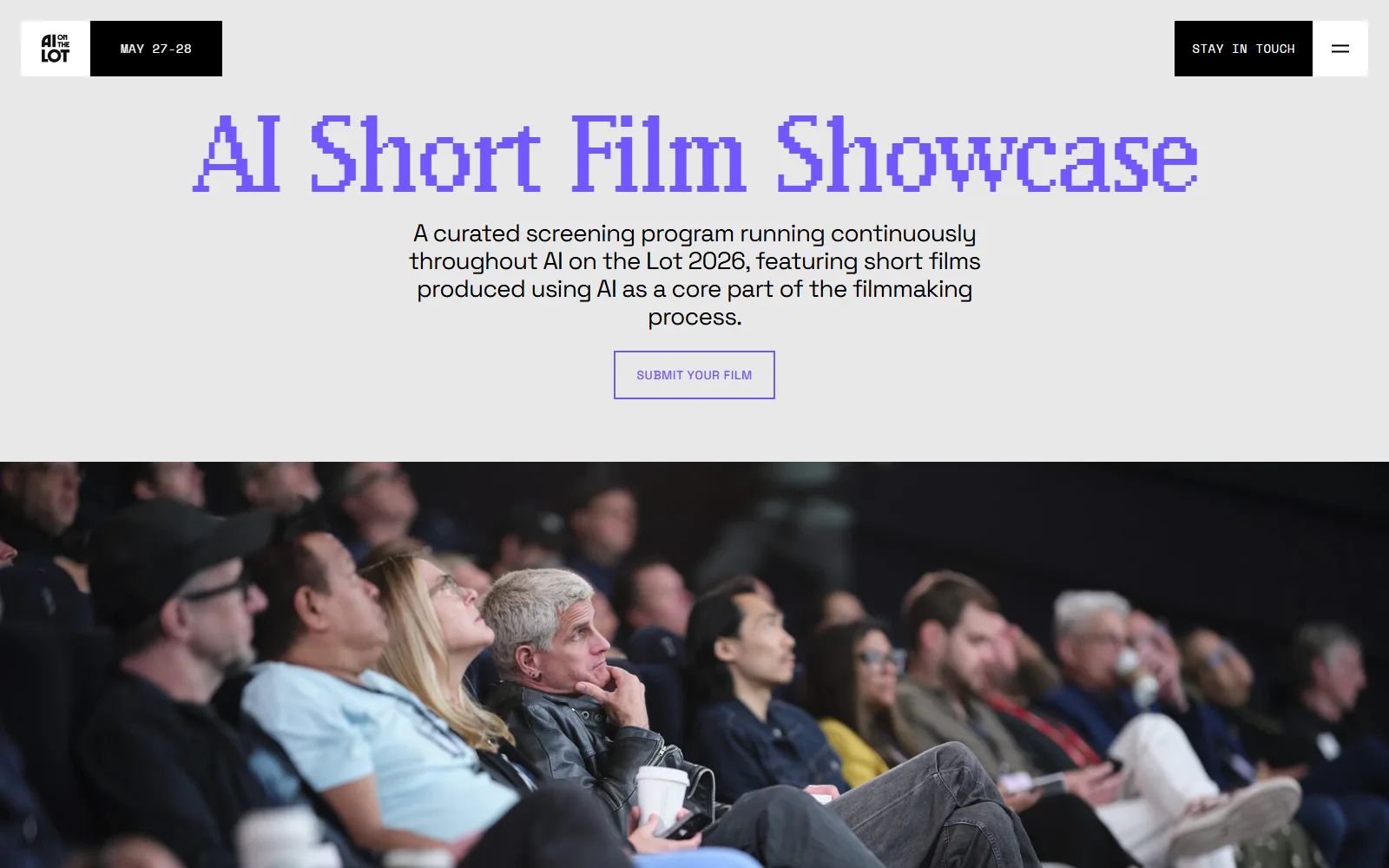
AI on the Lot's Short Film Showcase page, captured 8 September 2026.
Route 3: the platforms that actually pay
Three routes put money in your account, and they work differently.
Vurt launched in March 2026 as a mobile-first vertical platform for independent filmmakers. It runs on advertising, splits revenue 50/50, and the licence is non-exclusive, which means you keep the right to show the film elsewhere. Approved projects go live within 48 to 72 hours. It is an app rather than a website, which tells you what the viewing context is: your film competes with the feed, so the first ten seconds carry everything.
Higgsfield Original Series is an AI-native streaming platform, and the way in is contests rather than an inbox. Its recent action contest drew 8,752 submissions from 139 countries and paid out $500,000, with the strongest entries getting sponsored production and a slot on the platform. Treat the contest calendar as the submission calendar. (Higgsfield publishes the current slate on its Original Series page.)
Festivals with real prize funds are covered in the next section, and in 2026 the numbers stopped being symbolic.
Try it free
Try Screenweaver for free on your script
It is free. Import your existing project, get a clearer view of your outline, and regain control of your story structure in minutes.
Start FreeRoute 4: festivals, and the trap
The Astana AI Film Festival ran a $2,000,000 fund this year, with a $450,000 grand prize and five $50,000 category awards, and charged nothing to enter. The Reply AI Film Festival flies finalists to a premiere in Venice and pays €8,000 for first place. The full calendar, with deadlines and eligibility rules, is in AI film festivals: where to submit.
Here is the part that costs people their best shot. Plenty of festivals still care about premiere status, and a film sitting on a public YouTube URL has already premiered. Read the eligibility rules of the two or three festivals you actually want before you post anywhere. If they require an unpublished film, keep your cut on an unlisted or password-protected link until the results are out. The same logic applied to live-action shorts long before any of this, and the festival route for new writers still describes it well.
What to have ready before you submit anywhere
Assemble this once and every submission afterwards takes twenty minutes.
- A horizontal master and a separate vertical cut, not a crop.
- Burned-in or sidecar English subtitles. Astana required them, and it is becoming normal.
- A pipeline list: every model used, for what, plus every human contributor credited.
- A runtime that clears the minimums. Astana set a three-minute floor, and short festival categories often start there.
- One still frame at full resolution, and a one-sentence logline you did not write in a hurry.
That pipeline list is worth building as you go. It is the same discipline as tracking generation spend, which the real cost of an AI film gets into.
Where this leaves you
If you want to be seen, YouTube plus one curated showcase covers it. If you want to be paid, enter the festivals with prize funds first, keep the film off public URLs until they answer, then release wide and license to a vertical platform afterwards. The sequence is the whole strategy. Everything else is delivery specs.
FAQ
Can I monetise an AI film on YouTube in 2026?
Yes. AI-assisted work stays monetisable as long as you disclose realistic generated content and the video is not part of a mass-produced, templated batch. The inauthentic content policy targets volume and repetition, not the tools.
Will publishing on YouTube stop me entering festivals?
It can. Festivals that require a premiere treat a public URL as a release. Check the eligibility rules first, and use an unlisted link while you wait on results.
Which platform pays independent AI filmmakers directly?
Vurt splits advertising revenue 50/50 on a non-exclusive licence. Higgsfield pays through its contests, which distributed $500,000 in a recent round. Festivals with prize funds pay the largest single amounts.
Do I have to say which AI model I used?
Increasingly, yes. Curated showcases ask for the primary tool in the submission form, and Astana required entrants to disclose their models and pipeline and credit every contributor. Keep the list as you work.
Is there a Netflix for AI films?
Several platforms claim the label, and most of them are generation tools rather than places to upload a finished film. The Netflix of AI films sorts out which is which.
Final Step
Build your next script with Screenweaver
Move from ideas to production-ready pages faster with timeline-native writing and AI-assisted story flow.
Try Screenweaver