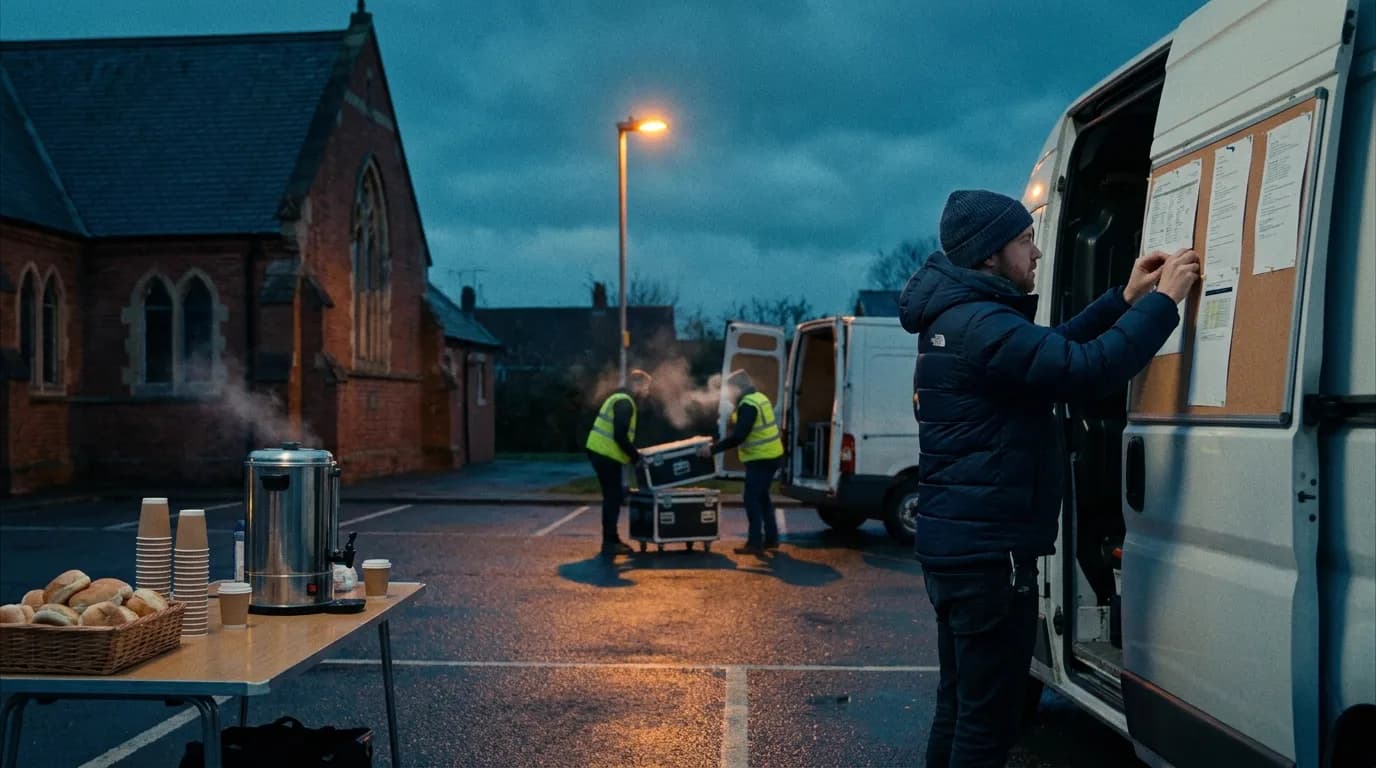

A call sheet is the one-page plan for a single shoot day: who comes in, at what time, to which address, and which scenes get filmed. Here's a free call sheet template you can download as a printable PDF, plus a filled example below. It belongs to our independent filmmaker workflow.
You write one call sheet per shoot day, from the day's strips on your shooting schedule, and send it the evening before. Most of the fields come from documents you already have. The rest is phone calls and a weather check.
What must be on a call sheet
Wikipedia's call sheet entry lists the usual contents: call times, the day's schedule, the scenes and script pages being shot, location addresses with parking, transport and safety notes, contact numbers, and logistics such as weather, sunrise and sunset, the nearest hospitals and meal times. It also describes a front section that warns department heads about anything beyond their usual kit.
That's a long list for a six-person crew, and only the "Must have" column below is non-negotiable.
| Section | Must have | Useful on bigger shoots | Comes from |
|---|---|---|---|
| Header | Production title, shoot day X of Y, date, general crew call | Breakfast time, shooting call, estimated wrap | Schedule |
| Contacts | Producer, director, 1st AD with phone numbers | Every head of department | Crew list |
| Light and weather | Sunrise and sunset, forecast and when it was checked | A written wet weather plan | Almanac, forecast service |
| Locations | Full address, parking, where the unit base is | Map pin, walking route from parking | Location scout |
| Safety | Nearest A&E with drive time, who the first aider is | Risk notes per scene | Your own search, the risk assessment |
| Scenes | Scene number, set, day or night, short synopsis, pages, cast numbers | Estimated time per scene | Stripboard, breakdown |
| Cast | Role, actor, status (W, WF, SWF), arrival, hair and make-up, on set | Pickup times and drivers | Day out of days |
| Crew calls | Role, name, phone, call time | Department-specific calls | Crew list |
| Department notes | Props, special kit, anything a department has to prepare | Costume changes per scene | Breakdown sheets |
| Advance | Next shoot day: location, scenes, crew call | A full advance schedule | Stripboard |
| Version | Version number and the time it was sent | Distribution list | You |
The nearest A&E is the field people leave blank because nobody expects an accident. Fill it anyway, with the drive time from each location. If somebody gets cut on a gaffer's blade at 4pm, nobody should be googling hospitals.
The filled example: day 2 of a three-day short
This sheet continues the short we used in the stripboard guide and the shot list template. Day 2 on that board is Ruth's house in the morning and the high street after lunch, six scenes, 4 7/8 pages.
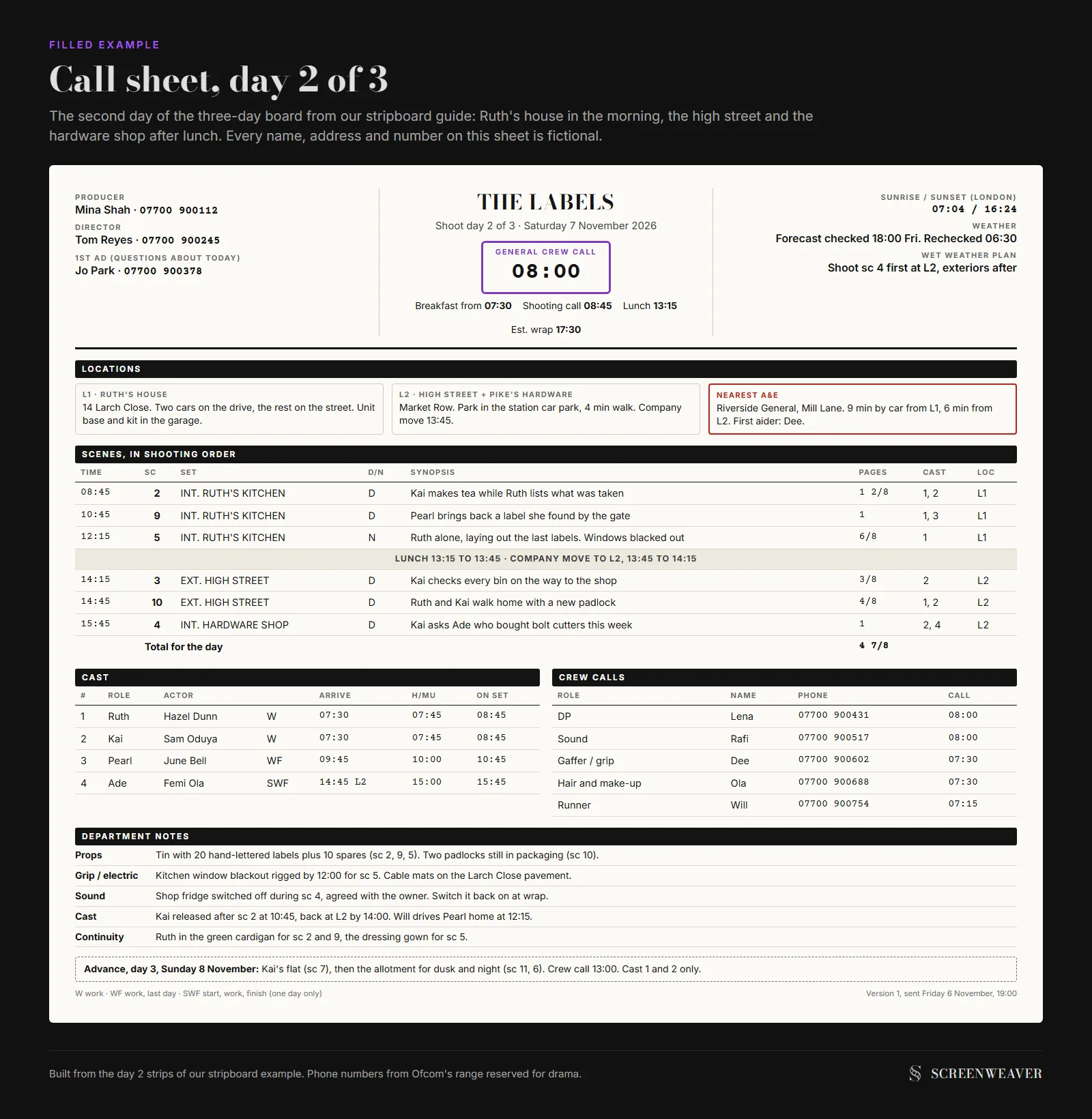
Everything on it was written for this guide. The phone numbers come from the block Ofcom keeps for TV and film scripts (07700 900000 to 900999, listed on its numbers for drama page), which is a good habit for any example sheet you share publicly. Nobody gets a call meant for a fictional producer.
How to fill each field
Work top to bottom. The order matters, because the times in the header depend on the scene order further down.
Header: the general crew call
The general crew call is the time most of the crew starts work. Put it in the biggest type on the page. Everything else on the sheet is detail; this is the number people read at 6am on their phone with one eye open.
Under it, list the shooting call (when the camera should roll on the first setup), breakfast, lunch and an estimated wrap. In the example, crew call is 08:00 and shooting call is 08:45. Those 45 minutes are for unloading, lighting the kitchen and getting Ruth and Kai through hair and make-up.
Some departments start earlier. Our runner comes in at 07:15 to set up breakfast, and the gaffer and make-up artist at 07:30. Those times go in the crew table, not the header.
Sunrise, sunset and weather
Sunrise and sunset are not decoration. On our example day, sunset in London on 7 November is around 16:24. That single number changed the order of the day, which we'll come back to.
For weather, write the time you checked the forecast and check it again on the morning. A forecast without a timestamp is useless the next day. Then write a wet weather plan in one line. Ours says: if it rains, shoot the shop interior first at location 2 and the street scenes after.
Locations, parking and the unit base
One box per location. Give the full address, where cars go, and where the kit lives during the day (the unit base). If parking is a walk away, say how long the walk is.
Then the safety box: nearest A&E, how far it is from each location, and the name of the first aider. We draw that box in red on the template so nobody can miss it.
Scenes in shooting order
This is the biggest block on the sheet, and it's mostly a copy of the day's strips from your board: scene number, set, D or N, a one-line synopsis, page count in eighths and cast numbers. Add a start time per scene and a band for lunch and any company move.
The synopsis is one line, written for the crew. "Kai asks Ade who bought bolt cutters this week" tells the sound recordist there's dialogue in a shop and the props person that bolt cutters might come up. Keep it that concrete.
On the stripboard, day 2's afternoon ran shop interior, then the two street exteriors. With sunset at 16:24, the last exterior would have finished after dark. The call sheet flips them: exteriors straight after the company move, the shop last, since the shop works fine after dark.
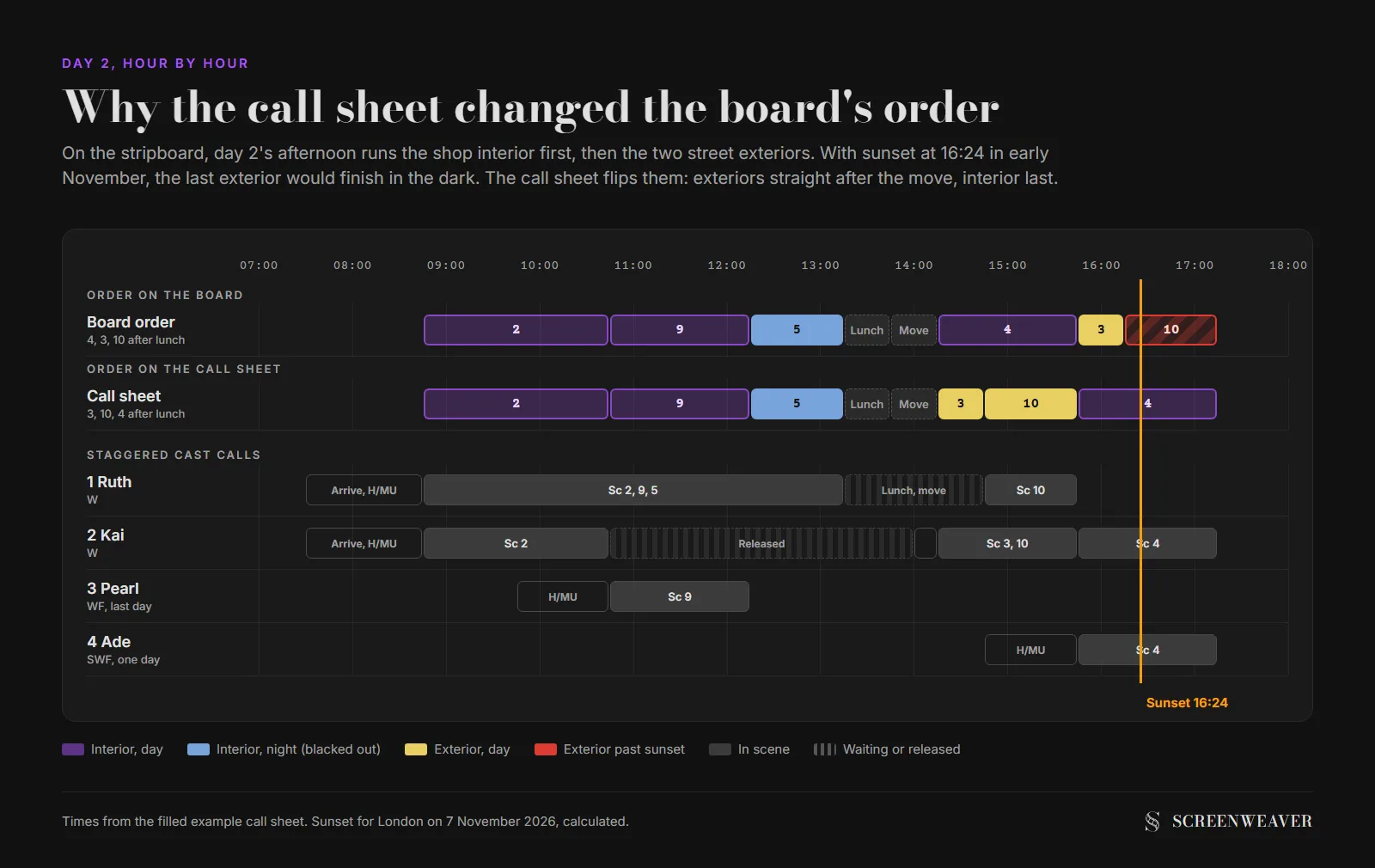
If you change the order on the call sheet, change it on the board too. Two documents that disagree about the same day are worse than one with a mistake in it.
Cast: status and staggered calls
List each actor with their cast number, role and status for the day. The status codes come from the day out of days: W for a work day, WF for the last day, SWF for an actor who starts, works and finishes on this one day. Ruth and Kai are W, Pearl wraps her part today (WF), and Ade comes in for one scene (SWF).
Then give each actor three times: arrival, hair and make-up, on set. Don't call everyone at crew call. Pearl only appears in scene 9, so she arrives at 09:45. Ade arrives at 14:45 at the second location. Kai has a three-and-a-half-hour gap between scene 2 and scene 3, so the sheet releases him after scene 2 and tells him to be at location 2 by 14:00.
Actors also need their pages. Our script sides generator pulls the day's scenes from the screenplay so you can attach them to the same email.
Crew calls
Role, name, phone number, call time. On a small shoot, put every crew member on the sheet. Everyone should be able to reach everyone without asking the producer for a number.
Department notes
This is the front section Wikipedia mentions: what each department must prepare beyond its usual kit. Write it as instructions, one line per department, and name the scene each note belongs to.
From our example: the tin of hand-lettered labels with 10 spares, two padlocks still in packaging for scene 10, a blackout on the kitchen windows rigged by 12:00 for the night scene, and the shop fridge switched off during scene 4 (and back on at wrap, because the owner will notice).
Advance and version
At the bottom, give a short advance of the next shoot day: location, scenes, crew call. Our day 3 has a 13:00 call because it ends with night work at the allotment, and people plan their sleep around it.
Last, the version number and the time it was sent. When something changes, that line is how the crew knows which PDF is current.
Try it free
Try Screenweaver for free on your script
It is free. Import your existing project, get a clearer view of your outline, and regain control of your story structure in minutes.
Start FreeWhen and how to send it
The call sheet goes out the evening before. Wikipedia describes the usual practice as no later than 12 hours before the next work day. On a small crew, someone also needs to check that every person actually received it.
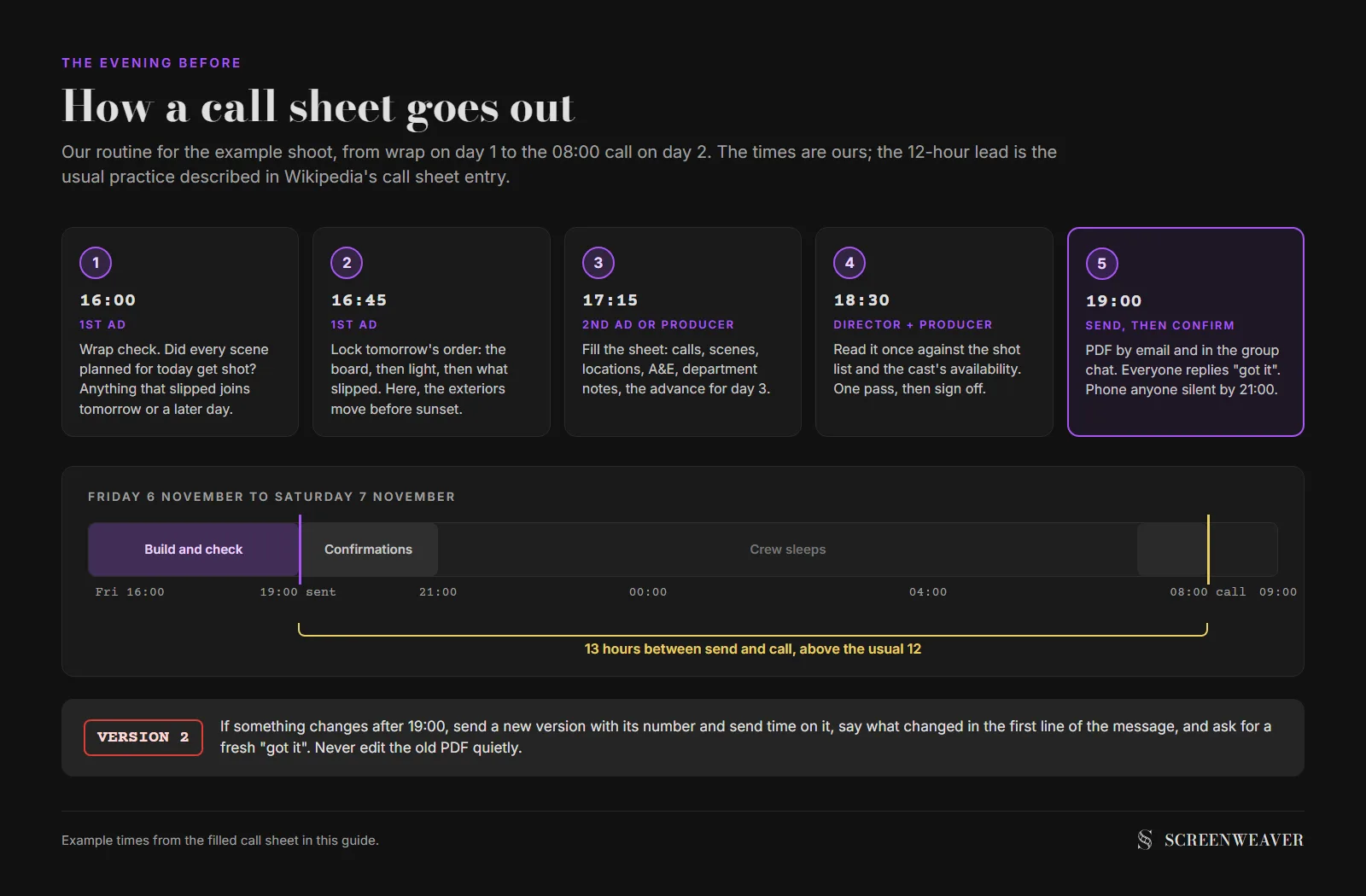
Start with a wrap check. Anything that didn't get shot today has to go somewhere, and it changes tomorrow's sheet. Then lock the order, fill the sheet, and have the director and producer read it once. Send it as a PDF by email and drop it in the crew's group chat too. Ask everyone to reply when they've read it, and phone anyone who hasn't by 21:00.
If something changes after you've sent it, send a version 2. Put the new version number and send time on it, say what changed in the first line of your message, and ask for confirmations again. Quietly replacing the old PDF is how one actor turns up at the wrong address.
Variants of the template
The template covers a standard drama day. A few common shoots need adjustments.
Two locations and a company move
Add the move as a band in the scene table with its own start time, as in our example. Give the second location's address in the header box, not just in the move line.
Night shoot
Crew call might be 16:00. Put sunset at the top in large type and add an estimated wrap after midnight. Check the next day's call against the turnaround you planned on the board.
Documentary or interview day
Swap the scene table for an interview table: contributor name, arrival, interview slot, location in the building and a contact who meets them at the door. Keep the safety box and the advance.
One-person or micro shoot
You still need one. Cut it to the header, the location box with the A&E, the scene list and the phone numbers. Half a page is enough, and it's still the thing you'll forward when a friend asks where to bring the coffee.
Big crew
Wikipedia's entry gives a two-sided layout as one example and says call sheets use US legal paper. Our template stays on one A4 page, which holds a small shoot comfortably. Once department notes run past a few lines each, move them to a second page.
Mistakes we check for before sending
Run this list against every sheet before it goes out:
- The date and the shoot day number both match the schedule
- Every scene on the sheet is on that day's strips, and every strip is on the sheet
- Page count totals match the board for that day
- Exteriors finish before sunset, with a margin of at least half an hour
- Each actor's on-set time comes before their first scene's start time
- No actor is called hours before their first scene without a reason
- Every location has a full address and parking instructions
- The nearest A&E is filled in, with a drive time from each location
- Every crew member has a phone number on the sheet
- Department notes name a scene for every item
- Version number and send time are on the page
Where the call sheet sits in prep
The call sheet is the last link of a chain. The script breakdown lists what each scene needs, the shot list sets the setups, the stripboard sorts scenes into days, and the call sheet turns one day of that board into instructions for people. For a rough number of days before any of that exists, the shooting schedule calculator gives an estimate from page count and complexity.
If you write and break down your film in ScreenWeaver, the characters, locations and objects you set up as story elements are the names you'll use on the board and on the call sheet, so the scene list on the sheet reads the same as the script. The film pre-production page covers that side. The call sheet itself stays in your spreadsheet or on this template.
FAQ
What is a call sheet in film? A call sheet is the document that tells cast and crew where and when to report for one shoot day. It lists call times, locations with parking, the scenes being shot, contact numbers, safety information and notes for each department, and it's usually sent the evening before.
Who makes the call sheet? On professional shoots it comes from the assistant directors, who build it from the shot list and the production schedule. On a small indie shoot, the producer or whoever runs the schedule often writes it, and the director checks it against the shot list.
When should a call sheet be sent out? The evening before the shoot day. Wikipedia's entry describes the usual practice as no later than 12 hours before the next work day. Send it as a PDF, ask everyone to confirm, and send a numbered new version if anything changes.
What's the difference between general crew call and shooting call? General crew call is when most of the crew starts work. Shooting call is when the camera should roll on the first setup. The gap between them covers unloading, lighting, rehearsal, and hair and make-up. In our example it's 45 minutes.
Do I need a call sheet for a short film with friends? Yes, a short one. Even with four people, it settles the address, the start time, who's needed when and where the nearest hospital is. Our template works for that if you leave the department notes empty.
Can I make a call sheet in Google Sheets or Excel? Yes. Wikipedia describes modern call sheets as spreadsheet-based and emailed as PDFs. Rebuild the sections of our PDF as blocks of rows, keep everything on one page, and always send the PDF so nobody edits their copy by mistake.
Final Step
Build your next script with Screenweaver
Move from ideas to production-ready pages faster with timeline-native writing and AI-assisted story flow.
Try Screenweaver