
AI film festivals stopped being novelty screenings in 2026. Astana ran a $2,000,000 fund with a $450,000 grand prize and charged nothing to enter. Reply flies finalists to Venice and pays €8,000 for first place. Most of the serious ones are free or cheap to enter, which changes the maths: the cost of submitting is now a deadline and a delivery spec, not a fee.
This is the festival branch of where to publish your AI film. For the rules, jury, deadlines and a winning plan for each festival, see our guides to 100 AI film festivals. Read the premiere warning at the end before you post anything publicly.
The 2026 calendar at a glance
| Festival | Where | Entry | Top prize |
|---|---|---|---|
| Astana AI Film Festival | Astana, 1 to 3 Oct 2026 | Free | $450,000, from a $2M fund |
| Reply AI Film Festival | Premiere in Venice | Free | €8,000, plus travel |
| The Next AI Film Festival | Seoul, 19 Sep 2026 | Free | KRW 3,000,000 |
| AIFFI | Roatán, Honduras, Apr 2026 | Paid | $1,000 |
| Token AI Film Festival | Chicago, Sep to Oct 2026 | Free | $250 per category |
| Sparknify Human vs AI | Online | Free early, then from $5 | Category awards |
| AI Short Film Showcase | AI on the Lot, Culver Studios | Free | Screening, no cash |
Deadlines move. Astana extended its 2026 deadline once already. Check the festival's own page the week you plan to submit rather than trusting any list, including this one.
Astana: the one that changed the numbers
The Astana AI Film Festival doubled its fund this year to $2,000,000, split between $1,000,000 in competition prizes and $1,000,000 invested directly into new AI productions.
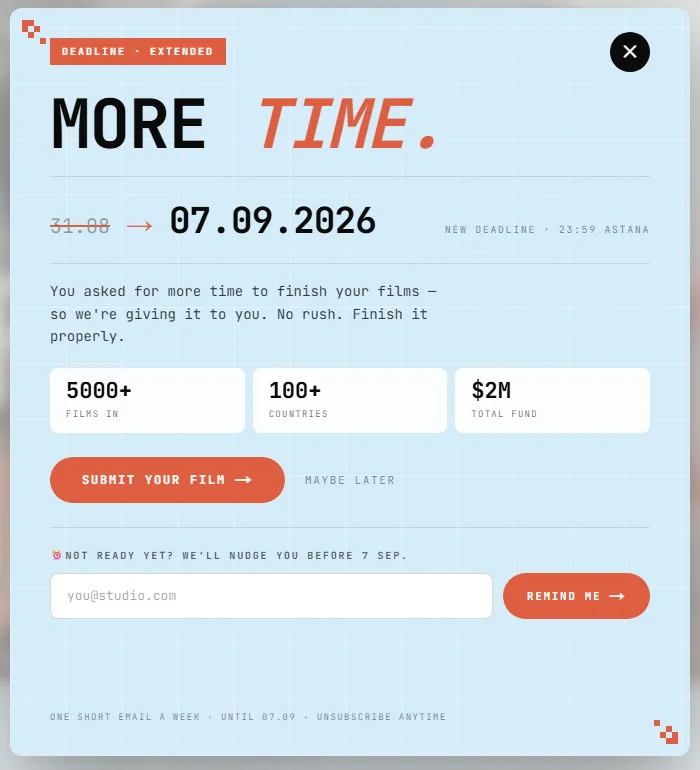
The AAIFF 2026 deadline notice, captured 8 September 2026, the day after submissions closed.
The competition prizes run across two sections: a thematic competition topped by the $450,000 grand prize, with $200,000 and $100,000 behind it, and an open competition of five $50,000 category awards for character, direction, visual, story and concept. The second million is a production fund put into promising projects rather than paid as prize money.
The eligibility rules are the part worth copying into your own checklist, because they are becoming the template:
- Minimum runtime of three minutes.
- Generative AI has to be integral to the film, not just VFX or an upscale.
- English subtitles required.
- Every contributor credited, with AI models and pipeline disclosed. The same per-shot record is what you need later to register the film.
- Submission by YouTube or Google Drive link, not a file upload.
The 2026 edition closed on 7 September and drew over 5,000 films from more than 100 countries. If you are reading this after that date, the festival runs 1 to 3 October and the next call is the one to watch.
Reply: the industry door
The Reply AI Film Festival positions itself as a competition connecting AI talent with the wider cinema industry, which is a different proposition from a prize pot.
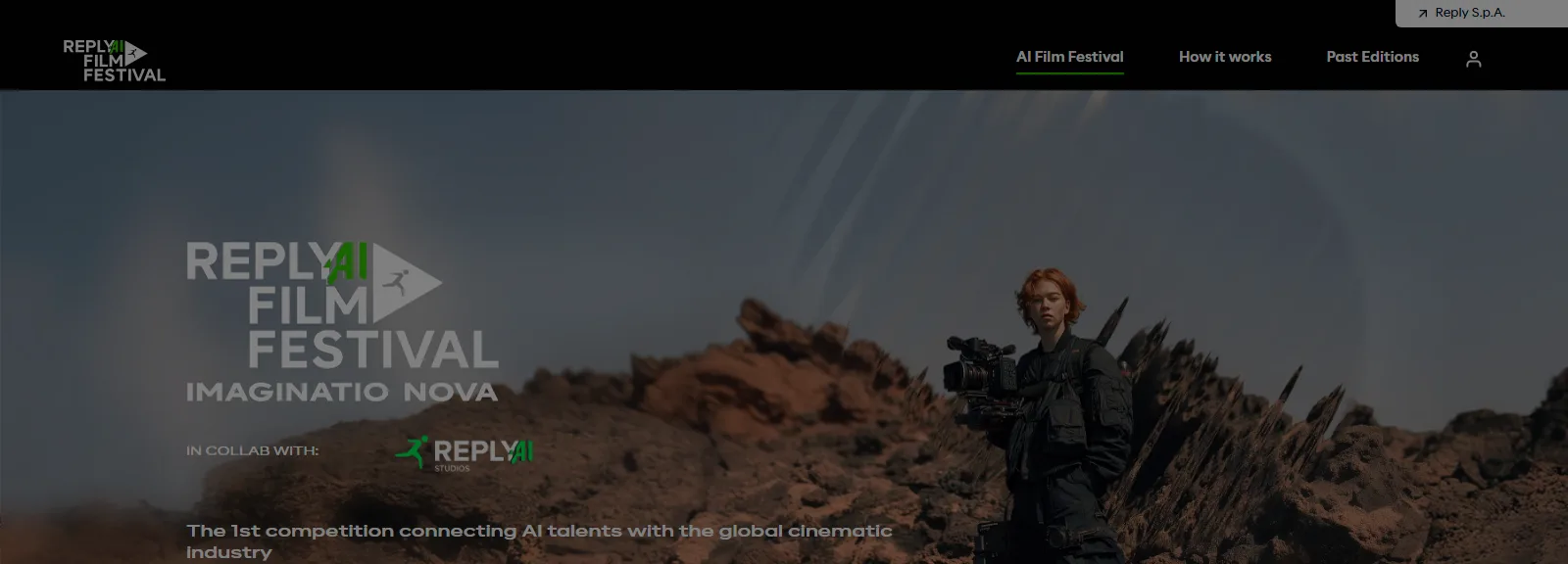
The Reply AI Film Festival site, captured 8 September 2026.
Finalists get an official premiere event in Venice with travel and accommodation covered. Prizes run €8,000, €5,000 and €2,000 for the top three. For a first-time entrant the travel matters more than the cash, because a premiere you attend produces conversations and a submission you email does not.
Try it free
Try Screenweaver for free on your script
It is free. Import your existing project, get a clearer view of your outline, and regain control of your story structure in minutes.
Start FreeThe rest of the field
The Next AI Film Festival in Seoul is free to enter, ran a late-August deadline for a 19 September event, and awards a grand prize of KRW 3,000,000. Useful if you want an Asian festival credit without a fee.
AIFFI in Roatán, Honduras bills itself as an international festival for AI-generated shorts, with a March deadline and a $1,000 prize. Small money, real festival.
Token AI Film Festival in Chicago screens from mid-September to mid-October, costs nothing, and awards $250 across four unusual categories: world building, previsualisation, ethics and storyboarding. Those categories are the opportunity. A film that would place nowhere in a general competition can win a category nobody else is entering.
Sparknify Human vs AI frames the competition itself around the comparison. Early entries are free and the fee rises as the deadline approaches, which is standard festival pricing.
The AI Short Film Showcase at AI on the Lot is not a competition. It is a curated screening programme running through a conference at Culver Studios in front of studio and tool-company people. No prize, better room.
Choose by category, not by prize
The instinct is to enter the biggest fund. The better move is to read the categories and find the one your film is unusually strong in. A festival awarding $250 for best previsualisation is a winnable award if previs is what your film does well, and a laurel is a laurel on a submission form afterwards. Astana's five separate $50,000 category awards work the same way: character, direction, visual, story and concept are five different films' worth of strength.
If your film's advantage is structural rather than visual, the storyboard-first workflow is the part that shows in a jury screening.
The premiere trap
Every year people post the film to YouTube the day it renders, then find the festival they wanted requires a premiere. A public URL is a release. Keep the cut unlisted or password-protected until the festivals you care about have answered, then publish wide. Traditional shorts have worked this way for decades, and the festival route for new writers covers the etiquette.
Two practical habits make the rest painless. Keep a pipeline document from day one, listing every model and every human contributor, because Astana already requires it and others are following. And cut a three-minute version early, since that runtime clears most minimums and forces the story problems into the open.
FAQ
Are AI film festivals free to enter?
Most of the serious ones in 2026 were. Astana, Reply, The Next AI Film Festival and Token all ran free entry. AIFFI charges, and Sparknify uses tiered pricing that rises toward the deadline.
What is the biggest AI film festival prize?
Astana's $450,000 grand prize, drawn from a $2,000,000 fund split between competition prizes and a production fund.
Do festivals require me to disclose which AI models I used?
Astana does, along with crediting every contributor. Treat model and pipeline disclosure as standard and keep the list as you produce, not afterwards.
How long should an AI festival short be?
Three minutes is the common floor, and Astana set it explicitly. Most category competitions sit comfortably between three and ten minutes.
Can I submit a film that is already on YouTube?
Sometimes, but not to festivals that require a premiere. Astana accepted YouTube links, including unlisted ones, which is the safe option. Check each festival's rules before the film goes public.
Final Step
Build your next script with Screenweaver
Move from ideas to production-ready pages faster with timeline-native writing and AI-assisted story flow.
Try Screenweaver