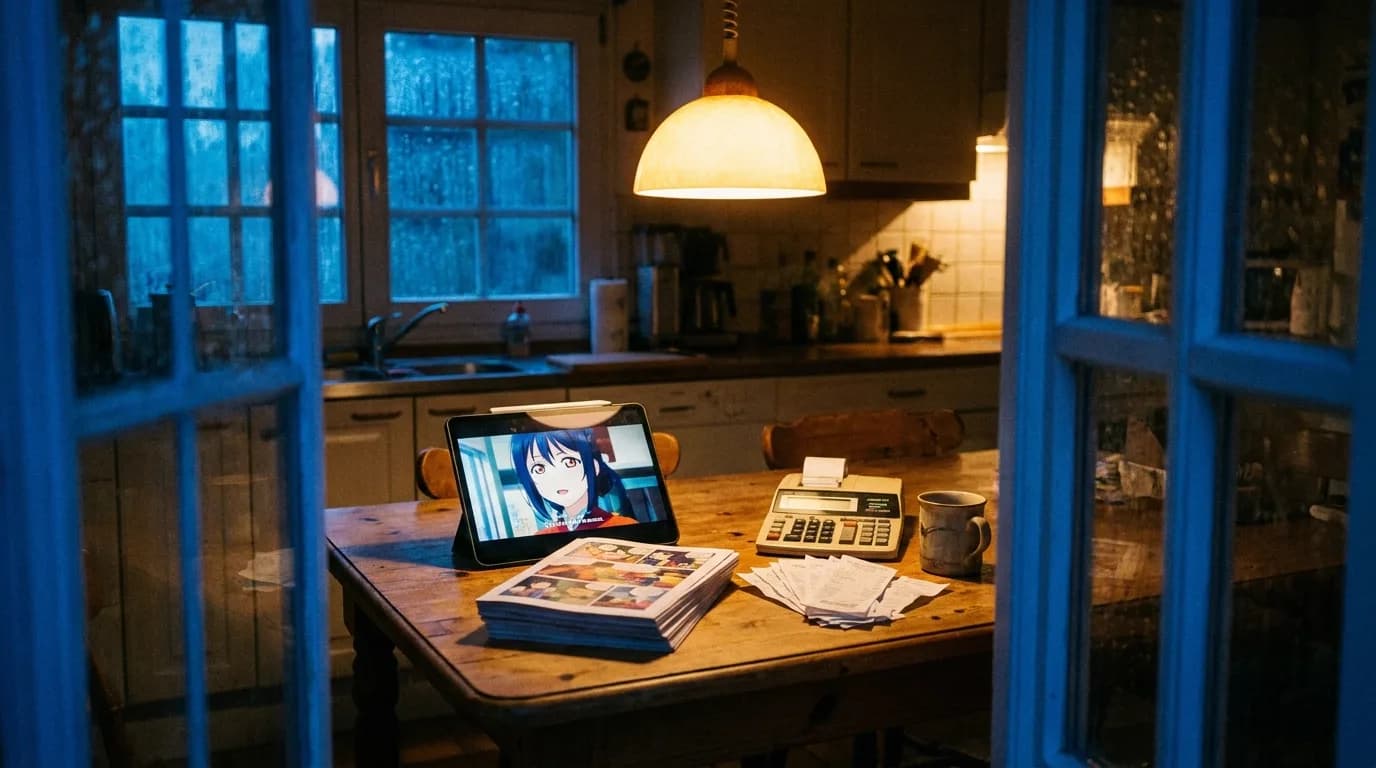

A studio anime adaptation of a webtoon costs more than any individual creator will ever spend, and it is not for sale to you anyway. An AI-produced adaptation of one chapter costs tens of dollars in generation for a pilot and low hundreds for a full chapter, plus your time. The number that decides your bill is not the per-second price of the video model. It is how many times you regenerate each shot.
This article puts numbers on both paths. The method behind the AI numbers is in webtoon to animation with AI.
The studio path: what an anime episode costs, and why it is irrelevant to you
Per-episode budgets for TV anime are not published by the studios, but trade reporting and producer interviews over the past decade have consistently placed a standard 22-minute episode in the low hundreds of thousands of dollars, with prestige productions well above that. A twelve-episode season is therefore a multi-million dollar commitment before marketing, and the money comes from a production committee or a streamer, never from the creator.
The creator's economics on that path are a licence fee and, sometimes, a share of downstream revenue, negotiated by the platform that holds the adaptation rights. Which is why the question "how much does it cost to animate my webtoon" has, for almost every creator, had the same answer for years: it does not cost you anything, because it is not going to happen. The studio versus AI overview explains the selection funnel.
The AI path: the four line items
An AI adaptation has four costs. Three are small and one is where the money goes.
| Line item | What it covers | Order of magnitude for a 60-second pilot |
|---|---|---|
| Storyboard frames | One image per shot, plus retries | A few dollars |
| Video clips | One clip per shot, times retries | Tens of dollars |
| Voice and music | AI voices or a recorded cast, a licensed or generated track | A few dollars to tens, depending on how you do it |
| Your time | Breakdown, references, prompting, editing | Two to five days |
The video line dominates, and inside it the retry multiplier dominates everything else.
Why retries decide the bill
Published model prices are per clip and assume every generation is a keeper. Nobody works that way. A shot gets regenerated because the character drifted off-model, because the movement went the wrong way, because a hand melted, or because the framing ignored the prompt. Creators consistently report two to five generations per shot that makes the cut.
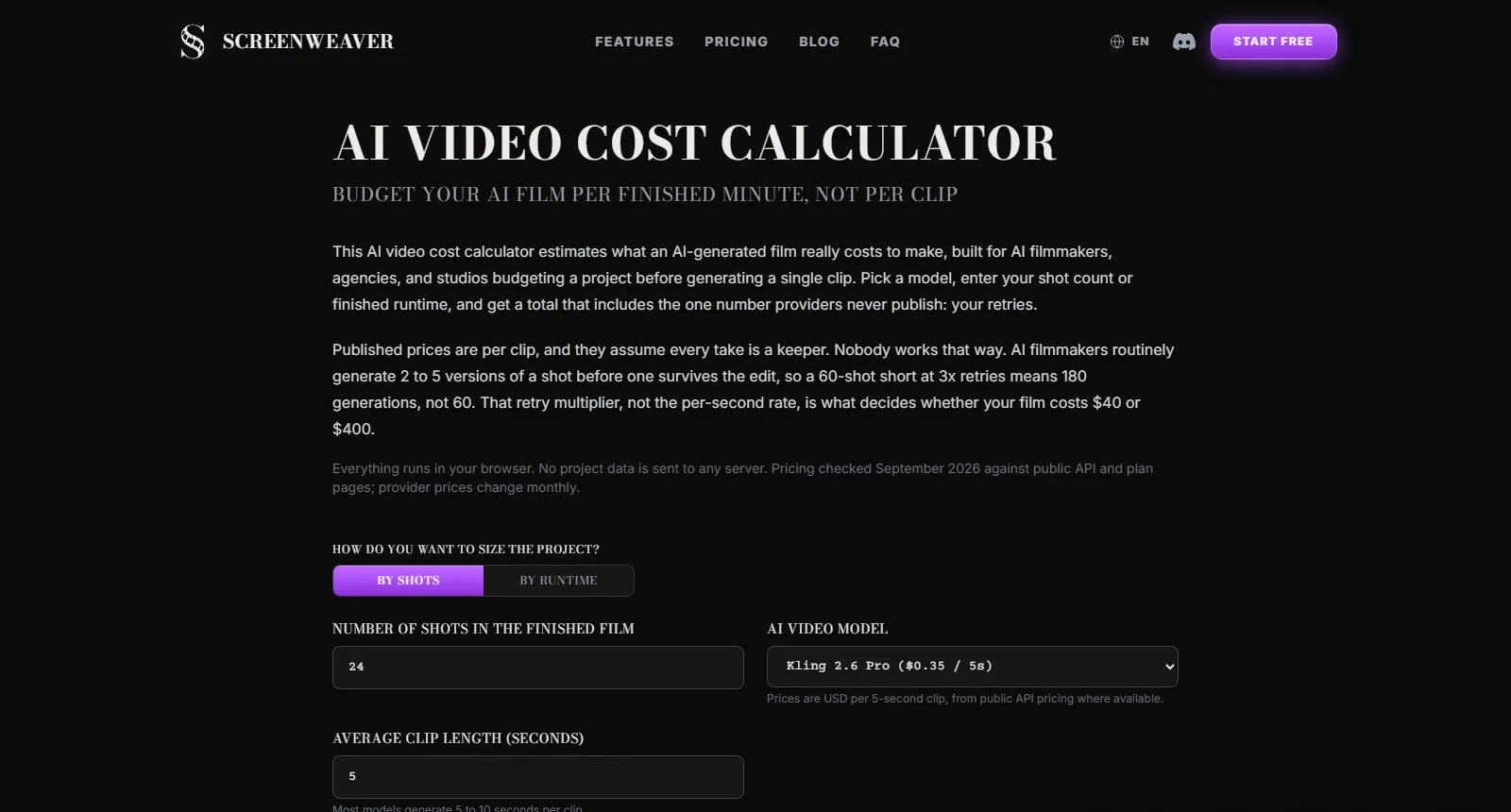
The AI video cost calculator on screenweaver.ai, captured 3 September 2026. Pricing is checked monthly against the public API pages of each provider; the retry multiplier is the input that matters.
Take Kling 2.6 Pro at $0.35 per 5-second clip, the rate the calculator listed from public API pricing in September 2026. Here is what the multiplier does to a chapter:
| Project | Shots | Retry multiplier | Generations | Video cost at $0.35 per clip |
|---|---|---|---|---|
| 60-second pilot | 18 | 1.5x (locked board, easy shots) | 27 | $9 |
| 60-second pilot | 18 | 3x (typical) | 54 | $19 |
| 60-second pilot | 18 | 5x (fights, close consistency) | 90 | $32 |
| Full chapter, dialogue-heavy | 55 | 3x | 165 | $58 |
| Full chapter, action-heavy | 70 | 4x | 280 | $98 |
| Twelve chapters, mixed | 720 | 3.5x | 2,520 | $882 |
Change the model and every row moves. A cheaper 480p option can be a third of that price; a top-tier 1080p model with audio can be two to three times it. The model picker keeps the current rates and the per-model strengths side by side.
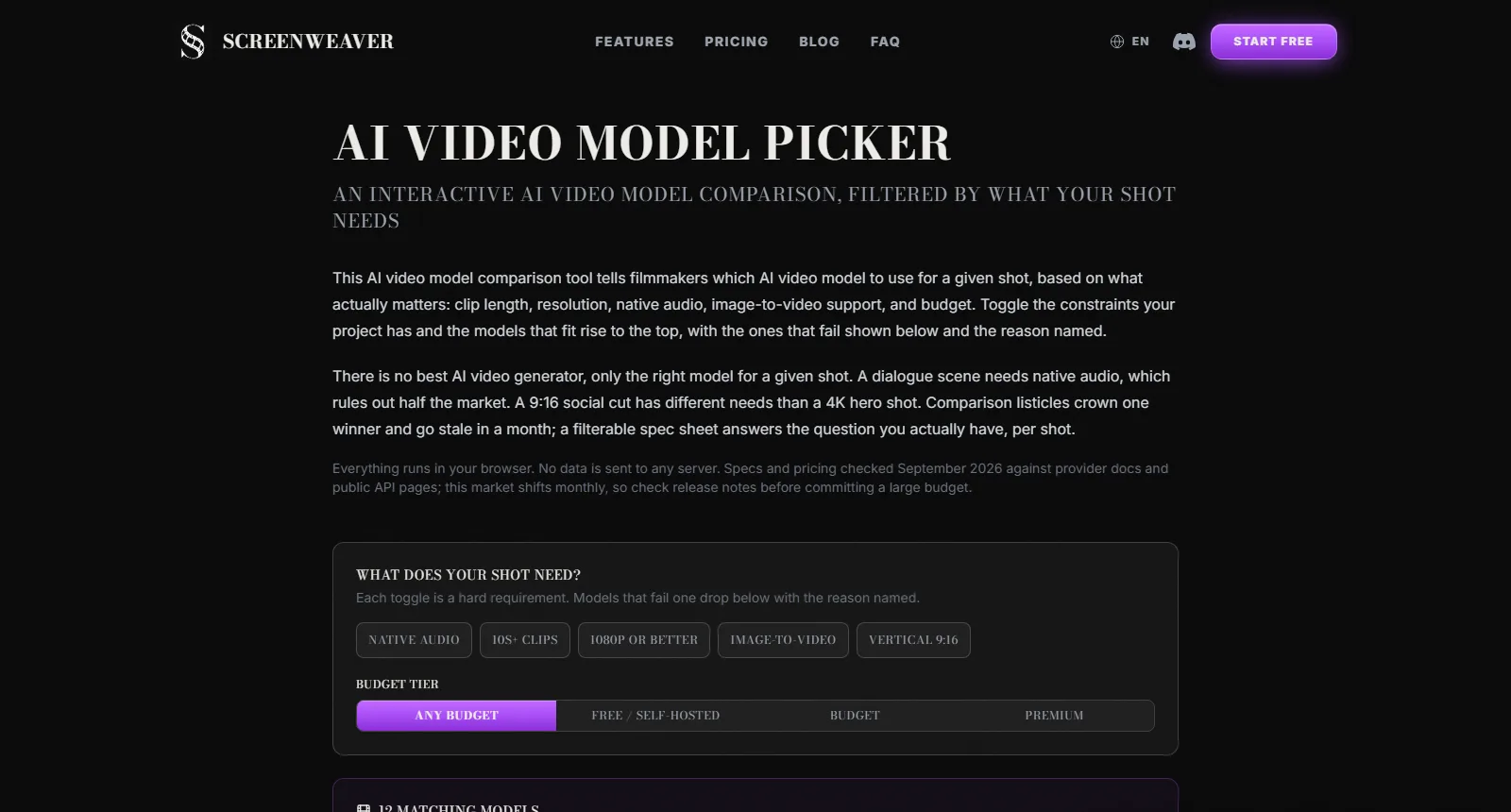
The AI video model picker on screenweaver.ai, captured 3 September 2026. The right model for a dialogue close-up is rarely the right model for a fight, and the price difference between them is large.
Storyboard frames are cheap. Do not skimp on them.
Image generation for the board runs at a few cents per frame on current models. A 70-shot chapter with three variants per shot is around 200 frames, which is a few dollars to perhaps fifteen depending on resolution. This is the cheapest money in the project and it saves the most expensive money, because a locked board with a good reference sheet is what takes the retry multiplier from 5x down to 1.5x.
Spend here. Generate the variants, pick the frame that is on-model and correctly framed, and only then send it to video. In ScreenWeaver the storyboard is open to every account with a starter pack of free credits, and one credit is worth half a cent, so the board for a whole chapter fits inside what a free account gets to try.
Voice and music
Two ways, very different prices:
| Option | Cost | Trade-off |
|---|---|---|
| AI voices per character | A subscription in the tens of dollars a month covers a chapter's lines comfortably | Fast, consistent, and readers who imagined the voice differently will say so |
| Recorded cast (friends, online voice actors) | From free to a few hundred dollars per chapter | Better performances, real scheduling, and you own the recordings |
| Generated music | Included in several video models, or a music model subscription | Fine for a pilot. Check the licence before monetising |
| Licensed track | Tens to hundreds of dollars per track | The safe option for anything you publish widely |
Record voice before generating video. The line durations set the shot durations, and a clip generated at the wrong length is a retry you paid for.
Try it free
Try Screenweaver for free on your script
It is free. Import your existing project, get a clearer view of your outline, and regain control of your story structure in minutes.
Start FreeYour time is the real budget
For one person with the references already built:
| Task | 60-second pilot | Full chapter (55 to 70 shots) |
|---|---|---|
| Scene and shot breakdown | Half a day | One day |
| Character and style references from the panels | One day, once per series | Reused |
| Storyboard generation and selection | Half a day | One to two days |
| Voice lines | Two hours | Half a day |
| Video generation and retries | One day | Three to six days |
| Edit, sound, music | Half a day | One to two days |
| Total | Three to four days | One to two weeks |
Action chapters sit at the top of every range. Dialogue chapters sit at the bottom. The webtoon storyboard method is what keeps the breakdown day from turning into three.
For a benchmark past the pilot stage: Lost Garden, an original anime series made the same way by one person, ran 21 minutes for its second episode and took 75 hours of work. The full pipeline behind that number, from three-view character sheets to retiming the motion on twos, is laid out in how to make anime with AI.
What the tools cost
The generation itself is billed by the provider through whatever tool you use, so tool subscriptions are a separate, smaller line.
ScreenWeaver's writing workspace is free. The Auteur plan is $39.99 a month with 6,000 credits a month and unlocks board generation from a script and video production in the same project, with generation charged in credits at half a cent each. The Studio plan, $149.99 a month with 25,000 credits, adds real-time collaboration for teams; both are listed in the pricing section of the site. The webtoon import that replaces the screenplay with the episode itself is the next step of that pipeline, and it will not change the cost structure above.
A realistic first budget
For a creator who wants to know whether their series survives the jump to animation:
- Generation: $20 to $40 for a 60-second pilot of the chapter's best scene, including storyboard frames and a typical 3x retry rate.
- Voice: one month of a voice subscription, or friends and a decent microphone.
- Tools: the free tier, or one month of a storyboard plan.
- Time: four days.
Under $100 and one working week to find out. The studio path answers the same question in two to four years, and only for series that already have an audience in the hundreds of millions of views.
FAQ
How much does it cost to animate a webtoon with AI?
Roughly $20 to $40 in generation for a 60-second pilot at a typical three-generations-per-shot retry rate, and $60 to $100 for a full chapter of 55 to 70 shots on a mid-range model. Storyboard frames, voice and music add a few dollars to tens. Your time, three days to two weeks, is the larger cost.
What is the biggest cost driver in AI animation?
The retry multiplier. Published prices assume every clip is a keeper, and in practice two to five generations per shot survive to the cut. A locked storyboard with good character references is what pulls that number down, which is why the cheap image step should get the most care.
How much does a studio anime adaptation cost?
Per-episode budgets are not published, but trade reporting has long placed a standard TV anime episode in the low hundreds of thousands of dollars, and a season in the millions. That money comes from a production committee or a streamer. The creator receives a licence fee negotiated by the platform, not a bill.
Is it cheaper to animate a webtoon in 9:16 than 16:9?
Slightly. Vertical shots need far less reframing, so fewer generations fail on framing, and most vertical panels crop straight into 9:16. Per-clip pricing is the same for both ratios on most models. The saving is in retries and time, not in the rate.
Can I animate my webtoon for free?
A short test, yes: free credits on storyboard tools and free tiers on some video models get you a handful of shots. A 60-second pilot with a real retry budget costs tens of dollars. A full chapter for free is not realistic unless you are drawing the motion yourself.
Does the video model choice matter more than the retry rate?
No. Models differ by two to three times in price. Retry rates differ by three to four times between a sloppy workflow and a locked one, and a bad model choice for a shot type also raises the retry rate. Pick the model per shot type, then protect the retry rate with references and a finished board.
Final Step
Build your next script with Screenweaver
Move from ideas to production-ready pages faster with timeline-native writing and AI-assisted story flow.
Try Screenweaver